
Commercial footpath cleaning in Sydney is usually priced per square metre, and published Australian rates for concrete and hard surfaces sit between $1.80 and $8.00 per m², with a median of $4.00 and minimum call-out charges that start around $100. Large, regular jobs such as strata common areas, shopping precincts and council frontages tend to land at the lower end of that range. Small or awkward jobs land at the top. Your final number depends on area, how stained the surface is, how often it is cleaned and how the water is captured. At Sydney Sweep and Scrub we quote footpath, carpark and site cleaning for property managers, strata managers, councils and facility operators across Sydney, and you can request a quote through our pressure washing page.
TL;DR
- Published Australian rates for concrete and hard surfaces run from $1.80 to $8.00 per m², with a median of $4.00 (UteQuote, October 2026 survey).
- Commercial work is typically priced lower per m² than residential, at about $2 to $5 per m², and is quoted on total area, frequency and after-hours needs.
- Minimum call-out charges of $100 to $440 (median $179) mean small patches cost far more per m² than large areas.
- Staining, access, after-hours work and wastewater control move a quote more than the base rate does.
- Compare quotes on area, method, water capture and extras, not on the headline rate alone.
Table of Contents
- What footpath cleaning costs in Sydney
- How commercial footpath jobs are priced
- What makes a Sydney footpath quote higher or lower
- What a good quote should include
- Sweeping first, then washing
- Permits and approvals for footpath work
- How to compare quotes
- Where footpath cleaning fits with carpark and site cleaning
- Get a footpath quote from Sydney Sweep and Scrub
- FAQ
- Sources
What footpath cleaning costs in Sydney
Start with the published numbers, then adjust for your site.
UteQuote’s October 2026 survey of published Australian pressure washing rates found concrete and hard surfaces priced at $1.80 to $8.00 per m², with a median of $4.00. The same survey found driveway entry prices of $150 to $400 (median about $205) and minimum call-out charges of $100 to $440 (median $179) where a minimum was stated.
Commercial work sits below the residential end. DayRoute’s February 2026 pricing guide for Australian businesses puts commercial areas such as car parks, loading docks, shopping centres and strata common areas at roughly $2 to $5 per m², quoted on total area, frequency (monthly, quarterly or annually) and any after-hours requirement.
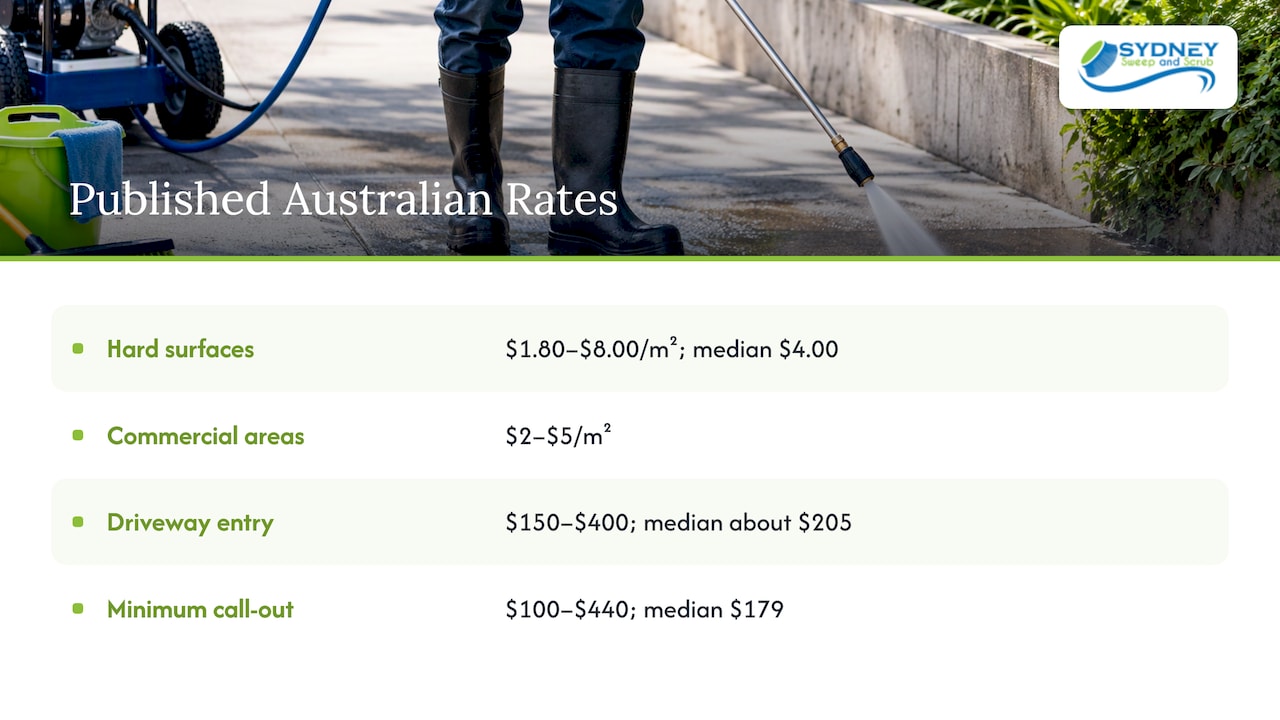
These are survey and guide figures from across Australia, not a Sydney price list, and they are not our rates. Sydney Sweep and Scrub does not publish a fixed price for footpath work, because the right price depends on the site. We quote each job after we know the area and the condition of the surface.
A worked example
Say you manage a strata complex with 400 m² of street-frontage footpath and entry paths.
- At the survey median of $4.00 per m², the base cost is $1,600.
- At the commercial guide range of $2 to $5 per m², the base cost is $800 to $2,000.
- If the same complex only needed a 25 m² entry forecourt cleaned, the median rate gives $100, which is below the typical call-out minimum. You would pay the minimum, not the per-m² figure.
The lesson is that the cost per m² falls as the area grows, and a small job is priced by its minimum.
How commercial footpath jobs are priced
Residential pressure washing is often a flat price for a driveway or a house. Commercial footpath work is quoted differently, and it helps to know the three common structures.
| Pricing structure | How it works | Best suited to |
|---|---|---|
| Per m² | Rate multiplied by measured area, with a minimum charge | One-off cleans and defined areas |
| Fixed job price | One figure for a described scope | Single sites with clear boundaries |
| Recurring contract | A set monthly or quarterly fee for a schedule | Strata, centres, council and ongoing facilities |
DayRoute’s guide notes that strata managers often prefer a fixed monthly retainer, which makes the cost predictable for a levy budget. Recurring work is also where the per-m² rate tends to fall, because the cleaner is not starting from heavy build-up each visit. We offer optional recurring maintenance contracts for larger facilities, so a footpath clean can sit alongside carpark and common-area work under one schedule.
What makes a Sydney footpath quote higher or lower
Two footpaths of the same size can be priced very differently. These are the factors that move the number.
Area and layout
Total square metres set the base. A long, narrow frontage takes longer to cover than a wide forecourt of the same area, because the operator moves more often. Many quotes round the area up or apply the minimum charge, so ask how the area was measured.
How dirty the surface is
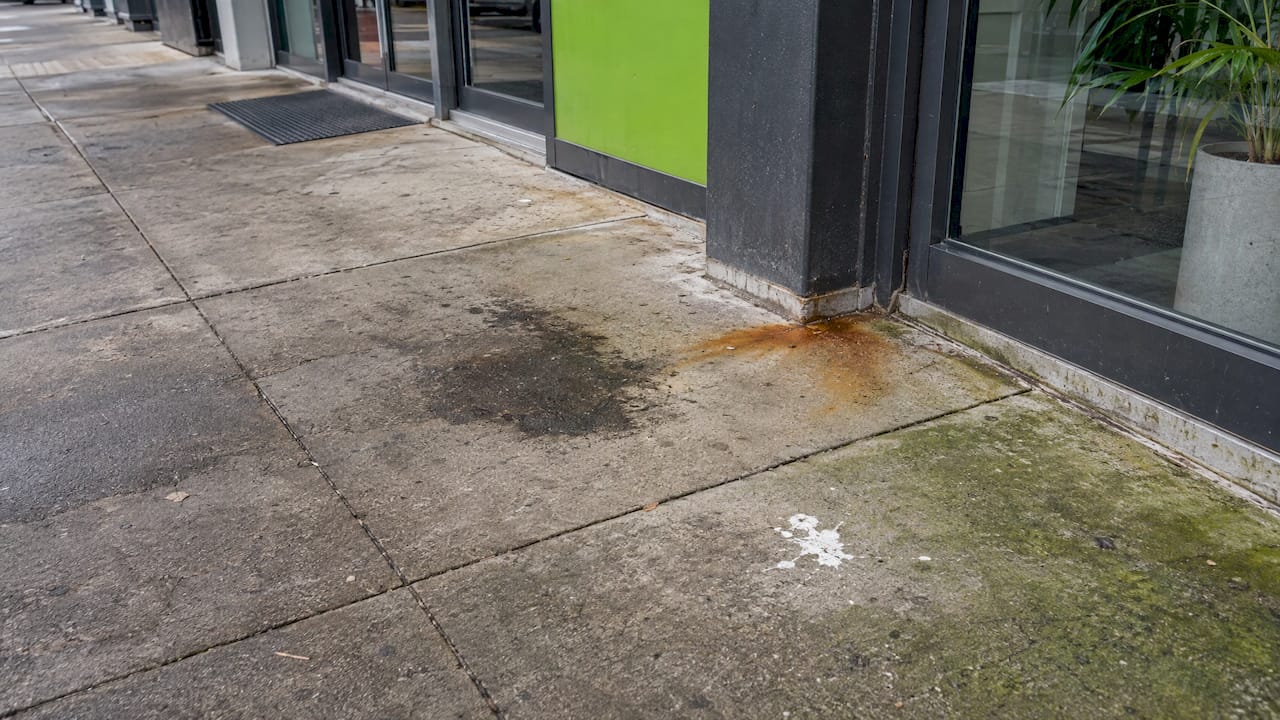
Light dust and organic film clean quickly. Chewing gum, oil, rust, paint and long-term algae take extra passes or different methods. UteQuote’s extras breakdown says mould treatment is often included at no charge but is sometimes a $70 extra, and that oil, rust and bore-water stains vary in price. Heavy weeds and re-sanding of pavers are usually extra. If you have a stain problem, read our page on pressure washing stains from footpaths before you request a quote, so you can describe the marks accurately.
Hot or cold water
Cold water handles dust, mud and general grime. Grease, oil and chewing gum respond better to hot water. We offer both, and you can see how they differ on our pages for pressure washing with hot water and pressure washing with cold water. Hot water generally costs more to run, so a quote that specifies the method is easier to compare.
Access and timing
Busy pedestrian frontages are often cleaned before trading hours or overnight. After-hours requirements are one of the inputs DayRoute lists for commercial quotes. Tight access, steps, and the need to keep one lane of a path open also add time.
Wastewater capture
This is the factor that surprises people most. The NSW EPA states that stormwater drains carry water to rivers and creeks untreated and unfiltered, and that the drain is for rain only. Dirty wash water from a footpath must not be allowed to run into it. Capturing and removing that water adds equipment and time, and a quote that includes it will cost more than one that ignores it. It also protects you as the property owner or manager, so it is a cost worth paying for. We use contained pressure washing on Sydney footpaths, which you can see in our contained pressure washing photo.
Distance and travel
UteQuote reports that travel is usually charged only outside an operator’s set service area. For a site inside our Sydney coverage, travel is rarely the factor that decides the price.
What a good quote should include
A useful quote is specific enough that you could hold the work against it afterwards. Look for these items:
- The measured area in square metres, and what is and is not included (entry paths, steps, kerbs, planter edges).
- The method: hot or cold water, surface cleaner or hand lance, and any pre-treatment.
- Stain and mould treatment: whether it is included or priced separately.
- Wastewater handling: how wash water is contained and removed.
- Timing: day, night or weekend work, and any extra for after-hours.
- Frequency: one-off price against a recurring schedule.
- Minimum charge and travel: stated plainly.
- Bundle pricing: UteQuote notes that bundling two or more services commonly earns a 5 to 10% discount, so ask whether footpath, carpark and common-area work can be priced together.
If a quote is one line with a single figure, you cannot tell which of these is covered. That is the usual reason two quotes for the same footpath are far apart.
Sweeping first, then washing
For most commercial frontages the cheapest way to keep a footpath clean is to remove loose litter, leaf matter and grit before washing. Mechanical sweeping clears the debris that otherwise turns into slurry under a pressure washer and blocks drains. Sweeping is also a regular, low-cost visit compared with a full wash. We provide mechanical sweeping and pressure washing together, so a site can be swept on a frequent schedule and washed less often.
A typical pattern for a busy frontage is frequent sweeping with periodic washing to lift the stains that sweeping does not remove. Your own mix depends on foot traffic, trees overhead and nearby food outlets, which drop the most staining material.
Permits and approvals for footpath work
Cleaning a footpath you own or manage is different from working on public land. If your work requires closing or partly blocking a public footpath, equipment on it or barricades, council approval may be needed. The City of Sydney, for example, requires approval for temporarily closing or partly obstructing a footpath, cycleway or roadway during works. Other Sydney councils have their own processes, so check with the council for your site. Ask whoever quotes whether they will handle the approval, and whether its cost is in the price.
Our page on Sydney footpath cleaning rules for property managers covers this in more detail.
How to compare quotes
Collect at least two quotes in the same format by giving each supplier the same brief. A short brief is enough:
- Site address and a sketch or photos showing the footpath areas.
- Approximate area, or measurements if you have them.
- The main problems: general grime, oil, gum, algae, rust or graffiti.
- Preferred times, and any trading hours to work around.
- Whether you want a one-off clean or a recurring schedule.
Then compare like with like:
| Check | What to look for |
|---|---|
| Area basis | Same square metres, same inclusions |
| Method | Hot or cold water stated, with the reason |
| Water control | Containment and removal described |
| Extras | Stains, mould, weeds and after-hours listed |
| Minimum | Minimum charge visible |
| Frequency | Price per visit and per year |
The lowest figure is not automatically the lowest cost. A cheap per-m² rate with extras added after the job, or with no wastewater control, can turn out dearer or leave you exposed to a pollution complaint.
Our own commercial pressure washing cost guide sets out how commercial jobs are scoped and quoted for Australian sites.
Where footpath cleaning fits with carpark and site cleaning
Most property managers who need footpaths cleaned also have a carpark, loading dock or entry that collects the same grime. Combining them has two benefits: one visit and one set of access arrangements, and the chance of a bundle price. Footpath dirt gets walked into lobbies and carparks, and oil from the carpark gets tracked back onto paths, so cleaning one without the other often means the first area is dirty again quickly.
If you are also looking after a carpark, see our carpark cleaning service. For strata complexes, our article on common area cleaning in your Sydney strata complex explains why regular cleaning of shared paths and areas matters.
Get a footpath quote from Sydney Sweep and Scrub
We are a family-owned Sydney business offering mechanical sweeping, scrubbing, pressure washing and hot water cleaning for footpaths, carpark and public spaces, using industrial-grade equipment with a focus on eco-friendly, carbon-neutral operations. You can book online, and we offer optional recurring maintenance contracts for large facilities. Tell us the address, the area and the problem, and we will quote the job. Start on our pressure washing page or see everything on our services page.
FAQ
How much does footpath cleaning cost per square metre in Sydney?
Published Australian rates for concrete and hard surfaces range from $1.80 to $8.00 per m², with a median of $4.00, according to UteQuote’s October 2026 survey. Commercial work is typically at the lower end, around $2 to $5 per m² in DayRoute’s February 2026 guide. The exact figure for your site depends on area, staining and access.
Is there a minimum charge for footpath cleaning?
Yes, most operators set a minimum call-out charge. The survey found minimums of $100 to $440, with a median of $179, where they were stated. A small area is therefore charged at the minimum rather than at the per-m² rate.
What can make a footpath cleaning quote more expensive?
Heavy staining from oil, rust or chewing gum, hot water methods, after-hours work, tight access and wastewater capture all add cost. Extras such as mould treatment, heavy weeds or paver re-sanding may be quoted separately. Ask for each to be listed.
Do I need approval to clean a footpath in Sydney?
It depends on whether the work closes or partly obstructs a public footpath. Where it does, councils such as the City of Sydney require approval. Check with your own council before work starts, and ask your supplier whether they handle it.
Is a recurring contract cheaper than one-off cleaning?
Often it is per visit, because the surface is kept in condition and does not need heavy cleaning each time. A fixed monthly retainer also makes the cost predictable, which strata managers commonly prefer. We offer optional recurring maintenance contracts for larger facilities.
Sources
- UteQuote: How to Price Pressure Washing in Australia
- DayRoute: Pressure Washing Pricing Guide for Australian Businesses
- NSW EPA: The drain is just for rain
- City of Sydney: Get approval to use the public way for minor construction works