
A safety audit does not grade how shiny your site looks. It checks whether cleaning is controlling hazards (slippery floors, spills, blocked walkways, dust and waste) and whether you can show it is scheduled, done and followed up. The sites that pass easily run cleaning as a documented routine with mechanical sweeping, scrubbing and pressure washing on a set frequency, not as a scramble the week before the auditor arrives. We clean warehouses, car parks, construction sites and public spaces across Sydney, and this guide sets out what to prepare.
TL;DR
- Auditors look for three things: a clean, safe condition on the day, a cleaning schedule that fits the work, and records showing problems were fixed.
- Wet or contaminated floors, unattended spills, residue from cleaning products, cords across walkways and blocked access are the standard slip, trip and fall findings.
- Safe Work Australia’s model code says cleaning frequency should reflect the type of work, contamination likelihood and number of workers, including shift work.
- Keep a simple evidence file: schedule, completed checklists, spill and incident records, and corrective actions with an owner and a date.
- Scheduled mechanical cleaning is the most repeatable way to hold a large floor area at audit standard between inspections.
Table of Contents
- What a safety audit expects from your cleaning
- The cleaning hazards auditors look for
- A five-step approach to hazard review
- What to prepare, site by site
- Building the evidence file
- A four-week preparation plan
- Where a cleaning contractor makes the audit easier
- Common audit mistakes
- FAQ
- Sources
What a safety audit expects from your cleaning
In Australia, the person conducting a business or undertaking (PCBU, the legal term for the business or employer responsible for a workplace) must provide a safe work environment. Safe Work Australia’s model code of practice on managing the work environment and facilities says the work environment must be kept in a clean and safe condition and that facilities must be clean, safe, accessible and in good working order.
The same code covers housekeeping. Spills on floors should be cleaned up immediately, walkways kept clear of obstructions, materials neatly stored and waste removed regularly. Where waste builds up quickly, workers need training in housekeeping procedures.
That gives you the audit’s logic. The auditor asks:
- Is the site in a safe condition now?
- Is there a system that keeps it that way?
- Can you prove the system runs?
A clean floor on audit day answers only the first. Good records and a schedule answer the other two.
Which rules apply
The model Work Health and Safety Regulations sit underneath these duties, and the consolidated model regulations are published on the Federal Register of Legislation. Each state and territory adopts its own version, so confirm the code that applies in your jurisdiction with SafeWork NSW or your regulator. Safe Work Australia published an updated version of the facilities code in December 2025. The ACT, for example, brought seven updated codes into effect on 5 November 2025, including the facilities code. If your last audit preparation predates those updates, check your checklist against the current text.
The cleaning hazards auditors look for
WorkSafe Queensland’s guidance on cleaning and slips, trips and falls is a useful picture of what a risk assessment examines. It flags:
- floors that are not fully dry after cleaning
- spills and contaminants left unattended
- cleaning-product residue that reduces slip resistance
- equipment or cords across walkways
- ad hoc cleaning with no plan
- poor or dirty equipment
- the wrong products or procedures
It also looks at process: whether methods are specified and recorded, contractors are instructed, cleaning is scheduled for minimum foot traffic, workers and supervisors are trained, accountability is clear, and spot cleaning is reliable and known to staff.
Notice how many of these are about the system, not the surface. “Ad hoc cleaning” and “accountability is clear” are things a mop and goodwill cannot fix. They need a schedule, a named person and a record.
Why residue and wet floors matter
Two findings catch managers out. The first is a floor cleaned in a way that leaves it wet or slippery during trading hours. The second is residue: a degreaser or detergent that is not fully removed leaves a film that makes the floor more slippery than the dirt did. Cleaning methods that lift and recover the water and soil in the same pass, such as machine scrubbing, are designed to leave a floor dry and free of loose debris. Whichever method you use, put wet-floor signage out while a floor is being cleaned or is still wet, a basic control that cleaning risk assessment templates, such as this Australian housekeeping template, also check for.
Equipment, cords and working alone
The same template checks that cleaning machines are inspected for electrical or mechanical damage before use, and that anyone working alone out of hours or in isolated areas has a check-in arrangement. Both matter on large sites where overnight cleaning is common. If you use a contractor, ask how their operators are instructed and who is on site, and put the answer in your file.
A five-step approach to hazard review
The Australian risk assessment tool sets out a sequence you can follow for cleaning as for any other task:
- Identify hazards. Review incident records, talk to workers, walk the site and analyse tasks, including slip and trip hazards.
- Check the guidance and legislation that applies to your workplace.
- Consider who might be injured: staff, forklift drivers, visitors, contractors, the public.
- Eliminate or reduce the risk.
- Record the assessment, the controls chosen, and tell the workers affected.
The tool also lists cleaning-specific controls: keep surfaces dry and slip resistant, clear work areas of obstructions, provide adequate lighting and appropriate footwear, and train staff in manual handling.
Before an audit, run this sequence once across your cleaning arrangements and save the result. It is often the document an auditor asks for first.
What to prepare, site by site
The audit logic is the same everywhere. The hazards differ.
Warehouses
Warehouses combine forklifts, pedestrians, pallets and dust. Typical findings are oil or product spills, dust build-up, packaging waste in aisles and unmarked wet areas. Three things help:
- A frequency based on traffic and the type of goods. Our guide on how often to clean warehouse floors walks through how to set it.
- A spill response procedure that staff know. Our warehouse spill response playbook covers it, and for large or unexpected spills there are emergency callouts for Sydney warehouses.
- A checklist with fields an auditor can read. The warehouse cleaning checklist sets out six audit fields, and the three-tier warehouse hygiene checklist shows how to structure daily, weekly and periodic tasks.
Car parks
Car parks collect oil, grit, leaf litter, rubbish and sometimes graffiti. For strata and building managers the audit concerns are slip hazards at ramps and lift lobbies, drainage blocked by debris, faded line marking and poor lighting visibility due to grime. A sweep to remove loose debris followed by scrubbing or pressure washing for oil and stains, plus line marking where it has worn, gives the inspector a visibly maintained surface. See our car park sweeping and car park cleaning pages for what we do on these sites.
Construction sites
Construction auditors focus on dust, mud tracked onto roads, debris in access ways and waste left on the ground. Our page on construction site sweeping requirements explains how regular sweeping supports your obligations. Where a site has been flooded, we also offer de-flooding.
Event venues and public spaces
For venues and councils the exposure is high foot traffic and rapid waste generation. The code’s point about training and regular waste removal where waste builds quickly is exactly this case. A staged plan, with cleaning before, during and after an event, is easiest to evidence. Our three-stage event cleaning checklist is built for that.
End of lease
A tenant leaving a warehouse often faces a different kind of audit: the landlord’s inspection against the lease. Oil stains, dust, rubbish and residue are the usual disputes. We handle end of lease commercial cleaning for warehouse and commercial premises, so the make-good inspection finds a clean floor, not a list of defects.
Building the evidence file
A clean site you cannot document is a weak audit result. Keep these in one place, digital or paper:
| Record | What it shows | How often to update |
|---|---|---|
| Cleaning schedule | Tasks, areas, frequency and who is responsible | When the work or traffic changes |
| Scope of work | What the cleaning contractor does and to what standard | At contract start and review |
| Completed checklists | That each scheduled clean happened | Every clean |
| Spill and incident log | What happened, response time, who attended | Every event |
| Risk assessment | Hazards, controls, workers informed | At least when work changes |
| Corrective actions | Problem, owner, deadline, closure date | Every audit or inspection |
The corrective actions row matters most. Health care auditing guidance from the Australian Commission on Safety and Quality in Health Care recommends that audit findings lead to an action plan with a named person responsible and a timeframe for each action. It is written for hospitals, but the discipline of owner plus deadline transfers to any site, and a finding with a closed action looks very different from one left open.
Housekeeping inspections are also best conducted at planned intervals and documented, with corrective actions tracked, as the HSE Direct universal WHS checklist sets out. Do not rely on memory or a verbal assurance from a cleaner.
Writing the scope of work
If a contractor cleans for you, the scope of work is the bridge between your duty and their work. It should state the areas, methods, frequency, how spills are handled and how work is recorded. Our guide to a commercial cleaning scope of work that meets Australian WHS shows the headings to include.
A four-week preparation plan
If an audit is coming, work in this order.
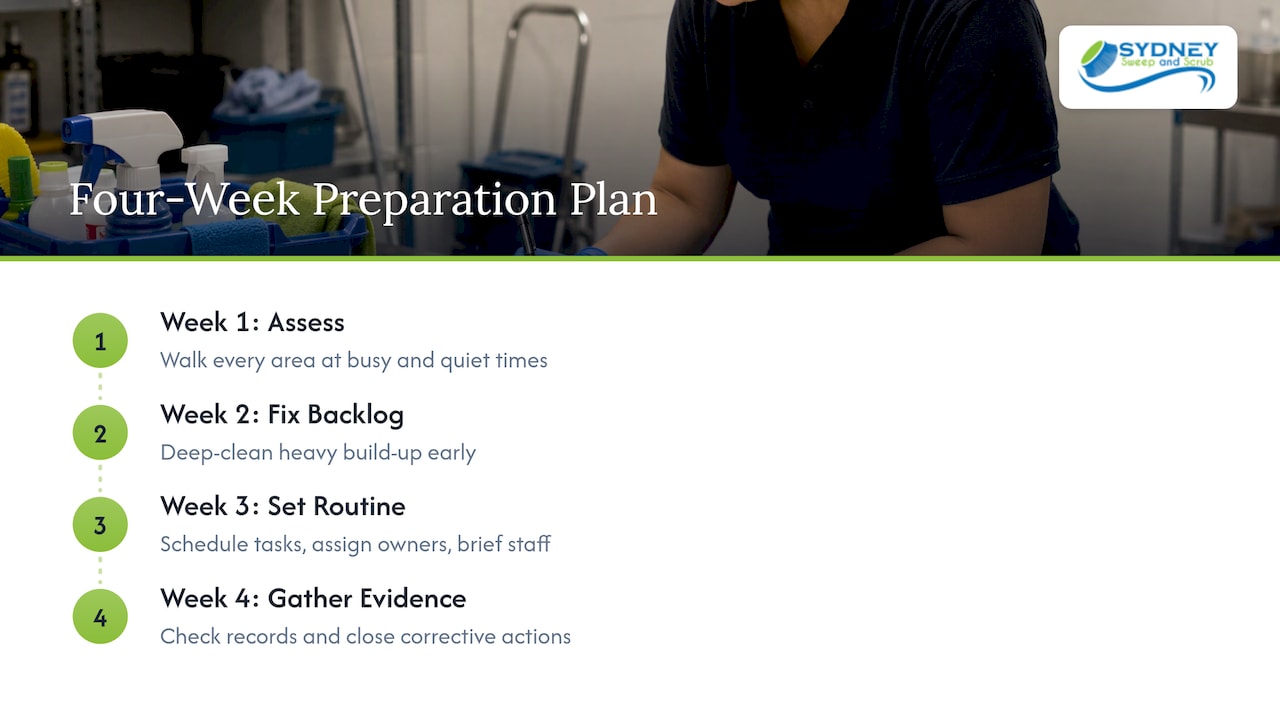
Week 1: Walk and assess. Walk every area as the auditor would, at the busiest time and at the quietest. Note wet areas, debris, blocked walkways, overflowing bins, spill kits that are empty and cords across floors. Run the five-step hazard review above.
Week 2: Fix the backlog. Heavy build-up cannot be solved by routine cleaning. Oil-stained concrete, years of dust on floors and ramps, and stained car park bays call for a deep clean with mechanical scrubbing or pressure washing, hot water where grease is the problem. Do this early, so floors have time to dry and any gaps can be redone.
Week 3: Set the routine. Write the schedule, set the frequency by traffic and contamination, name the person responsible, and fix the spill procedure. Brief staff, because the plan only works if workers know how to report and handle a spill.
Week 4: Collect the evidence. Assemble the file, check every record is dated and signed, and close any corrective actions you can. Then walk the site once more.
Where a cleaning contractor makes the audit easier
On a large floor area, the difference between a site that holds its standard and one that slips is repeatability. A machine sweeps and scrubs a warehouse or car park to a consistent pattern, and an auditor looking for “ad hoc cleaning” finds a schedule instead. Handing the work to a specialist also takes the equipment, the chemical handling and the operator scheduling off your team.
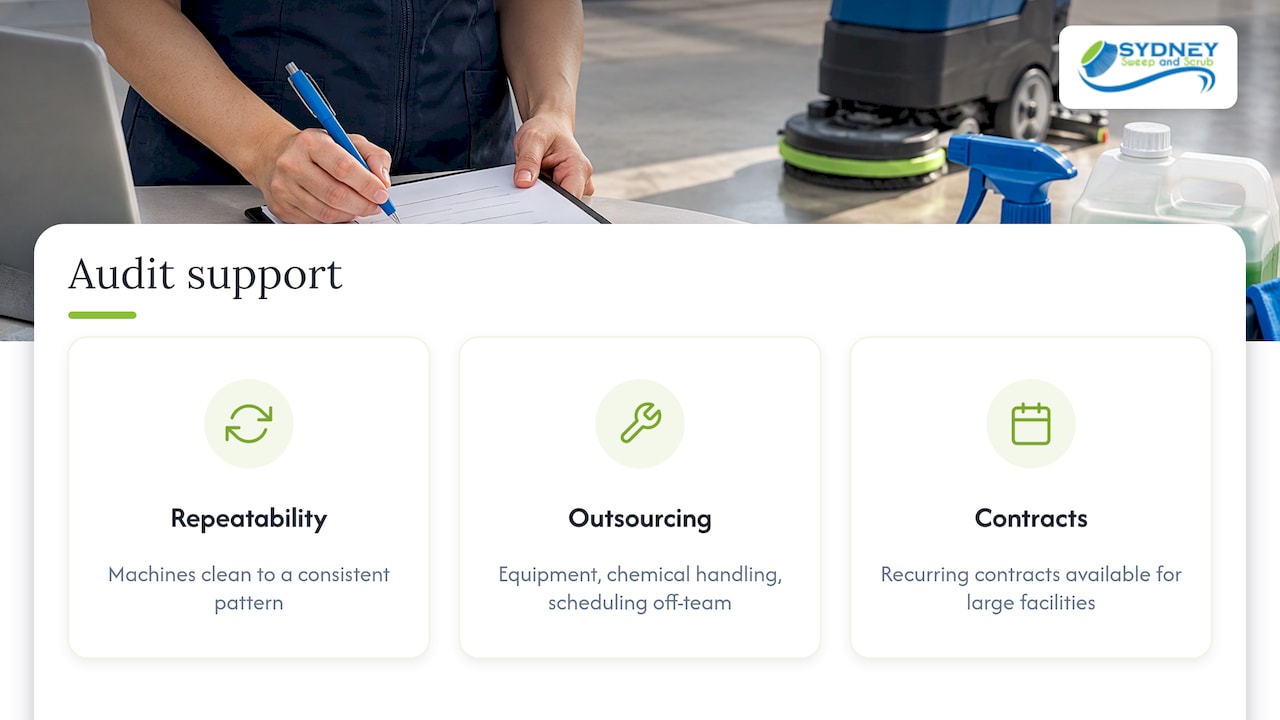
Sydney Sweep and Scrub is a family-owned Sydney business doing mechanical sweeping, mechanical scrubbing, pressure washing (including hot water), rubbish removal and automated robotic cleaning for warehouses, car parks, construction sites and public spaces. Large facilities can choose recurring maintenance contracts, and you can request a quote and book online. For the three most common audit situations, start with warehouse cleaning, car park cleaning or commercial cleaning, or see everything on our services page.
Common audit mistakes
- Cleaning only before the audit. Auditors read dates. A single clean, with no earlier records, shows the system is missing.
- No link between frequency and risk. The code ties frequency to contamination likelihood, worker numbers and shifts. Explain your reasoning in the schedule.
- Findings left open. An item with no owner or deadline reads as a managed risk that is not managed.
- Contractor details missing. Keep the scope, the safety data sheets for chemicals used on your site (the documents that cover storage, handling, spill clean-up and first aid) and the contractor’s contact in your file.
- Wet floors without signage. A simple, avoidable finding.
FAQ
What is a cleaning audit?
It is an inspection of whether cleaning is done to the standard and frequency you set, and whether it controls the hazards on your site. It checks the surface on the day and the schedule, training and records behind it. Findings should lead to actions with an owner and a deadline.
How often should we clean for a safety audit?
There is no single number. Safe Work Australia’s model code ties frequency to the type of work, the likelihood of contamination and the number of workers, including shift work. Set the schedule on those factors, write the reasoning down and review it when your operation changes.
What do auditors check on floors?
They look for floors that are wet or slippery, unattended spills, product residue, cords or equipment across walkways, and blocked access ways. They also ask how you find and clear spills between scheduled cleans.
Do we need records if the site looks clean?
Yes. A clean site on the day shows the current condition only. Dated checklists, a spill log and closed corrective actions show that the control works every day.
Can a contractor handle cleaning ahead of an audit?
Yes. Machine sweeping, scrubbing and pressure washing can clear heavy build-up and then hold a floor to standard on a regular schedule. Agree the scope in writing so it fits your audit file, and request a quote through our website.
Sources
- Managing the work environment and facilities, Safe Work Australia (November 2024)
- Managing the work environment and facilities, Safe Work Australia (December 2025)
- Work Health and Safety Regulations 2011, Federal Register of Legislation
- Work Safety Group public notices, ACT Government
- Cleaning, WorkSafe Queensland
- Risk assessment tool for Australian workplaces
- Principles of environmental cleaning auditing, Australian Commission on Safety and Quality in Health Care
- Cleaning and housekeeping duties risk assessment template
- Universal WHS Checklist for Workplaces