
Australian businesses have four main ways to dispose of commercial waste: a contracted bin collection, a hired skip, a one-off rubbish removal job, or a drop-off at a facility that accepts commercial loads. Which one suits you depends on how much waste you make, how often, what is in it and how easily a truck can reach your site. Councils generally do not collect business waste as part of the rates you pay, so the arrangement is yours to make. This guide walks through each option, the special streams that need separate handling, the rules to know and how to choose.
TL;DR
- Commercial waste is any waste produced by a business activity, and in places like the City of Sydney, business rates do not cover its collection, so you must arrange your own contract.
- Your main options are regular bin collection, skips, once-off rubbish removal and self-haul to an accepting facility. Match the option to volume, frequency and site access.
- Oils, liquids, e-waste, batteries, gas canisters and chemicals need separate handling. Putting them in general bins is illegal in some places and a leading cause of truck fires.
- Plan storage for at least two days of waste, label bins and keep lids closed to avoid illegal dumping penalties.
- For clean-outs, construction debris, car parks and warehouses, a once-off removal job is often faster and cheaper than adding permanent bins.
Table of Contents
- What counts as commercial waste
- Your main commercial waste disposal options
- Quick comparison
- Waste streams that need separate handling
- Rules to know before you sign anything
- How to choose the right option
- When waste is really a cleaning problem
- Making disposal safer and cheaper
- How Sydney Sweep and Scrub can help
- FAQ
- Sources
What counts as commercial waste
Commercial waste is any waste produced by a business activity. The City of Darwin describes it in exactly those terms, and the definition holds across the country. An office’s paper and coffee cups, a café’s food scraps, a warehouse’s pallets and shrink wrap, a building site’s offcuts and a strata car park’s accumulated litter all qualify.
The label matters because it decides who is responsible. Household waste goes into the council service. Commercial waste goes into a service you contract, and you carry the duty to keep it contained, sorted and sent to a lawful destination.
In NSW, the official classification system sorts waste into special, liquid, hazardous, restricted solid and general solid waste, with general solid split into putrescible and non-putrescible. Most day-to-day business waste is general solid waste. The other classes are where the rules tighten, and where you need a licensed handler rather than a standard bin truck.
Your main commercial waste disposal options
There is no single best option. Most sites combine two: a regular service for the predictable waste and a once-off service for the lumpy, irregular waste.
Contracted bin collection
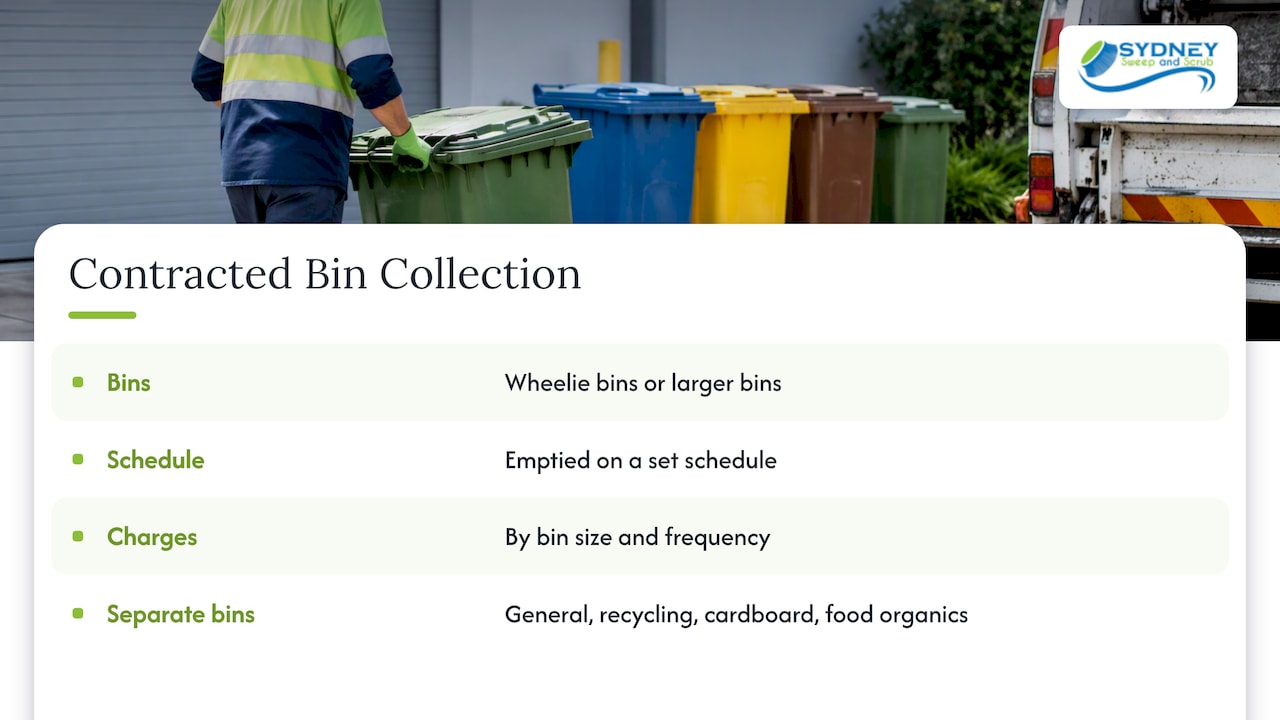
This is the standard for offices, shops, restaurants, medical centres and most light industrial tenants. A contractor supplies wheelie bins or larger bins, empties them on a set schedule and charges by bin size and frequency. You can usually run separate bins for general waste, commingled recycling and cardboard, and in some areas food organics.
In the City of Sydney, businesses must arrange their own collections, label bins with the business name, address and contractor’s name, and store bins inside their premises. That labelling requirement is a useful reminder that a bin without a clear owner becomes a problem for everyone.
Best for: steady, predictable waste volumes.
Watch for: contract lock-in periods, bin-lift fees, and paying for collections that run mostly empty.
Skip bins
A skip suits sites that produce a lot of waste over a short period: a fit-out, a demolition, a warehouse clear-out or a landscaping job. You hire the bin for a set time, fill it, and the supplier hauls it away. Sizes run from small bins for a tenancy refit up to large open-top bins for building sites.
Best for: projects with a start and end date.
Watch for: placement. A skip on a public road or nature strip usually needs a council permit, and heavy or restricted materials such as asbestos, liquids and many chemicals cannot go in a general skip.
Large bins, compactors and balers
High-volume sites, such as distribution centres, shopping centres and large factories, often move to front-lift bins, bulk bins or on-site compaction. The NSW EPA better practice guidelines note that compactors and balers can offer cost savings for commercial buildings, but the equipment must conform to relevant safety and design standards. Fewer, fuller collections mean lower haulage cost per tonne, but you need the floor space, the power supply and the staff training to run it safely.
Best for: a steady stream of bulky, light material such as cardboard and plastic wrap.
Watch for: upfront or rental cost, and the need for safe operating procedures.
Once-off rubbish removal
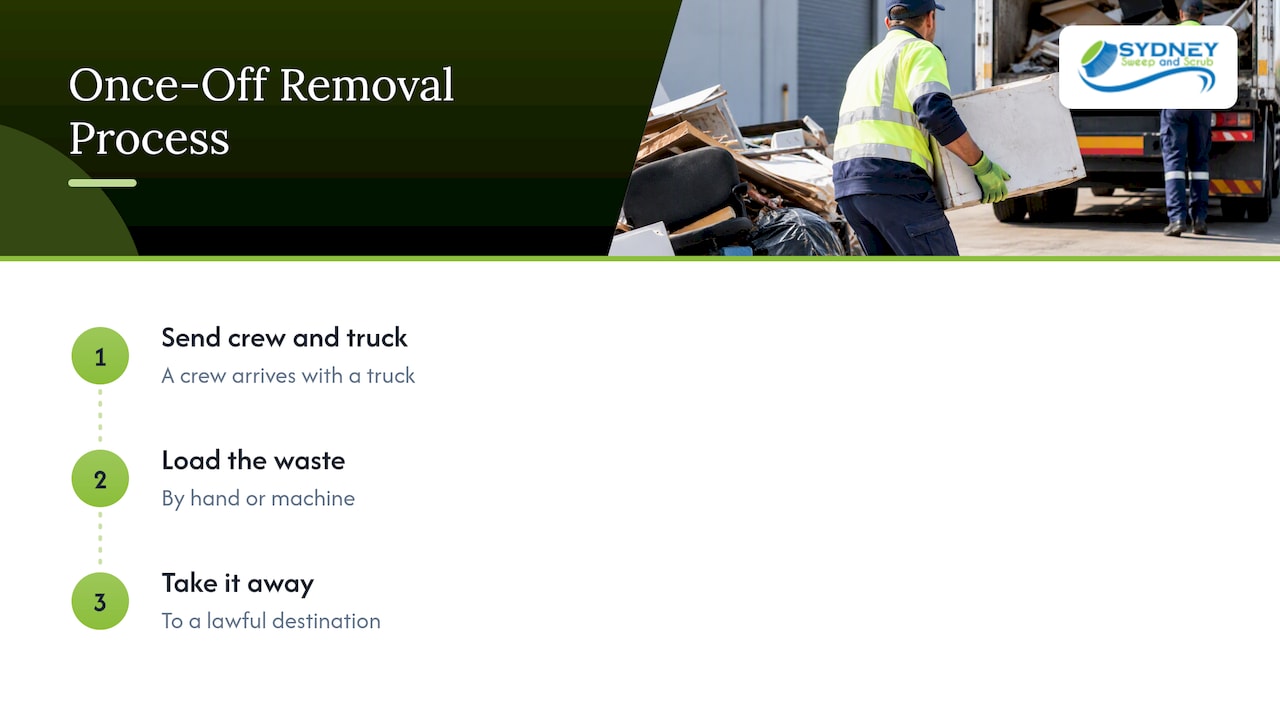
Sometimes the waste is not in a bin at all. It is a pile of pallets behind a loading dock, debris left by a contractor, abandoned goods after a tenant leaves, or litter and sweepings from a large car park. A once-off removal service sends a crew and a truck, loads the waste by hand or machine and takes it to a lawful destination. You pay for the job, with no contract and no bin sitting on your site afterwards.
This is the option most often overlooked, and it is where we work. Our rubbish removal service handles commercial clean-outs and site debris across Sydney, and our guide to commercial rubbish removal costs in Sydney explains what drives the price, including the landfill levy and food organics rules.
Best for: clean-outs, end of lease, construction tidy-ups, event bump-out and irregular loads.
Watch for: confirming that the operator takes waste to a licensed facility and can describe where it goes.
Self-haul to a waste facility
Some councils and regional facilities accept commercial loads directly. In Darwin, for example, businesses can use the Shoal Bay facility or commercial waste transport operators, and some hazardous waste is accepted at Shoal Bay with prior approval. Check with the facility before you load: acceptance rules, weighbridge fees and opening hours differ by site.
Best for: small tradies and businesses with a ute or trailer and flexible time.
Watch for: your own time, vehicle safety, load covering and what the facility will refuse.
Quick comparison
| Option | Best volume | Contract needed | Good for | Main drawback |
|---|---|---|---|---|
| Regular bin collection | Low to medium, steady | Usually yes | Offices, retail, hospitality | Paying for empty collections |
| Skip bin | Medium to high, short-term | No | Fit-outs, refurbishments, clear-outs | Placement and permits |
| Compactor or baler | High, steady | Yes, plus equipment | Distribution and large retail | Space, cost and safety |
| Once-off removal | Any, irregular | No | End of lease, site debris, car parks | Not a daily service |
| Self-haul | Small | No | Sole traders | Your time, facility rules |
Waste streams that need separate handling
The biggest mistakes in commercial waste come from putting the wrong thing in the wrong bin. Sort these streams out first.
Oils, grease and liquids
Oil and liquid waste must be stored in suitable containers and collected from the property. The City of Melbourne says businesses must not put grease, oil or liquid waste in standard bins, compactors, public spaces or storm drains, and penalties apply. The principle is the same everywhere: liquids belong with a licensed liquid waste collector, not in the general bin or the drain. Workshops, kitchens and car parks with oil leaks are the usual culprits. Our article on keeping Sydney’s waterways clean explains why runoff from paved areas matters.
E-waste, batteries, gas canisters and chemicals
These are the items that start fires inside collection trucks. Incorrect disposal of e-waste, batteries, nitrous oxide and gas canisters, hazardous liquids and chemicals are leading causes of hot loads, and Fire Rescue Victoria responds to at least one hot load per day across Victoria. In Victoria, e-waste to landfill is illegal. Elsewhere the rules differ, but the safe approach is identical: keep these items out of general and recycling bins, and send them through a dedicated e-waste recycler or hazardous waste collector. Businesses must arrange private collection for hazardous and dangerous waste.
Food and garden organics
Food businesses in NSW may be subject to specific laws requiring the separation of food and garden organics from general waste. If you run a café, restaurant, supermarket or catering operation, check the current requirements with the NSW EPA and your contractor before you renew a bin contract. Organics are heavy and wet, so separating them can also reduce the weight of your general waste bin.
Returnable items
Crates, drums and similar containers often stay the property of the supplier. The City of Melbourne notes that businesses are expected to arrange their return rather than treat them as waste. Returning them is free disposal.
Construction and demolition waste
Building sites produce mixed loads of timber, concrete, metal, plasterboard and packaging. These are best split at source into separate skips so that metal and clean concrete can be recycled. Dust, mud and sweepings are a separate issue: they cannot go to waterways, and they are part of why site housekeeping matters. Our guide to running an environmentally friendly building site covers the practical side.
Rules to know before you sign anything
Waste law in Australia is made mostly at state level, with councils enforcing local requirements. Three points apply widely.
- Keep waste in the bin. In the City of Sydney, waste placed outside of bins is classed as illegal dumping, so lids must close fully. An overfull bin is a compliance problem, not just an untidy one.
- Know your state’s sorting rules. Victoria’s Circular Economy (Waste Reduction and Recycling) Act 2021 provides for mandatory sorting of waste and recycling for specific entities. NSW and other states have their own regimes, so check the environment agency for your state.
- Use colour coding and signage. The NSW EPA guidance says bins and signage should follow the colour coding in AS 4123.7-2006, so staff, cleaners and collectors read your system the same way.
If your waste falls into the hazardous, liquid or special classes, talk to your state environment protection authority before you move it. Asbestos in particular needs a licensed removalist and an approved facility, never a skip bin or a removal crew without the right licence.
How to choose the right option
Work through these questions in order.
- What is in the waste? List the streams. If any are liquid, hazardous or electronic, plan their separate pathway first.
- How much and how often? Measure a typical week. Steady volume suggests a contract. Spikes suggest skips or once-off jobs.
- Can a truck reach it? Sustainability Victoria recommends storage areas be designed for safe vehicle access, which reduces manual handling of bins at collection. Tight loading docks and basement bin rooms may rule out large bins.
- Where will the bins live? The same guidance says storage should hold at least two days’ worth of waste and recyclables, based on appropriate estimates. Size your bins and bin room together.
- Who is accountable? Name one person to oversee it. Business.gov.au suggests that a waste management coordinator can help engage staff and identify external partners and services for waste reduction.
- What does the contract say? Look at the term, price review clauses, bin-lift fees, contamination charges and how to cancel.
A worked example
A 4,000 square metre warehouse with a loading dock produces cardboard and plastic wrap daily, pallets weekly and the odd load of damaged stock. A sensible setup is a baler or large cardboard bin on a scheduled service, a pallet pickup arrangement with a pallet recycler, a small general waste bin and a once-off removal job when stock is written off. Paying for a skip to sit on site all year would cost more than it saves.
A strata building with a basement car park has a different pattern: council or contractor bins for residents, and periodic litter, leaf and sediment build-up in the car park itself. That second stream is not bin waste. It is collected by sweeping and scrubbing.
When waste is really a cleaning problem
A lot of commercial waste never reaches a bin. It builds up on the ground: dust and grit on warehouse floors, cigarette butts and leaves in car parks, oil stains, packaging blown against fences, dried mud at a site gate. Left alone, it clogs stormwater drains, makes floors slippery and puts your site in front of an inspector or a tenant complaint.
Collecting that material at the source is the cheapest way to keep it out of waterways. Machines that sweep and scrub lift it into a hopper so it can be disposed of as solid waste, rather than washing it into the drain. Our guide to why Sydney car park cleaning is essential for businesses covers that side in detail.
Making disposal safer and cheaper
A few habits cut both risk and cost.
- Train people. The NSW EPA guidance says to train stakeholders in the correct and safe use of the system and keep waste areas and equipment safe, clean and well signed.
- Mark it clearly. Directional signage and clear visual markings, with accessible and clean waste areas, help maximise recovery rates.
- Separate early. A clean cardboard stream is worth more and costs less to move than mixed waste.
- Right-size collections. If a bin leaves half empty, drop the frequency or the bin size.
- Keep the bin room clean. Pests, odour and slips are all cheaper to prevent than to fix. Regular washdowns and sweeping of bin areas and loading docks keep it tidy.
- Keep records. Hold your contractor’s details, collection schedules and any dockets for hazardous loads.
How Sydney Sweep and Scrub can help
We are a family-owned Sydney business that handles the waste that bin contracts do not: commercial rubbish removal, mechanical sweeping and scrubbing, pressure washing and hot water cleaning for car parks, warehouses, construction sites and public spaces. If you are clearing a warehouse at the end of a lease, our end of lease commercial cleaning and warehouse cleaning teams can remove leftover rubbish and leave the floor clean. For car parks, our carpark cleaning service deals with debris, oil and sediment. You can request a quote and book online through our site, and we also offer recurring maintenance contracts for larger facilities. We do not publish fixed prices because they depend on the site, so tell us the size and what is on it.
FAQ
Does my council collect my business’s waste?
Usually not. In the City of Sydney, business council rates do not cover commercial waste and recycling, so businesses must arrange their own collection contracts. Other councils may offer a commercial service or point you to approved operators, so check your local council’s business waste page.
Can I put oil or chemicals in my general bin?
No. Liquids, oils, chemicals, batteries and e-waste need their own pathway through a licensed collector. Melbourne’s rules, for example, prohibit grease, oil and liquid waste in standard bins and storm drains. Contact your state environment authority if you are unsure how a particular waste is classified.
What is the cheapest way to dispose of a one-off pile of rubbish?
For most businesses it is a once-off removal job or a single skip hire, not a new bin contract. Compare what is included, especially labour, loading and disposal fees, and ask where the waste will be taken. Our cost guide for Sydney commercial rubbish removal explains the factors that move the price.
How much storage space do I need for bins?
Sustainability Victoria’s guidance says to allow for at least two days of waste and recyclables, using sound estimates. Add space for access, so staff can move bins without lifting them by hand. Your collection contractor can usually advise on bin sizes.
Who is responsible if waste is dumped illegally from my site?
The rules vary by state and council, but waste left outside bins at a business is treated as illegal dumping in the City of Sydney. Keep lids closed, label bins and use a collection frequency that stops them overflowing. If the waste came from a contractor, make sure your contract states who removes it.
Sources
- Businesses and waste services, City of Sydney
- Other business waste services, City of Melbourne
- Commercial waste, City of Darwin
- Better Practice Guidelines for Waste Management and Recycling in Commercial and Industrial Facilities, NSW EPA
- Waste and recycling for commercial and industrial land use, Sustainability Victoria
- Waste classification guidelines Part 1: Classifying waste, NSW EPA
- Manage business waste, business.gov.au