
Sweeper dust suppression is the set of controls that stops a sweeping machine from throwing fine dust back into the air while it cleans. On most commercial machines that means water spray at the brushes and suction inlet, a vacuum or regenerative-air system to pull in fines, and a filter to hold what is collected. Used together and kept in good order, they let a sweeper clear a warehouse, carpark or construction site without leaving a haze behind it.
This guide explains each method, how they combine, what Australian safety rules say about dust, and what to check before you book a sweeping contractor in Sydney.
TL;DR
- Dry sweeping can lift the finest dust into the air. Wet suppression, vacuum capture and filtration are the three main ways a machine prevents that.
- The methods work best combined: water binds dust at the point of contact, suction and a filter capture what remains.
- Where dust contains crystalline silica (concrete, stone, brick, tile, mortar), Australian rules require effective controls, and wet methods or M- or H-class vacuums are named options.
- Ask your contractor what suppression the machine uses, how it is maintained, and how the dust is disposed of.
- Sydney Sweep and Scrub runs mechanical sweeping and scrubbing for warehouses, carparks and construction sites across Sydney.
Table of Contents
- Why dust matters when you sweep
- How the main dust suppression methods work
- Comparing the methods
- Why the methods are usually combined
- What Australian rules expect
- Choosing a sweeper dust suppression approach by site
- Questions to ask a sweeping contractor
- Common mistakes
- How Sydney Sweep and Scrub helps
- FAQ
- Sources
Why dust matters when you sweep
A broom or an unsuppressed sweeper does two jobs at once: it moves debris, and it stirs up whatever is light enough to float. The heavy material ends up in the hopper. The fine fraction, the part you can least afford to breathe, can end up in the air of the warehouse, on the neighbour’s windscreens or in the lungs of the operator.
The risk is not only cosmetic. Sweeping dust on a building site or industrial floor often contains respirable crystalline silica (RCS). Safe Work Australia’s model code of practice on managing RCS risks treats exposure to it as a cause of serious occupational lung disease, and it sets out how dust-generating work must be controlled. Sweeping is a dust-generating activity like any other.
For a property manager, strata committee or warehouse operator, that turns a housekeeping question into a duty-of-care question. How the floor gets cleaned is part of how you manage the risk.
How the main dust suppression methods work
There are three building blocks. Most modern machines use more than one.
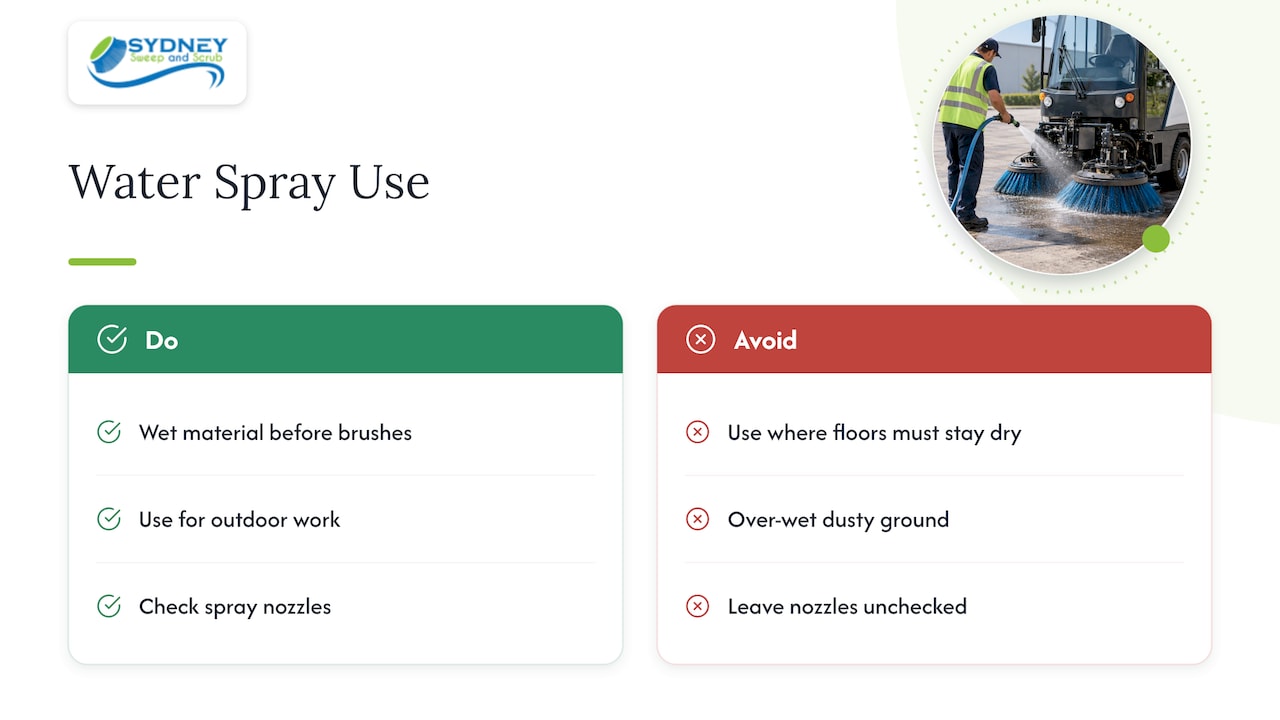
Water spray at the brushes
Water sprays wet the material before the brushes disturb it. Wet dust tends to clump into heavier particles that fall into the hopper instead of floating. On many road and carpark sweepers, spray nozzles sit at the side brushes and near the suction inlet, which are the points where dust is first released.
This is the oldest and simplest approach, and it suits outdoor work such as carparks, loading yards, footpaths and construction sites. Its limits are practical. Water is no help where a floor must stay dry, and over-wetting can leave a muddy film on dusty ground. Nozzles also block, so a spray that is not checked is a spray that quietly stops working.
Misting
Misting uses much finer droplets than a standard spray. The idea is to bind small airborne particles without soaking the surface. It is used on fixed installations such as crushers and stockpiles, and on mobile equipment. Industry guides to dust control describe fine-mist systems as a way of capturing dust at its source with relatively little water, which matters where water supply or runoff is a concern.
Vacuum and regenerative-air capture
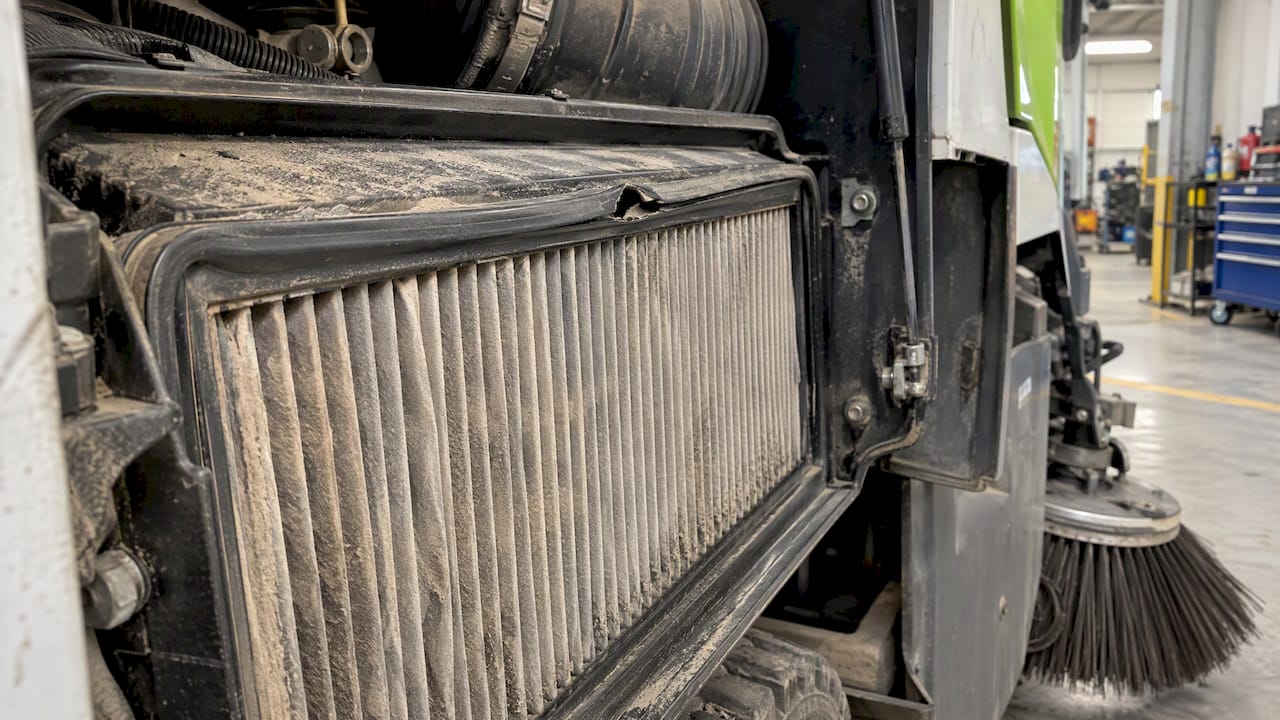
Mechanical broom sweepers move debris into a hopper with rotating brushes. Vacuum and regenerative-air machines add airflow, which is especially effective for lighter, finer particles. The air then passes through a filter or settling chamber so the dust is retained rather than exhausted.
The quality of the filter is what separates a machine that captures dust from one that simply relocates it. A sweeper with strong suction and a worn or clogged filter can be worse than a gentler machine in good condition.
Filtration and enclosure
Captured air has to go through something. Safe Work Australia’s silica guidance lists engineering controls including wet processing, local exhaust ventilation and dust extraction, and says cleanup should use M- or H-class industrial vacuum cleaners that comply with AS/NZS 60335.2.69:2017. The same code recognises an enclosed operator cabin with high-efficiency air filtration as an effective control for the person driving.
Comparing the methods
| Method | What it does | Best suited to | Watch out for |
|---|---|---|---|
| Water spray | Wets dust so it clumps and drops | Outdoor carparks, yards, construction sites | Not for dry-floor areas; blocked nozzles; runoff |
| Misting | Binds fine airborne particles with a light mist | Source-point control, high-dust areas | Needs water supply and good nozzle upkeep |
| Vacuum or regenerative air | Pulls fines into the machine | Warehouses, fine dust, mixed debris | Only as good as the filter and seals |
| Filtration (M- or H-class) | Holds captured dust and stops re-release | Silica-containing dust, enclosed spaces | Filters need scheduled cleaning and replacement |
| Enclosed filtered cab | Protects the operator | Heavy, prolonged dust exposure | Does not protect people nearby |
Why the methods are usually combined
No single method handles everything. A water spray suppresses dust at the point of contact, then a vacuum system and internal filter capture the fines that get past it. This is the logic behind most professional sweeping, and it matches the way Safe Work Australia’s code frames controls: it asks for at least one effective control during dust-generating work, with wet suppression, local exhaust ventilation or a filtered enclosed cabin as examples, and respiratory protection where a person remains at risk after controls are applied.
Practically, that means a good sweeping job on a dusty site looks like this:
- Damp the surface lightly where it is safe and sensible to do so.
- Sweep with a machine that has suppression at the brushes and suction at the inlet.
- Filter the exhaust air and handle the hopper contents without tipping them dry.
- Schedule the work for quiet periods, away from peak traffic and foot traffic.
The last step is administrative, not mechanical. Safe Work Australia’s guidance on managing occupational lung disease risks lists planning tasks to minimise airborne dust, setting policies for cleaning and equipment maintenance, and training workers as administrative controls.
What Australian rules expect
Sweeping dust rules are not written for sweepers alone. They sit inside work health and safety law, which applies to the business that controls the workplace (the PCBU) as well as the contractor.
The hierarchy of controls
Safe Work Australia’s approach starts with the hierarchy of controls: remove or substitute the hazard where you can, then use engineering controls, then administrative controls, with personal protective equipment last. For sweeping, substitution can mean choosing a method that generates less dust in the first place. A wet or vacuum approach is generally preferred over dry brushing for that reason, and an engineering control such as wet suppression ranks above relying on masks.
Silica dust
If the dust may contain crystalline silica, the model code says that processing it must be controlled, and that respiratory protective equipment is provided and worn if a person is still at risk after the control measures. We cover what this means for PCBUs on our page about silica dust compliance in Australia, and the practical side of cleanup in our guide to silica dust removal and management in the workplace.
Model codes become binding through state and territory law, so check the version that applies in New South Wales with SafeWork NSW if your site carries a silica risk.
Equipment upkeep
The code also says equipment used for suppression or extraction needs a maintenance and cleaning schedule, and regular inspection for wear, damage, kinks, holes or leaks. This is the clause that most affects a sweeping contract. A hose with a split, a nozzle that no longer sprays or a torn filter seal turns a compliant system into a decorative one.
Councils and complaints
New South Wales councils investigate dust complaints at construction sites, and the EPA’s visual guide for council officers shows the kind of controls they look for, such as well-maintained porous dust screens. Sweeping that keeps fines off the road and out of the neighbourhood is part of the same picture. Our page on construction site sweeping requirements goes into what site managers should expect.
Choosing a sweeper dust suppression approach by site
Construction sites
Construction dust is often silica-rich and generated continuously: cutting, grinding, demolition, tracking mud and dry material onto roads. A combination of damp-down, vacuum-assisted sweeping and prompt removal of settled dust works better than occasional dry passes. See our overview of what a compliant construction dust cleanup delivers.
Warehouses
Indoors, water is awkward and dust has nowhere to go, so filtered vacuum capture matters most. Fine dust from pallets, packaging, concrete floors and forklift traffic builds up on racking and in the air. A scrubber-sweeper that sweeps, scrubs and recovers in one pass leaves the floor dry and removes dust instead of redistributing it. Compare this with manual methods in our piece on sweep and scrub versus mop and bucket in warehouses, and read how routine cleaning supports indoor air quality.
Carparks
Carparks collect gritty, oily dust, tyre residue and litter. Outdoor and open-sided carparks suit water-assisted sweeping. Basement carparks need more care, because exhaust air and wash water both have to go somewhere. Sweeping before any pressure washing also keeps grit out of drains. Details are on our carpark cleaning page.
High-dust industrial yards
Quarry-adjacent, bulk-material and heavy industrial sites produce dust faster than a weekly clean can manage. These sites need a fixed schedule and a machine matched to the load. Our article on high-dust industrial sweeping and air quality covers how that works in practice.
Questions to ask a sweeping contractor
These are the questions that separate a contractor who manages dust from one who just moves a machine around.
- What suppression does the machine use? Water spray, vacuum, filtration, or a combination, and for which surfaces?
- What filter class is fitted? If your dust may contain silica, ask whether the vacuum or extraction meets the M- or H-class standard named in the code.
- How is the water system calibrated and checked? Spray rates should follow the manufacturer’s specification, and nozzles should be inspected before each job.
- What is the maintenance schedule? Look for regular inspection of brushes, hoses, seals and filters, with records.
- How is the hopper emptied? Tipping dry dust into a skip is a way of releasing it again.
- What does the operator wear, and what training have they had? Respiratory protection is the last layer, not the first.
- When will the work be done? Out-of-hours or low-traffic windows reduce exposure for your people and visitors.
- Is there a safe work method statement for the job? A reputable contractor will have one that describes dust controls and traffic management.
If the answers are vague, treat that as information.
Common mistakes
- Dry sweeping a dusty floor. It is quick and cheap, and it puts the finest dust into the air. Use wet or vacuum methods first.
- Treating the filter as a consumable you can ignore. A blocked or damaged filter reduces suction and lets fines through.
- Over-wetting. Too much water turns dust to slurry, which tracks onto roads and is harder to remove.
- Cleaning during peak activity. Sweeping while forklifts, trucks or pedestrians move through puts more people in the dust.
- Relying on masks. Respiratory protection matters, but under the hierarchy of controls it comes after the engineering and administrative measures.
How Sydney Sweep and Scrub helps
We are a family-owned Sydney business running mechanical sweeping, mechanical scrubbing, pressure washing, rubbish removal and hot water cleaning for warehouses, carpark owners, strata managers, construction companies, councils and event venues. We also offer automated robotic cleaning for carparks and warehouses, and our operations are carbon-neutral, with optional waste offset initiatives.
If you are planning a regular clean or a one-off job where dust is the concern, start with our mechanical sweeping service, tell us the site type, the surface and what the dust is likely to contain, and request a quote through our online booking. We do not publish set prices, because the right machine and frequency depend on the site. Tenants preparing to hand a unit back can look at end of lease commercial cleaning, and warehouse operators can go straight to warehouse cleaning.
FAQ
What is dust suppression on a sweeper?
It is any feature that stops the sweeping action from releasing dust into the air. The common ones are water spray at the brushes and suction inlet, vacuum or regenerative-air capture, and filters that retain what is collected. Most professional machines combine at least two of these.
How do you reduce dust when sweeping?
Wet or lightly damp the surface where that is suitable, use a machine with vacuum capture and a maintained filter, and avoid dry brushing on fine dust. Plan the work for quiet periods and empty the hopper in a way that does not release the dust again. For silica-bearing dust, Safe Work Australia names wet methods and M- or H-class vacuums as effective controls.
Do I need dust suppression if my site has silica dust?
Yes. The Safe Work Australia model code requires the processing of crystalline silica substances to be controlled, and it lists wet dust suppression, local exhaust ventilation or a filtered enclosed cabin as examples of effective controls. Respiratory protection is required where a person is still at risk afterwards. Your state or territory regulator, such as SafeWork NSW, can confirm what applies to your site.
Can water spray and vacuum be used together?
Yes, and that is the usual design. The spray suppresses dust where the brushes meet the surface, while the vacuum and filter capture the finer particles that remain. Combining them handles a wider range of particle sizes than either does alone.
What should I check before hiring a sweeping contractor?
Ask what suppression the machine uses, what filter class is fitted, how often the equipment is inspected, how the hopper is emptied, and whether the crew work to a safe work method statement. A contractor who manages dust well will answer all of these plainly.
Sources
- Managing risks of respirable crystalline silica, Model Code of Practice (Safe Work Australia, August 2025)
- Occupational lung diseases: managing risks (Safe Work Australia)
- Local Government Air Quality Toolkit: dust from construction sites visual guide (NSW EPA)