
The best way to clean a truck yard is to match the method to what is on the ground: mechanical sweeping for dust and loose debris, scrubbing for wet residue and oil film, pressure washing for ingrained grime, and absorbent clean-up for spills. Whichever you use, the wash water must never reach the stormwater drain. That second rule, not the machine, is what separates a tidy yard from a pollution offence. Mechanical sweeping, scrubbing and pressure washing are what we do at Sydney Sweep and Scrub, so this guide is written from the operator’s side of the fence.
TL;DR
- Dry methods first: vacuum or dry sweeping is the preferred way to lift dust, grit and debris, and hosing down a yard is treated as unacceptable because it pushes pollutants towards stormwater.
- Use mechanical scrubbing, high-pressure jetting or steam cleaning in preference to chemical solvents where practicable, as WA’s water quality guidance advises.
- Any washing needs a contained area. In NSW, runoff must not enter stormwater drains, and wastewater goes to a collection pit, then to sewer under an approved trade waste agreement, or is treated and recycled.
- Spills are cleaned with absorbent material and the waste is sealed and disposed of properly, not rinsed away.
- A scheduled mix of sweeping, scrubbing and targeted washing usually beats occasional big wash-downs.
Table of Contents
- What a truck yard cleaning programme has to deal with
- Method 1: Mechanical sweeping for dust and loose debris
- Method 2: Mechanical scrubbing for wet residue and oil film
- Method 3: Pressure washing for ingrained grime
- Method 4: Spill clean-up with absorbents
- Choosing the method: a quick guide
- Keeping wash water out of the drain
- Safety and compliance on the day
- Getting the yard cleaned without running the programme yourself
- FAQ
- Sources
What a truck yard cleaning programme has to deal with
A truck yard collects five different problems, and each wants a different tool:
- Dust and grit from hardstand, unsealed edges and tyres.
- Loose debris such as pallet fragments, strapping, packaging and tyre residue.
- Mud and sediment tracked in from construction and quarry runs.
- Ingrained grime: diesel film, tar, rubber and grease worked into concrete.
- Oil, fuel and coolant spills from leaks and refuelling.
The constraint over all of them is where the water goes. The NSW EPA sums it up as the drain is just for rain: stormwater runs untreated into local rivers and creeks, so every washing, storage and spill practice on a yard exists to keep pollutants out of that pathway. It is also against the law in NSW to place material where it can flow into a waterway and cause pollution, according to the same guidance.
For a property manager, warehouse occupier or council, that means a cleaning method is only as good as its water plan. A powerful wash that sends a grey stream to the gutter is a liability, not a result.
Method 1: Mechanical sweeping for dust and loose debris
Sweeping is the foundation of yard cleaning because it removes the material that turns into mud and sludge the moment it gets wet. The SA EPA’s stormwater guidance for vehicle yards names vacuum sweeping or dry sweeping with brooms as the preferred methods, with sweepings collected into a pile and binned.
On a large yard, hand brooms do not keep up. A mechanical sweeper uses rotating brushes and a vacuum system to lift fine dust as well as larger litter, and it covers hardstand far faster than a crew can. Power type matters on site: diesel or LPG machines suit open hardstand, while battery machines suit enclosed areas such as covered docks.
Where it goes wrong:
- Sweeping a yard that is already wet. Debris clumps, brushes clog and fine material stays behind.
- Skipping the edges, kerb lines and areas under parked trailers, where sediment collects and then washes out in the next storm.
- Leaving the collected material in an open pile near a drain.
Sweeping is also the cheapest way to cut the volume of anything you later have to wash. Our mechanical sweeping service covers yards, car parks and warehouse surrounds across Sydney, and it works well as a scheduled routine rather than a one-off. If you manage a car park attached to the yard, the same approach is described on our car park sweeping page.
Method 2: Mechanical scrubbing for wet residue and oil film
A scrubber machine washes, brushes and recovers the water in a single pass, so the wet residue is collected rather than left to run. It suits the zones where trucks idle, load and refuel, where a thin oil and rubber film builds up that a broom or vacuum cannot shift.
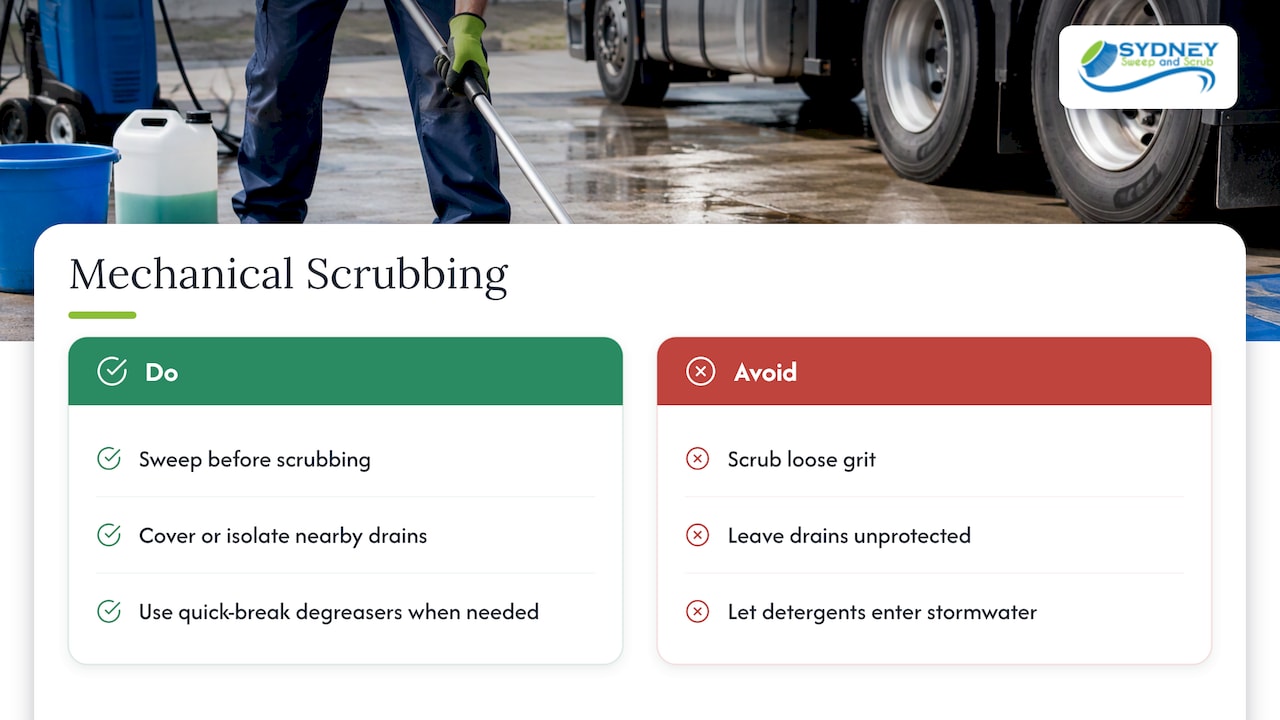
WA’s guidance for mobile servicing and cleaning says that, where practicable, high-pressure jetting, mechanical scrubbing or steam cleaning should be used instead of chemical solvents on paved surfaces. Where a solvent is genuinely needed for tar, grease or grime, it recommends quick-break degreasing compounds or biodegradable, phosphate-free soaps.
A caution on detergents: the SA EPA states that all detergents, even biodegradable ones must stay out of the stormwater system. “Biodegradable” on the label does not make a rinse-off to the gutter acceptable.
Where it goes wrong: scrubbing before sweeping, so the machine spends its water and brushes on loose grit; and scrubbing near a drain without covering or isolating it first.
Scrubbing is part of our warehouse cleaning and car park cleaning work, and our automated robotic cleaning option suits sites that want consistent, repeatable passes.
Method 3: Pressure washing for ingrained grime
Some stains are in the concrete, not on it: years of diesel drip, rubber marks, tar and weathered grease. High-pressure water, and hot water for greasy deposits, is the tool for those areas. We run pressure washing and hot water pressure cleaning for commercial and industrial sites.
The technique matters as much as the machine:
- Sweep first. Remove debris that would become projectiles or end up in the wash water.
- Match pressure to the surface. Start at the lowest setting and work up. Too much pressure etches concrete and chews out joints and line marking.
- Keep the nozzle at a consistent distance and work in a grid pattern, top down, so you do not leave stripes or push dirt over cleaned areas.
- Contain the water before the first pass, not after the first complaint.
- Depressurise before disconnecting hoses, and keep petrol or diesel machines out of enclosed spaces because of exhaust fumes.
The weak point is almost always step 4. Pressure washing creates a lot of dirty water in a short time, and that water carries oil, sediment and detergent. Our guides on pressure washing wastewater and pressure washing trade waste in Sydney go through the checks for Australian businesses.
Method 4: Spill clean-up with absorbents
With oil, fuel or coolant, speed and containment beat water. The SA EPA says spills should be cleaned up with absorbent materials. On gravel or rubble surfaces the affected material can be removed and replaced. The contaminated material is sealed in a container and binned so residual oil is not washed into stormwater.
WA’s guidance on equipment wash down adds two practical points: keep sand or kitty litter on site for spills, and avoid sawdust, which is a fire hazard. It also advises training and assigning site staff to manage chemical spills, so the response does not depend on whoever happens to be on shift.
A workable spill routine:
- Stop the source and keep people and vehicles clear.
- Block the nearest drain.
- Spread absorbent from the outside of the spill inwards.
- Sweep up, seal and label the waste.
- Treat any remaining film with scrubbing or hot water, with the water contained.
We have laid out the sequence in more detail in our guides to oil spill response in car parks and warehouse spill response.
Choosing the method: a quick guide
| Problem | First choice | Then, if needed |
|---|---|---|
| Dust, grit, loose litter | Mechanical or dry sweeping | Scheduled repeat sweeps |
| Pallet fragments, strapping, tyre residue | Sweeping with hand pick-up | Rubbish removal |
| Mud and sediment | Sweeping once dry, then scrubbing | Contained low-pressure wash |
| Oil and rubber film in work zones | Mechanical scrubbing | Hot water pressure cleaning, contained |
| Ingrained grime, tar | Pressure washing, contained | Quick-break degreaser, contained |
| Fresh oil or fuel spill | Absorbent, seal and dispose | Scrub the residue |
Four things decide the actual plan:
- Surface. Sealed concrete takes pressure well. Older or weathered concrete, asphalt and line marking need a lower setting.
- Traffic. A yard with constant truck movements needs short, frequent sweeps in the busy lanes, because grit and drips build up daily.
- Frequency. Regular sweeping and scrubbing cut the number of heavy wash-downs. Large facilities can set this up as a recurring maintenance contract.
- Water. This is both an environmental and a cost factor. The SA EPA notes that South Australia is the driest state on the driest continent, and that conserving water saves money and may mean nothing is discharged from the site. The same logic holds in Sydney, where every litre you do not use is a litre you do not have to capture. Our note on water saving techniques in car park cleaning applies equally to yards.
The SA EPA’s low-water options are a low-pressure nozzle, dry cleaning, or a bucket and chamois with a trigger nozzle on the hose. Detergent washing is acceptable there only where the wash bay drains to an approved trade waste treatment facility, bunded and roofed so stormwater cannot enter.
Keeping wash water out of the drain
This is the part of truck yard cleaning that carries legal weight. The NSW EPA’s guidance says that for any washing activity, runoff must not enter stormwater drains. Washing of vehicles, equipment or work floors should be confined to a designated wash bay. The wastewater goes to a collection pit and then to sewer under a Trade Waste Agreement approved by the local council, or it is treated and recycled with water treatment equipment. Wash bays should sit away from drainage lines, stormwater drains and water bodies, and staff should be told when and how to use them.
What counts as wastewater is wider than most people expect. The SA EPA lists vehicle and equipment washdown, cleaning agents and detergents, high-pressure water blasting waste, engine coolant, oil, grease and petroleum products as things the street drain must not carry.
What a compliant wash area looks like
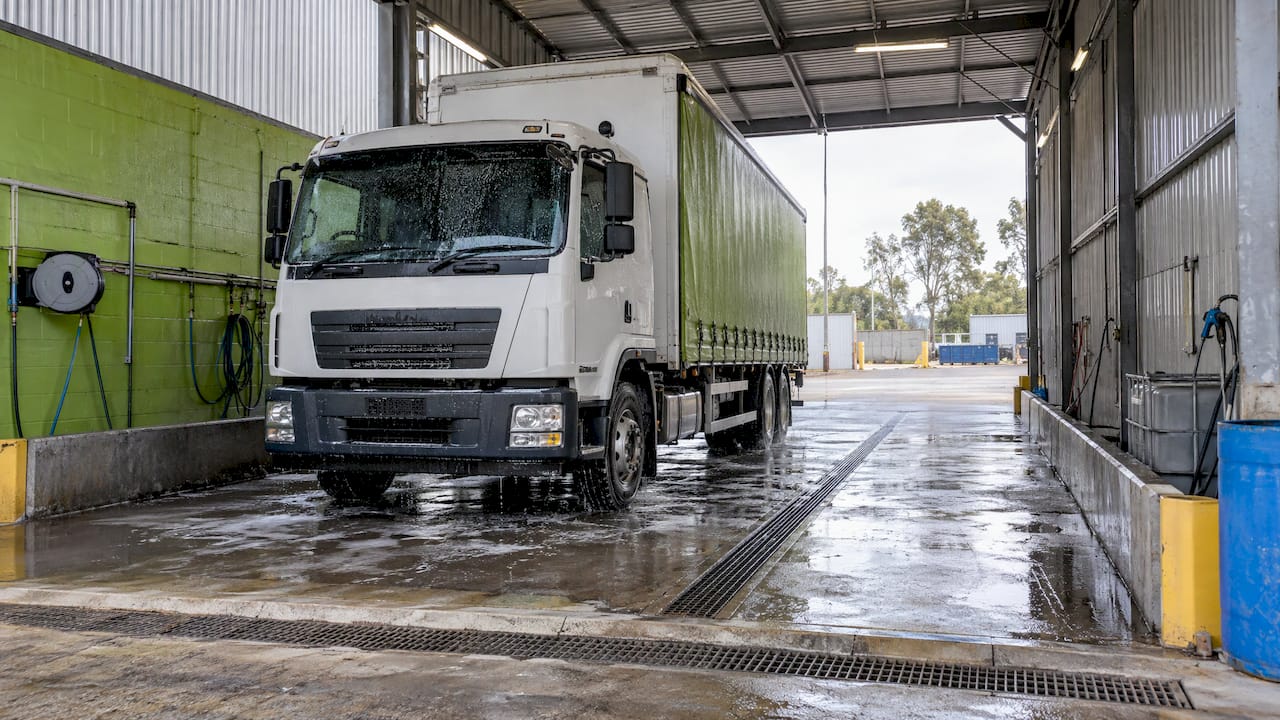
Transport for NSW’s truck wash guide sets out the standard for purpose-built truck washes. It requires an oil/water separator that produces a waste stream with a maximum hydrocarbon level of 30 ppm, roughly 30 mg per litre. It notes that triple interceptors are no longer approved as the primary separator, and it calls for an inspection and sampling point before disposal.
The SA EPA’s wash bay guidance describes the physical design: a roof, bunds at entry and exit, a low-permeability concrete floor graded to a collection channel, and pre-treatment through screens, a settling chamber or sump and a separator. After treatment, water goes to an approved holding tank, to sewer under a trade waste licence, or through a unit that cleans it for reuse. The WA guidance adds that settled sludge in sediment traps should be removed periodically and sent to a registered landfill, and recovered hydrocarbons stored in weatherproof containers for approved disposal.
These details vary by state and by council, and the sewer authority sets the final conditions. Treat the figures above as the benchmark to design towards and confirm the requirements with your local council or water utility before you build or change a wash area. If you are unsure whether your site’s wash-down arrangement meets them, take it up with the council or the EPA in your state.
Why a dry-first routine helps
Every step in that treatment chain costs money to build, inspect and empty. The less sediment and oil that reaches the wash stage, the lighter the load. That is the practical case for sweeping first, scrubbing the work zones and keeping pressure washing for the areas that need it. Our guide to commercial waste disposal options covers what happens to the collected waste.
Safety and compliance on the day
The Transport for NSW guide lists the framework that applies to truck wash facilities, including the Work Health and Safety Act 2011, environmental protection legislation, plumbing and drainage standard AS/NZS 3500.2 and Building Code requirements for slabs and structures. The NSW EPA’s 2024-25 annual report states that no new or amending regulations were made between 1 July 2024 and 30 June 2025, so the existing POEO (General) Regulation 2022 remains the operative rule set for trade waste and stormwater in NSW. Check the current legislation page for any later change.
On the day, a few habits prevent most incidents:
- Brief the crew on where the drains are and how to block them.
- Keep trucks and pedestrians out of the work zone, and use signage on wet surfaces, which stay slippery after a wash.
- Carry a spill kit. The SA EPA recommends one with portable bunds, absorbent material, a dustpan and brush, and a container for disposal at a licensed facility.
- Store oils and solvents in a bunded area that cannot drain to sewer or stormwater, as the Power and Water Corporation requires for automotive and engineering sites in the Northern Territory.
Getting the yard cleaned without running the programme yourself
For most property managers, warehouse occupiers and councils, the sweep, scrub and wash sequence is a recurring job, and the contained-water side is a compliance task on top. We are a family-owned Sydney business offering mechanical sweeping, mechanical scrubbing, pressure washing, hot water cleaning, rubbish removal and automated robotic cleaning for warehouses, car parks, construction sites and public spaces, with optional recurring maintenance contracts for large facilities. You request a quote and book online.
If you want to see what is on offer, start with our services, or go directly to warehouse cleaning if the yard sits with a warehouse, including cleaning at the end of a lease.
FAQ
Can I just hose down a truck yard?
No, it is the method regulators discourage most. The SA EPA calls hosing down a yard unacceptable because it increases pollutants entering the stormwater system. In NSW, washing runoff must not enter stormwater drains. Sweep first, and wash only in a contained area.
What is the best method for oil stains on concrete?
Start with absorbent material for fresh spills, then mechanical scrubbing or hot water pressure cleaning for the film left behind. WA guidance prefers jetting, scrubbing or steam cleaning over chemical solvents where practicable. Capture the water and dispose of it through an approved route.
How often should a truck yard be swept?
It depends on traffic and the surface. A busy yard with constant movements benefits from frequent sweeps of the main lanes, while a quieter one may need less. Regular sweeping reduces how often you need heavy washing, and a recurring schedule keeps the standard consistent.
Do I need approval to send wash water to sewer?
Yes. In NSW the wastewater from a wash bay goes to sewer under a Trade Waste Agreement approved by the local council. SA requires a SA Water trade waste licence. Confirm the conditions with the relevant authority before you start.
Sources
- NSW EPA: The drain is just for rain
- SA EPA: Stormwater Management for Car Yards
- SA EPA: Stormwater Management for Wash Bays
- SA EPA: Businesses
- WA Water Quality Protection Note 29: Mobile mechanical servicing and cleaning
- WA Water Quality Protection Note 68: Mechanical equipment wash down
- Transport for NSW: Truck Washes Information Guide
- NSW EPA annual report 2024-25
- Power and Water Corporation: Managing trade waste in the automotive and engineering industry