
High-traffic floors stay clean when you stop treating them like ordinary floors. Heavy foot, forklift and vehicle traffic grinds grit into the surface, so the job is a repeatable system: mechanical sweeping first, machine scrubbing second, a schedule matched to how hard each zone is used, and safety controls that keep people off wet floor. Sydney Sweep and Scrub runs mechanical sweeping and scrubbing for warehouses, carparks, public spaces and event venues across Sydney, so property managers and facility operators can hand the whole routine over.
This guide is for people responsible for a floor that gets hammered: warehouse owners and occupiers, strata and building managers, councils, event organisers, construction site managers and business owners. It explains what to do, in what order, how often, and where it usually goes wrong.
TL;DR
- Sweep before you scrub. Dry grit left on the floor clogs scrubbing equipment and scratches the surface.
- Heavily soiled floors need more than a quick pass: let the cleaner dwell, scrub, recover the solution and let the floor dry before traffic returns.
- Set cleaning frequency by zone, not by building: entrances, aisles and loading areas need daily attention, low-use corners far less.
- Safe Work Australia’s model code expects floors to be inspected and maintained so slip and trip hazards are eliminated or minimised, including hazards caused by the cleaning itself.
- Machine cleaning on a recurring schedule, done outside peak hours, is the most reliable way to meet all of this. Request a commercial cleaning quote.
Table of Contents
- Why high-traffic floors fail faster
- The sequence: sweep first, then scrub
- Match the method to the surface
- How often: set the schedule by zone
- Keep people safe while you clean
- Doing it in-house or booking a contractor
- Ending a warehouse lease
- How Sydney Sweep and Scrub handles high-traffic floors
- FAQ
- Sources
Why high-traffic floors fail faster
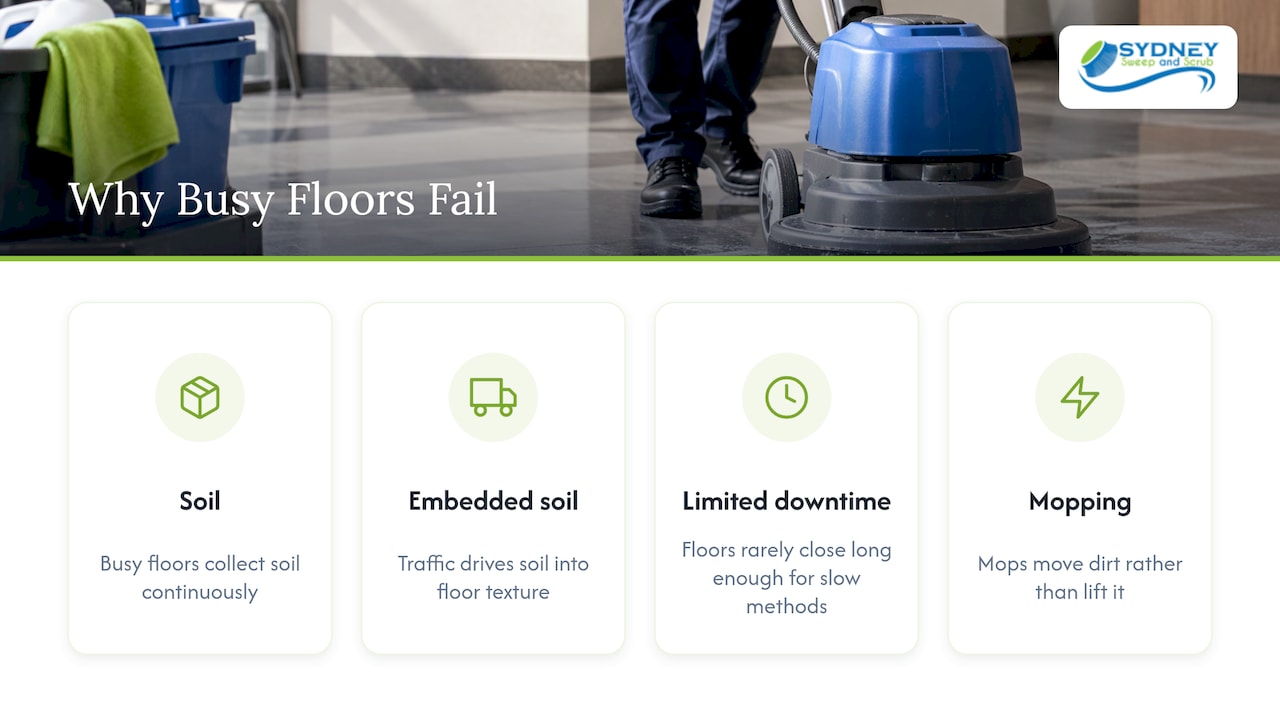
A floor in a busy entrance, warehouse aisle or carpark ramp does three things that a quiet floor does not. It collects soil continuously, it has that soil walked, rolled or driven into its texture, and it is rarely out of service long enough for slow cleaning methods.
The result is a familiar pattern. A mop and bucket move dirt around rather than lift it. Fine dust sits in the texture of concrete. Oil and tyre residue form a film. The floor looks grey even straight after cleaning, and the film that remains can be slippery.
Floor care specialists describe the economics plainly. Frequent, simple maintenance extends the time between aggressive restorative work, which is expensive and disruptive. That is the reason a regular machine routine costs less over a year than periodic rescue cleans on a neglected floor.
The sequence: sweep first, then scrub
The order matters more than the equipment. We cover it in more detail in our guide to the right sweep-then-scrub sequence for commercial floors, but the principle is simple.
Step 1: Remove dry debris
Sweeping lifts loose grit, packaging offcuts, leaves, cigarette butts and dust before any water touches the floor. Skip this and the wet process turns dry soil into slurry. It clogs the scrubber’s recovery path, wears brushes and squeegees faster and leaves streaks behind.
Where it goes wrong: a broom or a walk-behind pass over a large floor misses fine dust and takes hours. For big areas such as warehouse floors, loading yards and multi-level carparks, mechanical sweeping covers the area in a fraction of the time and picks up the fine material that brooms push around. That is the first thing we take off your hands.
Step 2: Apply the right cleaner and allow dwell time
Chemistry does part of the work, but only if it has time. Forbo, a flooring manufacturer, advises in its care guide for resilient flooring that heavily soiled floors need a dwell time of 5 to 10 minutes, longer for heavy soil, and a neutral cleaner in the pH 6.0 to 8.0 range. Always follow the flooring manufacturer’s instructions for your surface, as a cleaner that suits one floor can strip the finish from another.
Where it goes wrong: using a stronger product than the soil needs. Heavy-duty alkaline cleaners have their place on stubborn industrial soils, but they can damage sealers and leave residue. Residue is slippery in its own right and attracts more dirt.
Step 3: Scrub with a machine
A scrubbing machine agitates the surface, lifts the soil into the solution and recovers the dirty water in the same pass. For heavily soiled floors, the same Forbo guide recommends double scrubbing with an automatic scrubber: one pass to loosen the soil, a second to lift it.
Where it goes wrong: a worn squeegee blade. It leaves a thin wet film behind, which is exactly the slip hazard you were cleaning to remove. Machine condition is part of the result, and it is one reason a contractor who maintains its own fleet delivers a more consistent finish than occasional in-house use. Our mechanical scrubbing and sweeping services are built around this routine.
Step 4: Rinse, recover and dry before traffic returns
Floor care guidance says to rinse thoroughly after scrubbing and let the floor dry completely before it takes traffic. On a busy site this is the hard part, because stopping people and forklifts is costly. That leads to scheduling, covered below.
Match the method to the surface
Not every high-traffic floor is the same, and the right method changes with the surface and what lands on it.
| Area | Typical soil | Method that suits it |
|---|---|---|
| Warehouse (sealed or bare concrete) | Dust, tyre marks, oil film, packaging debris | Mechanical sweeping, then machine scrubbing |
| Carparks and ramps | Oil drips, grit, leaves, gum, stains | Sweeping, pressure washing, hot water for oil |
| Footpaths and public spaces | Litter, gum, food stains, weather grime | Sweeping, pressure washing, rubbish removal |
| Event venues and stadiums | Spilled food and drink, litter, heavy footfall | Rubbish removal, sweeping, scrubbing between events |
| Construction sites | Dust, mud, concrete slurry, debris | Mechanical sweeping, pressure washing |
| Lobbies and common areas | Walked-in soil, moisture | Daily scrub or machine clean in quiet hours |
Warehouses
Polished, sealed or bare concrete creates dust continuously as traffic wears it. Sweeping first is therefore not optional, it is the main job. A regular scrub then removes the oil film and tyre residue that sweeping cannot. Our warehouse cleaning combines both, and our guide on regular warehouse cleaning and efficiency explains why clean floors keep operations running.
Carparks
Carpark floors suffer from oil, brake dust and standing grime. Pressure washing, including hot water pressure cleaning for oil and grease, takes surface stains that a scrubber alone does not. Sweeping before washing keeps loose debris out of drains. See our carpark cleaning page for building managers, owners and strata committees. We also offer line marking, which is useful after a deep clean when the markings are ready to be refreshed.
Public spaces and event venues
Footpaths, plazas and venue concourses face litter and food waste on top of grime. Routine sweeping and rubbish removal keep them presentable between events, with scrubbing or pressure washing for deeper resets. Our page on routine cleaning for public spaces sets out how that routine works for councils and venue operators.
Large floors and repetitive routes
Where a floor is large, open and cleaned on a fixed pattern, automated robotic cleaning is one of the options we offer for carparks and warehouses.
How often: set the schedule by zone
The most common mistake is a single frequency for the whole site. A better way is to split the floor into zones by how heavily each is used.
WorkSafe Queensland’s guidance on cleaning says a sound cleaning system has systematic schedules, routine daily cleaning during quiet periods, periodic deep cleaning and a rapid response to spills, covering indoor and outdoor areas used by workers, customers and visitors. Queensland’s regulator wrote it, but the principles apply to any Australian workplace managing slip risk.
Here is a practical way to apply that, as an illustration rather than a rule:
- High-traffic zones (entrances, main aisles, loading docks, carpark entry ramps): sweep daily or every few days, machine scrub on a regular weekly cycle, deep clean periodically.
- Medium-traffic zones (secondary aisles, common areas): sweep weekly, scrub on a longer cycle.
- Low-traffic zones (storage corners, plant areas): inspect and clean as needed.
The right numbers depend on your floor, your product and your hours, so the best starting point is a site walk. Our guide on how often to clean warehouse floors goes deeper for warehouses.
Worked example
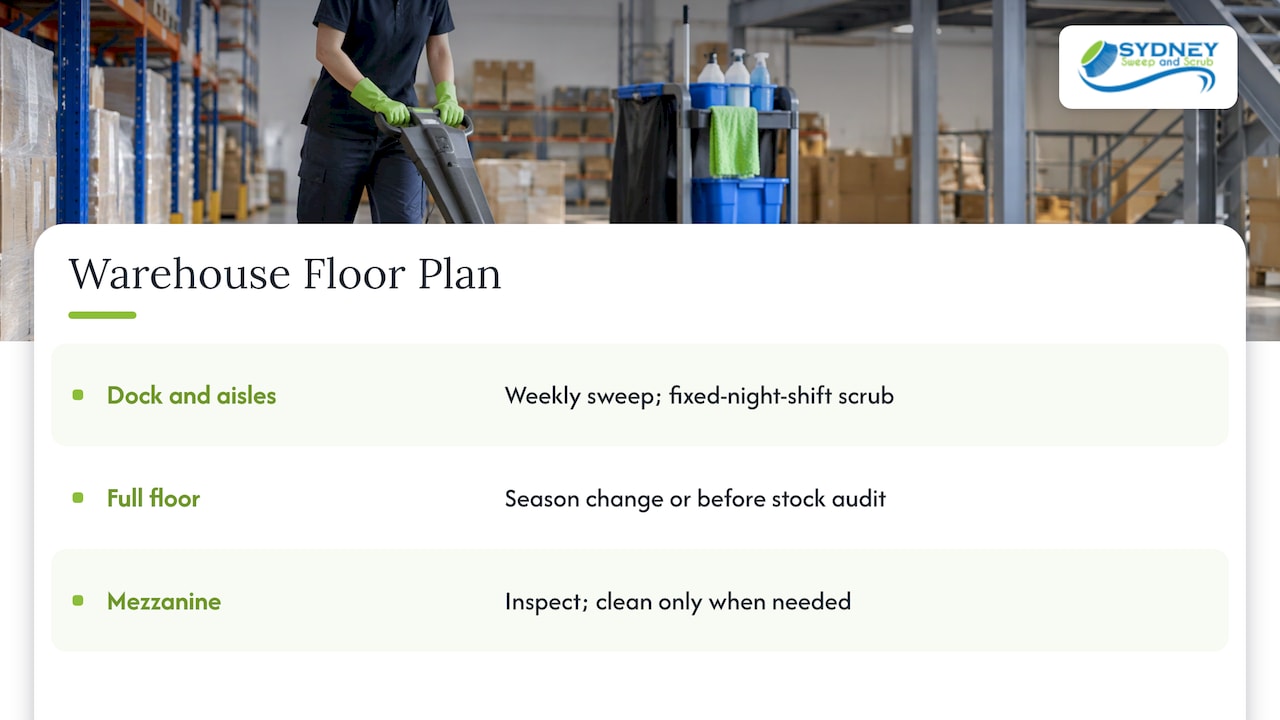
Take a Sydney distribution warehouse with a dock area, three main aisles and a mezzanine storage zone. Dust and tyre marks build up fastest at the dock and in the main aisles. A sensible plan could be a mechanical sweep of the dock and main aisles each week, a machine scrub of those same zones on a fixed night shift, and a full-floor deep clean once the seasons change or before a stock audit. The mezzanine zone is inspected and cleaned only when it needs it. Labour and machine time go where the soil is, and the floor never reaches the stage where it needs a costly restorative clean.
A recurring maintenance contract suits this pattern, because the same crew and the same schedule run each cycle. We offer optional recurring maintenance contracts for larger facilities.
Keep people safe while you clean
Cleaning creates its own hazards. A wet floor, a cord across a walkway or a film of leftover detergent can cause the very slip you wanted to prevent.
What the regulations expect
Safe Work Australia’s model code of practice on managing the work environment and facilities (November 2024) says floors should be inspected regularly and maintained to eliminate or minimise slip and trip hazards. Surfaces need enough grip, especially where they may become wet or contaminated, and cleaning methods must account for the slip risk that some cleaning agents add. Model codes are adopted by each state and territory, so check the version that applies to your site. Your WHS adviser or your state regulator can confirm the local requirements.
Controls that work in practice
WorkSafe Queensland sets out these controls:
- Clean to dry where possible. Methods that leave the floor dry, such as machines that recover the solution as they go, reduce the exposure time.
- Separate people from wet areas. If the floor cannot be left dry, use barriers and signs to keep people off it.
- Avoid residue build-up. Product left on the floor reduces slip resistance over time.
- Clean in quiet periods and respond fast to spills. Schedule routine work when few people are around, and keep a rapid spill response in place.
WorkSafe Queensland also lists the signs of a poor cleaning system: floors not fully dry, unattended spills, residue build-up, equipment and cords left across walkways, and ad hoc, unplanned cleaning. If you recognise two or three of these on your site, the routine needs restructuring rather than more effort.
For warehouses, a defined spill process is the quickest win. Our spill response playbook for warehouse managers lays out how to set one up.
Out-of-hours work
The simplest way to remove the hazard is to clean when people are not there. Night, early morning and between-event cleaning mean no forklifts crossing a wet floor and no customers walking through a barrier zone. This is where a contractor earns its keep: the work happens in your off-hours with the machines and operators already organised, rather than pulling your own staff off their jobs.
Doing it in-house or booking a contractor
In-house cleaning works for light daily upkeep, such as spot cleaning and spill response. The difficulty comes with scale: a large floor needs industrial sweeping and scrubbing machines, trained operators, a schedule, and documented safe work procedures. That is a lot to carry for a facility whose core business is something else.
Booking a specialist moves that burden off your team. You get the equipment, the operators and the routine in one arrangement, with a single point of contact for quotes and bookings. If you are weighing up providers, our guide on choosing the right cleaning service for a commercial space lists the questions that matter.
Ending a warehouse lease
Warehouse occupiers leaving a site face a specific version of this problem: the floor has to be returned in the condition the lease requires, with years of tyre marks, oil and dust on it. Sweeping, scrubbing and pressure cleaning done in the right order is the practical route, and our end of lease commercial cleaning service is built for it. Check your lease for the exact standard your landlord expects.
How Sydney Sweep and Scrub handles high-traffic floors
We are a family-owned Sydney business offering mechanical sweeping, mechanical scrubbing, pressure washing, hot water pressure cleaning, rubbish removal and automated robotic cleaning for warehouses, carparks, construction sites, public spaces, stadiums, event venues and footpaths. Our equipment is industrial-grade, and we run eco-friendly, carbon-neutral operations, with optional waste offset initiatives for clients who want to take part.
You can request a quote and book online. For a warehouse, start with warehouse cleaning; for a building or strata carpark, carpark cleaning; for lobbies, common areas and other commercial floors, commercial cleaning.
FAQ
What is the best way to clean a heavily soiled high-traffic floor?
Sweep first to remove dry grit, then apply a suitable cleaner and let it dwell. Scrub with a machine, recover the solution and let the floor dry before traffic returns. For very heavy soil, a second scrubbing pass is recommended in manufacturer guidance such as Forbo’s care guide.
How often should high-traffic floors be cleaned?
It depends on the zone. Entrances, main aisles and loading areas usually need daily or weekly attention, while low-use areas need much less. WorkSafe Queensland’s guidance calls for routine daily cleaning in quiet periods, periodic deep cleaning and fast spill response.
Why sweep before scrubbing?
Loose grit and dust turn into slurry once they meet water. That slurry clogs the scrubber, wears brushes and squeegees and leaves a film on the floor. Sweeping first gives the scrubbing pass a clean surface to work on.
Do cleaning products affect slip risk?
Yes. Safe Work Australia’s model code says cleaning methods must account for the slip risk that some cleaning agents increase. Residue left on the floor reduces grip, so use the right product at the right strength and rinse or recover it fully.
Can cleaning be done without disrupting my operations?
Yes, by scheduling it outside peak hours and working zone by zone. Night, early-morning or between-event cleaning removes the need to share the floor with people and vehicles. We can discuss a schedule that suits your site when you request a quote.
Sources
- Managing the work environment and facilities: Model Code of Practice, Safe Work Australia (November 2024)
- Cleaning, WorkSafe Queensland
- Caring for Allura and Allura Flex, Forbo care guide v2.10