
A car park stairwell is cleaned well when it is swept and washed from the top landing down, left clean and dry (or barricaded and signed until it is), and its wash water never reaches the stormwater drain. Stairwells are exit paths, so the job covers treads, landings, handrails and walls, and nothing is left behind that blocks the way out. This guide sets out what to clean, the order to work in, the safety duties that apply in Australia, how often to schedule it and when to bring in a specialist crew.
TL;DR
- Clean every stairwell and fire stair from the top level down. Sweep first, then damp mop or wash, then finish at the bottom landing.
- Stairs are exit paths. Keep equipment off the travel path, keep doors and landings clear, and use wet floor signs until the surface is completely dry.
- Wash water carrying detergent, oil or grit must not enter the stormwater system. Plan capture and disposal before any pressure cleaning starts.
- Set the frequency by foot traffic and contamination: routine sweeping and spot cleaning, regular mopping, and periodic deep cleans.
- Sydney Sweep and Scrub can add stairwells and fire stairs to a scheduled carpark cleaning program. See the carpark cleaning page.
Table of Contents
- Why car park stairwells need their own plan
- What a stairwell clean should cover
- The safe method: top down, dry at the end
- Match the method to the surface
- Your safety duties in Australia
- How often to clean car park stairwells
- Wastewater: keep it out of the stormwater drain
- Doing it in-house or booking a crew
- A simple stairwell inspection list
- FAQ
- Sources
Why car park stairwells need their own plan
The car park floor gets the attention. Stairwells get forgotten, even though every driver and pedestrian who parks there ends up using them at some point. Grit, leaves, cigarette butts, oil carried in on shoes and rainwater all collect on the treads and landings. Left alone, that build-up turns stairs into a slip risk and makes the whole building look neglected.
The risk is real. WorkSafe Victoria names wet and slippery floors, and the use of steps, ladders or other equipment, as the most common causes of slips, trips and falls in workplaces. The UK’s Health and Safety Executive makes a point that applies here too: stairs are a particularly hazardous part of a building and become more so while being cleaned, and the chance of a slip or trip applies to both the cleaner and the person using the stairs.
So the plan has two goals. Leave the stairwell cleaner and safer than you found it, and do not create a hazard while doing it.
For building owners and strata committees, there is a practical side too. A grimy stairwell is where tenants, visitors and inspectors form their view of how the car park is managed. Our guide to why fire stairs deserve regular cleaning covers that angle in more detail.
What a stairwell clean should cover
Work out the scope before the first broom comes out. A routine clean of a car park stairwell normally takes in:
- Treads, risers and nosings on every flight.
- Landings at each level, including the thresholds at the doors to the parking deck.
- Fire stairs and lift lobbies that sit beside them.
- Handrails and balustrades, wiped down.
- Walls and corners where dust and spiderwebs gather, plus the floor edges where debris collects.
- Drains, if the stairwell has them at the base or on open landings.
- Bins, if any are placed nearby.
One rule sits over all of it. Fire stairs and stairwells are exit paths, so nothing should be stored in them, including cleaning gear left between jobs. That also applies to the pallets, signs and equipment the cleaning crew brings in.
Open-sided stairs and edges
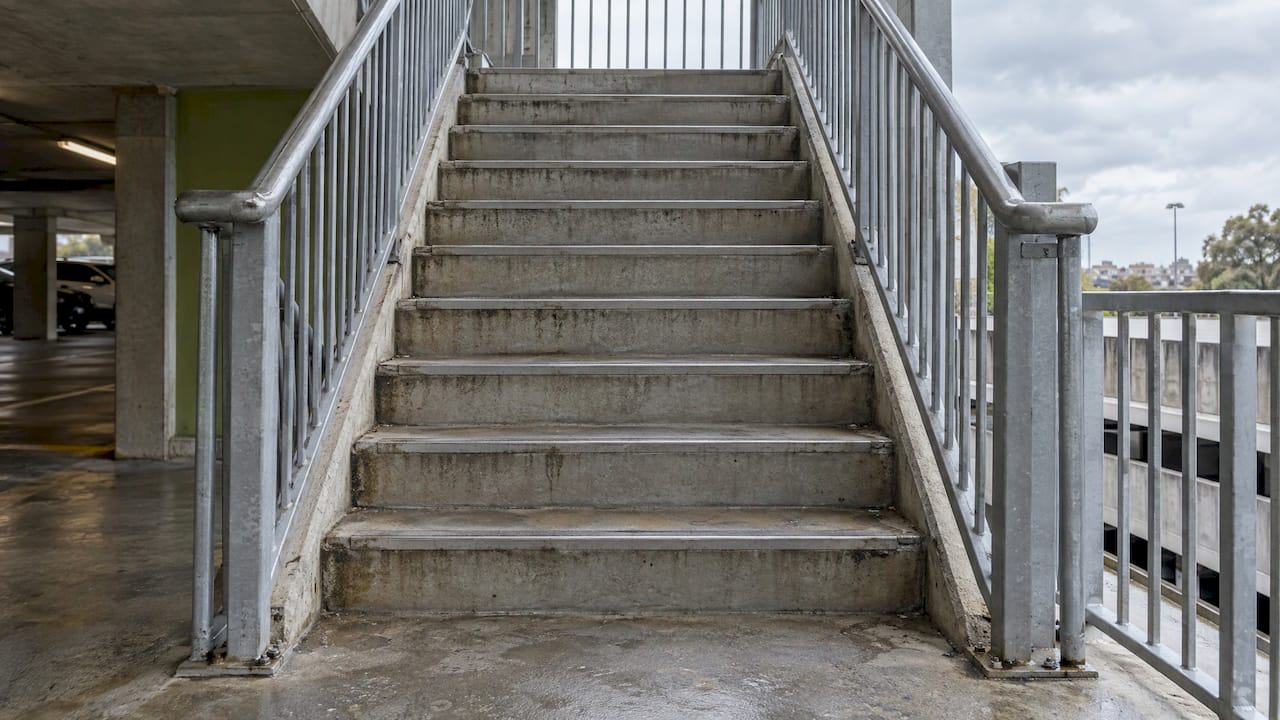
Many car park stairs are open to the weather or have open sides. Safe Work Australia’s Model Code of Practice on the work environment says the open sides of staircases should be guarded with an upper rail at 900 mm or higher and a lower rail. It also says aisles and walkways should be at least 600 mm wide and kept free of obstructions. When you clean, check the rails are intact and the width is not reduced by your own equipment.
The safe method: top down, dry at the end
A sound method for the stairwell follows the same logic as the NSW Centre for Environmental Health’s procedure for cleaning stairs, written for health facilities but sensible anywhere. Its work procedures for cleaning set out the order below.
- Set up the signage first. Place wet floor signs before wet cleaning begins. Remove them only when the floor is completely dry.
- Start at the top level. Work from the outside or open edges towards the wall, and finish at the bottom. Debris and dust move downhill, so cleaning upwards means cleaning twice.
- Raise as little dust as possible. Use a broom and dustpan or a vacuum or sweeper suited to the surface rather than flicking dust into the air.
- Damp mop with as little solution as possible. Keep the mop from slopping over open edges, where it can drip onto people or vehicles below.
- Wipe handrails with a cloth or microfibre cloth.
- Keep the path clear. Buckets, trolleys and cords stay off the travel path and never block doors, landings or exit routes. Office Clean’s guidance makes the same point about keeping equipment out of the way of stair users.
- Check the finish. The stairs should be clean and dry, with no puddles on landings or at the door thresholds.
The same procedure lists the basic kit: a broom and dustpan, mop, bucket, microfibre cloths, a waste container, wet floor signage and a neutral detergent diluted to the manufacturer’s specification, with gloves, eye protection and other PPE as the task requires. It also gives a rough planning figure of one person, 30 minutes per four storeys for internal and external stairs including stairwells and fire exits. Treat that as a starting point. A neglected stairwell with oil and ingrained grime will take longer than a lightly used one.
Clean to dry
The most useful single idea comes from WorkSafe Queensland. Its cleaning guidance says methods should leave a clean and dry surface free from moisture or dry waste, and should not leave a build-up of cleaning products. Where clean-to-dry is not possible, the guidance calls for barriers and signs to keep people off the wet areas.
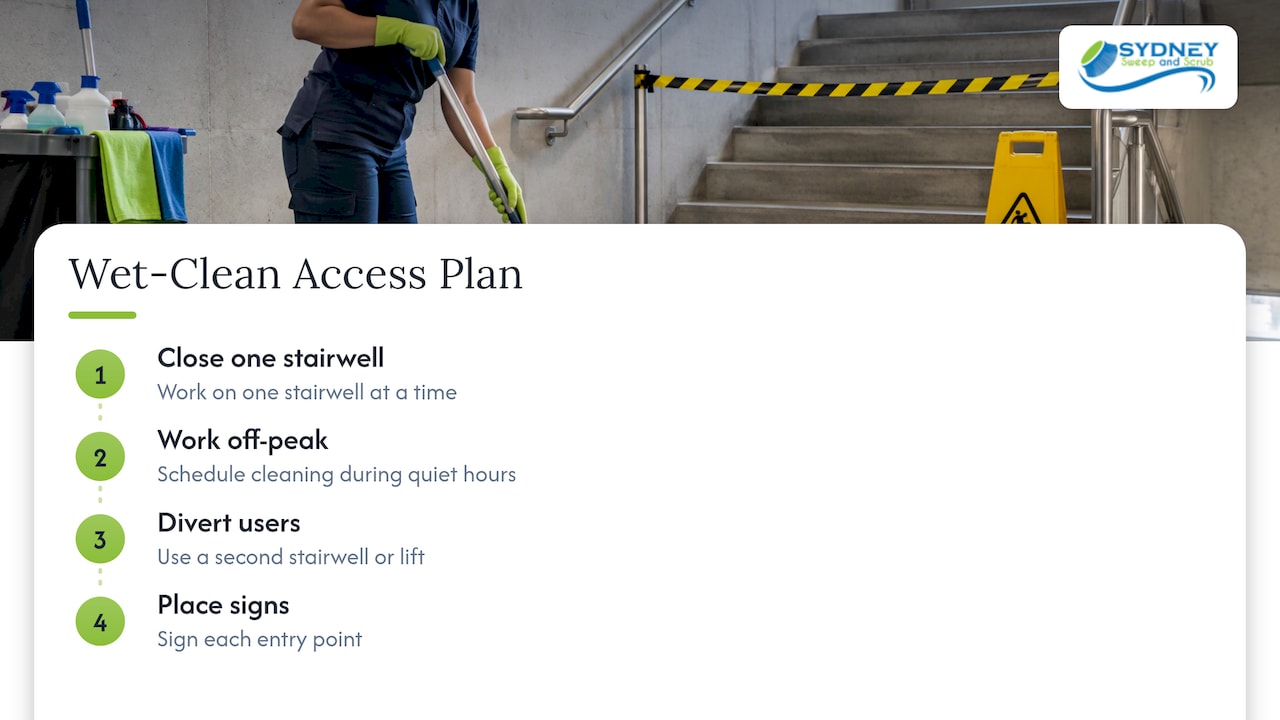
In a car park stairwell, that has a practical meaning. If the stairs are the only route between levels, a wet clean needs a plan: close one stair at a time, work in off-peak hours, or use a second stairwell or lift as the diversion, with signage at each entry point.
The same guidance says cleaning products and equipment should suit the task and not spread the problem. A paper towel suits a small spill better than a wet mop, and a spill kit suits an oil leak. It also notes that the time detergent stays on a floor affects how clean it gets, and that slip-resistant flooring can be cleaned to the same hygiene standard as other flooring. Slip-resistant treads are worth keeping and cleaning properly.
Match the method to the surface
Car park stairs are not all the same, and the method should change with them.
| Surface | Typical problem | Suitable approach |
|---|---|---|
| Raw or sealed concrete treads | Dust, grit, tyre marks, oil from shoes | Sweep, then damp mop or scrub; pressure clean for heavy build-up |
| Painted or coated steps | Scuffing, dirt in the texture | Neutral detergent, soft scrub, avoid harsh solvents |
| Metal stairs and handrails | Grime, rust streaks, fingerprints | Wipe with cloth and detergent; dry afterwards |
| Sandstone or stone stairs | Algae, moss, staining | Controlled wash, with the pressure matched to the stone |
| Walls and corners | Dust, cobwebs, graffiti, tyre scuffs | Dry dusting first, then wash or spot clean |
For heavier soiling, pressure cleaning is the usual next step, with hot water for oil and grease and cold water for general dirt. Our pages on pressure washing with hot water and pressure washing with cold water explain when each suits. Walls and edges around the stairwell are covered in pressure washing walls and edges in your car park.
Your safety duties in Australia
Who carries the responsibility? Under the Work Health and Safety Act 2011 (Cth), a person conducting a business or undertaking must ensure, so far as is reasonably practicable, the health and safety of workers, and must provide and maintain a work environment without risks to health and safety. States and territories that have adopted the model laws apply equivalent duties. For a car park, that means the owner or manager and the cleaning contractor both have a part to play, and the two should agree who controls what. Check the rules that apply in your state or territory with your WHS regulator.
WorkSafe Victoria’s guidance gives concrete benchmarks you can use as a checklist on a walkthrough:
- Floor surfaces in work areas, car parks and entrances should be clean, well lit and clear of obstacles, and in good condition.
- Entries and exits should be slip-resistant in wet and dry conditions, as the Safe Work Australia code also states.
- Steps, stairs and handrails should meet AS 1657-2013, according to the Victorian guidance.
- Spills should be cleaned up immediately, and the cause of the spill fixed. WorkSafe Victoria’s public and community services guidance also recommends weather protection over walkways, entrances, loading bays and car parks, and removing loose mats and objects from walk areas.
Signage and PPE round out the controls. A workplace WHS checklist from HSE Direct says safety signage should comply with AS 1319, and that PPE is the last line of defence once engineering and administrative controls are not enough. Whatever gear is supplied should be correct for the task, checked and maintained, and workers should be trained to use it.
Pedestrian and vehicle conflicts
Stairwell doors open onto the car park deck, so cleaning crews must think about vehicles too. Position signs and barriers at the door as well as on the stairs, and keep crews out of vehicle lanes unless traffic is controlled. Our carpark cleaning checklist is a useful way to organise those walkthrough points.
How often to clean car park stairwells
There is no single legal frequency. Safe Work Australia’s code says facilities should be cleaned regularly, taking into account the type of work, the likelihood of contamination, the number of people using them and the type of facility. It also says spills on floors should be cleaned up immediately. In other words, the schedule is yours to justify.
WorkSafe Queensland describes what a sound schedule looks like: systematic and well planned, with routine daily cleaning in quiet periods, periodic deep cleaning, a rapid response to spills, coverage of indoor and outdoor areas, and allowance for bad weather.
A practical way to apply that to a stairwell is to build three layers:
- Routine. Sweeping and spot cleaning of treads and landings, with a check for litter, spills and broken lighting. Heavily used stairs in a busy commercial or retail car park need this most often.
- Regular. Damp mopping or scrubbing and handrail cleaning, set at a frequency that matches foot traffic.
- Periodic deep clean. A full scrub or pressure clean of stairs, walls and landings, with wash water captured and disposed of properly.
Bring a clean forward when any of these happens: a spill or oil leak, heavy rain that carries mud and leaves into the stairwell, a building event with large crowds, or after construction work nearby. A scheduled carpark cleaning program lets you set those layers once and keep them going, rather than reacting to complaints.
Wastewater: keep it out of the stormwater drain
This is the part that catches property managers out. Water from washing a stairwell picks up detergent, oil, rubber and grit. If it runs into a stormwater drain, it goes untreated to creeks and rivers.
In New South Wales, section 120 of the Protection of the Environment Operations Act makes it an offence to cause or permit waters to be polluted. As Coleman Greig explains, “waters” includes stormwater drains and sewerage pipes, and pollution is defined broadly to include adding any matter that changes the state of the water. The same firm notes that failing to prevent material being washed into waters by rainfall can still amount to a breach, so a stairwell that drains to the street needs thought even on a day you are not washing it.
Rules differ by state and council. As one example, the ACT Government’s guidance for mobile cleaners says contaminated water entering the stormwater system is an offence, with penalties from $100 on-the-spot fines up to $50,000 in court. It also says no products may enter the stormwater system, including environmentally friendly ones, and that water should go to the sewer where approved. Always check what applies in your state, council area and building.
In practice, this means:
- Identify where the stairwell drains go before any wet clean. Sewer-connected drains and stormwater drains look alike.
- Use sweeping and dry methods first, so less debris is in the water.
- Block or cover stormwater inlets and recover wash water when pressure cleaning.
- Use the least detergent that does the job, diluted to the manufacturer’s specification.
Our article on sweeping and scrubbing carpark drains shows why drains in a car park deserve attention before and after a clean.
Doing it in-house or booking a crew
A building with a handful of short flights can handle routine sweeping with the caretaker. The picture changes when the stairwell serves several levels, the surface is oily or stained, handrails and walls need washing, or the wash water has to be controlled. At that point the job calls for equipment, traffic and signage control, and wastewater handling that a general cleaner may not have.
That is the work we do. Sydney Sweep and Scrub is a family-owned business that provides mechanical sweeping and scrubbing, pressure washing and hot water cleaning for carparks across Sydney. We can fold stairwells and fire stairs into a carpark cleaning visit, so the whole building is cleaned to one plan. If you are weighing a regular contract, our comprehensive carpark services page sets out what we cover, and our commercial cleaning team can look after areas beyond the car park.
Our approach includes optional waste offset initiatives and carbon-neutral operations for clients who want to take part in sustainability programs. More on that is on our carpark cleaning and sustainability page.
Request a quote for stairwells and fire stairs
We do not publish set prices, because stairwell cleans vary with the number of levels, the surface, the level of soiling and access. Tell us the building, the number of stairwells and how often you want them cleaned, and we will quote on that. Start from the carpark cleaning page or the Sydney Sweep and Scrub home page.
A simple stairwell inspection list
Use this on a monthly walkthrough, and record the result so you can show that the schedule works.
- Are treads and landings free of grit, litter, oil and standing water?
- Are handrails secure, clean and in good condition?
- Are open sides guarded, and are walkways clear and wide enough?
- Is lighting working on every landing?
- Are fire doors closing, and are exit paths free of stored items?
- Are drains clear, and do you know where they discharge?
- Are wet floor signs and barriers stocked and used?
- Is there a record of the last routine and deep clean?
A written record helps if there is ever an incident, because it shows the duty of care was taken seriously. If the inspection throws up repeated problems in the same spot, look at the cause, such as a leaking pipe, a blocked drain or an oil leak above, rather than cleaning the same stain again.
FAQ
How often should car park stairwells be cleaned?
There is no fixed legal interval. Safe Work Australia’s code says to clean regularly based on the type of work, contamination risk, number of users and facility type. A busy car park usually needs routine sweeping and spot cleaning, regular mopping, and a periodic deep clean.
Should stairwells be cleaned from the top or the bottom?
From the top. Start on the highest level, work from the outside edge toward the wall, and finish at the bottom. Dust and dirt move downward, so top-down cleaning avoids going over the same stairs twice.
Can I pressure wash a car park stairwell myself?
You can for a small, routine job, but the wash water is the issue. It must not enter the stormwater system, and slippery wet stairs need signage and barriers until dry. For multi-level stairwells or heavy oil and grime, a contractor with capture equipment is the safer route.
Do I need to keep fire stairs clear while they are cleaned?
Yes. Fire stairs are exit paths, so buckets, trolleys and cords must stay out of the travel path and doors, landings and exit routes must not be blocked. Work one stair at a time where you can, and sign the diversion.
Can Sydney Sweep and Scrub clean stairwells as part of a carpark contract?
Yes. We can include stairwells and fire stairs in carpark cleaning across Sydney, alongside sweeping, scrubbing and pressure washing. Send us the building details through our website and we will quote for the whole scope.
Sources
- Module 3: Work procedures for cleaning, NSW Centre for Environmental Health
- Cleaning, WorkSafe Queensland
- Slips, trips and falls, WorkSafe Victoria
- Injury hotspots: slips, trips and falls, WorkSafe Victoria
- Managing the work environment and facilities, Safe Work Australia Model Code of Practice
- Work Health and Safety Act 2011
- Watch Your Step campaign, Health and Safety Executive
- Water pollution: the crime that’s hard to avoid, Coleman Greig
- Mobile carpet cleaners, Access Canberra
- Car park cleaning guide, SiteClara