
Councils clean footpaths in four main ways: dry brushing or mechanical sweeping, water washing, pressure washing, and steam or hot water cleaning. The right choice depends on what is on the surface, how old and sensitive the paving is, and where the wash water will end up. Start with the least intense method that works, then step up only for the deposits that need it. Collect everything you remove, and keep every drop of wash water out of the stormwater system.
This guide sets out each method, what it removes, how to match it to the surface, and the wastewater and pedestrian-safety controls that Australian councils expect. It is written for council officers, property managers and facility teams who manage public or semi-public paving.
TL;DR
- Sweep or blow loose material off first. Wet methods come second, in increasing order of intensity: water washing, pressure washing, then steam cleaning.
- Use fan-spray nozzles for general work and keep the nozzle distance adjusted so the concrete is not damaged. Never pressure clean concrete less than seven days old.
- Wash water must not enter gutters or stormwater drains. Capture it and send it to a place where it can be treated.
- Separate pedestrians from machinery with delineation, signage and barriers, and use traffic controllers where people and vehicles cannot be kept apart.
- Do heavy cleaning at night or early morning, and schedule it as a cycle rather than reacting to complaints.
Table of Contents
- The main footpath cleaning methods at a glance
- Dry methods: brushing, blowing and mechanical sweeping
- Mopping and squeegee cleaning for light spills
- Water washing and pressure washing
- Steam, hot water and targeted stain and gum removal
- Managing wastewater, detergents and debris
- Keeping pedestrians and workers safe
- Routine cleaning without the disruption
- How Sydney Sweep and Scrub can help
- FAQ
- Sources
The main footpath cleaning methods at a glance
The table below pulls the methods together. Each is explained in the sections that follow.
| Method | Best for | Watch out for |
|---|---|---|
| Dry brushing and blowing | Leaves, litter, dust, loose grit | Dust in windy conditions, collecting what is moved |
| Mechanical sweeping | Daily or weekly upkeep of long runs of paving | Access for the machine, kerbside parked cars |
| Mopping or squeegee with bucket | Light spills, small areas | Wastewater must go to the sewer, use detergent sparingly |
| Water washing | Light soiling on hardened concrete | Runoff must be controlled |
| Pressure washing | Ingrained dirt, algae, oil film, tyre marks | Nozzle distance, surface age, wastewater capture |
| Steam or hot water cleaning | Grease, oil, chewing gum | Trial on a small area first, wastewater capture |
| Clean-capture systems | High-traffic centres and sensitive sites | Equipment and collection point needed |
The order matters. The Cement Concrete & Aggregates Australia (CCAA) datasheet on concrete cleaning lists water washing, pressure washing and steam cleaning as methods in increasing order of intensity, and says loose leaves and material should be brushed or blown off before any of them.
Dry methods: brushing, blowing and mechanical sweeping
Dry cleaning removes the bulk of what is on a footpath and uses no water at all, which is why it is the first step on almost every job.
The City of Newcastle’s guidance for footpath cleaning is to use a dry brush to clear solid material and dust, then collect it for bin disposal. That one habit prevents most of the pollution problems described later, because leaf litter, cigarette butts and grit never get a chance to wash into a drain.
Blowers move debris quickly on wide, open paving. They suit autumn leaf fall and plaza areas, but the material still has to be gathered and removed. Pushing it into a garden bed or a gutter simply relocates the problem.
For long runs of paving, such as main streets, shopping strips, car park access paths and event precincts, mechanical sweeping is the practical option. A sweeper collects dust, litter and fine sediment in one pass and carries it away for proper disposal. Our mechanical sweeping service covers this kind of work across Sydney, and our guide to mechanical sweeping benefits for asset managers explains how regular sweeping fits an asset-care program.
Clarence Valley Council makes the water-saving case plainly: it recommends sweeping or blowing hardstand areas instead of unnecessary hosing. If the surface only carries dry debris, a wet method adds cost and risk for no gain.
Mopping and squeegee cleaning for light spills
On small areas, such as a spill outside a kiosk or a patch near a bin enclosure, a mop or squeegee and bucket is enough. Newcastle’s guidance is to dispose of the wastewater in the sewer, use no detergent on lightly soiled surfaces and use detergent sparingly on heavily soiled ones.
The key point is where the bucket is emptied. A sink or other connection to the sewer is the right place. A gutter or stormwater pit is not.
Water washing and pressure washing
When dirt is ingrained and sweeping does not shift it, water and then pressure come into play. Pressure washing removes algae films, tyre marks, oil residue, food waste and the grey build-up that dulls concrete paving.
Choosing nozzles and pressure
CCAA says fan-spray nozzles are the most common choice for general cleaning. Narrow, concentrated jets are seldom used for general work, but they can give extra force on small stubborn deposits.
The same datasheet gives typical pressure ranges of about 10,000 kPa for domestic machines and 14,000 to 18,000 kPa for larger commercial machines. It also warns that the nozzle distance must be adjusted to clean without damaging the concrete. In practice that means starting further back, checking the surface, and moving closer only as needed. Pavers, exposed aggregate and older concrete with worn surfaces are all easier to mark than a sound, broom-finished slab.
Surface age and condition
CCAA states these procedures should not be used on concrete less than seven days old. Newly laid footpath sections near a worksite should be fenced off from cleaning crews as well as from the public.
Working systematically
CCAA guidance is to work systematically from one edge or corner, and to begin only after provision has been made to remove the wash water and contaminants. Planning the run before the machine is switched on is what separates a clean result from streaky, patchy paving and a stormwater complaint.
Our pressure washing service is built around this approach for commercial and public paving, and our page on concrete pressure cleaning goes into the concrete side in more detail.
Steam, hot water and targeted stain and gum removal
Some deposits do not respond to cold water. Grease, oil drips and chewing gum are the usual culprits on busy footpaths.
CCAA notes that steam cleaning can dissolve chewing gum, and advises trialling any chemical on an inconspicuous area first. Western Australia’s Department of Water guidance goes further on grime: where practicable, it recommends high-pressure jetting, mechanical scrubbing or steam cleaning instead of chemical solvents, especially on paved surfaces.
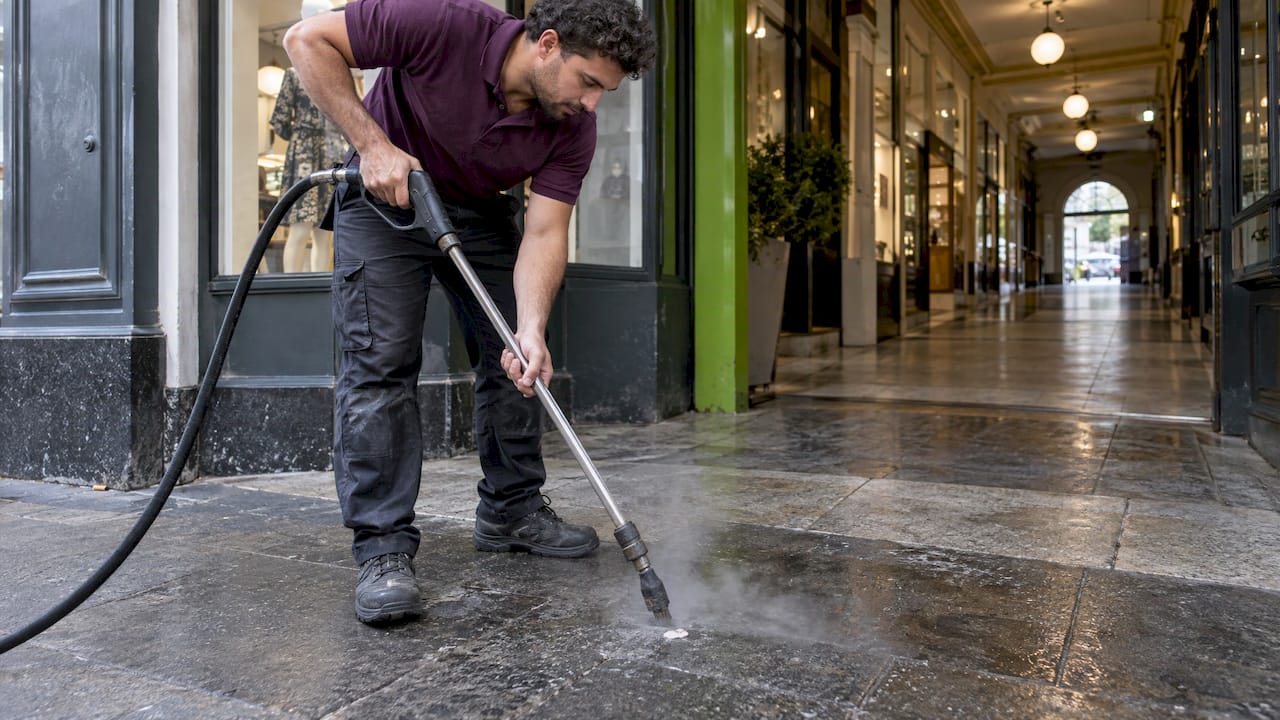
Where a cleaning agent is still needed for tar, grease or grime, that guidance points to quick-break degreasers or biodegradable, phosphate-free soaps and detergents.
Hot water cleaning is the practical version of this on a commercial scale. We offer hot water pressure cleaning for greasy concrete, and our footpath stain removal guide explains which stains respond to which approach.
Councils that want to cut manual handling and consistent coverage on large paved areas can also look at automated equipment. Our automated robotic cleaning is designed for car parks and warehouses, and suits semi-public paved areas attached to those sites.
Managing wastewater, detergents and debris
Cleaning a footpath well and polluting a waterway are not mutually exclusive, but only if the wash water is controlled. Stormwater drains typically run to creeks and bays untreated.
What the rules say
The law differs by state, and local councils add their own conditions, so check your own jurisdiction. Two examples show the pattern:
- In Queensland, Tablelands Regional Council states that pressure-cleaning wastewater is a prescribed water contaminant under Schedule 10 of the Environmental Protection Regulation 2014 and must not enter roadside gutters or stormwater systems. The same page cites section 440ZG of the Environmental Protection Act 1994 as making it unlawful to allow that wastewater into gutters or stormwater.
- In New South Wales, the City of Newcastle says water pollution can attract on-the-spot fines of up to $1,500.
Good practice on the day
- Dry-sweep first and bin the solids.
- Use minimal water and minimal biodegradable, phosphate-free products. Whitsunday Regional Council advises collecting wastewater for disposal where it can be treated.
- Block or cover nearby drain inlets before washing starts, and capture wash water with a recovery system rather than letting it run along the gutter.
- Dispose of collected water at an approved point, such as the sewer where permitted.
Clean-capture systems, which Newcastle describes, filter the collected material from wastewater before it is pumped to a waste-collection area. They are well suited to high-use centres where daily washing is part of the routine.
For the practical detail, see our checklists on pressure washing wastewater and pressure washing waste recovery. If your footpath work is in Sydney and you are wondering about approvals, our summary of Sydney footpath cleaning rules is a good starting point, though the council’s own page is the final word.
Keeping pedestrians and workers safe
Footpath cleaning happens where people walk, so the safety plan is as important as the cleaning method.
Separate people from machines
Transport for NSW’s guidance on separating pedestrians from work areas says controls should let people navigate safely onto and through the site, with pedestrian paths delineated separately from vehicle paths. It suggests flagging, para webbing in higher-volume areas and signage, plus barriers, cones, bollards or pedestrian-crossing signs as needed, and traffic controllers where pedestrian and vehicle interfaces cannot be avoided.
Keep a usable path open
The City of Ryde’s Development Control Plan says works on public roads must warn, instruct and guide pedestrians, cyclists and road users safely around the work area. It recommends maintaining a 2.0-metre footpath width, with an absolute minimum of 1.2 metres at local constrictions. If pedestrians must be directed onto the carriageway, warning signs and barricades are required.
Distances and traffic management
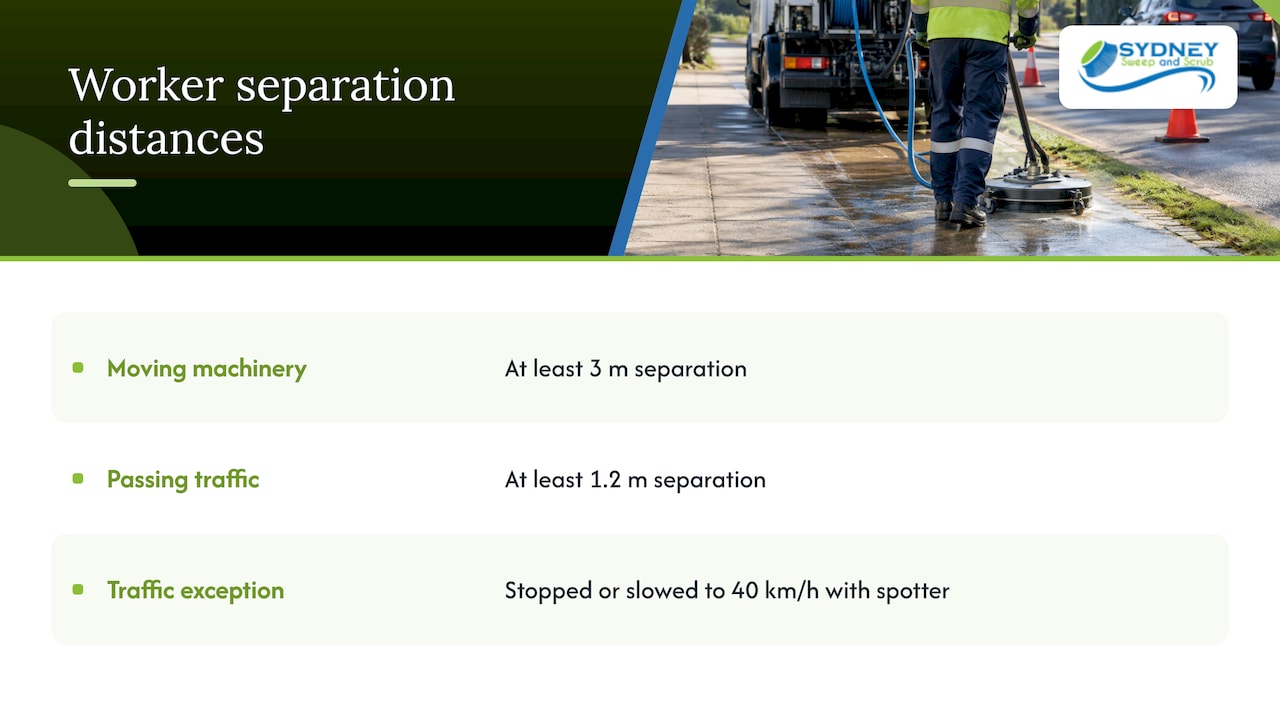
Griffith City Council’s contractor handbook lists high-visibility PPE, separation from moving plant, traffic diversion, speed reduction, warning signs and barricades as possible controls. It requires people on foot to stay at least 3 metres from moving machinery unless exceptional controls apply, and at least 1.2 metres from passing public traffic on road works unless traffic is stopped or slowed to 40 km/h with a spotter.
Permits and plans
Some councils require a permit before you start. City of Adelaide, for example, requires a City Works Permit for works on council roads and footpaths and asks for a traffic-management or site plan showing hoarding, lighting, pedestrian signs, spotters and distances. Ask your own council what it needs before you book a crew.
Routine cleaning without the disruption
A footpath that is cleaned to a schedule needs less aggressive treatment than one that is only cleaned after complaints. Councils show what a cycle looks like:
- Inner West Council reports a high-pressure-cleaning cycle of 8 weeks on main streets, daily sweeping on main streets and a 40-working-day alternative cycle for residential streets.
- Northern Beaches Council says it machine-cleans shopping-centre footpaths and removes stains, grease and gum from paved footpaths once a year, at night or early morning to minimise inconvenience.
Those are local programs, so use them as a pattern rather than a standard. A sensible split is frequent dry sweeping, periodic pressure washing of high-traffic strips, and an annual deep clean for stains and gum.
Planning ahead also helps with budgets and contractors. Property owners who want a framework for scheduling work in advance can adapt the thinking in this proactive maintenance scheduling guide, then apply it to paving, drainage and surface cleaning.
How Sydney Sweep and Scrub can help
We are a family-owned Sydney business offering mechanical sweeping, mechanical scrubbing, pressure washing, hot water cleaning, rubbish removal and automated robotic cleaning for footpaths, car parks, public spaces, stadiums and event venues. Our equipment is designed to suit commercial and public work, and we run carbon-neutral operations, with optional waste offset initiatives for clients who want them.
If you manage paving for a council, strata, building or event site, see our full list of services or request a quote through the pressure washing page. We can also set up recurring maintenance for large facilities.
FAQ
What is the best way to clean a footpath without damaging it?
Sweep or blow off loose material first, then step up through water washing, pressure washing and steam cleaning only as the dirt demands. Use a fan-spray nozzle and adjust the distance so the concrete is not damaged. Do not pressure clean concrete less than seven days old.
Can pressure washing wastewater go into the stormwater drain?
No. Queensland’s Tablelands Regional Council says it is unlawful to let pressure-cleaning wastewater into roadside gutters or stormwater systems, and other councils give similar direction. Capture the water and send it somewhere it can be treated, such as the sewer where permitted.
How often should councils clean main street footpaths?
It varies by council. Inner West Council reports daily sweeping and an 8-week high-pressure cycle on main streets, while Northern Beaches Council cleans stains and gum on paved footpaths once a year. Set your cycle by foot traffic and the type of soiling.
How do you remove chewing gum from a footpath?
Steam cleaning can dissolve chewing gum on concrete, according to CCAA. Trial any chemical on an inconspicuous spot first, and collect the residue and wash water rather than letting it reach a drain.
Do I need traffic control to clean a footpath?
Often you need at least delineation and signage, and traffic controllers where pedestrians and vehicles cannot be kept apart. Some councils require a permit and a traffic-management plan, so check with the council that manages the footpath.
Sources
- Footpath Cleaning, City of Newcastle
- Cleaning Concrete, Cement Concrete & Aggregates Australia
- Mobile mechanical servicing and cleaning, Western Australia
- Water Pressure Cleaning, Tablelands Regional Council
- Mobile Cleaning and Trade Industry, Whitsunday Regional Council
- Why we conserve water, Clarence Valley Council
- Guide to delineation and signage for Separate Yourself, Transport for NSW
- Development Control Plan 2014, City of Ryde
- Contractor Induction Handbook, Griffith City Council
- City works, City of Adelaide
- Streetscape maintenance, Inner West Council
- Public cleaning, Northern Beaches Council
- Proactive maintenance scheduling guide