
Sydney’s outdoor water rules are the Water Wise Guidelines: permanent rules that apply to everyone on Sydney Water’s drinking water supply, not drought restrictions that switch on and off. For a property manager, strata committee or warehouse operator, the point that matters is that hosing down paved areas is generally prohibited, while pressure washing and sweeping a car park or loading yard are workable when the job is set up properly. We are Sydney Sweep and Scrub, and this guide sets out what the rules say, where commercial sites get caught out, and how mechanical sweeping and pressure washing fit inside them.
TL;DR
- The Water Wise Guidelines are permanent and apply across Sydney Water’s area of operations, including Sydney, the Blue Mountains and the Illawarra, until further notice.
- Lawns and gardens can be watered before 10am or after 4pm with a trigger-nozzle hose, sprinkler or watering system. Drip and smart irrigation can run at any time.
- Hosing paths, driveways and paved areas is prohibited unless the cleaning is needed for safety, health, an emergency, construction activity or surface contamination.
- The guidelines cover drinking water only. Recycled water, greywater, most rainwater and bore water sit under other rules.
- For car parks, loading docks and footpaths, mechanical sweeping and properly managed pressure washing keep you on the right side of the rules.
Table of Contents
- Water Wise Guidelines versus water restrictions
- What you can do with lawns, gardens and irrigation
- Cleaning hard surfaces: where the rules bite hardest
- Washing water leaves the site: a separate set of obligations
- Exemptions, permits and other water sources
- Who is responsible on a multi-tenant or leased site
- A practical checklist for your site
- How we fit in
- FAQ
- Sources
Water Wise Guidelines versus water restrictions
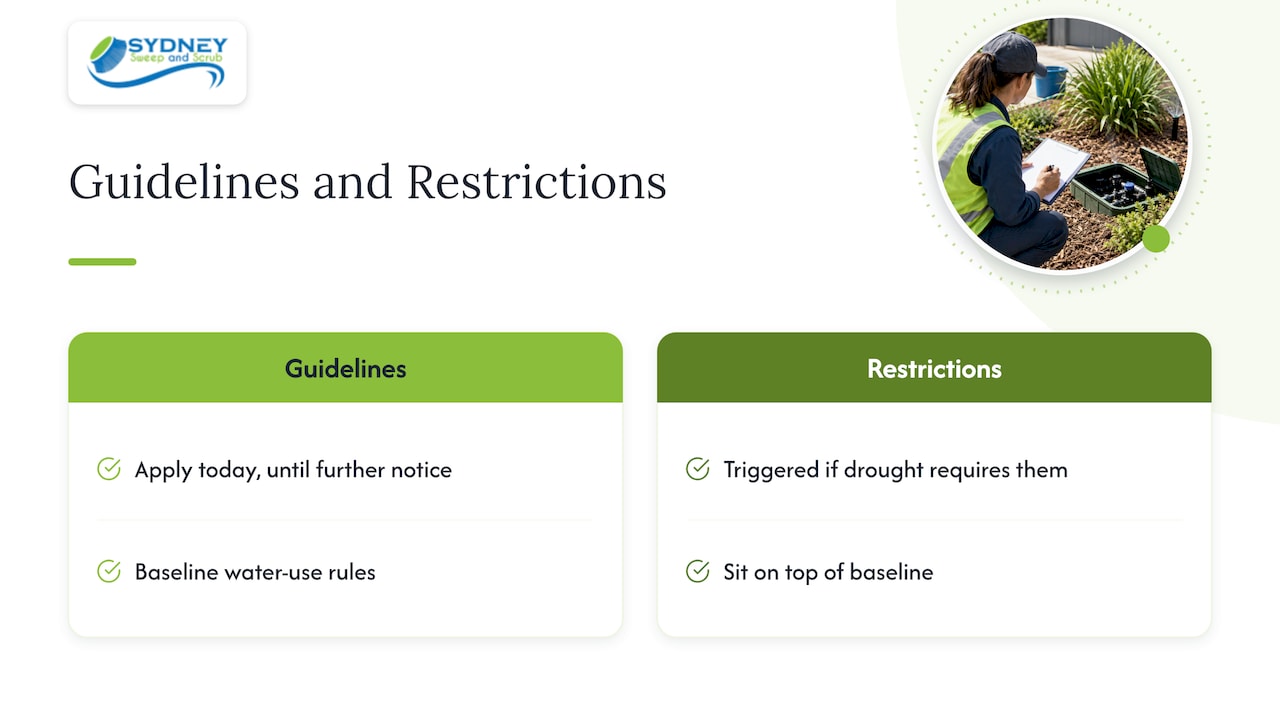
People often search for “water restrictions” in Sydney and expect levels or stages. Sydney has a standing set of rules instead. The Water Wise Guidelines are Sydney Water’s rules of water use for residents and businesses in Sydney, the Blue Mountains and the Illawarra. They conserve drinking water and prepare the region for restrictions during drought.
The legal basis is a notice in the NSW Government Gazette in December 2020. The gazetted guidelines state that they remain in force until further notice, apply across the whole of Sydney Water’s area of operations, and apply to all users of drinking water supplied by Sydney Water. That includes water from a Sydney Water main or from a supplier licensed under the Water Industry Competition Act 2006. The Bureau of Meteorology’s restrictions page for Sydney confirms the same position.
The NSW Government also notes that permanent water-saving measures have replaced what used to be called water restrictions for many areas, with some exemptions for health, safety and emergency reasons and for certain businesses. Reports of misuse in Greater Sydney, the Blue Mountains and the Illawarra go to Sydney Water.
What this means in practice: you do not wait for an announcement. The rules apply to your site today, and if drought did ever trigger formal restrictions, they would sit on top of this baseline.
What you can do with lawns, gardens and irrigation
Most commercial sites have some landscaping: a strata complex with garden beds, an office park with turf, a warehouse estate with street-front planting. The rules, taken from the Water Wise Guidelines page, are as follows.
| Activity | What the guidelines allow |
|---|---|
| Watering lawns and gardens | Before 10am or after 4pm, on any day, with a hose fitted with a trigger nozzle, a sprinkler or a watering system |
| Drip and smart watering systems | Any time |
| New turf or new gardens | Any time for 28 days from installation, following the supplier’s or installer’s instructions |
| Run-off or overspray onto hard surfaces such as pathways | Not permitted |
The last row catches more commercial sites than any other. A sprinkler that throws water across a footpath or into a driveway breaks the guidelines even when it runs at 6am. Check spray patterns when landscapers or irrigation contractors change a layout, and check them again after turf or garden beds go in.
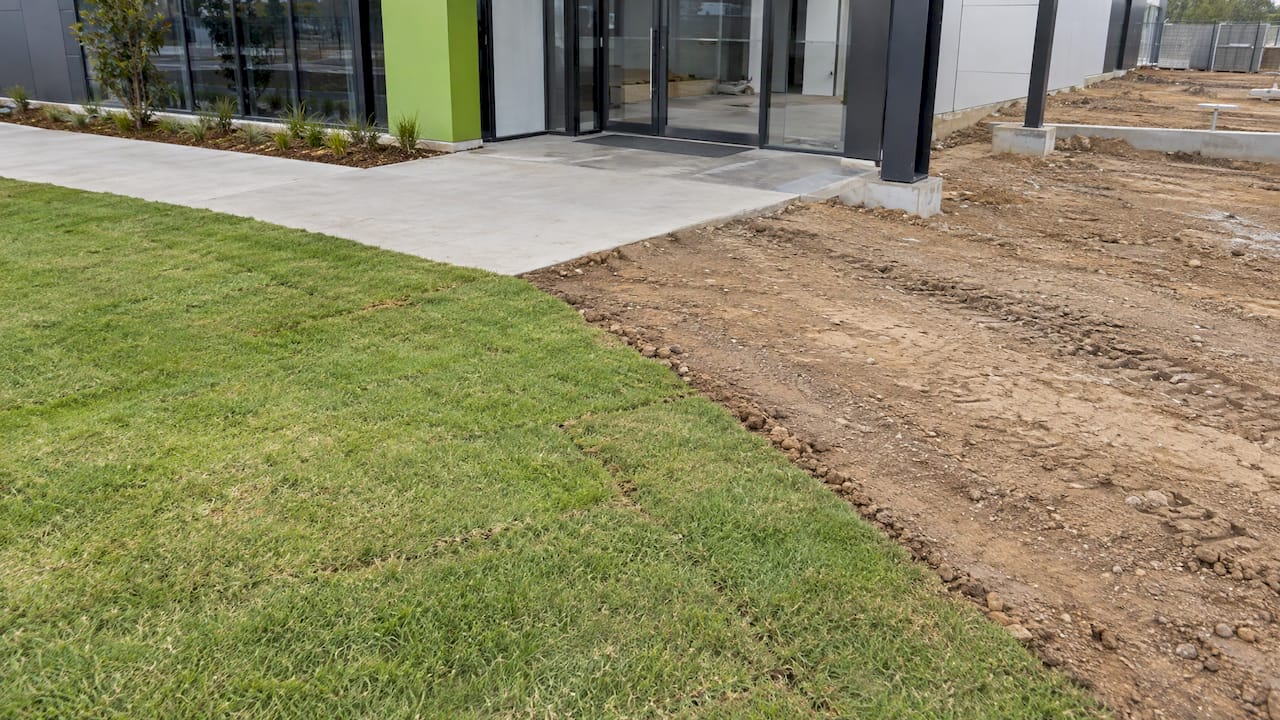
The 28-day window for new turf or gardens starts at installation. If you have a landscaping contract running alongside a build, sequence the turf with the construction schedule so that the window is not used up while the site is still unfinished.
Cleaning hard surfaces: where the rules bite hardest
This is the section that matters most for car parks, loading docks, forecourts and footpaths. Under the gazetted guidelines, hosing paths, driveways, concrete and other paved areas is prohibited. There are exceptions, and they are specific.
Cleaning with water is allowed when it is necessary for:
- safety
- health
- an emergency
- construction activity, including resurfacing
- surface contamination
Even then, the guidelines call for a hose with a trigger nozzle, unless the water is supplied to high-pressure equipment. Washing building exteriors (windows, walls, gutters, roofing) and vehicles is permitted at any time using a trigger-nozzle hose or high-pressure water cleaning equipment.
What counts as a good reason to wash a paved area
Some situations fit the exceptions clearly:
- Oil and fuel spills in a car park or loading bay. That is surface contamination, and it is also a slip hazard.
- Slippery algae or organic build-up on ramps and walkways. That is a safety issue.
- Dust and slurry on a construction site. That is construction activity.
- Bird droppings, food waste or bin-area residue. That is a health issue.
Routine tidying is different. Washing leaves and general dust off a forecourt with an open hose because it looks neater is the use the rules target. NSW Government guidance for businesses says to use a broom rather than the hose outdoors, and the same page advises comparing your water use against Sydney Water’s water-efficiency benchmarks.
Dry work first, water where it is needed
This is where the cleaning method matters. Most of what accumulates on a car park or warehouse yard is loose dirt, litter, leaves and fine dust. Mechanical sweeping removes that without a hose in sight. We run mechanical sweeping across Sydney, and for regular maintenance of large paved areas it is the broom-instead-of-hose principle applied at site scale. Where stains, oil or ground-in grime remain, pressure washing is the targeted step, which is the high-pressure equipment route the guidelines recognise, and our hot water pressure cleaning covers greasy surfaces.
A sensible routine for a car park is regular sweeping, then pressure washing for the areas with a real contamination or safety reason. That keeps water use low and gives you a documented reason for every wash.
Paving around pools, decks and entrances
The same prohibition applies to the paving and decking around amenity areas in residential strata and commercial developments. If you are replacing or specifying surfaces around a pool or entry, poolside deck materials are worth weighing against how you plan to maintain them, because a surface that needs frequent hosing is a poor fit for rules that restrict hosing.
Washing water leaves the site: a separate set of obligations
The Water Wise Guidelines cover how much drinking water you use and how. They do not cover where the dirty water goes. Wash water from a car park carries oil, sediment and cleaning residue, and it should not be sent to the stormwater drain. We have published two guides on this: pressure washing wastewater checks for Australian businesses and what sites must do about trade waste in Sydney. If your site has a drain near the wash area, read them before you schedule a clean. Our piece on keeping Sydney’s waterways clean explains why car park cleaning and stormwater are linked.
Footpaths add a further question, because they are often council land. Our guide on Sydney footpath cleaning rules for property managers covers when a permit is and is not an issue.
Exemptions, permits and other water sources
The guidelines recognise that some users need to water or wash outside the standard rules. According to the gazetted guidelines, exemptions include:
- permits for medical reasons
- exemption permits issued by Sydney Water
- any-time watering by specified commercial businesses and community grounds maintainers
Pools and spas can be topped up to replace water lost through normal use, including evaporation. New or renovated pools and spas can be filled. Overfilling to the point of run-off is not permitted.
If you think your operation qualifies for an exemption, confirm it with Sydney Water before relying on it. Do not assume a business type is covered.
Water the guidelines do not cover
The guidelines apply only to drinking water. Sydney Water lists the following as outside them:
- recycled water (purple pipe)
- greywater
- rainwater, where the tank or dam is not also supplied from the drinking water system
- bore water, where some government restrictions apply
- river water, which requires a licence
The Woollahra Council summary makes the same point about recycled and tank water. A site with a rainwater tank is a practical way to wash vehicles, plant or surfaces, as long as the tank is not topped up from mains.
Taking water from rivers, lakes or aquifers in NSW needs a water access licence, and taking it without one is an offence. Bores need a licence or approval before they are sunk and must be built by a licensed driller. Sydney Water’s commercial guidance notes that groundwater embargoes prohibit new commercial licences around the Botany Sands aquifer in the Eastern Suburbs and the Hawkesbury sandstone aquifer in the Blue Mountains and Southern Highlands. If your warehouse is in an embargoed area, a bore is not a quick fix for wash water.
Who is responsible on a multi-tenant or leased site
The rules attach to whoever uses the water, so responsibility depends on the arrangement:
- Strata and building managers control common property: car parks, driveways, landscaping and irrigation. Put the guidelines into contractor briefs, and confirm that any cleaner or landscaper works within them.
- Warehouse owners and occupiers should check the lease for who maintains the yard and loading areas. At the end of a lease, tenants often need to clean floors, docks and external paving, which is a peak time for hose use. Plan the method before the handback date, not on it.
- Construction companies can rely on the construction-activity exception for water cleaning that is necessary, but wash-down of site roads and accessways still needs to be controlled, and runoff managed.
- Councils and event organisers cleaning public spaces face the same hard-surface rules, so a dry sweep before and after an event reduces the amount of washing needed.
If a neighbour or passer-by sees what looks like a breach, they can report it to Sydney Water. A site that can show why it washed (a spill, a safety hazard, a documented contamination) and how (high-pressure equipment, controlled water) is in a far better position than one that cannot.
A practical checklist for your site
- Map your water uses. List irrigation, hose points, wash bays and any tank or bore supply.
- Check irrigation timing and overspray. Anything on the mains should run before 10am or after 4pm unless it is drip or smart.
- Remove open hoses from routine cleaning. Fit trigger nozzles to hoses that remain, and use sweeping for dry debris.
- Record the reason for any water clean of paved areas. Safety, health, emergency, construction or contamination.
- Plan where wash water goes. Keep it out of the stormwater system.
- Confirm the source. If you use tank, recycled or bore water, make sure it is legitimately sourced and licensed.
- Review at lease end or contract renewal. Build the rules into the cleaning scope.
How we fit in
If you manage a car park, warehouse, construction site, footpath or venue in Sydney, the simplest way to stay within the guidelines is to book cleaning that starts dry and uses water only where there is a reason. We offer car park cleaning, warehouse cleaning and end of lease commercial cleaning, with mechanical sweeping, scrubbing, pressure washing and hot water cleaning available across Sydney. You can request a quote or book online through the Sydney Sweep and Scrub site, and we can set up recurring maintenance for large facilities.
FAQ
Are there water restrictions in Sydney right now?
Sydney is under the permanent Water Wise Guidelines, which apply until further notice. Formal drought restrictions are a separate matter, and the Bureau of Meteorology lists what is in force for Sydney. Check Sydney Water’s page for the current position, because it can change.
Can a business pressure wash a car park in Sydney?
Yes, where the washing is needed for safety, health, an emergency, construction activity or surface contamination, and it is done with a trigger-nozzle hose or high-pressure equipment. Sweeping first reduces how much water the job needs. Wash water must also be managed so it does not reach the stormwater drain.
What times can I water the garden at a commercial property?
Before 10am or after 4pm on any day, using a trigger-nozzle hose, sprinkler or watering system. Drip and smart irrigation can run at any time, and new turf or gardens can be watered at any time for 28 days from installation.
Do the rules apply to tank or recycled water?
No. The guidelines cover drinking water supplied through Sydney Water mains or a licensed supplier. Recycled water, greywater, rainwater from a tank not connected to drinking water, bore water and river water fall under other rules, and river and groundwater need licences.
Who do I report water misuse to?
In Greater Sydney, the Blue Mountains and the Illawarra, reports go to Sydney Water, as set out on the NSW Government’s misuse reporting page.
Sources
- Water Wise Guidelines, Sydney Water
- Gazetted Water Wise Guidelines, NSW Government Gazette No 349, 1 December 2020
- Water Restrictions: Sydney, Bureau of Meteorology
- Reporting water misuse, NSW Government
- Saving water in the workplace, NSW Government
- Water restrictions, Woollahra Municipal Council
- Best practice guidelines for water conservation in commercial office buildings and shopping centres, Sydney Water