
Yes, pressure washing can be genuinely eco friendly, but only when three things happen together: low-flow equipment, biodegradable chemistry, and zero-discharge containment that stops wastewater reaching a drain. Skip any one of those and you’re just spraying dirt (and sometimes chemicals) into the stormwater system.
Before anything else gets booked, ask one question: how will wash water be contained and disposed of? Councils treat pressure-cleaning runoff as a prescribed contaminant, and Tablelands Regional Council warns that willful unlawful discharge can attract fines up to 1,665 penalty units. That’s not a rounding error in a facilities budget.
- Verdict: eco friendly pressure washing is achievable with the right equipment, cleaners and containment plan.
- First action: confirm capture mats, bunds, or vacuum recovery are part of the job before a hose gets turned on.
- Reference points: Sydney Water’s Water Wise Guidelines and Sweepandscrub’s own site-based methods both build compliance in from the start.
Key Takeaways
Eco friendly pressure washing works when low-flow equipment, biodegradable chemistry, and zero-discharge containment operate together, not as separate boxes to tick.
| Point | Details |
|---|---|
| Containment comes first | Confirm capture mats, bunds, or vacuum recovery before any job starts, not as an afterthought. |
| Match chemistry to contaminant | Use enzyme-based cleaners for organic growth and surfactants for grease, at manufacturer-stated dilution rates. |
| Compliance carries real cost | Unlawful discharge to stormwater can trigger fines up to 1,665 penalty units under Queensland’s penalty scale. |
| Right-size the equipment | Oversized machines waste water and energy on jobs that don’t need industrial-scale flow rates. |
| Sweepandscrub applies documented methods | Capture-and-vacuum recovery, PFAS-free chemistry options, and photo evidence of disposal are available on request. |
Table of Contents
- How does eco friendly pressure washing actually work?
- Which cleaning agents are actually eco friendly?
- What water-saving technology gets you to zero-discharge?
- A step-by-step checklist for an eco friendly pressure wash
- What are the compliance risks and how does a compliant job look?
- Where does eco friendly pressure washing pay off, and where does it not?
- How Sweepandscrub handles the eco side so you don’t have to
- Where to check the details yourself
- Frequently asked questions
- Sources
How does eco friendly pressure washing actually work?
The trick isn’t just “less water.” It’s matching pressure, flow, and heat to the job so you’re not blasting more litres than the surface needs. High-flow industrial jetting shifts stubborn grime fast but wastes water on jobs that don’t need that much force. Controlled, water-efficient cleaning uses optimised pressure with the correct nozzle to do the same work at a lower flow rate, measured in litres per minute rather than pure psi.
Hot water breaks down grease and oil far faster than cold, which matters on loading docks and workshop floors. Cold water paired with the right chemistry often does the job just as well on general grime, without the energy cost of heating.
- Adjustable-pressure machines let operators dial in only what the surface demands.
- Flow meters and low-flow nozzles keep litres-per-minute in check.
- Softwash rigs suit painted or fragile surfaces; high-pressure jetting units suit concrete and masonry.
Pro Tip: Don’t send an industrial-grade unit to do a small footpath job. Oversized machines waste water, waste diesel or electricity, and often do more surface damage than a properly sized rig.
Which cleaning agents are actually eco friendly?
Not every product labelled “green” earns the name. EPA SA’s water wash guidance points operators toward biodegradable, pH-neutral surfactants and enzyme-based cleaners rather than legacy solvent-based products, and stresses that correct dilution matters more than product strength.
- Biodegradable surfactants (APG-based): general grime and dirt on hard surfaces.
- Enzyme-based cleaners: organic buildup like mould, algae, and biofilm.
- pH-neutral detergents: delicate surfaces where acidic or caustic cleaners risk etching.
- Oxygen-based bleaches: stain and mildew removal without chlorine runoff.
More product is rarely better. Overdosing surfactants increases biological oxygen demand in any water that escapes containment, and it wastes money for no extra cleaning power. Watch for two red flags: PFAS-containing formulas (increasingly flagged by environmental regulators) and vague “natural” labelling with no data behind it. A legitimate supplier will hand over a datasheet showing biodegradability data and a stated dilution rate, not just a marketing claim.
What water-saving technology gets you to zero-discharge?
Zero-discharge means exactly what it sounds like: every litre of wastewater is captured, not a drop reaches a stormwater drain or neighbouring waterway. EPA SA’s stormwater protection guidance treats this as the benchmark for compliant pressure cleaning, not an optional extra.
The toolkit is straightforward:
- Capture mats and portable bunds to ring-fence the work area.
- Drain blocking on any stormwater inlet within reach of overspray.
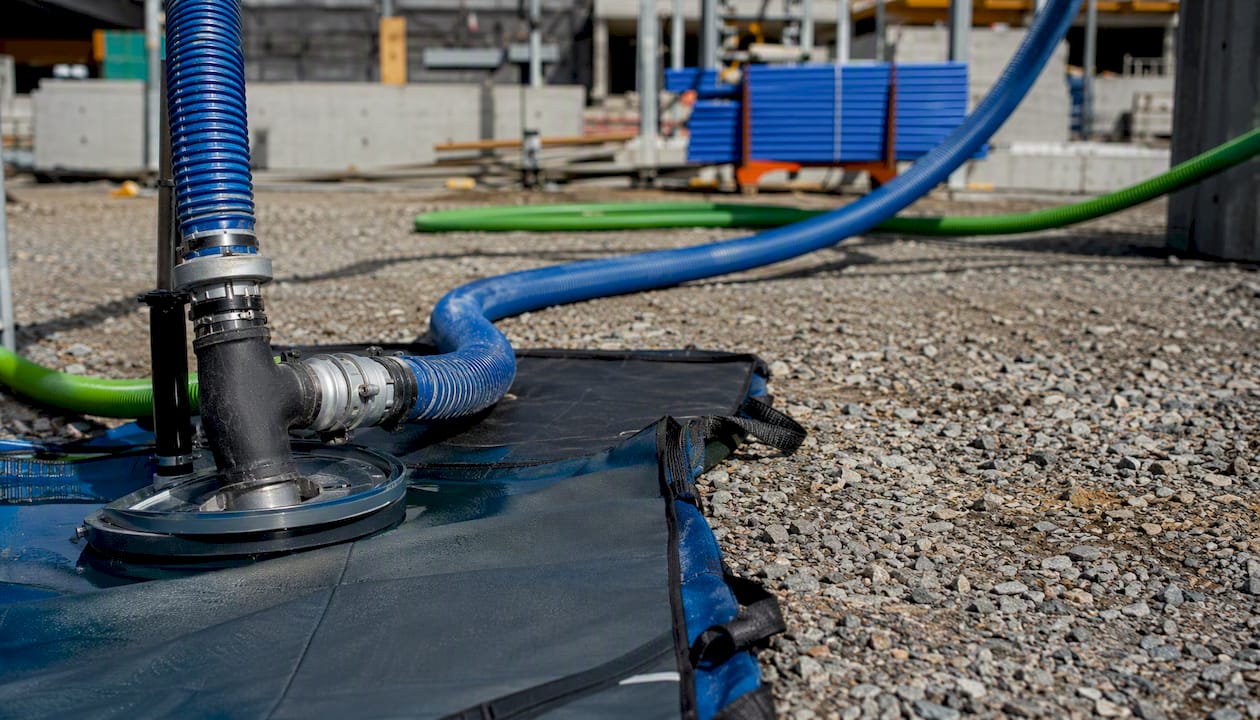
- Vacuum recovery pumps to lift wastewater straight off the surface as it’s generated.
- Holding tanks for onsite storage before licensed offsite disposal.
- Silt bags and flow meters to catch sediment and track litres used in real time.
Onsite settling and filtration can make some water reusable for the same job, though offsite treatment is usually the safer call for anything touching legacy contaminants like oils or old paint. The financial stakes are real: unlawful deposits into stormwater systems can trigger fines running into the hundreds of thousands of dollars under Queensland’s penalty unit scale, and every state has its own version of the same rule.
A step-by-step checklist for an eco friendly pressure wash
- Survey the site first. Locate drains, downpipes, sensitive garden beds, and check for asbestos-containing materials before any equipment arrives.
- Set up containment. Disconnect or divert downpipes, install bunds, block nearby stormwater drains, and stage vacuum recovery or holding tanks.
- Choose chemistry and equipment. Match the cleaner to the contaminant, set dilution per the datasheet, and fit trigger nozzles or flow restrictors to the machine.
- Pre-wet any nearby vegetation to protect it from chemical drift or overspray.
- Apply cleaner with a controlled dwell time, letting it break down grime before rinsing rather than relying on pressure alone.
- Rinse at low flow, capturing wastewater as it’s generated rather than letting it run.
- Tidy the site and inspect, confirming no residue or standing wastewater was left behind.
Before signing off on a contractor, ask how they capture and dispose of wash water, what dilution rates they use, whether their chemistry is PFAS-free, what flow rate (L/min) their machine runs at, and what training or insurance backs the crew.
Pro Tip: Add one line to every quote request: “Provide a written zero-discharge method statement and photo evidence of the site at job completion.” Contractors who balk at that request usually aren’t doing it properly in the first place.
What are the compliance risks and how does a compliant job look?
The legal exposure here isn’t theoretical. Every state treats pressure-cleaning wastewater as a controlled substance once it enters a stormwater system, and the penalties scale with intent. Run through this checklist before any job starts:
- Never discharge wash water to stormwater, drains, or roadside gutters.
- Check local Water Wise or equivalent rules before scheduling water-intensive work.
- Confirm whether the job needs a permit, especially on public land.
- Keep a spill kit on site for accidental chemical release.
- Never use high-pressure cleaning on asbestos-containing roofing or cladding, per EPA SA’s roof restoration guidance.
A property manager weighing quotes should treat “how do you handle wastewater” as the single most revealing question in the entire process. A contractor with a genuine zero-discharge method will answer it without hesitation and usually have photos ready.
Sweepandscrub applies exactly this approach on commercial sites: capture mats and vacuum recovery lift wastewater as it’s generated, with documented disposal and photo records available on request. That’s the standard every quote should be measured against.
Where does eco friendly pressure washing pay off, and where does it not?
Done properly, the benefits stack up quickly: faster turnaround than manual scrubbing, lower chemical volumes when the chemistry is matched to the job, longer asset life on concrete and pavers because you’re not grinding surfaces down, and a regulatory paper trail that protects the business if questions ever come up.
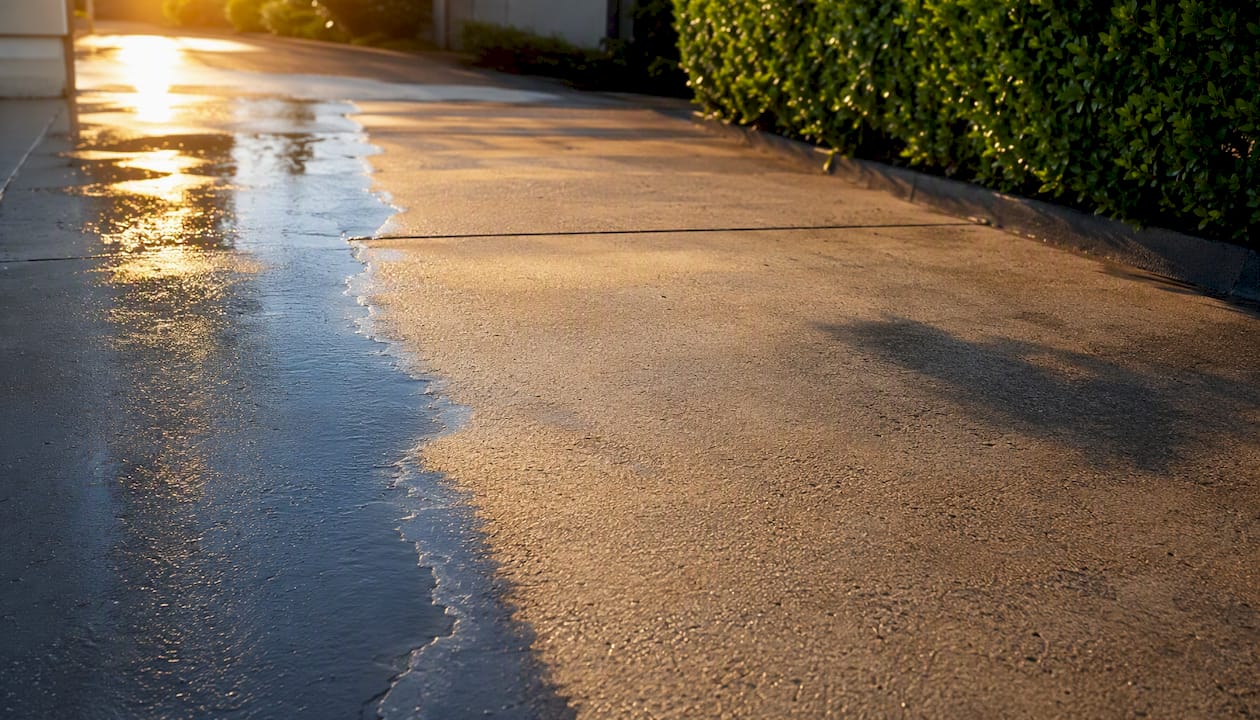
The trade-offs are worth naming honestly. Wastewater can mobilise legacy contaminants like old oils or paint flakes that biodegradable soap alone won’t neutralise, so containment failure is a real risk, not a hypothetical. Hot-water rigs use more energy, and collected wastewater still needs a disposal pathway with its own footprint.
Pressure washing isn’t the right call everywhere. Skip it on fragile cladding, anything asbestos-containing, or during severe water restrictions with no alternative supply. Dry cleaning, manual degreasing, or a low-impact softwash often gets the job done with less risk.
How Sweepandscrub handles the eco side so you don’t have to
Vetting containment gear, chemistry datasheets, and disposal paperwork on every job takes time most facility managers don’t have. Sweepandscrub builds it in as standard: capture-and-vacuum recovery equipment, PFAS-free chemistry options, and photographic proof of disposal on request, whether the job is a warehouse floor, a stadium concourse, or a multi-level car park.
The service range covers both ends of the chemistry question too, from hot water pressure washing for grease-heavy loading docks to cold water pressure washing for general hard-surface grime where heat isn’t needed. For a broader look at how the methods flex across site types, the hard surface cleaning page covers current availability and lets you request a quote directly.
Where to check the details yourself
- Sydney Water’s Water Wise Guidelines for permitted cleaning circumstances and runoff rules.
- EPA SA’s roof restoration guidance for stormwater entry points and asbestos precautions.
- Ask any contractor for their product datasheets and a wastewater disposal receipt before the job is booked.
Frequently asked questions
Is pressure washing bad for the environment?
Not inherently. It becomes a problem when wastewater carrying detergent, oil, or paint residue reaches stormwater drains untreated. Contained, low-flow pressure washing with biodegradable chemistry has a far smaller footprint than uncontrolled runoff.
What makes a cleaning product genuinely eco friendly?
Look for stated biodegradability data, a PFAS-free declaration, and a clear dilution rate on the datasheet. A “natural” label alone tells you nothing about ecotoxicity.
Do I need a permit for pressure washing on commercial property?
It depends on your local council and whether the site touches public land or drains to a shared stormwater system. Check local Water Wise guidance before scheduling, and confirm with your contractor that they’ve done the same.
Can pressure washing be done during water restrictions?
Sometimes, if the work qualifies as a safety, health, or contamination exception under guidelines like Sydney Water’s. Non-essential jobs are usually better postponed until restrictions lift.
How do I know if a contractor is actually using zero-discharge methods?
Ask directly: how is wastewater captured, where does it go, and can they provide photo evidence or a disposal receipt. A contractor with a real process answers all three without hesitation.
Sources
- Water pressure cleaning – Tablelands Regional Council
- Water wise guidelines – Sydney Water
- EPA SA — Water wash guidance (water wash / cleaning guidance)
- EPA SA — Roof restoration and stormwater guidance
Recommended
- The Importance of Sustainable Cleaning – Sydney Sweep and Scrub – Commercial Cleaning – Carpark Cleaning – Warehouse Cleaning
- Pressure Washing: A Versatile Option – Sydney Sweep and Scrub – Commercial Cleaning – Carpark Cleaning – Warehouse Cleaning
- The Importance of Saving Water in Industrial Cleaning – Sydney Sweep and Scrub – Commercial Cleaning – Carpark Cleaning – Warehouse Cleaning
- Common Mistakes to Avoid When Pressure Washing – Sydney Sweep and Scrub – Commercial Cleaning – Carpark Cleaning – Warehouse Cleaning