
A construction site cleanup runs in four passes: make the site safe, remove the bulk waste, control and remove dust, then detail the finished surfaces for handover. Each pass has its own checks, and each hands the site to the next trade or the owner in a better state. The heavy passes (bulk debris, sweeping, scrubbing, pressure washing) are where time, plant and safety exposure pile up, so at Sydney Sweep and Scrub we run them with mechanical sweepers, scrubbers and pressure washing crews rather than leaving them to the last labourers on site.
This checklist is written for property managers, builders, strata managers, councils and facility operators who have to sign off a site as clean and safe. It uses Australian regulator guidance, not a generic home-renovation list.
TL;DR
- Clean in order: safety check, bulk debris and waste, dust control and extraction, detailed clean, final inspection.
- Never dry sweep or use compressed air or blowers on dust that may contain silica. Use water suppression and filtered industrial vacuums.
- Suspected asbestos or other hazardous residue stops the cleanup until a licensed specialist has dealt with it.
- Match PPE to the task: hi-vis, gloves and boots for waste, eye protection for pressure washing, a P2 respirator for dusty first passes.
- For large slabs, car parks and warehouses, mechanical sweeping, scrubbing and pressure washing finish the job faster and more consistently than hand work. Request a quote for construction site cleaning.
Table of Contents
- Before you start: is the site ready to be cleaned?
- Pass 1: Safety setup and PPE
- Pass 2: Bulk debris and waste
- Stop and escalate: hazardous materials
- Pass 3: Dust control and extraction
- Pass 4: Mechanical sweeping, scrubbing and pressure washing
- Pass 5: The detailed and handover clean
- Final inspection before handover
- Who does what: a simple split
- Book the cleanup
- FAQ
- Sources
Before you start: is the site ready to be cleaned?
A cleanup started too early is a cleanup done twice. Dusty trades such as cutting, grinding, plastering and sanding should be finished in the area, and exposed services should be made safe. Cleaning crews working near live wiring or open switchboards is a hazard in its own right.
WorkSafe Victoria’s planning guidance gives a useful pre-start routine for any new trade or crew coming onto site. The supervisor should check the previous trade has cleaned up, induct the new workers and check induction cards and licences, make sure amenities are clean, review the safe work method statement (SWMS) where one is needed, and confirm equipment and height access are suitable. The same page recommends building regular clean-ups and site walks into the site plan (WorkSafe Victoria). Victoria’s rules differ from NSW in detail, but the sequence works on any Australian site.
Pre-start checklist
- Dusty and wet trades are complete in the area to be cleaned.
- Electrical outlets and switchboards are finished or isolated, with no exposed wiring.
- Everyone entering holds a current General Construction Induction (White Card) and has been inducted to the site.
- A SWMS covers the cleaning task, including high-risk elements, and is on site.
- Barricades, signage and traffic control are set up where cleaning plant or trucks share space with other workers or the public.
- Amenities, skip bins and a waste area are in place.
The SWMS point matters more than it looks. Under NSW’s WHS Regulation, work with a risk of falling more than 2 metres is high-risk construction work, and a SWMS must be in place before it starts and kept available on site (OH Consultant). That catches facade washing, window cleaning and soffit work as well as roof-level debris. Check the rules of your own state or territory before you assume the same thresholds.
Pass 1: Safety setup and PPE
Before a broom or machine moves, settle who is wearing what. A building-site cleanup SWMS used on Australian sites lists the baseline: a General Construction Induction card, hi-vis clothing near roadways or mobile plant, gloves and protective footwear when filling skips, eye and hand protection when handling chemicals, and eye protection for high-pressure cleaning (Unique Building SWMS).
SafeWork NSW’s pocket guide puts the duty on the employer. Workers must have the right tools, plant and PPE, correctly fitted, and be trained in using, caring for and storing it. PPE may include hard hats, safety shoes, and hand, eye and ear protection (SafeWork NSW).
PPE and the standards behind it
One Australian contractor’s site requirements show how the standards line up for typical cleanup tasks (Ertech Group HSEQ requirements):
| Item | Australian Standard |
|---|---|
| Safety footwear | AS 2210 |
| Helmet | AS 1800 / AS 1801 |
| Safety glasses | AS 1336 / 1337 / 1338 |
| Hi-vis clothing | AS 4602 |
| Hearing protection (designated noise areas) | AS 1269.3 / AS 1270 |
| Cut-resistant gloves | AS 2161 |
Also check machinery. WorkSafe Victoria’s pocket guide says tools and machinery should be used to the manufacturer’s instructions, inspected and maintained, with moving-part risks controlled and operators trained and competent (WorkSafe Victoria pocket guide). That applies equally to a ride-on sweeper, a scrubber and a pressure washer. When we attend a site, the plant and the people who operate it arrive together, so you are not auditing a stack of hired machines and casual labour yourself.
Pass 2: Bulk debris and waste
This pass removes anything large, loose or bulky before fine cleaning can start. It is the pass that most often stalls, because skips fill, offcuts end up in corners and nobody owns the last 10 per cent.
Bulk debris checklist
- Walk the whole site, including car parks, loading docks, stairwells and plant rooms, and mark waste by type.
- Sort into streams: timber, metal, plasterboard, concrete and masonry, packaging, general waste, and anything that could be hazardous.
- Pick up sharps and fixings (screws, nails, glass, banding) by hand with tools into rigid, puncture-resistant containers, wearing cut-resistant gloves (WorkSignals SWMS template).
- Remove protective coverings and temporary protection, inspecting them for trapped dust before they come up.
- Load skips safely, with gloves and boots, and keep walkways and fire exits clear.
- Confirm waste leaves site with a licensed carrier and goes to a facility that can lawfully take it.
If you would rather not coordinate this yourself, our rubbish removal and labour hire services cover the loading and clearing that comes before machine work.
Waste planning is a legal and cost issue
Separating waste early pays off at the tip and in compliance. Waste authorities advise taking an inventory of reusable, recyclable and recoverable material at the start, and flagging possible contamination by asbestos or lead, which restricts reuse and requires special disposal (WALGA construction waste plan guidelines). Those guidelines are from Western Australia, so confirm local requirements where you work. Our approach to running an environmentally friendly building site covers the waste side in more depth, and we offer optional waste offset initiatives alongside carbon-neutral operations.
Stop and escalate: hazardous materials
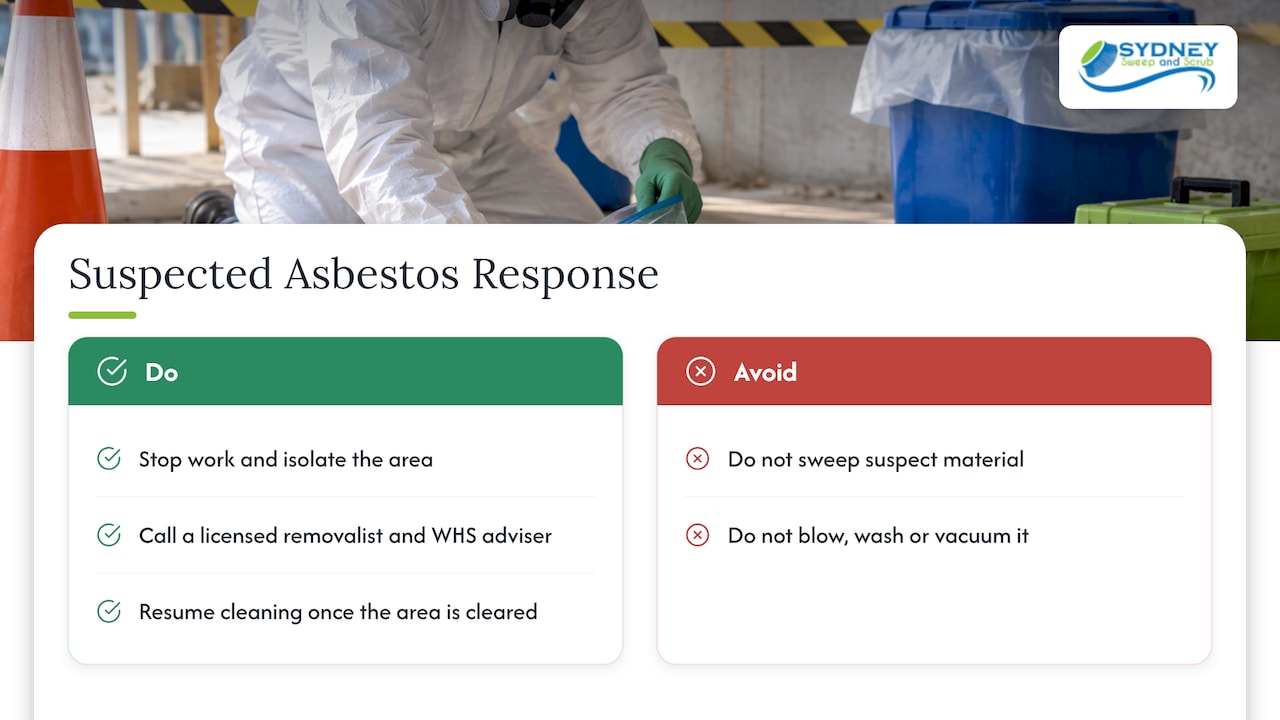
Some residues are not cleanup tasks. If you find or suspect asbestos, treat the area as closed.
In NSW, the EPA’s construction and demolition waste toolkit says asbestos waste must be classified on site under the EPA’s Waste Classification Guidelines. SafeWork NSW may require written notification of removal by a licensed asbestos removalist, and a clearance certificate may be needed to verify the site is safe for normal use. Asbestos waste over 100 kg, or 10 square metres, transported in NSW is tracked through WasteLocate (NSW EPA toolkit). Asbestos-containing material must go only to a designated asbestos waste facility (Unique Building SWMS).
The practical rule: do not sweep, blow, wash or vacuum suspect material. Stop work, isolate the area and call a licensed asbestos removalist and your WHS adviser. Cleaning resumes once the area is cleared.
Pass 3: Dust control and extraction
Dust is the part of cleanup that looks harmless and is not. Cutting, grinding and drilling concrete, bricks, tiles and engineered stone can release respirable crystalline silica, and plaster and fine dust travel into every cavity.
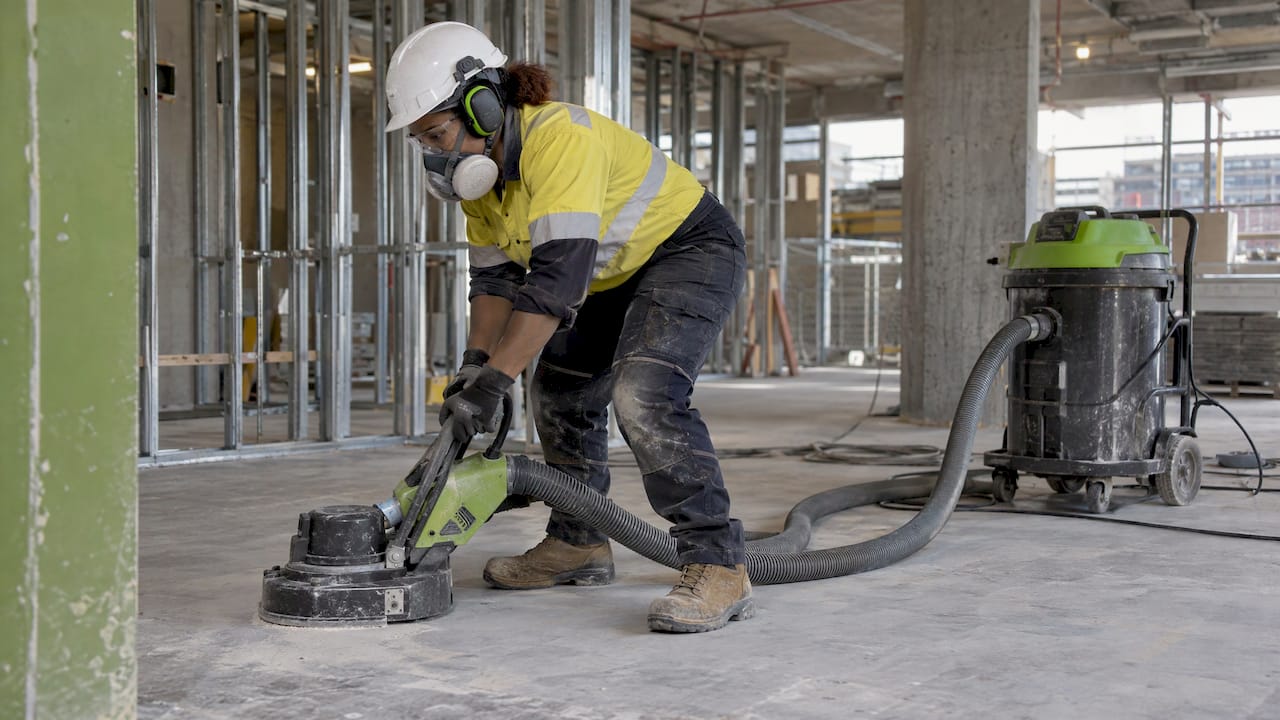
Safe Work Australia’s construction checklist on airborne contaminants directs duty holders to use isolation controls (barriers, enclosed cabins and restricted areas for dusty power-tool work) and engineering controls such as local exhaust ventilation and water suppression. Dust that has settled is cleaned up with an industrial vacuum with appropriate filtration (Safe Work Australia, November 2025).
Dust checklist
- Identify the dust source and whether the material may contain silica.
- Use water spray to suppress dust where practical (Unique Building SWMS).
- No dry sweeping, leaf blowers or compressed air on fine dust. A published Australian post-construction SWMS template controls plaster and silica dust with an H-class filter vacuum followed by damp wiping, and a P2 respirator for the first pass in each area (WorkSignals).
- Work from high surfaces down towards the exit, so you are not re-dusting finished floors.
- Keep electrical safety in view: vacuum leads tested, tagged and on an RCD, and no wet cleaning around exposed wiring or open switchboards (WorkSignals).
Silica rules are moving
Silica is under active regulatory attention. ABC News reported on 24 June 2026 that a Safe Work Australia recommendation to halve the workplace exposure limit for respirable crystalline silica, from 0.05 to 0.025 mg/m³, had been put on hold. The same report notes workers exposed to silica dust must undergo health monitoring before and during employment (ABC News). Because limits and duties vary by jurisdiction and are reviewed from time to time, confirm the current figure with your state WHS regulator before you rely on one.
If your site has a silica problem or you need a documented approach to it, see our page on silica dust removal and management in the workplace and the guide to construction dust cleanup and what a compliant service delivers.
Pass 4: Mechanical sweeping, scrubbing and pressure washing
Once bulk waste is out and dust sources are controlled, hard surfaces need machine cleaning. This is where large sites separate from small ones. A hand crew can clean a unit. It cannot economically clean a 5,000 square metre slab, a multi-level car park or a hardstand.
| Area | Typical task | Method we use |
|---|---|---|
| Slabs, hardstand, roadways | Remove loose fines and aggregate | Mechanical sweeping |
| Warehouse and basement floors | Lift ground-in grime and residue | Mechanical scrubbing |
| Car parks | Sweep, scrub and wash, then line marking | Carpark cleaning |
| Driveways, ramps, facades, paving | Remove staining and splatter | Pressure washing, including hot water |
| Flooded or wet areas | Clear standing water | De-flooding |
The order inside this pass matters. Sweep before you scrub, so machines are not pushing grit around. Pressure wash last on exterior surfaces and capture or direct runoff away from drains. Wear eye protection for high-pressure cleaning, and a face shield where there is splash (BlueSafe Online SWMS sample).
For warehouse sites, our warehouse cleaning covers sweeping and scrubbing of large floor areas. For repeat sites, we also offer automated robotic cleaning for car parks and warehouses, and optional recurring maintenance contracts for large facilities.
Pass 5: The detailed and handover clean
The detailed clean covers what people touch and see: windows, frames, doors, fixtures, skirting, benchtops, wet areas and floors. A builders clean is usually staged as a rough clean to remove loose waste and prepare access, a detailed clean of accessible surfaces after dusty work finishes, and a handover clean after defects are rectified and the last trades have moved out.
Detail checklist
- Release rooms to the cleaners only when the trade has confirmed it is finished in that room.
- Remove coverings and extract dust, with no dry sweeping.
- Wipe fixtures, fittings, glazing and hard surfaces with damp cloths, from top to bottom.
- Clean floors last, closing off wet sections with signs.
- Clean windows from the ground where practicable. Water-fed pole systems can reach to about 15 metres, which avoids working at height (OH Consultant). Our page on telescopic pole window washing explains how this works for strata buildings.
- Choose the lowest-hazard cleaning product that does the job, and wear gloves matched to the safety data sheet.
- Do a final walk-through against the contract scope and photograph the result.
Our own post-construction cleaning checklist and guide to post construction cleaning go room by room for fit-outs and new buildings.
Final inspection before handover
A clean site is part of handover, not a courtesy. Sign-off should confirm the site is clear of building rubbish, access and external areas are clean, and external surfaces, car parks and loading areas are free of dust, staining and debris. Keep your own cleaning records, the SWMS, waste dockets and any asbestos clearance certificate together in the handover file.
For tenants leaving a warehouse or commercial premises, the same logic applies at the end of a lease: the floor, dock and external areas all need to be returned in the condition your lease requires. Our end of lease commercial cleaning is set up for that, and the warehouse team handles the large floor areas in the same visit.
Who does what: a simple split
Not every task needs a specialist, and not every site needs the same crew. A workable division on most commercial sites:
- Site supervisor: permits, inductions, SWMS, isolation of services, the pre-start walk.
- Licensed specialists: asbestos and other hazardous material, and licensed high-risk work.
- Our team: mechanical sweeping and scrubbing, pressure washing, rubbish removal, labour hire for clearing and cleaning, and de-flooding.
- Property or site manager: final inspection against scope and sign-off.
The sweeping rules for sites are covered in more detail in our guide to Safe Work Australia sweeping rules for construction sites.
Book the cleanup
If you are managing a site, car park or warehouse in Sydney, we can quote the machine passes and clearing work and book them online. See construction site cleaning for the request form, or our full list of services. Tell us the site type, approximate area and the stage you are at, and the job can be planned against your handover date.
FAQ
What is included in a construction site cleanup?
It covers removing debris and waste, controlling and extracting dust, machine cleaning of floors and external surfaces, and a detailed clean of fixtures, glazing and finishes. Hazardous material such as asbestos is handled separately by licensed specialists. The order matters: bulk waste first, dust second, detail last.
Can I dry sweep a site after cutting concrete or tiles?
No. Dry sweeping, blowers and compressed air throw fine dust, which may contain silica, back into the air. Safe Work Australia’s guidance points to water suppression and industrial vacuums with appropriate filtration instead. Confirm the requirements with your state WHS regulator.
What PPE does a cleanup crew need?
At minimum, a White Card, hi-vis clothing, safety footwear and gloves. Add eye protection for pressure washing and chemicals, hearing protection in noisy areas and a P2 respirator for dusty first passes. Your SWMS should name the PPE for each task.
When should the cleanup start?
Start after dusty and wet trades finish in an area and exposed services are made safe. Cleaning too early means re-cleaning once later trades have worked. A pre-start walk with the supervisor confirms the area is ready.
Do I need a SWMS for cleaning?
Often, yes. In NSW, a SWMS is required before high-risk construction work starts, and tasks such as facade or window cleaning with a fall risk of more than 2 metres fall into that category. Check your own state or territory’s rules and ask your WHS adviser.
Sources
- WorkSafe Victoria: Planning for safety on construction sites
- SafeWork NSW: The pocket guide to construction safety
- WorkSafe Victoria: The pocket guide for construction safety
- Safe Work Australia: Managing airborne contaminants in construction checklist
- NSW EPA: Construction and demolition waste management toolkit
- WALGA: Construction waste plan guidelines
- ABC News: Chemical exposure limits put on hold
- Building Site Clean-up SWMS
- HSEQ Requirements, Ertech Group
- Post-Construction Cleaning SWMS Template
- Brick and Masonry Cleaning SWMS sample
- Construction Cleaning SWMS Template