
Painted safety lines clean best in three stages: sweep first, wash with low-pressure water and a mild detergent, then rinse and inspect. Go harder only where oil, grease or rubber needs it, and only with a cleaner and pressure the coating can handle. Aggressive scrubbing, strong alkaline cleaners and a nozzle held too close are what turn a dirty line into a faded or peeling one.
This guide is for property managers, strata managers, warehouse operators and facility teams who look after painted lines on concrete or asphalt. It covers how to clean them, which products to avoid, how to handle the wash water, and how to tell when a line needs repainting rather than another wash.
TL;DR
- Sweep or vacuum the dry debris first, then wash with low-pressure water and mild detergent. Rinse with clean water.
- Avoid stiff brushes, rough abrasives and high-alkaline or caustic products. They can dull the coating and leave marks that only repainting fixes.
- Use hot water for oil and grease, but choose nozzle and pressure to suit the surface, and test any cleaner on a small patch first.
- Wash water must not go to the stormwater drain. Plan capture and disposal before you start.
- After cleaning, check contrast, edges and coverage. Some lines that look failed are only dirty; others need repainting.
Table of Contents
- Why dirty lines matter more than they look
- Know what you are cleaning
- Step-by-step: cleaning painted safety lines
- Which cleaners are safe, and which to avoid
- Dealing with oil, grease and heavy build-up
- Using a pressure washer on painted lines
- Wash water, stormwater and site safety
- What to check after cleaning
- Cleaning is not removing
- How we can help
- FAQ
- Sources
Why dirty lines matter more than they look
Safety lines do a job. They mark pedestrian walkways, forklift routes, exclusion zones, loading bays and parking bays. When they are buried under dust, tyre rubber and oil, people stop reading them correctly.
Safe Work Australia’s model code of practice expects workplaces to keep floors clean and safe to remove slip and trip hazards, and notes that cleaning methods need to account for the risk of slipping, which certain cleaning agents can increase (Safe Work Australia, Managing the work environment and facilities). That cuts both ways. A dirty floor is a hazard, and so is a freshly washed one that stays wet, or one coated in the wrong detergent residue.
Anti-slip additives add another wrinkle. Lines with grit mixed into the paint hold dirt more easily, so they need more regular cleaning than smooth lines to stay visible and do their job.
Know what you are cleaning
Before choosing a method, answer four questions.
- What is the surface? Sealed concrete, raw concrete, asphalt and epoxy-coated decks behave differently. Raw concrete is porous and holds oil. Coated decks need cleaners that are compatible with the coating.
- What is the paint? Most safety lines are acrylic, epoxy or similar. Dulux’s Australian care guide for paints and coatings notes that the pressure should be set only as high as needed to remove contaminants without damaging an acrylic coating (Dulux Construction Solutions Paints & Coatings Care Guide, November 2022).
- How new is it? Freshly applied paint needs time to cure before it meets pressure or chemicals. The curing period depends on the product, so follow the manufacturer’s data sheet and hold off washing until it has passed.
- What is the contamination? Loose dust, general grime, oil, hydraulic fluid, tyre rubber and old spills each call for a different step.
If you do not know the paint system, treat it as the most delicate case. Start gentle and escalate only if needed.
Step-by-step: cleaning painted safety lines
1. Sweep or vacuum first
Grit under a brush or a pressure jet acts like sandpaper on the paint edge. Remove loose debris from the whole area before any water touches it. In a warehouse, that usually means a mechanical sweeper or scrubber-dryer; in a car park, a ride-on or truck-mounted sweeper. If you are weighing up equipment, skid steer industrial sweepers are one option for sweeping large hard surfaces.
For dust that may be hazardous, such as silica-bearing or chemical residue, Safe Work Australia lists low-pressure water, wet sweeping or an M- or H-class vacuum as cleanup options (Safe Work Australia, occupational lung diseases). Dry sweeping that throws dust into the air is the wrong choice there.
2. Wet the area with low-pressure water
The Dulux guide recommends starting with a low-pressure water wash. Often that is all a line needs, especially if the dirt is only surface dust and road film.
3. Add mild detergent where dirt remains
If dirt stays on, use warm water with a small amount of mild detergent, preferably sugar soap, and a soft cloth or soft-bristle brush. Work gently in circular motions, then rinse with clean water (Dulux guide). For long runs of line, a scrubbing machine with soft pads does the same job faster than hand work.
4. Rinse thoroughly
Detergent left behind attracts dirt and can leave the surface slippery. Rinse until the water runs clear, and squeegee or vacuum the wash water into your capture point.
5. Let it dry and look at the result
Check the line in good light once it is dry. Wet paint looks brighter than dry paint, so judging contrast on a wet floor can mislead you.
Which cleaners are safe, and which to avoid
The safe list is short. Mild detergents, sugar soap and biodegradable cleaners suit painted line markings, and a water-based heavy-duty cleaner described as non-toxic and non-corrosive is suitable for painted surfaces. For oil or rubber build-up, use a mild or biodegradable agent and test it on a small area first to check it suits the marking material.
The avoid list matters just as much:
- Rough abrasives and stiff brushes. The Dulux guide warns they can polish the coating and leave highlights that need repainting to fix.
- Harsh caustic preparations. Same risk, plus possible discolouring.
- High-alkaline cleaners in car parks. Parking Professional advises against high-alkaline products on painted surfaces in parking structures, and says any pressure washing detergent should be specified as compatible with the deck coating or marking system (Parking Professional, parking garage cleaning schedule).
- Solvents and degreasers you have not tested. Always test on a hidden section of line first, rinse, let it dry and compare.
Tyre marks and rubber transfer are often cosmetic. If a gentle wash does not shift them, a hot water wash is usually a better next step than a stronger chemical.
Dealing with oil, grease and heavy build-up
In loading docks, workshop areas and car park bays, oil is the main problem. Cold water simply pushes it around.
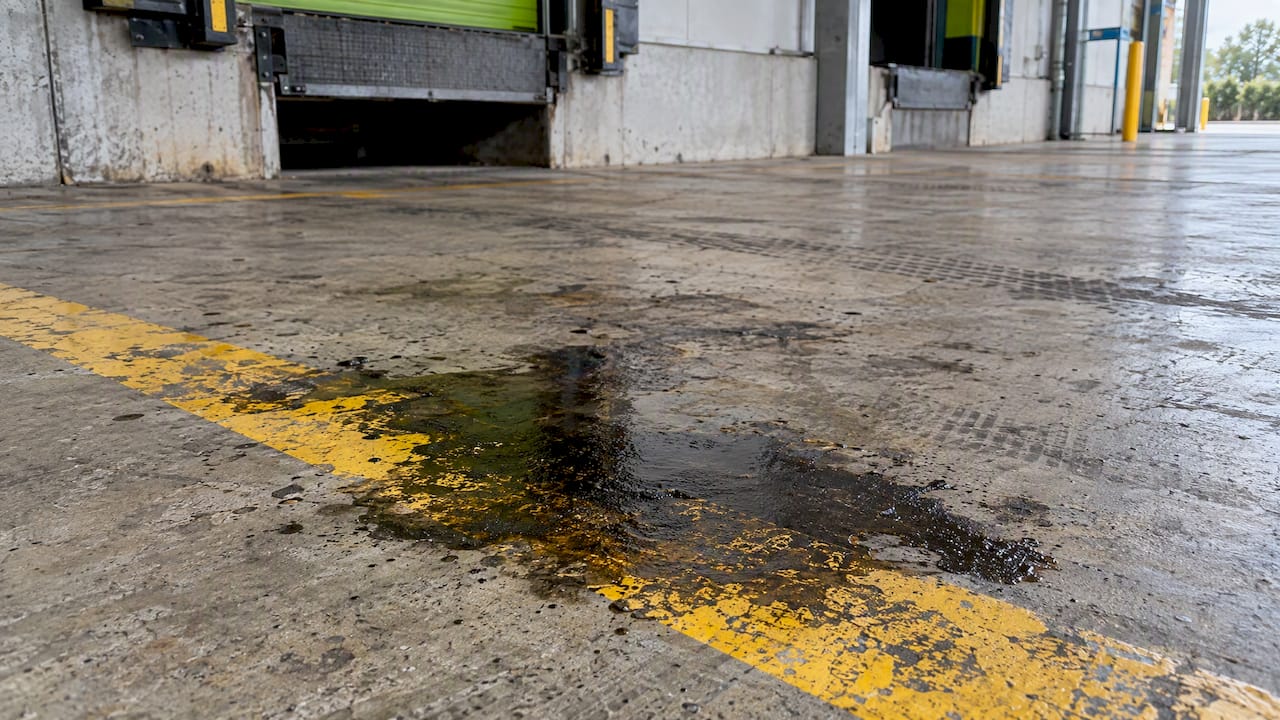
Parking Professional notes that hot water pressure washers in the 2,500 to 4,000 PSI range are more effective than cold water at removing oil and grease from parking structures, provided the nozzle is chosen so the surface is not damaged (Parking Professional). That figure describes the machine’s capability, not the setting to use on a line. In practice the working pressure at the surface is controlled by the nozzle type, the distance and the dwell time, and painted lines should get the gentlest combination that works.
A sensible approach for stubborn staining:
- Soak up fresh spills with absorbent before they spread into the surface.
- Apply a compatible, biodegradable degreaser and let it work for the time the label says.
- Rinse with hot water at a controlled pressure, moving across the line rather than lingering on one spot.
- Repeat once if needed, then reassess. If the stain has soaked into raw concrete, no amount of surface washing will fully lift it, and repainting over a clean section may be the better fix.
Our own guides on hot water pressure washing and the top five car park stains go deeper on matching the method to the stain.
Using a pressure washer on painted lines
Yes, you can pressure wash painted safety lines, and for large car parks and warehouse floors it is often the only practical way to get an even result. The risk is peeling, eroding or lifting the paint, particularly at the edges and on older, thinner lines.
Precautions that reduce the risk:
- Start low, step up. Begin with a wide fan nozzle at a distance and move closer or increase pressure only until dirt lifts.
- Keep the wand angled, not square-on. A glancing angle lifts dirt without driving water and force straight into the paint edge.
- Keep the lance moving. Sweep along the line in even passes.
- Avoid turbo or rotary nozzles on painted lines. They concentrate force and cut through thin paint.
- Use hot water only where grease demands it, and test a patch first.
- Leave new paint alone until it has fully cured under the manufacturer’s guidance.
Pressure washing also carries operator risk. Safe Work Australia’s guide to managing the risks of high pressure water jetting says operators should be trained for hazards including injury, falls and hazardous chemicals. It also says equipment should be serviced to the manufacturer’s recommendations, defective equipment removed from service, work areas barricaded, and jetting stopped if conditions change, unauthorised people enter the area or something malfunctions (Safe Work Australia, high pressure water jetting guide). In a busy car park, that means closing off bays or levels and using signage, not working around traffic.
For a closer look at how the work is set up on site, see our pages on pressure washing for car park maintenance and how we use pressure washers in Sydney car parks.
Wash water, stormwater and site safety
Cleaning lines produces wash water that carries detergent, oil, rubber and sediment. It should not run into the stormwater system. Safe Work Australia’s guidance and state environmental regulators treat discharges to stormwater as a compliance issue, and the NSW EPA points out that businesses discharging wash water to sewer generally need approval from the local sewerage authority, commonly a trade waste agreement, with conditions that typically include equipment to remove pollutants (NSW EPA, smash repair industry). That page is written for one industry, but the principle of approval before sewer disposal applies widely, so confirm the rules for your site with your water utility and local council.
Practical steps before you wash:
- Locate and protect stormwater pits and drains with covers or bunding.
- Plan how you will capture and remove the water, for example with a vacuum recovery unit.
- Keep detergent use low and biodegradable.
- Keep a spill kit on hand. The NSW EPA’s case studies describe absorbent bags placed in stormwater drains and used to form a dam after a spill (NSW EPA case studies).
- Barricade the wet area and put out wet-floor signs until it is dry, because a freshly washed floor is a slip risk for staff and visitors.
We cover this in more detail in our guide to pressure washing wastewater for Australian businesses.
What to check after cleaning
Once the floor is dry, look at the lines the way a driver or forklift operator would, from a normal standing or seated height.
Three checks tell you most of what you need:
- Contrast. Does the line stand out clearly from the floor, or has it gone grey and dull?
- Edge definition. Are the edges crisp, or feathered and ragged?
- Coverage. Is the paint film continuous, or is the floor showing through?
A useful rule of thumb from an airport line marking maintenance guide is that if two of the three are marginal you should plan repainting, and if all three are marginal the work is overdue. The rule comes from airfield markings, so apply it as a guide for other sites, not a standard.
One point works in your favour: some lines that look worn out are only buried in grime, and a proper clean can reveal sound paint underneath. So clean first, then judge.
When you do repaint, preparation decides how long the new line lasts. Remove loose dirt, oil and grease so the paint can adhere. If a section keeps failing in the same spot, look for the cause, such as a leaking vehicle, a drainage fault or a high-turn area where tyres scuff the paint.
A simple inspection rhythm
Busy car parks and warehouse aisles benefit from a routine, not a reaction. A reasonable pattern is a quick visual check each month, a scheduled wash several times a year depending on traffic, and a closer review of line condition annually. Frequency should follow how quickly your site gets dirty: loading docks and entry ramps will need more attention than a quiet upper deck.
Cleaning is not removing
Washing will not take off sound line paint, and it should not. If you want a marking gone, because you have changed the layout or a lease is ending, that is a removal job. Common methods include painting out, pressure washing sometimes with a chemical paint stripper, sand or shot blasting and surface grinding. The right choice depends on the surface and the age of the marking (Barsec, how to remove line marking paint).
Two cautions apply. Blacking out a line with dark paint hides it for a while but does not remove it, and the old line often shows through again. Grinding takes off the surface of the concrete and leaves a patch that may need treating. For tenants leaving a warehouse, the lease make-good clause usually decides which approach is required, so check it before choosing.
How we can help
If you manage a car park or warehouse in Sydney and want lines cleaned without risking the paint, we can do it. Our car park cleaning and line marking service covers mechanical sweeping, scrubbing and pressure washing, and our warehouse cleaning service handles floors, aisles and loading areas. We are a family-owned business, and our approach includes eco-friendly practices and optional waste offset initiatives. Prices are not published, so request a quote with your site type, approximate floor area and the contamination you are dealing with. If you are leaving a lease, see our end of lease commercial cleaning page.
FAQ
Will marking paint wash off with water?
Cured line marking paint will not wash off with ordinary cleaning, which is the point of it. Water and mild detergent remove dirt on top of the line, not the paint itself. Aggressive pressure, harsh chemicals or abrasives can wear a line down, especially an old one.
How do I get rid of paint lines I no longer want?
That is removal, not cleaning. Methods include painting out, pressure washing with or without a paint stripper, blasting and grinding, chosen by surface and marking age. Ask a contractor to assess the floor first, because grinding and blasting leave marks of their own.
What is the best way to clean a painted surface?
Start with low-pressure water, then use warm water with a little mild detergent, preferably sugar soap, and a soft cloth or soft-bristle brush. Rinse with clean water. Avoid rough abrasives, stiff brushes and harsh caustic products.
Can I pressure wash painted safety lines?
Yes, with care. Use the lowest pressure that lifts the dirt, keep the wand moving at an angle, choose a suitable nozzle and avoid washing freshly applied paint before it has cured. Capture the wash water and keep it out of stormwater drains.
How often should painted safety lines be cleaned?
It depends on traffic and contamination. Many sites suit a scheduled wash a few times a year, with extra cleaning at loading docks, ramps and workshop areas. Inspect lines regularly so you can touch up fading before the whole line needs re-marking.
Sources
- Dulux Construction Solutions Paints & Coatings Care Guide, November 2022
- Safe Work Australia, Managing the work environment and facilities
- Safe Work Australia, occupational lung diseases: managing risks
- Safe Work Australia, guide for managing risks from high pressure water jetting
- Parking Professional, parking garage cleaning schedule
- NSW EPA, smash repair industry
- NSW EPA, case studies
- Barsec, how to remove line marking paint