
You can clean a working warehouse without stopping dispatch, but only if cleaning is planned as a safety task first. The method that works is simple: separate cleaners from forklifts and pedestrians, clean by zone in the quietest windows you have, leave every floor dry, and keep records. Done this way, floors stay safe and operations keep moving.
This guide is for warehouse owners, occupiers and facility managers in Australia who need floors, docks and aisles cleaned while the site is live. It covers timing, zoning, equipment, chemicals, spills and the paperwork that proves it was done.
TL;DR
- The main risk is contact between cleaning crews, pedestrians and forklifts, so plan separation before you plan cleaning.
- Clean by zone, in low-traffic windows, and close each zone off while work is under way.
- Floors must finish dry. Detergent residue and damp patches turn a cleaning job into a slip hazard.
- Check the Safety Data Sheet for every chemical before it is used on site.
- Write down methods, frequencies and completed tasks. Auditors and insurers want evidence, not intentions.
Table of Contents
- Why cleaning during operations is a risk decision
- Choose your timing window
- Clean by zone, not by site
- Pick the right method for each zone
- Leave the floor dry, every time
- Control chemicals and residue
- Have a spill response ready
- Look after the machines in the building
- Build a program, not a series of jobs
- Brief everyone before the machines start
- How we work with live sites
- FAQ
- Sources
Why cleaning during operations is a risk decision
A warehouse floor is a shared workspace. Forklifts, reach trucks, pallet jacks, pickers on foot and now a cleaning crew all use the same surface. Safe Work Australia’s traffic management guide for warehousing puts separation of vehicles and pedestrians first, and recommends enforcing pedestrian and forklift exclusion zones wherever possible. A cleaning machine is one more moving item in that mix, and it is often quiet, low and slow, which makes it easy to miss from a forklift seat.
The second risk is the cleaning itself. Queensland’s regulator notes that poor housekeeping is a common contributor to slips, trips and falls, and that bad cleaning can create hazards of its own. Too much detergent, the wrong concentration or a floor left wet can reduce slip resistance. WorkSafe Queensland’s guidance on cleaning says effective systems need suitable methods, schedules, equipment, trained cleaners and reliable communication.
In practice, that gives you four questions to answer before anyone starts a machine:
- Where will cleaners and forklifts be at the same time, and can we stop that?
- What will be left on the floor when the machine moves on?
- Who is told, and how?
- How will we prove it happened?
Choose your timing window
The cleanest answer to forklift interaction is not to have forklifts there. Safe Work Australia’s guidance favours removing the interaction altogether, and scheduling heavy mechanical cleaning in low-traffic periods is the practical way to do it.
Look at your own site data rather than guessing:
- Shift changeovers and breaks. Traffic often drops for short periods. These are suited to small zones, such as a single aisle or a dock apron.
- Gaps between inbound and outbound peaks. Many sites have a mid-morning or early-afternoon lull. Check your dock bookings.
- Before first shift or after last. Largest areas, open floor and bulk sweeping fit here when a site has any shutdown time.
- Quiet weeks. Post-peak periods suit deeper work such as scrubbing back stained or contaminated floor.
If your site runs around the clock, there is no true quiet window, so zoning (below) does the work that timing cannot. Tell us about your shift pattern when you ask for a quote and we can propose a schedule around it, rather than around ours.
Clean by zone, not by site
Treat the warehouse as a grid. Clean one zone at a time, close it, finish it, hand it back. This keeps the exposed area small and keeps your picking and dispatch flows running in the rest of the building.
Build the zone map
Divide the floor into zones that match how your site actually works: receiving docks, bulk storage aisles, pick faces, pack benches, dispatch, charging bays, amenities and external hardstand. Mark which zones carry the heaviest forklift traffic and which are pedestrian-heavy.
Close the zone properly
A cone in the middle of an aisle is not an exclusion zone. For each zone being cleaned:
- Block both ends of the aisle with barriers or signs that forklift drivers will see from the seat.
- Brief the forklift operators on that shift on which zone is closed and for how long.
- Use a spotter at any crossing point that cannot be closed.
- Keep the cleaning machine’s beacon or lights on, and check that the site lighting is adequate. The Safe Work Australia guide notes that shadows from plant, blind spots and poor light reduce visibility.
- Reopen only after the floor has been checked as dry and clear.
Handle the unavoidable crossings
Some routes cannot close, such as the main thoroughfare to dispatch. Set a rule: cleaners stop at the crossing, forklifts have right of way, and the cleaning crew has a person on foot controlling the gap. Agree this before the job, not on the floor.
Pick the right method for each zone
Different debris needs different tools, and the wrong tool is how dust gets pushed into racking or water gets onto a live floor.
| Task | Typical method | Operational impact |
|---|---|---|
| Dust, shrink wrap scraps, pallet debris | Mechanical sweeping | Low: ride-on or walk-behind sweeper, no water |
| Tyre marks, ingrained grime, light oil | Machine scrubbing with extraction | Moderate: needs a closed zone and a dry finish |
| Heavy oil, grease, dock aprons, external areas | Pressure washing, hot water where needed | Higher: water control and drainage must be planned |
| Repeated routine floor cleaning | Automated robotic cleaning | Runs a set route, suited to regular schedules |
| Rubbish, offcuts, dunnage | Rubbish removal | Clears trip hazards before machines run |
Sweeping first is almost always right. Debris lifted by a sweeper does not smear when the scrubber follows, and it keeps pallet splinters and strapping out of scrubber brushes. Our mechanical sweeping benefits page goes into the asset-management side of this.
Leave the floor dry, every time
In a live warehouse the finish matters more than the clean. A machine that scrubs and extracts in one pass leaves the floor effectively dry behind it, which lets a zone reopen quickly. Food Standards Australia New Zealand sets out cleaning and sanitising as separate steps, finishing with a rinse and air-drying. Food-grade sites follow that sequence, and non-food sites benefit from the same discipline of rinsing and drying.
Practical rules:
- Use a scrubber-dryer with extraction for any wet cleaning in trafficked aisles.
- Keep a squeegee and absorbent material at the zone edge for any residual water.
- Put wet-floor signs at every entry until the floor is checked, then remove them so they do not become clutter.
- Check the edges and corners, where machines leave the most water.
- In cold or humid weather, allow longer. Concrete takes longer to dry and condensation can undo the work.
Control chemicals and residue
Residue is the quiet hazard. WorkSafe Queensland flags detergent build-up and wrong concentrations as reducing slip resistance on floors. Forklifts need grip to brake as much as people need grip to walk.
Safety Data Sheets before anything is used
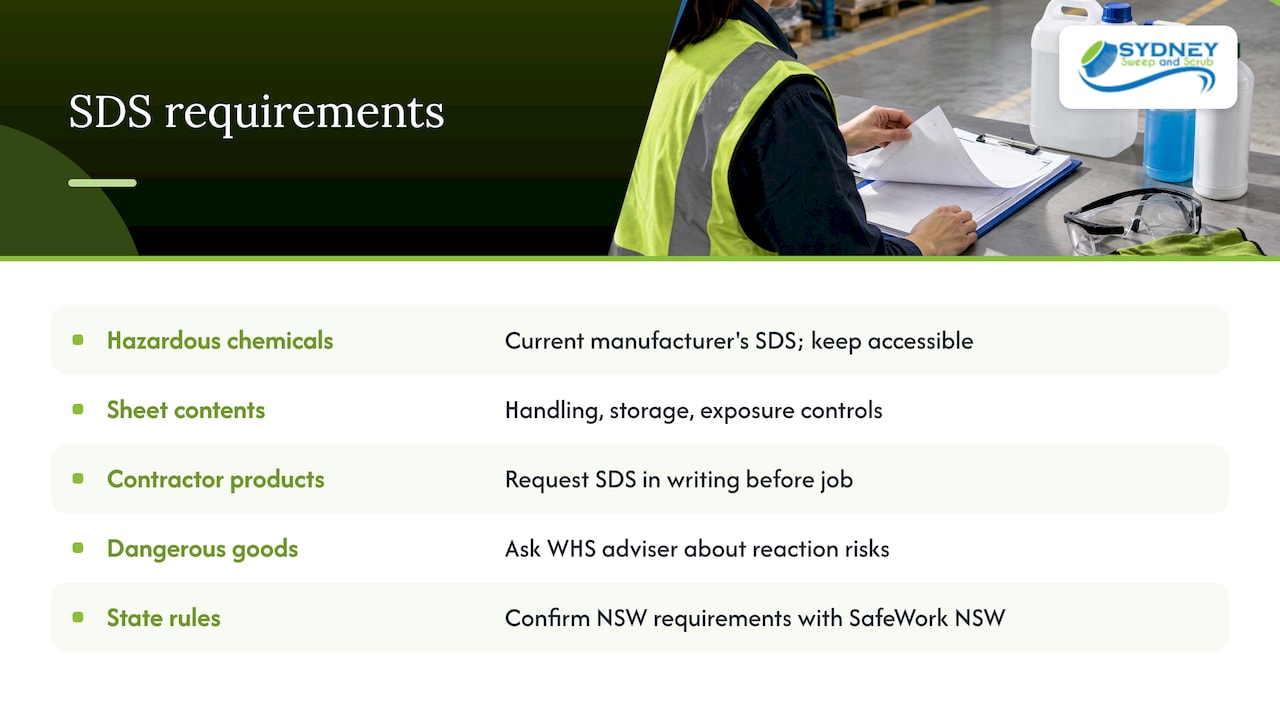
Under the model code on hazardous chemicals, the person conducting the business or undertaking needs the current manufacturer’s SDS for hazardous chemicals and must keep it accessible to workers who may be exposed. Safe Work Australia’s model code of practice for hazardous chemicals covers this, and WorkSafe Queensland explains what the sheet contains in its page on labelling and safety data sheets, including handling, storage and exposure controls. Check the sheet for any product a contractor brings onto your site, and ask for it in writing before the job. If your site stores dangerous goods, ask your WHS adviser whether the cleaning product could react with anything nearby. Rules differ between states, so confirm the requirement with SafeWork NSW if you are in New South Wales.
Practical residue controls
- Measure concentrations. Do not pour by eye.
- Prefer the mildest product that removes the soil.
- Rinse after detergent scrubbing where the product requires it.
- Keep cleaning equipment itself clean. Dirty tanks and pads put contamination back on the floor.
If you are weighing up floor finishes as well as cleaning, a guide to warehouse floor coating options explains how coatings affect cleaning methods. It is written for a US audience, so check local product and compliance requirements.
Have a spill response ready
Planned cleaning is only half the picture. In an active warehouse, a split pallet of liquid, a leaking forklift hydraulic hose or a dock-door flood happens in the middle of a shift. Reactive scheduling is exactly what WorkSafe Queensland describes as a sign of weak cleaning management, so decide in advance:
- Who is trained to respond and who is told first.
- Where the spill kits are, and that they are stocked.
- How the area is isolated, with forklift traffic diverted until it is clear.
- When to call in a contractor for oil, chemical or large water volumes.
Our spill response playbook for warehouse managers walks through the response steps, and our piece on how clean floors improve forklift efficiency shows why a rapid response protects throughput as well as people. For flooding events we also offer de-flooding of sites, listed on our main services page.
Look after the machines in the building
Cleaning equipment is plant. A scrubber that leaks oil or fuel, or a sweeper with a failing brake, creates a fresh hazard on your floor. Safe Work Australia’s general guide for industrial lift trucks says equipment should be suitable for the work and in a safe condition. Apply that same standard to any machine a contractor brings in. Ask what servicing they do and what happens if a unit fails mid-shift.
Build a program, not a series of jobs
A warehouse that cleans only when it looks bad is always managing risk after the fact. A program has four parts.
- Methods. For each zone, the tool, product and finish required.
- Frequencies. Daily, weekly, monthly and annual tasks, set by how fast the zone gets dirty.
- People. Who is trained, who supervises, who signs off.
- Records. What was done, when, by whom, and what the result was.
The record-keeping matters if you handle food, export goods or goods under biosecurity controls. The Department of Agriculture’s approved arrangement cleaning requirements show the kind of documented cleaning standards that regulated sites are held to. For packhouses, the department’s performance standards set hygiene and pest control expectations. Check whether your site falls under either before assuming a basic checklist is enough.
For scheduling and tracking, the principles in a work order scheduling process apply to cleaning: define the task, assign it, set the time, close it with evidence. Our warehouse cleaning checklist lists six audit fields to capture, and our PCBU hygiene checklist sets out a three-tier approach. If you store food, our article on health and safety in a food storage facility adds the extra considerations.
A simple weekly rhythm
| Frequency | Task | Zone |
|---|---|---|
| Daily | Spot sweep, rubbish and strapping removal, spill checks | Docks, pick aisles, pack areas |
| Weekly | Mechanical sweep of full floor, amenities clean | Whole site |
| Monthly | Machine scrub of main aisles, charging bays, dock edges | Whole site, zone by zone |
| Quarterly or as needed | Pressure washing of aprons, hot water for oil and grease | External and dock areas |
Adjust to your own traffic, product and risk. A dusty bulk site needs more sweeping than a palletised racking site, and food-grade stock needs more again.
Brief everyone before the machines start
Most incidents come from someone not knowing. A short pre-start briefing with the cleaning supervisor and your shift lead should cover:
- Which zones are closed, and for how long.
- Where forklifts are working and which routes stay open.
- Where the cleaners are and what they are wearing, with high-visibility clothing a baseline.
- Who has authority to stop the job.
- What to do if a spill, injury or near miss occurs.
Forklift operators should also be told to treat cleaning machines as obstacles that can stop suddenly. Our article on improving forklift safety with regular warehouse cleaning covers the relationship between floor condition and forklift behaviour.
How we work with live sites
Sweep and Scrub is a family-owned Sydney business offering mechanical sweeping, scrubbing, pressure washing, hot water cleaning, rubbish removal and automated robotic cleaning for warehouses, car parks and other commercial sites. For warehouses we can plan around your traffic: tell us your shift pattern, your busiest docks and your sensitive zones, and we will propose a zoned schedule. See our warehouse cleaning service for what is on offer, or request a quote through our site and describe how your warehouse operates. If you are leaving a lease, our end of lease commercial cleaning is a separate job with different timing, since the building is empty. Regular cleaning also supports productivity, which we cover in why regular warehouse cleaning promotes efficiency.
When you compare cleaning options, compare types of provider by what matters on a live site: whether they bring a safety plan, whether they supply SDSs, whether they can work in zones, whether they leave floors dry, and whether they give you records. In-house staff, general commercial cleaners and specialist mechanical cleaning contractors each fit different sites. In-house teams suit daily spot cleaning. Specialists suit machine work at scale.
FAQ
Can a warehouse be cleaned while forklifts are running?
Yes, if the work is planned as a controlled activity. Use exclusion zones, brief operators, time heavy machine work for low-traffic periods and keep a spotter at any crossing that stays open. If a zone cannot be isolated, delay the machine work until it can.
When is the best time to clean a working warehouse?
Use your own quietest period: between shifts, during breaks or in the lull between inbound and outbound peaks. Large open floors are best done when few people are on site. Sites that run constantly rely on zoning instead.
What should I check before a contractor uses chemicals on site?
Ask for the current Safety Data Sheet for every product and read the handling, storage and exposure sections before work starts. Make sure the SDS is accessible to your workers. If anything is unclear, ask your WHS adviser or your state regulator, such as SafeWork NSW.
How do I stop cleaning from making floors slippery?
Control concentration, rinse where required, use machines that extract water and check the floor before reopening a zone. Detergent residue lowers slip resistance, so a floor that looks clean can still be a hazard.
What records should I keep?
Keep the cleaning schedule, who did each task, the date and time, the products used with their SDSs, and any spill or incident reports. Food and biosecurity-regulated sites need more detail, so check your own requirements.
Sources
- Traffic Management Guide: Warehousing, Safe Work Australia
- Housekeeping, WorkSafe Queensland
- Cleaning, WorkSafe Queensland
- Cleaning and sanitising, Food Standards Australia New Zealand
- Managing risks of hazardous chemicals in the workplace, Safe Work Australia
- Labelling and safety data sheets, WorkSafe Queensland
- General Guide for Industrial Lift Trucks, Safe Work Australia
- Approved arrangement 4.3 cleaning requirements, Department of Agriculture
- Performance standards for packhouses, Department of Agriculture