
When a cleaning crew is working in a warehouse, car park or public space, you need signs at every point of access, in a format people understand at a glance, backed by physical barriers where the hazard is serious. No Australian law names a specific “cleaning” sign. What the law does require is that you manage the hazard, and signage is one tool for that. This guide covers which signs suit which job, where to put them, when a basic A-frame is not enough, and why a sign never replaces doing the cleaning properly.
TL;DR
- No law prescribes a particular cleaning sign, but WHS duties mean you must warn people of hazards such as wet floors and keep them away from areas that can’t be kept dry.
- AS 1319-1994 is the main reference for safety sign design in Australian workplaces. Symbols beat words, and signs go at every access point.
- A sign is the weakest control in the hierarchy. Pair it with barriers, dry-as-you-go methods and prompt drying.
- Cleaning that touches footpaths, roads or construction frontages can trigger traffic control rules, not just janitorial signs.
- The responsible person (the PCBU, manager or owner) owns the decision and should record it in a risk control plan.
Table of Contents
- What the law actually says about cleaning signs
- Where AS 1319 fits
- Which sign for which cleaning job
- Placement: where signs go and how many
- Why a sign is never the whole answer
- When basic cleaning signs are not enough
- Signs for warehouses and car parks
- How we handle signage on our jobs
- Common mistakes to avoid
- A simple signage plan you can adopt
- FAQ
- Sources
What the law actually says about cleaning signs
A common assumption is that a yellow “Caution Wet Floor” sign is a legal requirement. It isn’t, at least not in those words. Safe Work Australia and state regulators frame it as a duty to control slip, trip and fall risks. If an area cannot be kept dry, it should be cordoned off with barriers or signage so people stay away.
The duty sits with the person conducting a business or undertaking (PCBU), usually the business owner, facility manager or property manager. They need to assess whether the cleaning method makes the floor slippery. That includes the choice of detergents and polishes. The same WorkSafe Queensland guidance describes signage as one part of a documented risk control plan, which should be updated as site conditions change. Although it is a Queensland page, it explains model WHS duties that apply in the same form in New South Wales, where Sydney Sweep and Scrub works. Check your own state or territory regulator for local wording.
The Model Code of Practice on managing the work environment and facilities adds that conditions at a workplace must be monitored regularly, especially when something changes. A scheduled sweep, a scrub of a loading dock or a pressure wash of a car park level is exactly that kind of change.
Where AS 1319 fits
AS 1319-1994, Safety signs for the occupational environment, sets out the design and use of safety signs that regulate behaviour, warn of hazards and give emergency information. It was published in 1994 and reconfirmed in 2018, and it remains the primary reference for making signage fit for purpose.
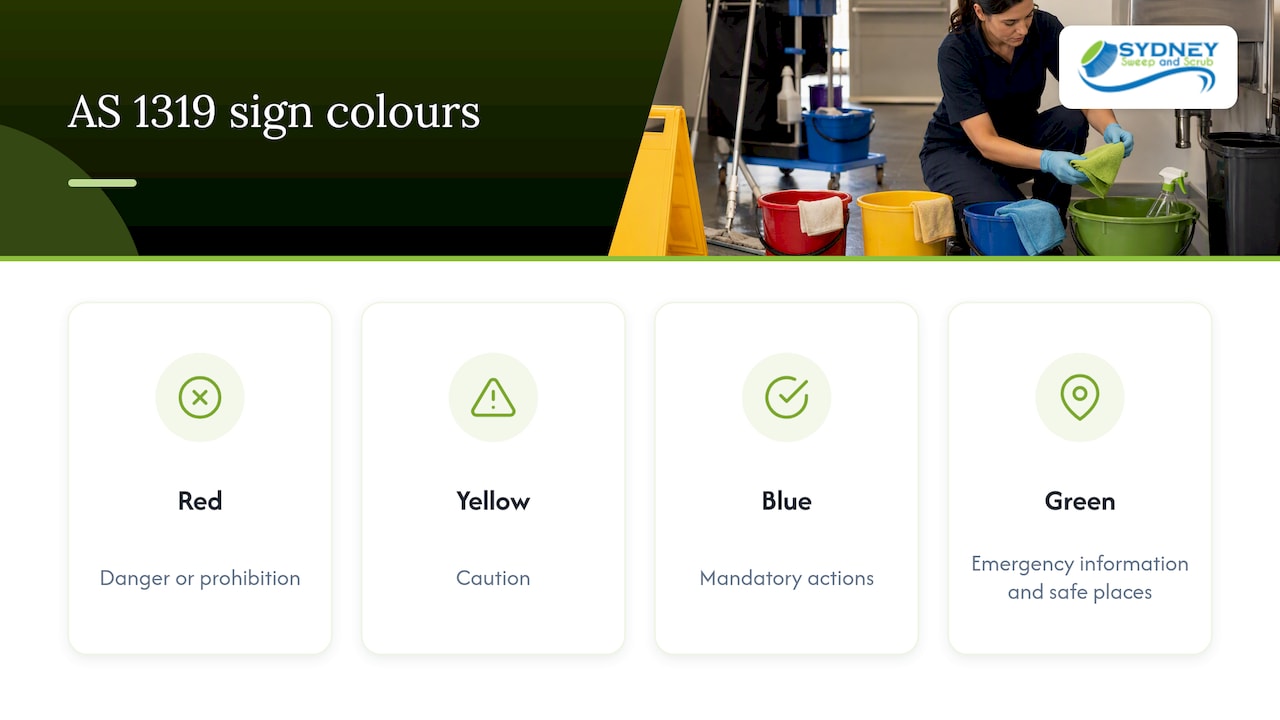
In practice, the standard works through coded shapes and colours. A colour guide to the AS 1319 system summarises it like this: red for danger or prohibition, yellow for caution, blue for mandatory actions and green for emergency information and safe places. That is why a wet floor sign is yellow, and a “No entry, cleaning in progress” sign for a closed area is better as a prohibition sign.
The standard also takes a clear position on words. The preview of AS 1319 explains that symbols are often regarded as superior visual communication because they cross language barriers. A sign that repeats its symbol in words is a hybrid, and the standard treats that as a sign that the symbol isn’t doing its job. In a Sydney warehouse with a multilingual workforce, that matters. If you feel the need to add text, ask first whether the symbol is clear.
Which sign for which cleaning job
The right sign depends on the hazard the work creates, not on the word “cleaning”. Here is how we would match them for common commercial jobs.
| Cleaning activity | Main hazard | Sign and barrier approach |
|---|---|---|
| Mopping or scrubbing a warehouse aisle | Wet, slippery floor | Wet floor A-frame at each end of the aisle, with barrier or cone where the aisle can be closed |
| Machine scrubbing a car park level | Wet surface, moving machine, vehicles | Barriers or bollards at ramps and entries, signs at every access point, pedestrian detour |
| Pressure washing a loading dock or forecourt | Overspray, slippery surface, wastewater | Prohibition or exclusion signs at entries, cones or tape to cordon the zone |
| Mechanical sweeping of a yard or site | Moving plant, dust | Plant-in-operation warnings, separation from pedestrians and forklifts |
| Cleaning that spills onto a public footpath or road | Public and vehicle exposure | Traffic control plan and compliant temporary signs |
| Spill response in a racked warehouse | Slip risk, forklift traffic | Immediate cordon, then sign until dry and verified |
A few details that save trouble:
- Portable A-frames suit short-term jobs and are quick to move as the work front advances.
- Cones and barrier tape work better than a lone sign for larger or outdoor areas, because they physically block the way.
- Door hangers and closed-for-cleaning signs suit amenities, lifts and stairwells, where you can shut the space.
- Floor graphics and wall signs suit permanent damp zones such as entrances in wet weather. They are not a substitute for an A-frame during active cleaning.
Placement: where signs go and how many
The rule from the research is simple: signs must be highly visible and placed at all points of access to the hazard. The Safe Work Australia confined spaces code applies this to high-risk work, with warning signs at every entrance. A cleaning job in an open warehouse is a different risk from a confined space, but the principle carries over: if there are four ways in, you need to cover four ways in.
A practical checklist before work starts:
- Walk the approaches. Look at the area the way a visitor, forklift driver or delivery driver would arrive, including from the side and from behind.
- Place signs where a decision can still be made. A sign beside the wet patch is too late. Put it far enough back that someone can turn around or choose another route.
- Keep sightlines clear. Don’t hide a sign behind a pallet, a door swing or a parked vehicle.
- Face both directions. Use double-sided A-frames or place one at each end.
- Check lighting. In car parks and the back of warehouses, a sign nobody can see in dim light does no work.
- Remove signs when the hazard is gone. A sign left out over a dry floor teaches people to ignore signs.
The confined spaces material also notes that when a sign is introduced or changed, staff should be told beforehand. AS 1319 recommends training people on sign meanings during induction. If your site uses its own colour coding, for example separate signs for cleaning zones, brief your team and your contractors.
Why a sign is never the whole answer
This is the part many sites get wrong. Safe Work Australia’s guidance treats signage as an administrative control, the final and least effective layer in the hierarchy of control. The Model Code of Practice on the work environment points to primary measures first: isolating the hazard by cordoning off the area, then engineering controls such as better lighting or drainage. If a cleaner leaves an area open and relies only on a wet floor sign, they are not adequately minimising the risk.
The Safe Work Australia slips and trips fact sheet sets out the same hierarchy with examples, starting from eliminating the hazard at the design stage.
In day-to-day terms:
- Clean to dry. Use methods that leave surfaces dry during and straight after cleaning. Scrubber-dryers pick up the water as they go, which is why a machine pass leaves a floor in a very different state from a mop and bucket.
- Isolate first. Close an aisle, a car park bay or a ramp while the work is on, then use signs to explain why.
- Dry promptly. Signage is not an excuse for poor housekeeping. It supplements active hazard management.
- Check the cleaning system itself. WorkSafe Queensland’s cleaning guidance lists warning signs of a poor cleaning system, such as floors that aren’t fully dry. Bad cleaning can increase contamination and risk, not reduce it.
The cost of getting this wrong is real. The same WorkSafe Queensland page cites 2018 data showing slips, trips and falls cost Queensland businesses over $60 million a year in workers’ compensation, with more than 13,000 injuries annually. That is one state and an older figure, but it shows the scale.
If you are the responsible person, a structured approach to hazards helps. For a general walk-through of how property professionals assess hazards and pick controls, see this piece on building risk assessment explained. On the cleaning side specifically, there are practical ideas in these sustainable office cleaning steps, including how product choices change the day-to-day risks in a building.
When basic cleaning signs are not enough
Wet floor A-frames are designed for indoor janitorial work. Once cleaning crosses into public space, the rules change.
If cleaning activities obstruct a public footpath or road in NSW, you may need a formal Traffic Control Plan and specific signage, often retroreflective, set out in the Transport for NSW Traffic control at work sites manual. That manual covers items such as roadwork speed limits, “prepare to stop” signs and detours. It is a different system from office janitorial signs, and a standard A-frame won’t satisfy it.
This matters for:
- Sweeping a construction site frontage where trucks track mud onto the road.
- Pressure washing a footpath outside a building or retail strip.
- Cleaning a kerbside loading zone or a car park entry that opens onto a public road.
- Post-event clean-ups of streets and plazas.
If you work within the City of Sydney area, the council’s technical specifications for construction refer to temporary works that keep pedestrians moving safely, including road signs and lane markings. Check the council’s current requirements before you start.
For site operators, our guide on sweeping rules for construction sites explains how sweeping fits into the site’s wider duties.
Signs for warehouses and car parks
Warehouses
Warehouses combine forklifts, pedestrians, racking and hard floors, so the sign has to be seen by drivers as well as walkers. Keep these points in mind:
- Close the aisle and sign both ends, rather than signing a single patch.
- After a spill, cordon first and sign second. Our spill response playbook for warehouse managers covers the response sequence.
- Record signage and cleaning in your checklist. Our warehouse cleaning checklist lists the audit fields worth capturing.
- Floor finish matters, because a floor with poor slip resistance stays risky even when clean. See the slip resistance specs for property managers.
If you are a warehouse occupier preparing to hand back a lease, the same rule applies to the clean-out: the crew needs controlled access while the work happens. We cover that under end of lease commercial cleaning.
Car parks
Car parks add moving vehicles, ramps and low light. Sign every entry and ramp, close levels in sequence where you can, and give pedestrians a clear alternative route. Machine work happens at ground level in places where drivers don’t expect it, so barriers carry more weight than signs alone. Line marking is often done after cleaning, and wet paint needs its own signs and cordon until it cures.
How we handle signage on our jobs
We are a family-owned Sydney business doing mechanical sweeping, scrubbing and pressure washing for warehouses, car parks, construction sites and public spaces. Signage is part of how we plan a job, but we treat it as the last layer. We start by deciding what needs to be closed, what can stay open and how the area will be left, then we agree with the property or facility manager how access will be controlled. If your site has its own signage rules or a traffic control plan, tell us at the quote stage so the job fits them.
You can request a quote and book online. For car parks, see our carpark cleaning page. For industrial sites, see warehouse cleaning. For washdowns, see pressure washing. For anything else, our full list of services shows what we do. Pressure washing also raises a wastewater question, which we cover in five wastewater checks for Australian businesses.
Common mistakes to avoid
- Using one sign for everything. A wet floor sign doesn’t tell people a machine is operating or that a ramp is closed.
- Leaving signs out after the floor is dry. People stop believing them.
- Relying on text in a multilingual workforce. Choose a clear symbol, as AS 1319 favours.
- Putting signs in one spot only. Every access point needs coverage.
- Treating the sign as liability cover. Pedestrians don’t take on the risk because a sign exists. The duty to manage it stays with the responsible person.
- Skipping the record. Note what you assessed, what you chose and who was briefed, then update it when the site changes.
- Using janitorial signs for road or footpath work. Look at traffic control requirements first.
A simple signage plan you can adopt
- List each cleaning task and the hazard it creates.
- Decide what can be isolated, and isolate it.
- Choose symbol-led signs that match AS 1319 colour coding for the hazard.
- Place signs at every access point, facing the direction people approach from.
- Brief staff and contractors, and add sign meanings to inductions.
- Dry the surface, check it, then remove the signs.
- Record the control and review it when something changes.
A sign that works is one people see in time, understand without reading and find backed by a closed aisle or a barrier.
FAQ
Is a wet floor sign legally required in Australia?
No specific sign is mandated by name. Employers must manage slip risks under WHS laws, and if an area can’t be kept dry, it should be cordoned off with barriers or signage. A sign alone isn’t enough if the area is still open to people.
What standard covers workplace safety signs?
AS 1319-1994, Safety signs for the occupational environment, is the main reference. It was reconfirmed in 2018 and covers shapes, colours and use. It favours symbolic signs over text because symbols work across language barriers.
Can I use a normal cleaning sign when work affects a footpath or road?
Usually not on its own. In NSW, work that obstructs a public footpath or road may need a Traffic Control Plan and compliant temporary signs under the Transport for NSW manual. Check with the road authority or council before the job starts.
Who is responsible for putting up the signs?
The responsible person at the workplace, such as the business owner or manager, must assess the risks and decide on controls. Contractors play a part, but the duty doesn’t disappear by hiring a cleaner. Agree the arrangement in writing before work begins.
Sources
- AS 1319-1994, Safety signs for the occupational environment (Standards Australia Store)
- AS 1319-1994 preview (Standards Australia Store)
- Cleaning, slips, trips and falls (WorkSafe Queensland)
- Model Code of Practice: Managing the work environment and facilities (Safe Work Australia)
- Confined spaces code of practice (Safe Work Australia)
- Slips and trips at the workplace fact sheet (Safe Work Australia)
- Traffic control at work sites (Transport for NSW)
- Sydney Streets technical specifications: construction (City of Sydney)
- AS 1319 safety sign colour coding (OptSigns)