
A speed bump is cleaned properly when loose grit is swept up first, stubborn oil and tyre residue are lifted with targeted pressure or hot-water cleaning, and every drop of wash water is recovered rather than sent down a drain. Then the bump, the pavement around it and its markings are inspected. A bump that only looks clean because the grime was hosed into the gutter has not been cleaned. It has been moved.
This guide is for property managers, strata managers, warehouse operators, construction site managers and council staff who need speed bumps and humps cleaned and want to brief a contractor properly. We are Sydney Sweep and Scrub, a family-owned mechanical cleaning and pressure washing business, and we have written it the way we would brief our own crew.
TL;DR
- Sweep or vacuum first, then wash only where oil, tyre rubber or bonded grime remains. Dry-first work cuts the volume of dirty water you have to deal with.
- Wash water must not reach the stormwater system. NSW EPA guidance says washing belongs in a contained area with wastewater going to an approved collection, sewer or treatment system.
- Ask for a written scope: traffic control, drain protection, water recovery, before and after photos and defect reporting.
- Cleaning does not fix structural damage or worn paint. Report cracked, loose or faded humps to whoever is responsible for the pavement.
- No Australian authority we found sets one cleaning interval for speed bumps, so base the schedule on traffic, weather and visible loss of contrast.
Table of Contents
- Why speed bumps get dirty faster than the rest of the pavement
- What proper speed bump cleaning involves
- Wastewater is the part that can get you in trouble
- Choosing a method
- Who is responsible for the bump?
- How often should speed bumps be cleaned?
- What to ask for in a quote
- When cleaning is not the answer
- Need speed bumps cleaned in Sydney?
- FAQ
- Sources
Why speed bumps get dirty faster than the rest of the pavement
A speed bump is where vehicles brake, load up and then accelerate away. That means tyre rubber, brake dust, oil drips and fine grit collect around the base and in the low spots either side. On a ramp or hump in a car park, the same patch also catches rubbish blown along the surface and sediment carried in on tyres.
Three things then go wrong:
- Contrast disappears. The painted or coloured surface that tells a driver or pedestrian a hump is ahead becomes dull and grey. Austroads describes traffic control devices as needing a standard appearance and being maintained in good repair, and visibility is a large part of that.
- Loose grit becomes a hazard. Fine material sitting on a sloped surface can reduce traction, particularly for wheeled traffic such as trolleys, pallet jacks and bikes, and especially when it is wet.
- Water pools. Debris packed against the upslope edge can hold water, which speeds up staining and algae growth and makes a slip more likely in shaded basement car parks.
None of this is dramatic, which is why speed bumps are usually cleaned only when someone complains. A scheduled approach is cheaper and safer.
What proper speed bump cleaning involves
The sequence below is what we would expect from any contractor, ours included. The order matters more than the equipment.
1. Site assessment and traffic control
Before anyone starts, the contractor should see the bump in context: how busy is the route, is it a private car park or a road managed by council, and are there pedestrians or forklifts nearby? Work areas need cones, barriers and a plan for keeping vehicles and people out. On public roads, cleaning should be scheduled with a traffic management plan, as the Austroads material on traffic control devices makes clear that these devices need regular inspection and maintenance.
2. Dry sweep or vacuum
This is the step cheap quotes skip. Mechanical sweeping or vacuuming lifts litter, sand and loose grit before any water touches the surface. South Australian EPA guidance for businesses prefers sweeping or vacuuming where dirty water cannot be fully collected, and it is the practical reason dry-first works: less grit in the water means less contaminated water to recover.
For a whole car park or warehouse yard, the sweeper that does the aisles can usually run the bumps in the same pass. Our mechanical sweeping service is built for that, with hand tools and blowers for the awkward edges where a machine cannot reach.
3. Targeted wet cleaning
Once the grit is gone, what remains is bonded: oil stains, tyre scuffs, chewing gum, algae. Pressure washing deals with these, and hot water helps where oil or grease is the problem, because heat loosens it far faster than cold water alone. Our pages on pressure washing with hot water and cold water pressure washing explain when each suits the job.
Use the minimum water and detergent that achieves the result. Biodegradable detergent does not make it acceptable to send wash water to the stormwater drain.
4. Recover the wastewater
This is the step that separates a professional job from a liability. More detail below, because it is where most of the legal risk sits.
5. Inspect and record
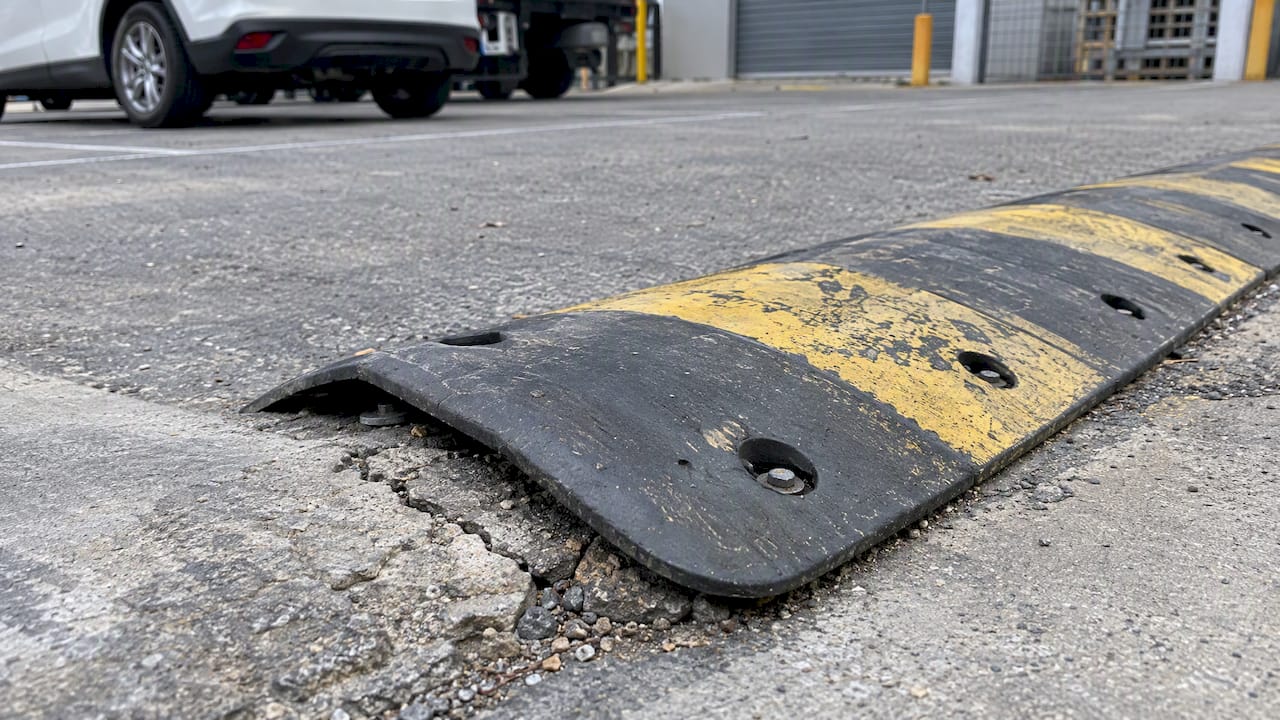
With the surface clean, defects show up: cracked asphalt, a rubber hump lifting from its fixings, worn paint, ponding at the base. A good crew photographs the bump before and after and notes anything that needs repair or repainting.
Wastewater is the part that can get you in trouble
If you remember one thing from this article, make it this: the bump is not clean until the dirty water has gone somewhere lawful.
The NSW EPA’s stormwater guidance for businesses says washing activities need to be confined to a designated wash bay or contained area, with wastewater going to an approved collection point, sewer or treatment and recycling system, and not to a stormwater drain. The same guidance notes that speed humps can form part of a bunded containment arrangement, so the bump itself may be useful in keeping water where you want it.
The reason is simple. As the SA EPA explains in its wash bay guidance, runoff from washing vehicles and equipment can threaten natural waterways if discharged to stormwater. Oil and detergent from a car park bump are no different.
Rules vary by state and council. In Queensland, for example, Tablelands Regional Council states that pressure cleaning wastewater entering roadside gutters or stormwater is unlawful under section 440ZG of the Environmental Protection Act 1994. Its recommended controls include portable bunds or sandbags, vacuum or pump recovery, diversion to a suitable soakage area where lawful, and licensed liquid-waste disposal. That is a Queensland council’s rule, not a Sydney one. For a site in Sydney, the contractor should confirm the council or trade-waste pathway before work starts.
We cover the practical checks in more depth in pressure washing wastewater: 5 checks for Australian businesses.
What a sensible method statement says
- Drains within the work area are identified and blocked or protected before water is used.
- Dry sweeping happens first.
- Bunds, mats or sandbags contain the wash area.
- Water is recovered by vacuum or pump, not left to evaporate or run off.
- Recovered water goes to a named destination: approved sewer or trade-waste arrangement, treatment or reuse, or an authorised liquid-waste contractor.
- The surface is left dry enough to reopen safely.
The SA guidance for wash bays also describes a graded, low-permeability floor with a collection point, and a floor grade of at least 1:80 towards collection channels. That is guidance for fixed wash bays rather than a rule for cleaning a hump, but it shows the principle: water has to be steered, not left to wander.
Choosing a method
| Situation | Usual approach | Why |
|---|---|---|
| Dust, litter and loose grit on a warehouse or car park bump | Mechanical sweeping or vacuuming | No wash water, fast, repeatable |
| Oil drips and tyre residue | Sweep, then hot-water pressure cleaning with recovery | Heat lifts oil; recovery keeps it out of drains |
| General staining on a concrete or asphalt hump | Sweep, then cold pressure washing with recovery | Lower cost where there is no grease |
| Basement car park with no safe drainage path | Sweeping and scrubbing with vacuum recovery | Limits water on the surface |
| Large site with many bumps and bays | Machine scrubbing plus hand finishing | Consistent results across the whole site |
| Faded paint or damaged surface | Cleaning for line marking preparation, then repair or repaint | Cleaning will not restore a worn finish |
If your site has a lot of paint or lines near the bumps, cleaning is also the first step of repainting. Our guide on preparing your carpark for line marking explains why paint fails on dirty concrete.
Who is responsible for the bump?
The answer decides who books the cleaner.
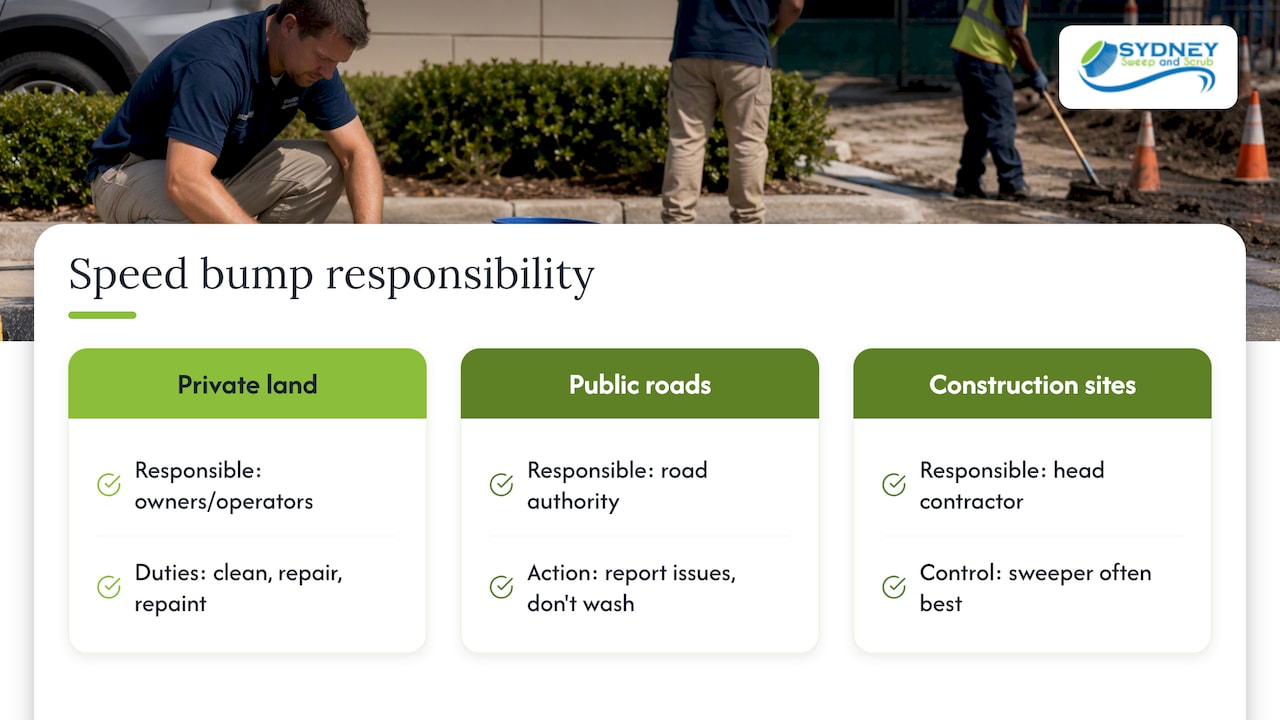
Private land. Strata schemes, building owners, shopping centres and warehouse operators are generally responsible for speed bumps within their own boundaries. That includes the cleaning, and also the repair and repainting.
Public roads. Humps on council streets belong to the road authority. The NSW Government’s design page on flat-top road humps and raised pavements gives a sense of how these assets are designed and treated as traffic-calming devices. AS 1742.13:2023 covers vertical deflection devices such as road humps, flat-top humps, road cushions and wombat crossings. If you are a resident or business owner and not the authority, do not start washing a public hump yourself. Report dirt, damage or faded markings to the council.
Construction sites. The head contractor usually owns the problem. Bumps and ramps at site exits collect mud and aggregate quickly, and a sweeper is often the best control. Our guide to after-build cleaning for your Sydney carpark covers the handover stage.
How often should speed bumps be cleaned?
We could not find an authoritative Australian standard that sets a universal cleaning interval for speed bumps, and anyone quoting one is guessing. What the road agencies do say is that maintenance is risk-based. Queensland’s Department of Transport and Main Roads frames routine maintenance as balancing road user safety, usability, deterioration and environmental requirements, and notes that conditions vary with pavement, traffic and climate.
In practice that means:
- Fold bumps into your regular sweep. If a car park is swept on a schedule, the bumps are swept too. Our article on why Sydney carparks need regular sweeping sets out the case.
- Inspect more often after trigger events: storms, nearby construction, an oil spill, a public event or any time contrast visibly drops.
- Wash less often than you sweep. Wet cleaning is for stains, not routine dust.
High-traffic sites such as loading docks and shopping centre entries will need more attention than a quiet strata basement. Your own inspection records are the best guide.
What to ask for in a quote
A bare “pressure wash the bumps” request invites a bare quote. The Queensland TMR guideline is aimed at road maintenance, but its logic applies to any cleaning tender: ask for a documented scope instead of an unspecified wash. Put these into your brief:
- Scope: which bumps, ramps and surrounding areas, and whether sweeping, washing or both.
- Traffic and pedestrian control: cones, barriers, signage and who supplies them.
- Environmental controls: drain protection, containment, recovery, and where the water goes.
- Equipment: machine sweeper, hot or cold water, and whether detergents are used.
- Evidence: before and after photos with locations.
- Defect reporting: a short list of damaged or faded bumps with photos.
- Timing: after-hours or staged work so the site stays open.
- Insurance and induction requirements: whatever your site demands.
On cost, pressure washing is usually priced by area, and our commercial pressure washing cost guide explains what drives the price and how to compare quotes like for like. A single bump is a small job, so it makes sense to bundle it with a site-wide clean.
When cleaning is not the answer
Cleaning shows you the condition of the asset. It does not repair it. If you uncover any of these, stop and arrange the right trade:
- cracked, crumbling or broken edges
- rubber or plastic humps that are loose or missing fixings
- paint or thermoplastic worn through to the base
- ponding that returns after cleaning, which points to a drainage fault
Pressure washing damaged material can make it worse, and it will not bring back faded markings. Record the defect and refer it to the responsible owner or road authority. For repainting, our carpark cleaning and line marking service picks up where cleaning leaves off.
Need speed bumps cleaned in Sydney?
We clean car parks, warehouses, construction sites and public spaces across Sydney with mechanical sweepers, scrubbers and pressure washing, including hot water. Speed bumps are usually part of a wider carpark or yard clean, so we plan them in with the rest of the site, with the dry sweep first. Our carpark cleaning page has the details, and you can request a quote or book online. Larger facilities can ask about recurring maintenance contracts. For sites that want less labour and more consistency, we also offer automated robotic cleaning.
FAQ
Can I pressure wash a speed bump myself?
On private land you can, but you remain responsible for where the water goes. Sweep first, block nearby drains and collect the runoff, because NSW EPA guidance says wash water should not enter stormwater drains. For oily bumps or a large site, a contractor with recovery equipment is the safer choice.
Is it legal to let wash water run into the gutter?
Generally not. Australian EPAs treat the stormwater system as being for rain only, and Queensland councils such as Tablelands state that letting pressure cleaning wastewater into gutters is unlawful. Rules differ by state and council, so confirm the requirements for your site before work begins.
How do I get a council speed hump cleaned?
If the hump is on a public road, contact the council that manages the road and report the dirt, damage or faded markings. Do not clean it yourself without the road authority’s approval, since work on a road needs traffic control.
What is the difference between sweeping and pressure washing a speed bump?
Sweeping removes loose material without water, while pressure washing lifts bonded stains such as oil and tyre residue. The best results usually come from doing both in that order, with the wash water recovered.
How often should a car park speed bump be cleaned?
There is no single Australian interval we could verify. Sweep the bumps with the rest of the car park on your regular schedule, and add a wet clean after oil spills, construction, storms or when the surface visibly loses contrast.
Sources
- Guidance for stormwater management: the drain is just for rain (NSW EPA)
- Stormwater Management for Wash Bays (EPA South Australia)
- Stormwater Management for Small Business and Industry (EPA South Australia)
- Water Pressure Cleaning (Tablelands Regional Council)
- Routine Maintenance Guidelines (Queensland Department of Transport and Main Roads)
- AS 1742.13:2023 preview (Standards Australia Store)
- Guide to Traffic Management Part 10 (Austroads)
- Flat-top road humps or raised pavements (NSW Government)