
Mechanical sweeping delivers faster, repeatable cleaning that reduces litter and debris, supports safer surfaces and can lower operating costs when specified and operated correctly. The evidence sits in Australian stormwater guidance, workplace safety standards and the national competency unit for sweeping operators. We draw on that guidance and our own operational experience to explain how the benefits are actually achieved, not just claimed.
TL;DR:
- Sweeping removes gross pollutants larger than several millimeters but struggles with particles below about 125 microns, so pair it with drain screens or traps.
- Use exclusion zones, inspect surfaces after each pass, and pair cleaning with spill response, since active leaks can quickly recontaminate treated areas.
- Set frequency against site traffic, surface type, and how quickly debris returns, then increase service before storms or high litter events.
- Before contracting, verify operator competence against RIICBS316 or an equivalent standard, and require written methods, disposal records, inspections, and before and after photos.
Table of Contents
- Practical and operational benefits of mechanical sweeping
- Environmental benefits: stormwater source control and litter reduction
- Safety benefits: reducing slips, trips and hazard build-up
- Cost and efficiency benefits for maintenance budgets
- Operator competence and procurement checklist for sweeping contracts
- Practitioner notes from day-to-day sweeping and scrubbing work
- Booking a mechanical sweeping service
- FAQ
- Sources
Practical and operational benefits of mechanical sweeping
A sweeper covers ground that a broom crew cannot match. One machine can clear a multi-level car park or a kilometre of road frontage in a fraction of the time a manual crew would need, with a consistent pass pattern that leaves no patchy coverage. That consistency matters most on large paved surfaces: road reserves, car parks, construction sites and logistics yards where litter, sediment and tracked-in material build up daily.
Getting full value from a sweeper means planning around the site, not just turning up with a machine. Operators need to sequence routes to avoid parked vehicles and loading activity, time passes around business hours, and run a preliminary pass on heavily soiled areas before a final finishing pass.
A simple scheduling checklist keeps outcomes consistent:
- Map access constraints (gates, bollards, peak traffic windows) before locking in a route.
- Set a baseline frequency, then adjust it against visible litter and complaint volumes.
- Record pass counts and photos so performance can be compared month to month.
Pro Tip: Schedule a short preliminary pass on heavily contaminated areas before the main run, it stops bulk debris from overloading the broom and gives a cleaner final result.
Environmental benefits: stormwater source control and litter reduction
Sweeping is a recognised land-based control for stormwater pollution. Australian government reviews list street sweeping among the practical approaches that remove litter, soil, grease and metals from paved surfaces before rain carries them into drains, and a Senate committee report on stormwater places it alongside drainage design and gross-pollutant traps as part of a broader control strategy.
Field research shows sweepers are effective at removing gross pollutants larger than several millimetres but are generally less effective on very fine particles, particularly those smaller than about 125 microns, according to a CRCCH technical review on street sweeping effectiveness. That means sweeping works best as one part of a treatment train rather than a standalone fix for fine sediment or dissolved pollutants.
To align sweeping with environmental goals:
- Increase frequency ahead of forecast rain in catchments feeding sensitive waterways.
- Pair sweeping with gross-pollutant traps and drain inlet screens for finer material.
- Choose a machine type suited to the surface and the pollutant profile, not just availability.
Our carpark drain cleaning workflow reflects this layered approach, combining sweeping with drain protection rather than treating sweeping as the only safeguard.
Safety benefits: reducing slips, trips and hazard build-up
Loose debris, oil residue, leaf litter and metal fragments are common contributors to slip and trip incidents on paved surfaces, and SafeWork NSW guidance on slips, trips and falls recommends prompt removal and consistent housekeeping as core controls. Mechanical sweeping addresses this directly when it leaves a surface clean and dry rather than damp or streaked, which matters because a wet residue can create a different hazard to the one it removed.
Good practice builds safety controls into the sweeping process itself:
- Set exclusion zones around active sweeping runs to protect pedestrians and vehicles.
- Check surfaces after each pass to confirm debris, oil and leaf litter have actually been lifted.
- Pair sweeping with a spill-response procedure, since cleaning alone will not stop rapid recontamination from an active leak or nearby works.
Rapid recontamination after a clean usually points to the wrong frequency or method rather than a failure of sweeping itself, so tracking how quickly a surface re-soils is a useful diagnostic for adjusting the schedule.
Cost and efficiency benefits for maintenance budgets
The economic case for mechanical sweeping comes down to labour hours and asset protection. A single sweeper run replaces many hours of manual broom work across a large site, and that labour-saving compounds over a maintenance contract term. Removing grit and sediment also protects the pavement itself: abrasive material ground into a surface by vehicle traffic accelerates wear on line marking, seal coats and concrete finishes, so regular sweeping is as much an asset-preservation measure as a cleanliness one.
Frequency is where budgets are won or lost. Sweeping too often wastes labour and fuel for no visible gain, while sweeping too rarely lets litter, grit and oil residue build up to the point where safety and stormwater performance both suffer. A practical approach:
- Set a baseline frequency against site traffic volume and surface type.
- Adjust upward before known high-litter periods, such as events or storm seasons.
- Review against aesthetic complaints, safety incidents and any measurable water-quality objective.
Our guidance on scheduling regular car park sweeping covers how to set that baseline for a typical commercial site.
Operator competence and procurement checklist for sweeping contracts
Equipment alone does not guarantee results. The national competency unit RIICBS316, Conduct pavement sweeping operations, sets out the skills an operator needs, including pre-start checks, wind-direction planning, broom pressure control and correct disposal of collected material, and procurement should treat this as a checklist, not a formality.
Before signing a sweeping contract, ask for:
- Evidence of operator competence against RIICBS316 or an equivalent recognised standard.
- A written method statement covering broom pressure, travel speed, pass overlap and wind-direction planning.
- A documented disposal process that keeps collected material out of stormwater drains.
- Performance records, including before-and-after photos, inspection checks and disposal logs for each visit.
Pro Tip: Ask contractors how they record disposal, digital site diaries and dockets make it far easier to prove compliance if a stormwater authority ever asks. Tools such as the ones covered in Dirt Champ’s guide to safety document control show how digital records can keep that evidence organised.
Practitioner notes from day-to-day sweeping and scrubbing work
We operate mechanical cleaning and pressure washing services across car parks, warehouses and public spaces, which means mechanical sweeping sits alongside scrubbing, pressure washing and automated robotic cleaning in the same maintenance programmes. Combining these methods matters: sweeping lifts loose debris first, then pressure washing or mechanical scrubbing handles ground-in grime that a broom cannot shift, giving a cleaner and more durable result than either method alone.
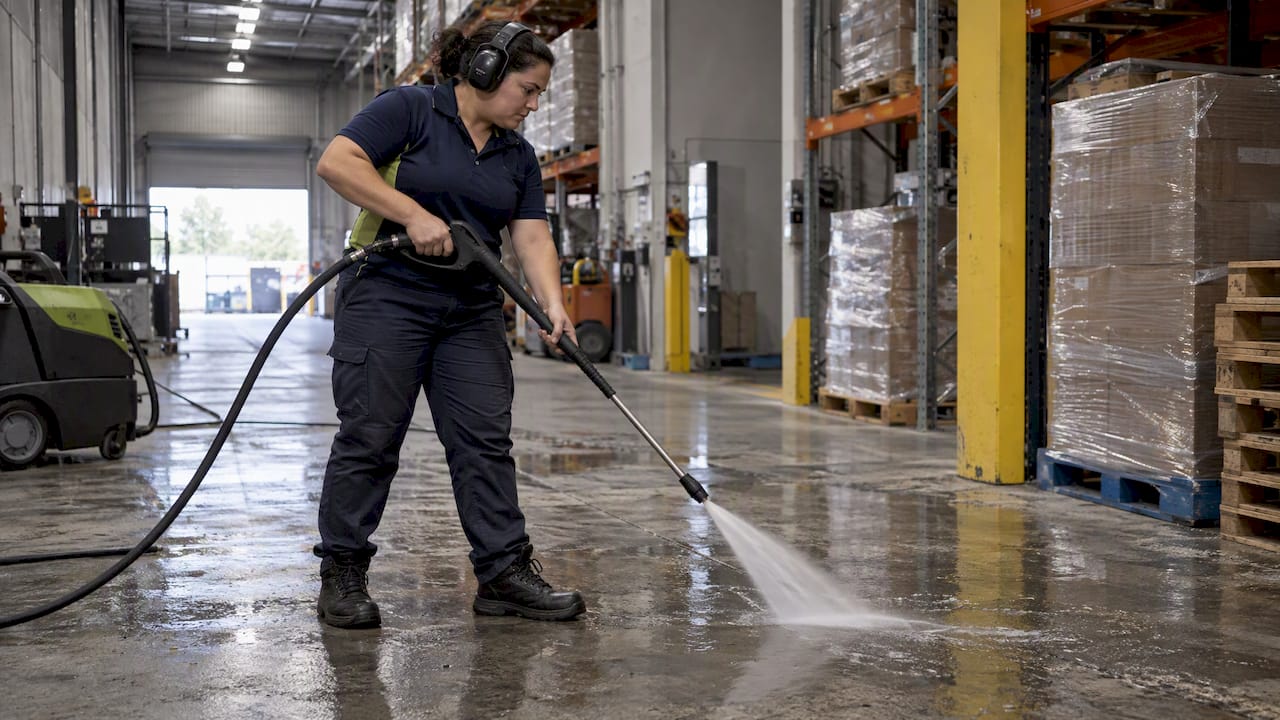
Equipment and operating practices can let clients fold sweeping into broader sustainability commitments rather than treating it as an isolated task.
Booking a mechanical sweeping service
Getting these benefits in practice starts with a clear brief: tell us the site area, your main objective (amenity, safety or stormwater compliance), and any access constraints like gate hours or loading activity. We will ask about operator competency evidence and disposal arrangements as part of scoping the job, so the service matches your site rather than a generic schedule. Request a quote through our mechanical sweeping and related services page and we will put together a schedule built around your site’s traffic and risk profile.
FAQ
What are sweeper machines used for?
Sweeper machines are used to clear litter, sediment, oil residue and debris from roads, car parks, construction sites and other large paved areas. They support stormwater source control, pavement protection and slip and trip hazard reduction across high-traffic commercial and public spaces.
Is sweeping or vacuuming more effective?
Mechanical sweeping covers large paved areas faster and handles bulk debris and gross pollutants more efficiently than vacuuming alone. WorkSafe Queensland’s review of cleaning methods notes that machine cleaning suits large areas well but needs regular equipment maintenance, and the right method depends on the surface and the type of contamination present.
Why are you not supposed to sweep at night?
Night sweeping is generally avoided on active sites because reduced visibility raises the risk to pedestrians, vehicles and the operator, and wind-direction planning and hazard checks required under operator competency standards like RIICBS316 are harder to manage safely in the dark. Daytime or supervised low-traffic windows let operators maintain proper exclusion zones and verify results.
What are the benefits of using a lawn sweeper?
A lawn sweeper collects grass clippings, leaves and light yard debris, improving the appearance of green areas and reducing material that can wash into stormwater drains during rain. The same source-control principle behind road and car park sweeping, removing debris before it is mobilised by water, applies at a smaller scale to lawn and garden maintenance.
Sources
- Effectiveness of street sweeping for stormwater pollution control (CRCCH technical report)
- Senate committee chapter on stormwater and land-based controls
- RIICBS316 Conduct pavement sweeping operations (National training register)
- SafeWork NSW: slips, trips and falls prevention guidance