
Keeping a plaza clean comes down to six disciplines: zoned cleaning schedules matched to footfall, frequent high-touch surface control, a working waste management plan, correctly selected tools and chemicals, measurable KPIs with regular audits, and environmental controls that keep wash water out of stormwater drains. Facility managers own the overall standard, cleaning contractors execute daily and weekly tasks, and tenants share responsibility for waste segregation and spill reporting. High-touch zones need attention several times a day, while deep cleans and audits typically run weekly to monthly.
TL;DR:
- Inspect restrooms every two to four hours for supplies, floors, and fixtures, and patrol entrances for litter every one to two hours during trading.
- Clean food court and restroom surfaces with detergent before disinfecting, then leave the product wet for its full stated dwell time.
- Match bin types and signage to actual waste streams and tenancy, then track diversion and overflow to distinguish education gaps from insufficient capacity.
- Route wash water to a trade waste bay connected to the sewer, and size bunds to contain the largest container plus 10%.
- Run weekly spot audits and monthly formal reviews with documented corrective actions, and track spill response times and restroom inspection pass rates consistently.
Table of Contents
- 1. Six core practices every plaza must get right
- 2. Area-by-area procedures for entrances, corridors, restrooms and carparks
- 3. Waste management and bin strategy for plazas
- 4. Choosing tools, equipment and cleaning products
- 5. Staffing, SOPs and quality control
- 6. Environmental compliance and stormwater controls
- 7. Sample cleaning schedule and quick-start checklist
- 8. Handling and prevention of pest infestations in plaza areas
- 9. Emergency spill response protocols and hazardous material handling
- 10. Special considerations for seasonal cleaning challenges
- How Sydney Sweep and Scrub supports plaza cleaning standards
- FAQ
- Sources
1. Six core practices every plaza must get right
Before drilling into area-specific tasks, it helps to lock in the fundamentals that apply across the whole site.
Zoning sorts the plaza into high, medium and low footfall areas, each with its own cleaning frequency. Entrances, food courts and public restrooms sit in the high-footfall tier and need multiple passes a day, while quiet corridors or back-of-house walkways can run on a daily or even alternate-day cycle.
High-touch surfaces, doors, handrails, lift buttons and restroom fittings need more frequent attention than general floor areas, with disinfection recommended several times a day in high-risk settings such as food courts and amenities blocks according to government guidance on routine cleaning and disinfection.
The remaining disciplines round out the checklist:
- Waste management plan: categorise streams, place bins where tenants and shoppers will actually use them, and back it with clear signage.
- Chemical safety: keep a Safety Data Sheet on file for every product, label containers correctly and store liquids in a bunded, covered area.
- KPIs and audits: track restroom pass rates, spill response times and patrol completion, then review them on a fixed schedule.
- Environmental guardrails: never let wash-down water run into a stormwater drain; route it to a bunded bay with a sewer or trade waste connection.
Each of these feeds into the area-by-area procedures below, and none of them works in isolation.
2. Area-by-area procedures for entrances, corridors, restrooms and carparks
Different zones carry different risks, so the tasks, tools and frequencies shift accordingly.
- Entrances and common exterior areas. Mechanical sweeping clears grit, leaves and litter before they get tracked indoors, and entrance mats need checking and shaking out or replacing several times a day in wet weather. A standing litter patrol every one to two hours during trading keeps the first impression intact, since this is the zone shoppers judge the whole plaza by.
- Corridors and seating areas. Damp dusting of rails, ledges and seating frames removes grime that dry dusting just redistributes, and spot cleaning deals with scuffs and spills as they happen rather than waiting for the next scheduled pass. Upholstered seating benefits from a scheduled vacuum and periodic professional extraction clean, since fabric holds odour and soil far longer than hard surfaces.
- Restrooms. These need an inspection checklist every two to four hours covering consumables (soap, paper, sanitiser), floor condition and fixture cleanliness, with a documented deep clean at least daily. Restrooms and toilets are explicitly named among the high-touch areas that drive public health guidance for crowded venues, including recommendations for visible hygiene signage and accessible hand sanitiser stations.
- Food courts. A written spill response protocol matters more here than anywhere else in the plaza, because grease and liquid spills create slip hazards fast. Surfaces around food preparation and seating need detergent cleaning before any disinfectant is applied, since grime shields germs from disinfectant contact, and tabletops should be wiped down between patrons wherever tenancy agreements allow it.
- Carpark and loading areas. Mechanical sweeper schedules, usually several passes a week depending on footfall, remove dust, grit and debris that would otherwise scratch vehicles and clog drainage. Oil and fuel stains need targeted remediation rather than routine sweeping, and any graffiti or acute spill should trigger pressure washing on a priority basis rather than waiting for the next scheduled visit; our guide on cleaning common areas covers the lobby and corridor side of this in more depth.
Loading docks deserve particular attention because they combine heavy vehicle traffic, waste staging and public access points in one compact space, which raises both slip and contamination risk if any single task slips.
3. Waste management and bin strategy for plazas
A waste management plan (WMP) is the document that turns bin placement from guesswork into a system. It starts by defining the waste streams the plaza actually generates, general waste, recycling, organics from food tenancies and cardboard, then matching bin types and numbers to footfall and the tenancy mix rather than a flat per-square-metre formula.
- Match inside to outside: internal bins should mirror the stream options available in the external compound, so tenants and shoppers aren’t guessing.
- Signage and tenant packs: clear, consistent signage plus an information pack for new tenants cuts contamination rates in shared bins, a point reinforced in waste management guidance for commercial facilities.
- Lease clauses and enforcement: build waste obligations into tenancy agreements so repeat offenders can be addressed without an awkward conversation every time.
- Collection logistics: confirm truck access, set maximum manual handling distances for cleaning staff and position compounds where illegal dumping is hard to do unnoticed.
Pro Tip: Review your waste management plan annually against foot traffic and tenancy turnover, not on a fixed calendar date, since a new food tenant can double organics volume overnight.
Diversion rate and bin overflow frequency are the two KPIs worth tracking consistently. A rising overflow count usually means bin capacity hasn’t kept pace with footfall, while a falling diversion rate points to a signage or tenant education gap rather than a collection problem. Treating waste as an ongoing business process, with regular reporting back to tenants, tends to lift diversion rates faster than treating it as a purely custodial task.
4. Choosing tools, equipment and cleaning products
The right equipment choice depends on surface type, area size and how often the task repeats. Mechanical sweeping and scrubbing suit large hardstand areas like carparks and plaza forecourts, where manual methods would take hours and still miss the gritty detail machines pick up; manual cleaning remains the right call for detailed spot work, upholstery and restroom fixtures.
- Floor-care machines: match disc or brush type to the surface (sealed concrete versus tiled plaza paving) and schedule routine maintenance so machines don’t become a cross-contamination risk between zones.
- Disinfectant selection: always clean with detergent first, since grime blocks disinfectant contact with surfaces, then apply the disinfectant for its full stated dwell time rather than wiping it off early.
- PPE and SDS review: every chemical on site needs a current Safety Data Sheet on file, reviewed when a product changes, with PPE selected to match the hazards listed in that sheet, as outlined in guidance on labelling and safety data sheets.
- Storage: liquids belong in bunded, covered storage with clearly labelled containers, away from drains and stormwater pits.
Our piece on disinfecting surfaces regularly walks through the clean-then-disinfect sequence in more detail for anyone setting up a restroom or food court protocol from scratch.
5. Staffing, SOPs and quality control
Standard operating procedures (SOPs) turn a zoning plan into something a cleaning crew can actually execute consistently, shift after shift, contractor after contractor.
- Draft SOPs by zone, not by task. A single SOP for “restrooms” that specifies frequency, products, dwell times and consumable checks is more useful to a new starter than a generic cleaning manual.
- Set measurable KPIs. Restroom inspection pass rate, average spill response time and percentage of completed patrols are concrete enough to report on weekly without needing judgement calls.
- Run a fixed audit cadence. Weekly spot audits plus a monthly formal review, each with a corrective action workflow attached, catch drift before it becomes a complaint.
- Write contracts with teeth. Scope of work, KPI targets, variation clauses for scope changes and a scheduled performance review protect both sides when circumstances shift mid-contract.
- Train on induction, then refresh. New staff need SDS familiarisation and site-specific induction before their first shift, with refresher audits scheduled rather than left to chance.
Pro Tip: Keep spill response time and restroom pass rate on the same monthly scorecard, since the two metrics usually move together and a dip in one often explains a dip in the other.
Partner guidance on commercial cleaning best practices for office hygiene covers similar scheduling and KPI principles from an office-cleaning angle, useful cross-reference material if your plaza includes attached office towers.
6. Environmental compliance and stormwater controls
One rule overrides every other cleaning decision outdoors: wash-down water never enters a stormwater drain. Stormwater drains run straight to waterways with no treatment, so detergent, oil residue or chemical runoff that enters one travels directly into local creeks and rivers, a point made explicitly in EPA guidance on stormwater protection.
- Wash bay design: any pressure washing or vehicle wash-down needs a bay that drains to sewer under a trade waste connection, never to an open stormwater pit.
- Bunding: liquid storage areas should be bunded to contain the largest container on site plus 10%, with covered storage to keep rainwater out of the containment area.
- Leak inspections: check bunded areas and storage containers on a set schedule, since a slow leak can sit unnoticed for weeks without a routine look.
- Spill kits: keep absorbent material, containment booms and PPE on hand at every wash point, with a documented immediate-action procedure for liquid spills.
- Fold it into the schedule: build stormwater checks and wash bay inspections into the same calendar as routine cleaning tasks, and confirm any outside contractor follows the same rules before they’re approved to work on site.
7. Sample cleaning schedule and quick-start checklist
A working schedule needs three tiers: daily, weekly and monthly, each with a clear owner.
Daily tasks:
- Patrol entrances, food courts and restrooms for litter and spills every one to two hours during trading.
- Clean and disinfect high-touch surfaces (door handles, handrails, lift buttons) on a fixed multi-pass schedule.
- Check and restock restroom consumables at each patrol.
- Empty and inspect external bins for overflow before close of trade.
Weekly tasks:
- Mechanically sweep carpark and loading areas.
- Deep clean food court floors and seating with a scrubber.
- Clear and sanitise bin compound areas.
- Extract-clean high-wear upholstery sections on rotation.
Monthly tasks:
- Service and inspect all cleaning machines for wear and cross-contamination risk.
- Run the formal KPI audit and document corrective actions.
- Review waste diversion rates against the previous month.
- Walk the bunded storage and wash bay areas for leaks or damage.
A typical staffing model splits a morning shift for deep tasks before trading starts and an afternoon shift for patrols and response, with a short handover note passed between shifts covering outstanding spills, restocks or incidents. Our overview of routine cleaning for public spaces sets out a similar patrol structure if you’re building this from a blank calendar.
8. Handling and prevention of pest infestations in plaza areas
Pest activity in a plaza almost always traces back to food waste, standing water or gaps in the building envelope, so prevention starts with the same waste and cleaning disciplines already covered rather than a separate pest programme bolted on afterwards.
Bin compounds need regular washdown and tight-fitting lids, since an overflowing or poorly sealed bin is the single biggest pest attractant in any food court precinct. Food court grease traps and floor drains should be cleaned on a fixed schedule rather than only when a blockage appears, because residual grease and food scraps left in drains draw cockroaches and rodents even when the visible floor looks clean.
A routine visual inspection, checking skirting, loading dock seals and bin compound perimeters for droppings, nesting material or gnaw marks, should sit on the same patrol checklist as litter and spill checks, so early signs get picked up by staff who are already on site rather than waiting for a dedicated pest inspection. Any confirmed activity should trigger an immediate review of nearby waste handling and storage practices alongside pest treatment, since treating the symptom without fixing the waste gap usually means the problem returns within weeks.
9. Emergency spill response protocols and hazardous material handling
A written spill response protocol needs to specify three things for every spill type likely on site: what counts as hazardous, who responds, and how fast.
Chemical spills from cleaning stock or tenant-stored liquids should trigger an immediate reference to that product’s Safety Data Sheet, since the correct containment method and PPE differ by chemical and guessing wrong can make a spill worse. Food court liquid spills carry a different priority: the slip hazard is immediate and the response needs to happen within minutes, with barricading and signage going up before the spill is even fully cleaned.
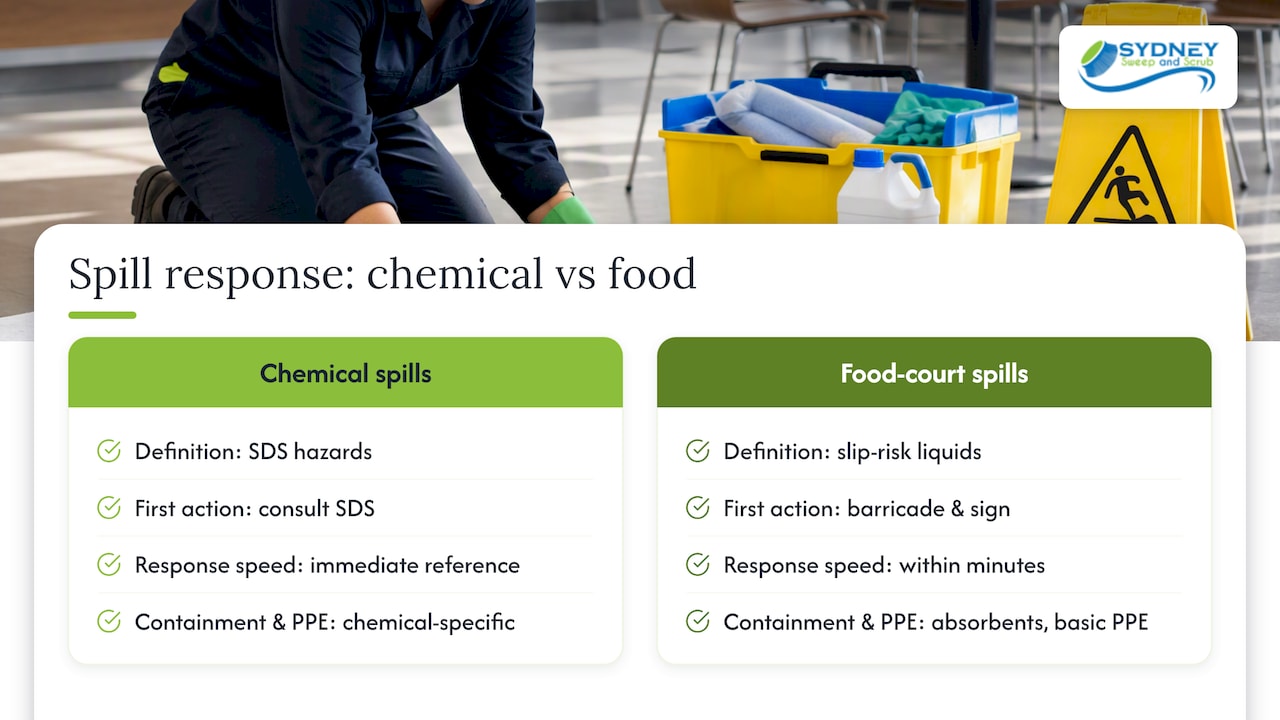
Every wash point and chemical storage area should have a spill kit within easy reach, stocked with absorbent material, containment booms, gloves and eye protection, so staff aren’t searching for equipment while a spill spreads toward a drain. Any spill near a stormwater pit needs immediate containment before cleanup starts, in line with the same stormwater protection principle that governs routine wash-down work.
Staff handling hazardous materials need training that goes beyond a one-off induction: refresher sessions on SDS interpretation and spill containment keep the response sharp when an incident is rare enough that muscle memory fades between occurrences.
10. Special considerations for seasonal cleaning challenges
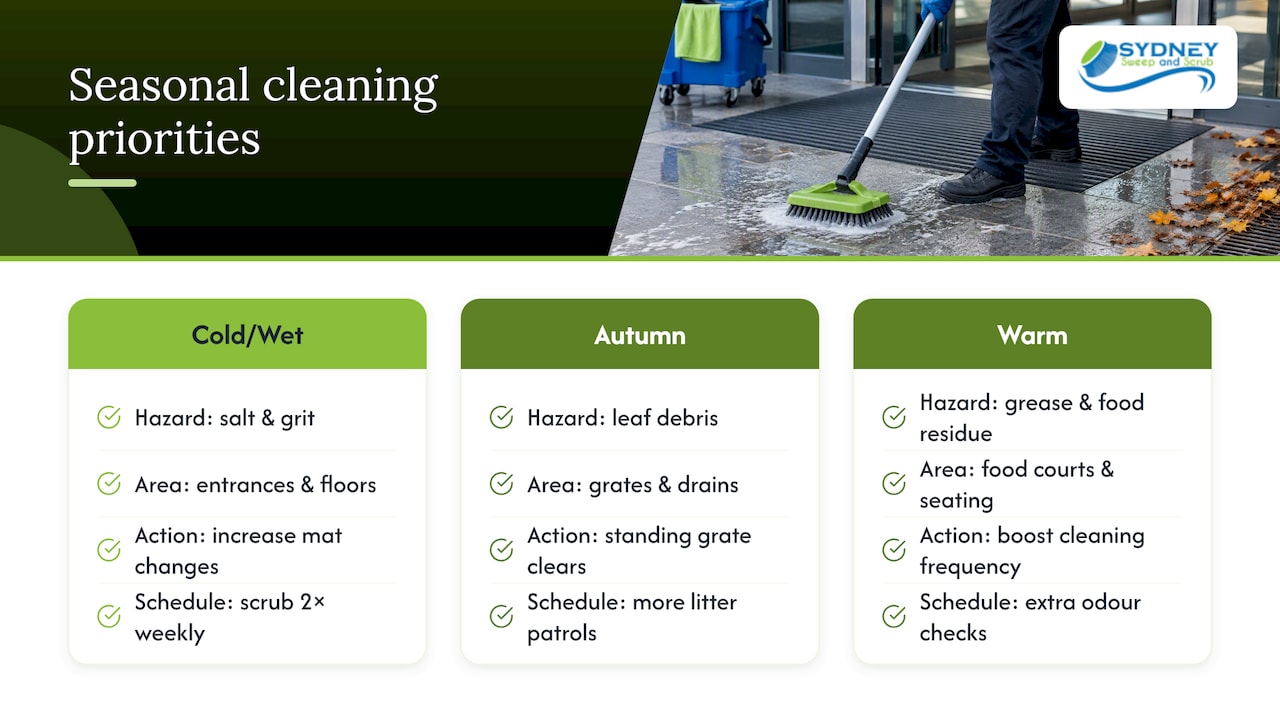
Seasonal shifts change what a plaza’s cleaning schedule needs to prioritise, even when the underlying tasks stay the same.
Cold months bring salt and grit tracked in from footpaths and carparks, which accelerates floor wear and creates a slip hazard distinct from the usual spill risk. Entrance matting needs more frequent changeovers in this period, and floor scrubbing schedules may need to shift from weekly to twice-weekly in high-traffic entry zones to clear residue before it builds into a visible film.
Autumn leaf debris clogs stormwater grates and drainage points around plaza forecourts and carparks, which raises the risk of pooling water, a secondary pest and slip hazard, if grates aren’t cleared on a standing schedule rather than only after visible blockage. Wet weather generally also means entrance mats and litter patrols need to run more frequently, since foot traffic carries more debris indoors per visit.
Warmer months bring the opposite problem in food courts and outdoor seating: higher ambient temperatures accelerate grease and food residue breakdown, which can intensify odour and pest attraction unless cleaning frequency in those zones increases to match. Building these seasonal adjustments into the standing schedule, rather than treating them as exceptions, keeps the plaza consistent across the year instead of scrambling each time the weather turns.
How Sydney Sweep and Scrub supports plaza cleaning standards
We built our service range around exactly the tasks this checklist covers, so a plaza manager can hand off the physical work without losing control of the standard. Crews can provide mechanical sweeping and scrubbing for carparks and forecourts, pressure washing for stains and graffiti, rubbish removal for bin compound clean-outs, and automated robotic cleaning for large hardstand areas that need consistent daily coverage.
- Crews are trained on bunded wash procedures that keep wash-down water out of stormwater drains.
- Work is done according to documented schedules that match the zoning and frequency principles set out above.
- Services can be provided using carbon-neutral practices, supporting a plaza’s own sustainability goals.
If your plaza needs a recurring maintenance contract or a one-off deep clean, request a quote through our commercial cleaning page and we’ll scope the site against the schedule that fits your footfall.
FAQ
What is the 5 5 5 rule for cleaning?
There’s no single, widely recognised “5 5 5 rule” in commercial or plaza cleaning standards; the phrase is more common in household cleaning content than in facility management guidance. For plaza operations, frequency decisions are better based on zoning and footfall tiers rather than a fixed numeric rule.
What is the 6/10 rule for cleaning houses?
Like the 5 5 5 rule, the 6/10 rule is a household cleaning concept rather than a standard used in commercial facility management. Plaza cleaning schedules are built around zoned frequency and documented SOPs instead of a fixed household ratio.
What are the 5 basic cleaning principles?
Commercial cleaning guidance generally centres on cleaning before disinfecting, using the correct dwell time for any disinfectant, matching product and PPE to the Safety Data Sheet, keeping high-touch surfaces on a frequent cycle, and documenting schedules so standards stay consistent across shifts, as reflected in routine cleaning and disinfection guidance and WHS facility management guidance.
What is the golden rule for cleaning?
The consistent rule across commercial cleaning guidance is to clean with detergent before applying any disinfectant, since grime and soil block a disinfectant’s contact with the surface it’s meant to treat. The second non-negotiable is environmental: wash-down water must never enter a stormwater drain, as set out in EPA guidance.
How often should a plaza’s high-touch surfaces be cleaned?
High-touch surfaces such as door handles, handrails and restroom fittings should be cleaned and disinfected several times a day in high-traffic or high-risk settings like food courts and amenities blocks. The exact frequency depends on footfall, with quieter zones needing less frequent attention than entrances and restrooms.
Sources
- Australian government guidance on cleaning and disinfection
- Safe Work Australia — Managing the work environment and facilities (model code of practice)