
Robots win for large, repeatable floor areas like warehouses and multi-level car parks, while manual teams remain the better choice for cluttered, irregular or small spaces that need detail work. Most real-world operations land on a hybrid model, where machines handle bulk floor care and people cover touch-points and edge cases. The practical next step is a site survey or a short pilot before committing to either.
TL;DR:
- Robots are most effective for large, open, and predictable floor areas, where they provide consistent coverage and support audit requirements.
- Manual cleaning remains necessary for cluttered, irregular, or small spaces that require detailed touch-point work and immediate adaptation.
- Hybrid models combining robotic and manual cleaning are common, with pilots recommended to tailor deployment based on site-specific layouts and workflows.
- Proper maintenance, infrastructure planning, and staff training are crucial to ensuring robot uptime and performance over their lifecycle.
- Cost-effective ROI depends on area size, cleaning frequency, and fleet scale, with leasing or contractor services often better for smaller or variable spaces.
Table of Contents
- Benefits of robotic cleaning
- Strengths and limitations of manual cleaning
- Efficiency and coverage: a side-by-side practical comparison
- Cost, ROI and procurement variables
- WHS, compliance and workforce implications
- How to plan and pilot a hybrid deployment
- Maintenance, uptime and lifecycle considerations
- How we help you trial and run hybrid cleaning
- FAQ
- Sources
Benefits of robotic cleaning
Robots generate a mapped, repeatable cleaning pattern every time they run. For facility managers, that means you get coverage reports rather than a supervisor’s best guess, which matters when a tender or audit asks for proof of service.
Freeing staff from repetitive floor passes is the other big gain. Once a machine takes over mopping or scrubbing large expanses, your cleaning team can shift to touch-points, washrooms and the hygiene-critical areas a robot cannot judge well.
- Consistency: mapping software and sensor logs prove exactly where a machine has cleaned and when.
- Labour reallocation: staff move from repetitive floor work to detail and touch-point cleaning.
- Extended hours: some machines run overnight or continuously, cutting into backlogs without extra rostering.
- Resource savings: depending on the machine type, water and chemical use can drop compared with manual mopping.
Industry reporting on Australian robotics adoption shows facilities are moving robots from trial projects into standard operations for large, repeatable floor areas, largely because the consistency and audit data support tender requirements and multi-site standardisation (Industry Update). Facilities seeing the strongest return tend to be large warehousing operations, big-box retail floorplates and portfolios managing several sites under one contract, where the fixed cost of deployment is spread across a lot of floor area.
Strengths and limitations of manual cleaning
Humans still beat machines in spaces that do not follow a predictable layout. Cluttered storerooms, multi-level stairwells, tight plant rooms and anywhere with constantly shifting furniture or stock all favour a person who can adapt on the spot. Detailed or high-touch cleaning, door handles, switches, bathroom fittings, also remains a manual task because no commercially available floor robot handles it.
Labour cost comparisons are rarely as simple as an hourly rate. The Cleaning Award sets minimum engagement hours, casual and part-time loadings, and allowances that apply to contract cleaning staff, and these provisions shift the real cost of a manual shift well beyond the base wage. Rostering around minimum hours can also make small, scattered jobs more expensive per square metre than they first appear.
Manual work carries its own consistency risk. Fatigue late in a shift, variation between different cleaners and the absence of any automatic record of what was actually covered make manual-only operations harder to audit.
- Flexibility: people adapt instantly to clutter, obstacles and layout changes.
- Detail work: touch-points and fittings still need hands-on cleaning.
- Judgement calls: spills, hazards and one-off messes are spotted and handled on the fly.
- Where it’s the only option: small sites, heritage buildings and spaces with heavy daily reconfiguration.
Efficiency and coverage: a side-by-side practical comparison
Cleaning rate is the simplest number to compare, but it needs context. A robot’s square-metre-per-hour figure assumes a reasonably open floor plan; add stairs, tight corners or dense racking and that rate drops fast, sometimes to the point where a manual crew is faster for that specific zone. The way to estimate your own figure is to measure the open, repeatable floor area separately from the broken-up zones, and model each with its own expected rate rather than one blended number.
Where robots pull ahead is auditability. A map and a sensor log tell you exactly what was covered and when, which supports quality assurance in a way a manual run sheet cannot. Academic research on adaptive robotic cleaning strategies found that adjusting a robot’s route and schedule to real conditions, rather than running a fixed static pattern, improved cleaning efficiency by about 14.1% and cut energy consumption by about 11.8% compared with conventional scheduled runs (Nature).
- Open floors: robots typically hold a steady, repeatable rate across large, unobstructed areas.
- Complex layouts: edges, stairs and dense furniture usually still need a manual pass.
- Audit trail: sensor logs and maps give you proof of coverage that manual checklists cannot match.
Cost, ROI and procurement variables
The purchase-versus-managed-service decision usually comes down to how much floor area you have and how often it needs cleaning. Buying a machine outright suits a single large site with daily, predictable cleaning needs; leasing suits a site still testing demand; a contractor-managed service suits anyone who wants the equipment, training, maintenance and compliance handled without the capital outlay. For a deeper look at these trade-offs, our guide to automated cleaning’s pros and cons and our piece on hiring a contractor instead of buying a machine both work through the detail.
When modelling ROI, focus on a handful of levers rather than a single payback number:
- Area cleaned per shift, since a bigger daily footprint spreads fixed costs further.
- Labour rate comparisons, adjusted for Award minimums and loadings rather than a flat hourly figure.
- Maintenance and consumables, including brushes, batteries and filters over the machine’s life.
- Storage and charging infrastructure, which adds setup cost that single-site buyers often underestimate.
- Scale across multiple sites, where one contract or one fleet can lower the per-site cost significantly.
Pro Tip: Model ROI on the repeatable floor area alone first, then add the irregular zones as a separate manual-labour line so the two don’t distort each other.
Procurement advantages go beyond the balance sheet too. Documented coverage reports strengthen tender submissions, and demonstrable WHS outcomes can matter as much as price in a competitive bid. Our guide to cost-effective commercial cleaning walks through how to weigh these non-financial factors against raw cost.
WHS, compliance and workforce implications
Safe Work Australia identifies hazardous manual tasks, repetitive lifting, pushing, pulling and awkward postures, as the leading cause of musculoskeletal disorders in Australian workplaces (Safe Work Australia). Automating repetitive floor scrubbing and sweeping removes a chunk of that repetitive physical load, which fits squarely into the hierarchy of controls that a PCBU is expected to apply when managing these risks.
On the cost side, the Cleaning Award still shapes rostering and labour-cost modelling even once robots take on part of the workload, because minimum engagement hours and penalty rates apply to whatever manual hours remain.
Cleaners who are treated as teammates to new technology, rather than as being replaced by it, report improved job satisfaction, and effective integration depends on clear communication and training rather than the technology alone.
(Nottingham Repository)
- Risk reduction: automation removes a share of repetitive manual handling tied to MSD risk.
- Rostering: remaining manual shifts still sit under Award minimums and loadings.
- Change management: involve staff early, explain what changes and what does not, and retrain rather than replace where possible.
How to plan and pilot a hybrid deployment
Start with a site assessment covering floor types, obstacles, power access, storage space for the machine and the scheduling windows available for cleaning, including options for advanced pool technology such as robotic cleaners for plunge pools. This single step prevents most of the early mismatches between what a robot can do and what a site actually needs.
- Map the floor into open, repeatable zones and irregular zones that will stay manual.
- Set pilot metrics upfront: coverage percentage, time saved and a quality check against the existing standard.
- Run the pilot for a defined period, long enough to cover normal operational variation, not just a quiet week.
- Train operators and cleaning staff together, so the robot is understood as a tool the team runs, not a replacement working around them.
- Review against the metrics before deciding on a wider rollout or a managed contract.
Pro Tip: Pick one metric the whole team can see daily, such as area covered, rather than a complex dashboard nobody checks.
The most common pilot mistakes are vague success criteria and no maintenance plan from day one. Smaller, simpler units often deliver the best early wins because they need less training and less storage space while still proving the concept (IncLean).
Maintenance, uptime and lifecycle considerations
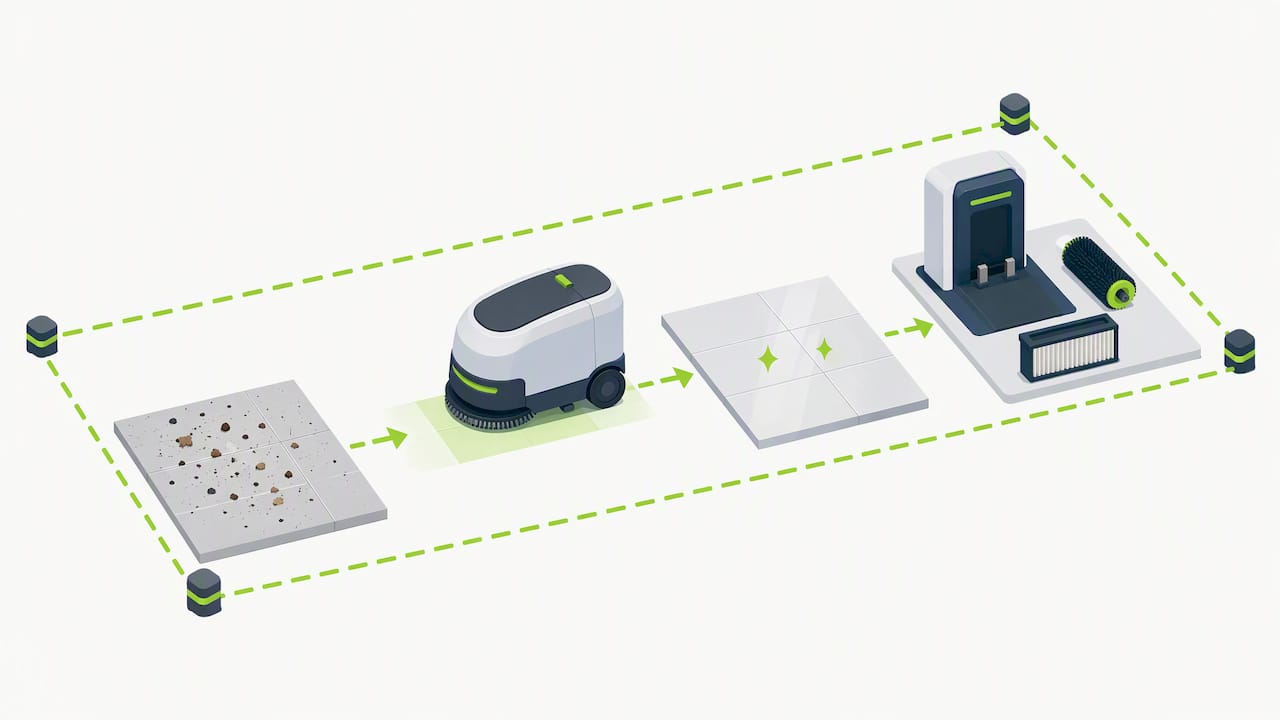
Daily checks on brushes, filters and battery charge keep a machine running at its rated performance, while a weekly inspection catches wear before it causes downtime. Charging and storage infrastructure needs planning before purchase, not after, and spare parts for brushes and filters should be kept on hand rather than ordered reactively.
Who handles this work depends on your model: owned machines put maintenance on your own team’s plate, while a contractor-managed service folds it into the service cost. Neglected maintenance is the most common reason robots underperform their rated coverage, and a documented maintenance log is what protects both uptime and your evidence trail for audits.
- Daily: check brushes, filters and charge level before each run.
- Weekly: inspect for wear, update software and review coverage logs.
- Infrastructure: confirm charging and storage space before committing to a purchase.
- Ownership: decide upfront whether maintenance sits with your team or a managed contractor.
How we help you trial and run hybrid cleaning
You can test automated robotic cleaning alongside mechanical sweeping, scrubbing and traditional crews without buying a robot outright. A site survey can identify floor types, obstacles and scheduling windows, enabling a pilot with reporting that shows coverage and comparisons with current service.
- Site survey: a warehouse or car park can be assessed before recommending an approach.
- Pilot runs: test automated robotic cleaning on a defined area before any long-term commitment.
- Hybrid crews: combine robotic floor care with our warehouse cleaning and carpark cleaning services for touch-points and detail work.
- Reporting: coverage data can be used for internal review or tender submissions.
If you manage a large floor area and want to see how robotic cleaning performs on your own site, request a site assessment through our automated robotic cleaning page and we will scope a pilot from there.
FAQ
What are the downsides of using a robotic vacuum cleaner?
Robots struggle with cluttered layouts, tight corners, stairs and complex furniture arrangements, so these areas usually still need a manual pass. They also depend on regular maintenance, brushes, filters and battery checks, and neglecting this is a common reason performance drops below expectations (IncLean).
Are robotic cleaners worth it?
For large, repeatable floor areas like warehouses, big retail floors or multi-site portfolios, robots tend to deliver strong value through consistent coverage and documented reporting. For small or highly irregular spaces, a manual team or a hybrid approach is usually the more practical and cost-effective option.
Do robot cleaners actually work?
Robots do clean effectively on open, repeatable floor areas, and adaptive scheduling strategies have been shown to improve cleaning efficiency by about 14.1% and cut energy use by about 11.8% compared with static-schedule runs (Nature). Performance in complex or cluttered spaces is more limited, which is why most commercial sites pair robots with manual detail cleaning.
How many times a week do you run your robot vacuum?
This depends entirely on foot traffic, floor type and the standard your site needs to maintain, so there is no single correct frequency. A short pilot with defined coverage and quality metrics is the most reliable way to work out the right schedule for a specific site.
Sources
- Safe Work Australia — hazardous manual tasks
- Nature — adaptive robotic cleaning efficiency study
- Fair Work — Contract cleaning award (MA000022)
- IncLean — Robots on the march