
Stormwater must only carry clean rainwater, so the single most important action is stopping pollutants at the source. After that, two things keep the system working: gross pollutant traps and inlets need regular maintenance, and heavy or hazardous clean-ups, like oil spills or flooded sites, call for a professional contractor.
TL;DR:
- Regular inspection and maintenance of gross pollutant traps and inlets are essential to prevent bypass and keep stormwater clean.
- Proper disposal of wash water and debris, along with dry cleaning methods, significantly reduces pollutant runoff into stormwater systems.
- Construction sites must implement sediment control measures like silt fences and inlet protection, with inspections before and after rain events.
- State regulations strictly prohibit pollutant discharge into stormwater drains and enforce penalties for violations, making timely compliance crucial.
- Visual signs such as oil sheens or sediment buildup indicate upstream issues, and scheduled inspections help prevent pollution from escalating.
Table of Contents
- What stormwater is and why keeping drains clean matters
- Common pollutants and the Australian legal framework
- Daily and scheduled cleaning for homeowners and property managers
- Construction site controls for erosion and sediment
- Keeping gross pollutant traps and treatment assets working
- Who is responsible: council, owners and businesses
- When to call in a professional contractor
- Stormwater pollution indicators and how they’re monitored
- Government programs supporting stormwater pollution reduction
- Best practices for urban and rural properties
- A professional option for ongoing stormwater cleaning
- FAQ
- Sources
What stormwater is and why keeping drains clean matters
Stormwater is rain that falls on roofs, roads, car parks and paved surfaces and flows into gutters, pits and pipes. Unlike sewage, it runs untreated straight into local creeks, rivers, wetlands or the ocean. Whatever sits on the ground when it rains, whether that is oil, detergent, leaves or litter, gets carried along with it.
When rain hits a dirty surface, it mobilises everything loose: sediment, rubbish, chemical residue. The results show up downstream as algal blooms fed by nutrients, blocked pits that cause localised flooding, and waterways that gradually become unsafe for swimming or fishing.
For a homeowner or site manager, this plays out in small daily moments:
- Hosing driveway grime towards the gutter instead of sweeping it up first
- Letting leaf litter build up over a grated drain until a storm pushes it all through at once
- Leaving a paint tray or oil drip near an outdoor drain overnight
None of these feel like pollution events at the time, but each one sends contaminants straight into the stormwater network.
Common pollutants and the Australian legal framework
Stormwater carries a predictable mix of contaminants when surfaces aren’t kept clean:
- Oils and greases from vehicles, machinery and food preparation areas
- Detergents and cleaning chemicals, including those used for driveway or vehicle washing
- Paints, solvents and construction residues
- Sediment and soil from exposed ground or poorly managed sites
- Green waste such as grass clippings and leaf litter
- Litter and plastics, including cigarette butts and packaging
The guiding principle behind Australian regulation is simple: the drain is just for rain. NSW EPA guidance built around that phrase sets out practical bunding, storage and wash-bay measures, including sizing a bund to contain the largest container on site plus 10%, to stop pollutants reaching stormwater in the first place.
Discharging pollutants into stormwater drains is prohibited under state law and can attract fines, Environment Protection Orders and prosecution, with penalties varying by state and by the severity of the incident. States each run their own enforcement instruments, such as environment protection acts covering pollution of waters, and enforcement typically escalates from an individual warning or fine through to formal orders and, for repeat or serious offenders, prosecution.
Daily and scheduled cleaning for homeowners and property managers
Good stormwater habits are mostly about sequencing: remove debris before water ever touches it.
- Dry clean first. Sweep or vacuum litter, leaves and dust before washing anything, rather than hosing it towards a gutter or grate.
- Clear gutters and grates safely. Wear gloves, use a stable ladder or long-handled tool for roof gutters, and bag debris for general waste rather than leaving it to wash back into the drain.
- Manage wash water properly. Capture roof runoff where you can, use a bunded wash bay for vehicles or equipment, or direct wash water to a trade-waste connection rather than letting it flow to a stormwater pit.
- Inspect on a cadence. Check pits, grates and gutters monthly, again after any significant storm, and act immediately if you notice pooling, slow drainage or an oily sheen.
Small businesses face the same logic at a larger scale. EPA South Australia’s guidance for small business and industry recommends dry cleaning methods, bunding, spill kits and confined wash areas routed to sewer, and specifically discourages hosing surfaces towards stormwater. Switching from hosing to mechanical sweeping and vacuuming avoids contaminated wash water altogether, which also reduces the chance of contravening state pollution laws. Our guide to pressure washing techniques for paved surfaces covers how controlled water use limits oil and sediment transfer to drains.
Pro Tip: Keep a small dustpan and stiff broom near any outdoor drain so loose debris gets lifted out in seconds rather than left for the next downpour.
Construction site controls for erosion and sediment
Construction sites are one of the biggest sources of sediment-laden runoff, and the controls are well established.
- Silt fences, straw bales and gravel sausages placed along site perimeters catch sediment before it leaves the boundary.
- Inlet protection, such as sandbag barriers or fabric socks, stops sediment entering stormwater pits directly.
- Stabilised entry and exit points and wheel-wash systems stop soil being tracked onto public roads.
Sediment basins need regular attention rather than a set-and-forget approach. Melbourne Water’s construction standards favour a prevent-first approach, since early controls like covering stockpiled materials, regular dry sweeping and perimeter barriers reduce the need for expensive remediation later. A commonly used de-silting trigger is to clear sediment once it reaches around one third of a measure’s design depth, whether that’s a silt fence, gravel sausage or basin.
- Confirm whether a Soil and Water Management Plan is required: in Queensland, sites over 2,500 square metres typically need one, with specific rules also applying to sites between 250 and 2,500 square metres.
- Inspect controls daily while works are under way.
- Reinspect and reinforce controls immediately after any rain event.
Our construction site cleaning and erosion control support sits alongside broader compliance planning; sitechief’s compliance guide for construction managers is a useful companion for managing documentation across a project.
Keeping gross pollutant traps and treatment assets working
Gross pollutant traps (GPTs) and litter baskets are designed to catch rubbish and coarse sediment before it reaches a waterway, but they only work while there’s room left to catch anything.
- A full basket or trap starts to bypass, letting litter and sediment pass straight through during the next rain event.
- Baskets need lifting and emptying on a schedule, with an extra check after any heavy rain.
- Larger GPTs need vacuum-truck access and clear documentation for handover to council, including as-constructed plans and a maintenance plan covering inspection frequency and costs.
Under-maintenance of GPTs is widely identified as a primary reason litter keeps leaking into Australian waterways. A national DCCEEW report on plastic leakage through stormwater systems found that GPTs are commonly installed but often under-maintained, and recommends inspection and cleanout every one to six months depending on local conditions, backed by periodic audits. Designing for maintenance matters just as much as scheduling it: sites need hardstand access for vacuum trucks and lifting equipment so baskets can be emptied without causing a secondary spill during the clean-out itself.
Who is responsible: council, owners and businesses
Responsibility usually splits at the property boundary. Private owners are responsible for pits, grates and inlets on their own land, while councils maintain the stormwater mains and public drainage network.
- Homeowners and strata managers must keep private inlets and pits clear of debris and free of pollutants.
- Businesses that wash vehicles, equipment or surfaces generally need trade-waste approval, and wash bays typically require pre-treatment such as an oil-water separator before any water reaches the sewer, never the stormwater system.
- Pollution incidents are reported to the local council or the relevant state EPA, both of which can investigate and enforce penalties.
When to call in a professional contractor
Some jobs go beyond a broom and a garden hose. It’s time to bring in a contractor for:
- Full gross pollutant trap cleanouts, which need vacuum trucks and licensed waste disposal
- Heavy sediment removal after major works or storm events
- Oil or chemical spills that need specialist containment and clean-up
- De-flooding a site where standing water has mixed with contaminants
When requesting a quote, ask what equipment will be used, what environmental safeguards are in place, how waste will be disposed of, and for evidence of insurance and maintenance records.
Pro Tip: A contractor who can show you a documented maintenance history for similar sites is generally a safer bet than one working from memory alone.
Stormwater pollution indicators and how they’re monitored
You don’t need a laboratory to spot early warning signs of stormwater pollution. An oily sheen on standing water, unusual foam near an outlet, discoloured runoff, or a build-up of sediment and litter at a pit are all visible indicators that something upstream needs attention.
Councils and water authorities typically combine site inspections with sampling of suspended solids, oils and nutrients at key points in the network, alongside visual audits of treatment assets like GPTs and sediment basins. For property managers and construction operators, the practical version of monitoring is simpler: scheduled inspections of pits, grates and traps, paired with a quick visual check after every significant rain event. Logging what you find, even just a photo and a date, builds a record that helps spot a recurring problem before it becomes a compliance issue. Sensors and automated level monitoring are increasingly used on larger treatment assets to flag when a trap is approaching capacity, reducing reliance on manual inspection alone.
For a homeowner, the same principle applies at a smaller scale: if a grate near your property regularly pools water or smells of chemicals after rain, that’s worth reporting to council rather than waiting for the next storm to make it worse.
Government programs supporting stormwater pollution reduction
State and local governments run a mix of regulatory and voluntary programs aimed at reducing stormwater pollution, from the erosion and sediment control rules construction operators must follow, to council-run education campaigns reminding residents that the drain is just for rain. Many councils support stencilling or signage programs near stormwater pits, flagging that they lead directly to local waterways rather than treatment plants, which helps shift everyday habits like hosing down driveways.
Melbourne Water and other catchment authorities also publish technical standards and guidance documents free for anyone to use, covering everything from sediment basin design to inspection schedules, which gives property managers and builders a consistent benchmark rather than guesswork. Some councils tie approval of larger developments to a requirement that treatment assets like GPTs come with a documented maintenance plan before handover, which keeps the obligation attached to the asset long after construction finishes.
For individual households and small businesses, support tends to be informational rather than financial: practical guides on dry cleaning methods, bunding and spill response, like those published by state EPAs, are designed to be followed without needing to buy specialised equipment. The common thread across these programs is prevention over cure: it is consistently cheaper and simpler to stop pollutants entering the system than to treat or remove them once they’re mixed into the stormwater network.
Best practices for urban and rural properties
Urban and rural properties face different stormwater pressures, so the priorities shift accordingly.
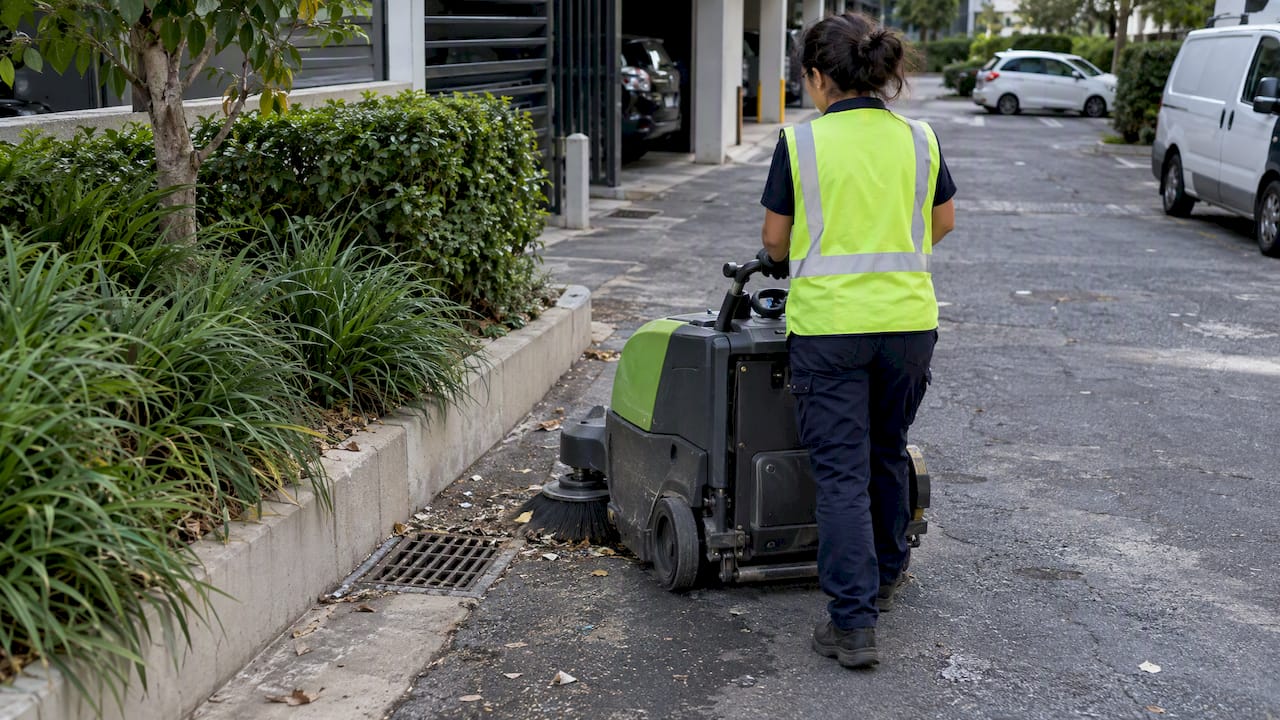
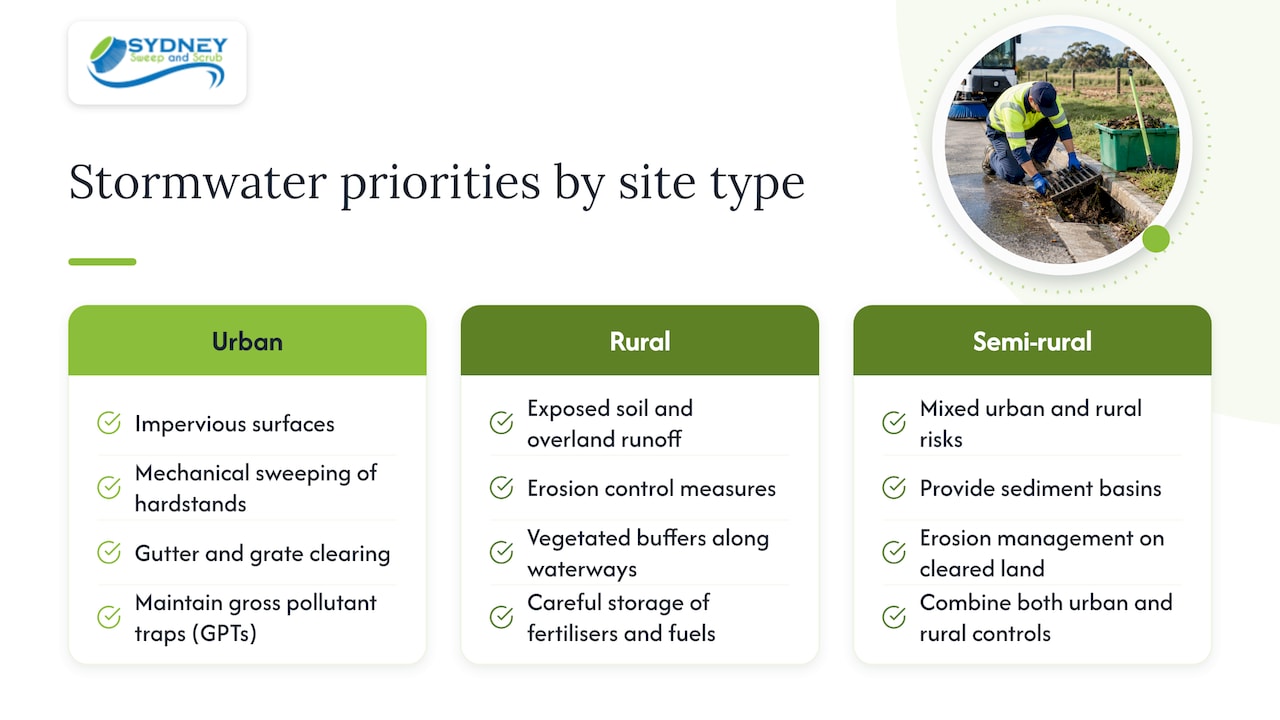
In urban areas, the challenge is impervious surfaces: roads, roofs, car parks and footpaths that don’t absorb anything, so pollutants travel fast and concentrated. Regular mechanical sweeping of car parks and hardstand areas, prompt gutter and grate clearing, and well-maintained GPTs matter most here, since there’s little natural filtration between the surface and the nearest pit. Higher-density sites, like apartment complexes or strata car parks, also see more frequent litter and vehicle-fluid contamination simply due to the volume of foot and vehicle traffic.
Rural properties deal with a different mix: larger areas of exposed soil, farm chemicals, and runoff from sheds, yards or unsealed driveways. Here, erosion control, vegetated buffers along waterways, and careful storage of fertilisers, fuels and chemicals do more work than drain maintenance alone, since the main risk is sediment and chemical runoff travelling overland rather than through a piped network. Construction sites in semi-rural growth corridors often sit between the two, needing both urban-style sediment basins and rural-style erosion management as land is cleared and built on.
A professional option for ongoing stormwater cleaning
For recurring sweeping, pressure washing, gross pollutant trap cleanouts or de-flooding work, we offer mechanical and industrial cleaning services using eco-friendly equipment and carbon-neutral operations. If your car park, warehouse or construction site needs a documented, repeatable cleaning routine, explore our mechanical sweeping, scrubbing and GPT services and request a quote.
FAQ
What are the Australian standards for stormwater drainage?
Standards vary by state and are set out through EPA guidance and water authority specifications rather than a single national code. Melbourne Water’s construction standards and Queensland’s erosion and sediment control guidance are two examples that set practical requirements for sediment controls and treatment measures.
How do you clean a blocked stormwater drain?
Start by clearing visible debris, leaves and litter from the grate by hand, wearing gloves, then check whether water flows freely once the surface blockage is removed. If the pit stays blocked or water pools well after the surface is clear, the blockage is likely further down the pipe and needs a professional with jetting or vacuum equipment.
Who maintains stormwater drains on private property in Victoria?
In Victoria, as in most Australian states, private property owners are generally responsible for stormwater pits and inlets within their own boundary, while the local council maintains the connecting mains and public network. If you’re unsure where that boundary sits for your property, your local council can confirm it.
How do professionals clean storm drains?
Professional stormwater cleaning typically combines vacuum trucks to remove sediment and debris from pits and gross pollutant traps, jetting equipment to clear blocked pipes, and documented disposal of the waste collected. For larger assets, this is paired with scheduled inspection and audit guidance to confirm the trap or pit stays within its design capacity between cleanouts.
Sources
- The drain is just for rain — NSW EPA guidance
- Approaches to prevent plastic leakage via stormwater systems within Australia (DCCEEW report)
- Erosion and sediment control — Queensland Government
- Stormwater management for small business and industry — EPA SA