
The fastest safe response to an oil spill on a parking garage floor is containment first, dry absorbent second. Stop the source if you can do it safely, cordon the area and protect any nearby drains, then cover the oil with cat litter or diatomaceous earth and let it soak before sweeping it up and sealing it. Only reach for water or degreaser once you have a way to capture and legally dispose of the resulting washwater.
TL;DR:
- Use containment measures such as drain covers or bunding before applying absorbent to prevent pollution from reaching waterways.
- Fresh oil spills respond best to dry absorbent treatment, leaving the area protected with barriers and reapplying absorbent as needed.
- Old or soaked-in stains require degreasing, scrubbing, and possibly hot-water cleaning, with wastewater carefully captured and disposed of legally.
- Different oils, like hydraulic fluids and brake fluids, may spread further and pose hazards, often requiring professional help for safe removal.
- Handling chemical and waste disposal correctly is crucial, with contaminated materials treated as hazardous waste and wastewater managed according to local regulations.
Table of Contents
- What to have on hand: materials, PPE and a simple spill kit
- Immediate dry-absorb method for fresh oil spills
- Treating old or penetrated stains: degreasing, scrubbing and hot-water cleaning
- Containment and wastewater: how to avoid moving pollution into drains
- Safe workflow and decision checklist: when DIY is enough and when to call professionals
- Professional approach: how Sydney Sweep and Scrub handles carpark oil cleanup
- Different oils need different handling: motor oil versus hydraulic fluid
- If you need a pro: how to get a quote and where to book
- FAQ
- Sources
What to have on hand: materials, PPE and a simple spill kit
A basic spill kit means you are not improvising halfway through a job. Keep absorbents, tools and protective gear together in one container near where vehicles are parked, so the response starts in seconds rather than minutes.
- Absorbents: kitty litter, diatomaceous earth or commercial oil-absorbent pads soak up free-flowing oil fast.
- Collection gear: a scoop, stiff broom and heavy-duty bags keep the used absorbent contained once it has done its job.
- Cleaning agents: a quick-break, phosphate-free degreaser works on residue, but check the safety data sheet before you use it on any surface.
- Tools for washwater: a stiff brush, squeegee, bucket and a hand pump or portable wet vac let you recover liquid instead of letting it run to a drain.
- PPE: nitrile gloves, splash goggles, chemical-resistant boots and a respirator when solvents are involved.
- Labelled waste containers keep contaminated absorbent separate from general rubbish until it is collected for disposal.
Immediate dry-absorb method for fresh oil spills
Fresh spills respond well to a dry method that never touches water, which means there is no contaminated runoff to manage. The sequence matters: skipping ahead to scrubbing before the free oil is gone just spreads it further.
- Isolate the area with cones or barrier tape so vehicles and pedestrians stay clear.
- Stop the source of the leak if it is safe to approach, such as a vehicle still dripping.
- Cover the oil generously with absorbent and leave it to dwell for the time stated on the product, usually 15 to 30 minutes.
- Sweep the saturated absorbent into a dustpan and bag it, then repeat the application if a sheen remains.
- Check the surface for slip hazard before reopening the area to traffic.
- Bag and label the used absorbent as contaminated waste for collection, following your local disposal rules.
Pro Tip: Lay absorbent in a ring from the outside in, rather than dumping it in the middle, so you are not pushing oil further across the floor.
Treating old or penetrated stains: degreasing, scrubbing and hot-water cleaning
A dark, wet-looking patch is usually fresh oil sitting on the surface. A dry, matte stain has likely soaked into the concrete, because the material is porous and holds oil well below the surface once it has had time to migrate.
Old stains need a different approach, and it has to be controlled from the start:
- Choose a quick-break degreaser and follow its safety data sheet, avoiding chlorinated solvents in any enclosed garage area.
- Apply the product, then agitate with a stiff brush or mechanical scrubber rather than relying on the chemical alone.
- Capture the rinse water as you go rather than letting it sheet across the floor to a drain.
- Treat hot-water pressure cleaning as the stronger option for penetrated stains, but only where the wastewater is contained for disposal.
Large car parks often need oil or grease separators fitted before wastewater can be discharged anywhere, and the discharge rules depend on the local authority, as per local regulations, as EPA SA guidance on wash bays sets out. Deep, long-standing stains may need mechanical grinding or several treatment passes, and some discolouration can remain permanently once oil has soaked into the concrete’s pores. Sydney Sweep and Scrub’s notes on what can be removed from concrete car park surfaces cover this same diagnosis in more detail.
Containment and wastewater: how to avoid moving pollution into drains
A clean-looking floor is not the goal if the oil just went down a drain instead. EPA NSW’s “the drain is just for rain” guidance is built on exactly this point: stormwater drains carry straight to waterways with no treatment, so anything washed into one becomes an environmental incident rather than a tidy-up.
Before any water touches the floor, put containment in place:
- Cover nearby drains with purpose-made drain covers or spill mats so nothing can run in.
- Use bunding or silt bags around the work area to hold rinse water where you can reach it.
- Set up a capture sump or portable bund for larger jobs where volumes are higher.
- Send captured washwater to a licensed liquid waste contractor or a site with a trade-waste agreement, rather than tipping it anywhere on site.
- On small jobs, a bucket and squeegee or a wet vac is often enough to collect the rinse for lawful handover.
Sewer discharge is sometimes permitted, but only with prior agreement from the water authority and usually after pre-treatment, as the EPA SA wash-bay guidance describes.
Safe workflow and decision checklist: when DIY is enough and when to call professionals
Small, fresh spills are well within DIY territory if you have a spill kit and clear drains to protect. Larger or uncertain jobs are a different calculation.
- Call a professional when the spill is large, the fluid is unidentified, or there is any risk of flammability.
- Escalate when stormwater drains sit close to the spill and you cannot guarantee containment.
- Bring in help for repeated leaks from the same bay, since that points to a vehicle or structural issue beyond surface cleaning.
- Avoid DIY on anything you are not confident handling safely, since illegal discharge, hidden contamination under a concrete slab and slip injuries are the common failure points.
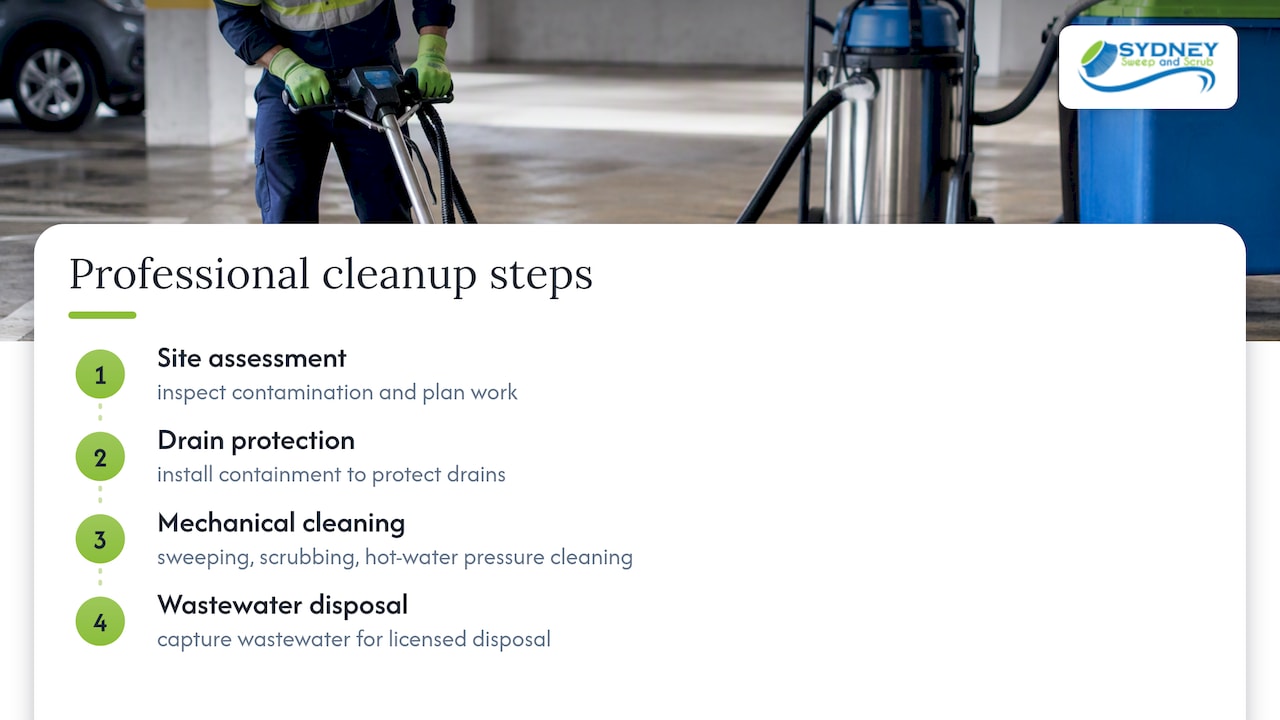
Professionals bring site inspection, drain protection, mechanical scrubbing or hot-water cleaning, wastewater capture and licensed disposal, often with documentation to prove the work was done lawfully. When requesting a quote, send photos of the stain, the approximate area, the location of nearby drains and when you need the work done.
Professional approach: how Sydney Sweep and Scrub handles carpark oil cleanup
A professional cleaning company may run mechanical sweeping, scrubbing and hot-water pressure cleaning on commercial sites, which covers the full range a stubborn oil stain usually needs. A typical job starts with a site assessment, moves to drain protection and containment, then uses mechanical cleaning with wastewater captured for licensed disposal rather than left to find its own way to a drain.
Some cleaning services offer eco-friendly, carbon-neutral cleaning options, allowing clients to integrate site cleaning into their sustainability reporting rather than treating it as a one-off expense. Details on that side of the operation sit on the carpark cleaning and sustainability page.
Property managers, strata committees and construction sites are the usual clients for this kind of work, generally because they are dealing with recurring contamination across a large area rather than a single isolated spill.
Different oils need different handling: motor oil versus hydraulic fluid
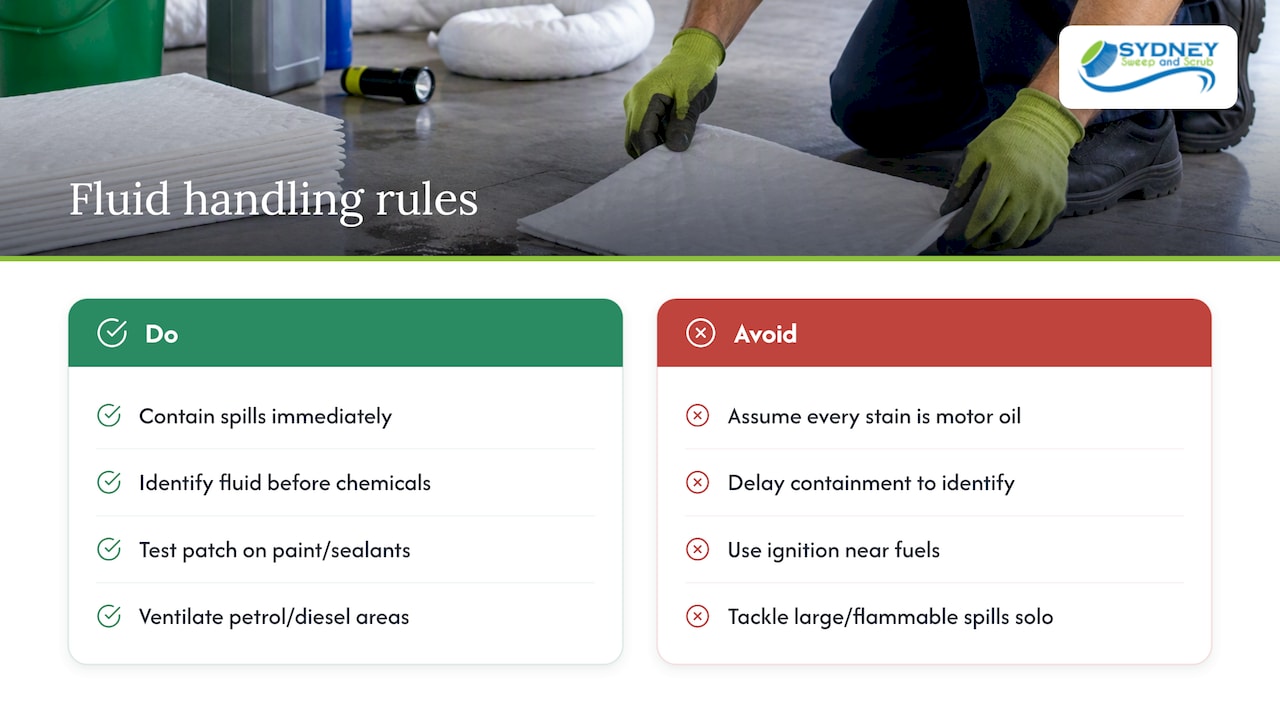
Not every stain in a garage is the same substance, and treating them identically wastes time or product. Motor oil is the most common culprit and responds well to the standard dry absorbent and degreaser sequence, since it is relatively stable and does not evaporate quickly.
Hydraulic fluid behaves differently. It is often thinner and spreads further and faster across a sealed floor than motor oil, so containment needs to happen sooner, before it reaches a wider area or a drain. Some hydraulic fluids are also flammable, which pushes a larger spill toward the “call a professional” category rather than DIY.
Transmission fluid and brake fluid show up less often but carry their own hazards: brake fluid in particular can damage painted surfaces and some sealants, so a quick test patch is worth doing before broad application of any solvent-based degreaser.
Diesel and petrol spills are a separate case again, since both evaporate faster than motor oil and carry a higher fire risk in an enclosed structure. Ventilation and ignition control matter here as much as absorbent choice. When the fluid type is not obvious from colour or smell, treat it as unknown and apply the same caution you would for a larger or hazardous spill: contain first, identify before escalating to chemical treatment.
If you need a pro: how to get a quote and where to book
If the stain is beyond a quick DIY clean, send photos of the affected area, the approximate size, what fluid is involved if known, and where the nearest drains sit. That is usually enough for an initial quote covering containment, cleaning method, wastewater disposal and a record of the work done.
Sydney Sweep and Scrub’s carpark cleaning and line marking service covers oil-affected bays directly, and the pressure washing page has more on the hot-water cleaning option for stains that have soaked into the concrete. Facilities with wider contamination across a site can also look at the full range of mechanical sweeping and scrubbing services for a broader clean beyond a single bay.
FAQ
How do you clean up oil in a parking lot?
Stop the source if it is safe, cordon the area, and cover the oil with a dry absorbent such as cat litter or diatomaceous earth. Let it dwell, then sweep it up and bag it as contaminated waste rather than hosing the area down.
What should you use to clean up oil in a garage?
For fresh spills, use a dry absorbent like diatomaceous earth or commercial absorbent pads first. For old, penetrated stains, a quick-break degreaser applied with a stiff brush can lift more, provided the rinse water is captured rather than left to run to a drain.
Can oil spills be completely cleaned up?
Free-flowing oil can usually be fully removed with prompt dry absorbent treatment. Oil that has soaked into porous concrete for some time may leave a permanent discolouration even after degreasing, scrubbing or hot-water cleaning, and can sometimes require mechanical grinding to fully resolve.
How do you clean old oil off a garage floor?
Diagnose whether the stain is wet and fresh or dry and set into the concrete, since old stains have usually penetrated the surface. Apply a suitable degreaser, agitate with a stiff brush or mechanical scrubber, and capture the resulting wastewater instead of letting it reach a drain.
What happens to oily rags and absorbent after cleanup?
Used absorbent and rags are treated as contaminated waste and need to be bagged, labelled and disposed of through an approved waste stream rather than general rubbish. Reusable industrial wiping rags, such as those available through wholesale recycled rag suppliers, are a practical option for sites doing this work regularly.
Sources
These sources informed the containment-first approach and the wastewater rules referenced above, and are worth checking against your own local requirements before any large clean-up.