
In Australia, the primary duty for warehouse hygiene sits with the person conducting a business or undertaking (PCBU) under the Work Health and Safety Act. Where a warehouse stores or handles food, the Food Standards Code also applies. Key actions include documenting a cleaning schedule, confirming your welfare facilities meet hand basin and consumable requirements, and maintaining records for cleaning, temperature, and pest control.
TL;DR:
- Warehouses storing food require strict temperature logging, calibration of probes monthly, and keeping products at least 100mm off the floor to prevent contamination.
- Cleaning schedules should be risk-based, covering daily sweeping, weekly deep cleaning, and monthly full-floor maintenance, tailored to traffic and product type.
- Documentation such as cleaning logs, temperature records, pest reports, and staff training records are essential for demonstrating ongoing hygiene compliance during inspections.
- Pest prevention depends on sealing entry points, monitoring bait stations, and managing waste and loading dock security to minimize pest access.
- Hygiene facilities must meet strict requirements with functional hand basins, adequate staff facilities, and regular checks to avoid inspection failures.
Table of Contents
- What warehouse hygiene standards apply in Australia?
- What must food-storage warehouses do differently?
- How do you build a risk-based cleaning programme?
- What hygiene testing should warehouses use?
- How do you stop pests and manage waste properly?
- What welfare and hand hygiene facilities are required?
- What records and audits do inspectors expect?
- Should you clean in-house or bring in a contractor?
- How does professional scheduled cleaning prove compliance?
- Sources
- FAQ
What warehouse hygiene standards apply in Australia?
Warehouse hygiene compliance in Australia rests on two overlapping frameworks, and most facility managers only know about one of them.
The first is workplace health and safety law. Under the model Work Health and Safety Act 2011, every PCBU carries a primary duty of care to keep the workplace safe, and that duty extends to housekeeping, dust control and the general cleanliness of the site. It’s not a suggestion buried in guidance material. It’s the legal foundation everything else sits on, and LegalVision’s overview of the WHS duty confirms the obligation covers keeping the workplace maintained in a clean, safe and accessible condition to minimise risk.
Sitting under that Act is the Managing the Work Environment and Facilities Code of Practice, published by Safe Work Australia. This Code is the closest thing Australia has to a rulebook for what “clean” actually means in a workplace. It sets expectations for hand-washing basins, general housekeeping, ventilation, lighting and the condition of floors and facilities, and it includes a checklist (Appendix B) that inspectors and managers alike use to review a site.
The second framework only kicks in if your warehouse stores, handles or distributes food. In that case, the Australia New Zealand Food Standards Code applies, specifically Standard 3.2.2 (Food Safety Practices and General Requirements) and Standard 3.2.3 (Food Premises and Equipment). These standards require premises to be built and maintained in a way that prevents contamination, and they set out temperature control obligations for potentially hazardous food, a point covered in detail further down.
A few things trip up managers who assume one national rulebook covers everything:
- WHS laws are harmonised nationally through model legislation, but each state and territory regulator (SafeWork NSW, WorkSafe Victoria, WorkSafe Queensland and others) enforces its own version, and minor differences exist in penalties and inspection processes.
- Victoria has not fully adopted the model WHS laws in the same form as other states, so Victorian warehouses should check WorkSafe Victoria directly rather than assuming national guidance applies word for word.
- The Food Standards Code is national and enforced through state and territory food authorities, with local council health inspectors commonly conducting site visits.
- Hazardous chemicals used in cleaning (degreasers, sanitisers, floor strippers) fall under the Model WHS Regulations, which govern storage, labelling and exposure monitoring.
If you manage a general storage or logistics warehouse with no food component, your obligations sit almost entirely with WHS law and the facilities Code. Add a cold store, a food distribution function, or even a staff kitchen preparing meals for sale, and you’ve stepped into Food Standards Code territory as well.
What must food-storage warehouses do differently?
Food-storage warehouses carry a heavier compliance load, and temperature control sits at the centre of it.
Standard 3.2.2 requires potentially hazardous food to be kept outside the “temperature danger zone” wherever practical, generally at 5°C or colder, or 60°C or hotter, according to Food Standards Australia New Zealand. Food sitting between those two points for extended periods is where bacterial growth becomes a real risk, which is why temperature logging is crucial evidence to demonstrate your cold chain held.
Pro Tip: Calibrate your temperature probes monthly against a certified reference thermometer, and log the calibration date alongside your regular temperature readings. Inspectors often ask for calibration evidence before they even look at the readings themselves.
Beyond temperature, FSANZ’s guidance on storing food safely makes it clear that inspectors treat “stock off the floor” as close to a pass or fail test. Pallets, dunnage racks or fixed shelving that keep product at least 100mm off the ground aren’t just about pest access. They stop moisture wicking up from the slab and they make it physically possible to clean underneath, which most warehouses with floor-level stacking simply cannot do properly.
Construction materials matter more than most managers realise:
- Floors should be smooth, sealed and free of cracks where food debris or moisture can lodge, with adequate drainage falls to floor waste points.
- Walls and ceilings in food-handling zones need washable, non-absorbent surfaces, not raw masonry or unsealed plasterboard.
- Shelving and racking should be made from materials that can be wiped down and don’t corrode or flake into product.
- Junctions between floors and walls should be coved, not squared off, because square corners trap grime that a mop can never reach.
A relevant figure to keep in mind: Standard 3.2.2 places specific weight on preventing “the accumulation of food waste, dirt, grease or other visible matter” on food premises, which is a broader and stricter standard than a general warehouse would need to meet for WHS purposes alone.
Inspectors not only visually inspect facilities but also request documented records to verify compliance. Temperature logs, probe calibration certificates, and stock rotation records showing proper product handling are important documents to demonstrate effective control beyond visual cleanliness.
How do you build a risk-based cleaning programme?
There’s no single cleaning frequency that fits every warehouse, and treating your schedule as a fixed checklist copied from another site is one of the more common compliance gaps WorkSafe Queensland’s cleaning guidance flags.
Start by scoring your own risk factors:
- Traffic volume. A distribution centre running three shifts with forklifts constantly moving generates far more dust and debris than a low-turnover storage facility.
- Product type. Food, pharmaceuticals or fine particulate goods (cement, grain, chemicals) demand tighter cleaning intervals than palletised general freight.
- Shift patterns. Multi-shift sites need cleaning windows built into the roster, not squeezed in whenever there’s a gap.
- Site layout. Loading docks, amenities and walkways accumulate grime faster than deep racking aisles that see less foot traffic.
Once you’ve scored those factors, build a schedule with three tiers:
- Daily: sweep or vacuum high-traffic floor areas, wipe down amenities, clear rubbish from bin points, spot check loading dock areas for spills.
- Weekly: scrub or mechanically clean main aisles and dock aprons, deep-clean amenities, inspect racking for debris build up, check pest bait stations.
- Monthly: full mechanical sweep and scrub of the entire warehouse floor, pressure wash external hardstand and dock areas, review pest contractor reports, audit the cleaning log itself.
Mechanical equipment earns its place here. Ride-on sweepers handle large open floor areas quickly and pick up fine dust that a broom simply redistributes. Scrubbers lift grease and grime bonded to concrete, particularly around loading docks where forklift tyres and spilled product build up residue. Pressure washing suits hardstand, external dock aprons and heavily soiled zones, but it needs proper containment so wastewater doesn’t run into stormwater drains untreated. A documented warehouse floor maintenance routine that matches the right method to the right surface protects both your compliance position and your concrete.
Every cleaning task, however it’s performed, should feed into what’s often called the six audit fields: what was cleaned, when it was cleaned, who cleaned it, what method or equipment was used, what was found (any issues or contamination), and what corrective action was taken. A warehouse cleaning checklist built around these six fields turns a cleaning schedule from a vague good habit into something an inspector can actually verify.
What hygiene testing should warehouses use?
Visual cleanliness and actual hygiene control aren’t the same thing, and regulators know it. A floor can look spotless and still carry contamination invisible to the eye.
Three testing methods cover most warehouse needs:
- ATP (adenosine triphosphate) swabs give a rapid numeric reading of organic residue on a surface, useful for spot-checking food-contact surfaces or high-touch equipment straight after cleaning.
- Microbiological swabs sent to a lab detect specific bacteria and give a more definitive result, but take days to return, so they’re better suited to periodic verification than daily checks.
- Visual inspection remains the fastest and cheapest tool, and it’s what catches obvious failures like pooled water, food debris in corners, or pest droppings, but it can’t detect what’s happening at a microscopic level.
Set action thresholds before you start testing, not after a bad result surprises you. Decide in advance what ATP reading triggers a re-clean, and write that threshold into your procedure so staff aren’t making judgement calls on the spot.
Temperature monitoring deserves the same discipline. Probes drift over time, so calibrate against a certified reference thermometer on a set schedule, and log both the reading and the calibration check together. FSANZ’s storing food safely guidance treats this documented monitoring as the difference between a business that can demonstrate control and one that’s simply hoping nothing goes wrong.
None of this testing matters if the results sit in someone’s phone or a scribbled notebook. Testing records only carry weight when they’re logged, dated and kept somewhere an auditor can pull them up on request.
How do you stop pests and manage waste properly?
Pest control failures almost always trace back to two things: gaps that let pests in, and waste that gives them a reason to stay.
Integrated pest management for warehouses works on three fronts. Proofing seals entry points, gaps under doors, damaged wall penetrations, unscreened vents, so pests can’t get in physically. Monitoring uses bait stations and inspection points placed at regular intervals to catch activity early, before it becomes an infestation. Contracted pest services provide the technical expertise and the paper trail regulators want to see, with scheduled visits and written reports rather than ad hoc callouts when someone spots a problem.
Bin areas deserve more attention than most warehouses give them. A well-run system means:
- Bins are covered, kept off bare ground where practical, and positioned away from building entry points and loading docks.
- Emptying and cleaning schedules are fixed, not “whenever someone notices the smell.”
- Cardboard and pallet waste is separated and cleared regularly, since stacked cardboard is a favourite pest harbourage.
- Spill areas near bins get cleaned immediately, not left until the next scheduled sweep.
Loading docks are the other major entry point. Pests travel in on pallets, in cardboard, and through open dock doors left ajar during unloading. Keeping dock doors closed when not actively in use, inspecting incoming pallets for signs of activity, and never letting product sit unattended on the dock apron overnight all cut the risk substantially.
Keep every pest-control contractor report and every monitoring log on file. When an inspector asks how you’re managing pest risk, “we haven’t seen any” is a weaker answer than a folder of dated reports showing an active, monitored program.
What welfare and hand hygiene facilities are required?
Hand-washing facilities are one of the most specific, checkable items in the Managing the Work Environment and Facilities Code, and it’s also one of the easiest things for an inspector to fail on the spot.
The Code sets expectations around basin ratios relative to worker numbers, and every basin needs hot and cold running water, soap, and a way to dry hands, whether that’s paper towel or a functioning hand dryer. A basin with no soap or a broken tap isn’t a minor maintenance issue in an inspector’s eyes. It’s a facilities failure.
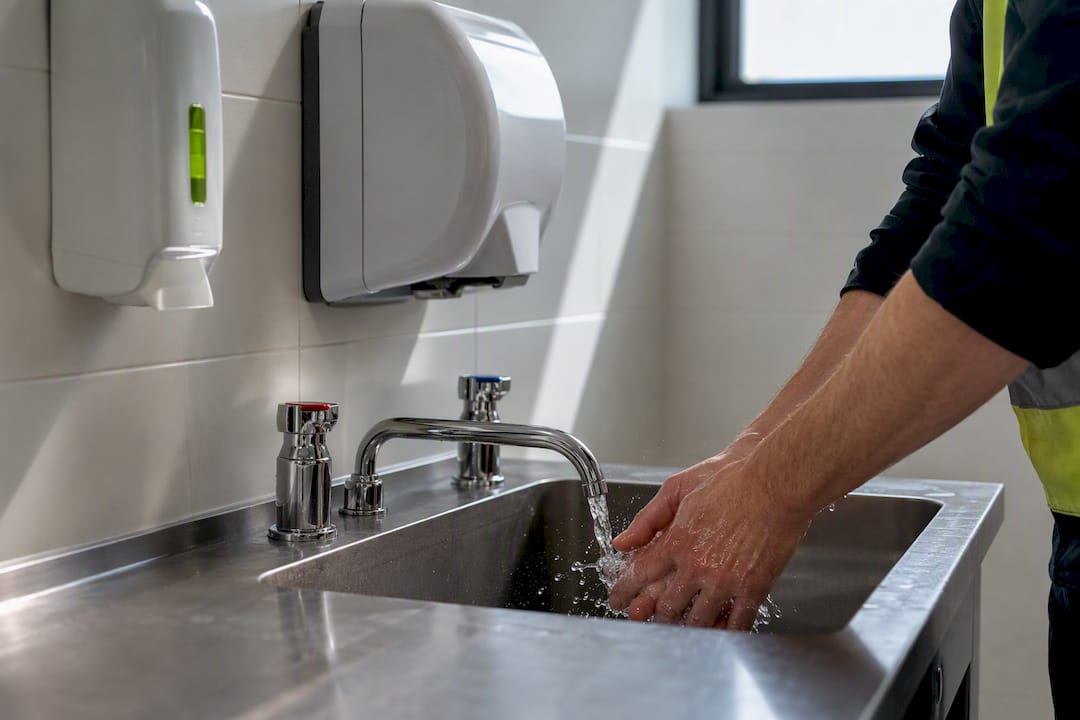
Toilets and, where relevant, showers need to be provided in numbers appropriate to the workforce, with sanitary item disposal available in women’s facilities. These aren’t areas to skimp on, because shared facilities are consistently flagged as one of the most common inspection failure points when consumables run out or minor repairs get delayed.
A few practical habits help keep facilities compliant, such as assigning a specific person or shift role to check soap, towel, and toilet paper stock regularly.
- Log any broken fixture (tap, dryer, lock) the moment it’s reported, and set a maximum repair turnaround.
- Fold facility checks into your existing cleaning schedule, rather than treating them as a separate task nobody owns.
- Raise facility standards during your regular WHS consultation meetings, since workers notice problems long before management does.
Neglected welfare facilities are rarely a deliberate compliance gap. They’re what happens when nobody’s job description includes checking the soap dispenser.
What records and audits do inspectors expect?
Documentation is what separates a warehouse that’s actually managing hygiene from one that’s just hoping for the best on inspection day.
The essential document set includes:
- Cleaning logs recording what was cleaned, when, by whom, and with what method or equipment.
- Temperature records for any cold storage or temperature-controlled zones, alongside probe calibration certificates.
- Pest control reports from your contracted service, plus your own internal monitoring log.
- Safety Data Sheets (SDS) for every cleaning chemical stored or used on site.
- Training records showing staff have been inducted on cleaning procedures, chemical handling and hygiene expectations.
A good cleaning log captures the same six audit fields covered earlier: task, date and time, person responsible, method used, findings, and corrective action taken. Skip any one of those fields and the record becomes far less useful to both your own managers and an inspector reviewing it.
Audit cadence should run in layers. Daily checks happen at the operator level, whoever’s doing the cleaning ticks off the task. Weekly supervisory review means a shift leader or facilities coordinator scans the week’s logs for gaps or repeated issues. Monthly management audit is where someone senior actually walks the site against the checklist, cross-references it with the logs, and signs off.
When something goes wrong, whether that’s a temperature excursion, a pest sighting or a contamination event, the corrective action workflow should follow a simple loop: detect it, record it, correct it, verify the fix worked. Skipping the verification step is the most common shortcut, and it’s exactly the step an inspector will ask about if a problem recurs.
Should you clean in-house or bring in a contractor?
Deciding between an in-house team and a contracted cleaning service usually comes down to scale, equipment cost, and how much administrative burden you want to carry internally.
Before signing with any contractor, run through this checklist:
- Do they carry current public liability insurance, and can they provide the certificate on request?
- Can they show SDS documentation and safe handling procedures for every chemical they bring on site?
- What training do their operators receive, particularly around mechanical equipment and chemical use?
- Do they provide documented service reports after every visit, not just an invoice?
- What are their environmental credentials, water use, chemical selection, waste disposal, if sustainability reporting matters to your organisation?
Pro Tip: Ask a prospective contractor to show you a sample service report from another client before you sign anything. If they can’t produce one, they probably aren’t generating the audit trail you’ll need later.
In-house cleaning gives you direct control over scheduling and immediate response to spills, but it means owning equipment costs, training, and consumables management yourself. Contracted, scheduled cleaning shifts that burden elsewhere and typically comes with structured reporting built in in return for a service fee.
Cleaning should also plug into your incident response plan. If a spill, contamination event or pest sighting occurs, your procedure should specify who cleans it, how it’s recorded, and when it gets escalated. For anything beyond routine housekeeping issues, contact your state WHS regulator (SafeWork NSW, WorkSafe Victoria, or the equivalent in your jurisdiction) or your local council’s food safety team if the issue involves stored food.
How does professional scheduled cleaning prove compliance?
A properly run cleaning contract does more than leave floors looking decent. It generates the paper trail an inspector actually wants to see.
Typical outputs from a well-managed scheduled service include:
- Signed cleaning checklists covering the six audit fields for every visit.
- Time-stamped photos of key areas before and after cleaning, useful evidence if a contamination event is ever disputed.
- Written service reports handed over after each visit, not just an invoice with no detail.
- A running record you can drop straight into your own compliance file when an inspector asks for evidence of control.
Sweepandscrub structures its scheduled warehouse cleaning around exactly that kind of documentation, because a warehouse manager shouldn’t have to chase a contractor for proof after the fact. Every visit should leave you with a record you can file, not just a clean floor you have to take on faith.
When vetting any provider, ask specific questions rather than accepting general claims. What equipment do they actually use for mechanical sweeping and scrubbing? What does “carbon-neutral operation” mean in practice, and can they explain how it’s calculated? What training do their operators hold for handling cleaning chemicals safely? Sweepandscrub’s process for cleaning Sydney warehouses is built around eco-friendly equipment and clear reporting, and if you’re weighing up mechanical sweeping, scrubbing or pressure washing for your own site, the hard surface cleaning service page is a reasonable place to start comparing what’s actually included.
Sources
- Safe Work Australia — Managing the work environment and facilities (Dec 2025)
- Food Standards Australia New Zealand — Standard 3.2.2 (2026)
- Work Health and Safety Act 2011 (Commonwealth consolidated)
FAQ
Are ISO standards mandatory for warehouse hygiene in Australia?
No. ISO standards for food safety management are voluntary certifications businesses can adapt to demonstrate best practice, but the legally mandatory requirements come from the WHS Act, its Codes of Practice, and the Food Standards Code where food is involved.
What are the basic hygiene requirements for a warehouse?
At minimum, a warehouse needs a documented, risk-based cleaning schedule, compliant welfare facilities with functioning hand basins, and pest prevention measures, with food-storage sites also needing temperature control under Standard 3.2.2 of the Food Standards Code.
What is the 2 hour/4 hour rule for food in the temperature danger zone?
This rule applies to potentially hazardous food that has spent time between 5°C and 60°C: under 2 hours, it can still be used or refrigerated; between 2 and 4 hours, it must be used immediately; beyond 4 hours, it must be thrown out, per the temperature control principles in Standard 3.2.2.
What are the key WHS standards that apply to warehouses in Australia?
The core standard is the Work Health and Safety Act 2011, which sets the PCBU’s primary duty of care, supported by the Managing the Work Environment and Facilities Code of Practice and the Model WHS Regulations covering hazardous chemicals used in cleaning operations.