
Industrial floor scrubbing is an onsite service using industrial-grade scrubbing and water-recovery equipment to remove grime, oil and contaminants and restore safe, serviceable floors. It improves slip safety, protects the floor surface from premature wear and lifts the site’s overall presentation. If you manage a warehouse, car park or construction site, the practical next step is booking a site assessment with an industrial cleaning provider so they can scope the job against your actual floor condition and traffic pattern.
TL;DR:
- High-traffic floors require weekly to biweekly scrubbing to effectively remove oil, dust, and grime that reduce traction and visibility.
- A detailed quote should include mechanized sweeping, auto-scrubbing, water recovery, and spot treatment, with clear exclusions listed to avoid surprises.
- Proper safety, traffic management, and wastewater disposal protocols are essential to prevent environmental harm and ensure worker safety during cleaning.
- Floor type and coating condition influence equipment choice, with sealed concrete and sound epoxy floors tolerating scrubbing, unlike unsealed or damaged surfaces.
- Regular daily sweeping and prompt spill cleanup significantly extend the interval between professional scrubbing, preserving coating longevity and safety.
Table of Contents
- What are the benefits of professional industrial floor scrubbing?
- What does an industrial floor scrubbing quote usually include?
- How often should you schedule industrial floor scrubbing?
- How do you choose a competent industrial floor scrubbing provider?
- What safety and wastewater controls should the contractor’s method cover?
- What drives the cost of industrial floor scrubbing, and how do you check eco claims?
- What happens on the day, and how do you sign off the job?
- How do you maintain the floor after professional scrubbing?
- Which floor types and conditions suit industrial scrubbing?
- What common problems come up during industrial floor scrubbing, and how are they fixed?
- What’s the actual sequence of an industrial floor scrubbing job?
- Is industrial floor scrubbing better than manual mopping or polishing?
- Book a site assessment with Sydney Sweep and Scrub
- Sources
What are the benefits of professional industrial floor scrubbing?
A dirty industrial floor isn’t just unsightly. Oil residue and dust build-up on concrete or epoxy reduce grip underfoot, and that’s before you factor in how much harder forklift operators have to work to spot hazards on a poorly lit, grime-covered surface.
Professional scrubbing addresses that directly. Removing embedded oil, dust and grime cuts slip risk and improves how much ambient light the floor reflects back into the space, which matters in warehouses running on tight sightlines between racking. Regular scrubbing also protects the sealant on epoxy and treated concrete, because grit left to grind underfoot during forklift and foot traffic acts like sandpaper over time.
The operational case is just as strong. A ride-on scrubber can cover thousands of square metres in a single shift, work a mop-and-bucket crew would take days to match, freeing staff for tasks that actually need a human.
Key benefits worth budgeting for:
- Reduced slip-and-trip incidents from oil, dust and grime removal
- Extended floor lifespan through less abrasive wear on seals and coatings
- Faster turnaround than manual cleaning, with less disruption to operations
- Better compliance outcomes in food-grade, pharmaceutical or regulated sites
- A cleaner presentation that reassures auditors, clients and site visitors
Pro Tip: Ask your provider for a before/after photo log on the first two visits. It’s the fastest way to see whether scrubbing is actually shifting the ingrained grime, not just the surface dust.
Consistent scrubbing schedules also function as preventive maintenance that delays costly resurfacing, an argument worth putting in front of anyone signing off your maintenance budget.
What does an industrial floor scrubbing quote usually include?
A proper scope avoids the vague “we’ll clean your floor” quote that leaves gaps once the crew arrives. Ask any prospective provider to break the job into these components.
- Mechanised sweeping to lift loose debris and dust before scrubbing starts.
- Machine scrubbing with a ride-on or walk-behind auto-scrubber, matched to your floor area and layout.
- Water recovery and vacuuming, so wastewater doesn’t pool or run toward drains untreated.
- Spot treatment for oil stains, tyre marks and localised contamination the scrubber pass won’t fully lift.
Beyond that core scope, several tasks are commonly quoted as add-ons rather than included by default: heavy degreasing for workshop or loading-dock floors, high-level dusting of racking, hazardous spill cleanup, and floor stripping and reseal work. A thorough industrial cleaning scope usually spells out mechanised sweeping, auto-scrubbing, degreasing and dust control as distinct line items rather than one bundled price.
Push for a written, area-by-area breakdown with explicit exclusions listed. If a quote doesn’t name what’s excluded, assume it isn’t included.
How often should you schedule industrial floor scrubbing?
Frequency depends on traffic intensity and what’s actually being tracked across the floor. A distribution warehouse running forklifts around the clock needs a different cadence to a low-traffic storage facility or an occasional-use event space.
- High-traffic warehouses and loading zones: weekly to fortnightly scrubbing, often supplemented with daily sweeping.
- Car parks and hardstand areas: monthly to quarterly, adjusted for weather and oil drip volume.
- Construction sites: scheduled around trade handovers, usually before inspections or client walkthroughs.
- Public spaces and event venues: scrubbed before and after major events, with routine cleaning between.
Scheduling models generally fall into three camps: between-shift cleaning that slots into a production gap, zone-based rolling cleans that rotate through sections without shutting the whole site down, and weekend or shutdown windows for a full deep clean. Whichever model you choose, factor in drying time before forklifts or foot traffic return to the area. Wet floors under load are how slip incidents happen.
How do you choose a competent industrial floor scrubbing provider?
Not every commercial cleaner is set up for industrial work, and the gap shows up fast once a job’s underway. Use this checklist to compare quotes on equal footing.
- Site assessment first. A provider should walk the site and produce a written scope, not quote blind off a floor plan.
- Insurance and paperwork. Confirm current public liability and workers compensation cover, plus site-specific Safe Work Method Statements (SWMS) for the job.
- Staff induction and safety data. Ask whether crews complete site inductions and whether Safety Data Sheets (SDS) are available for every chemical on the truck.
- References from similar facilities. A provider who’s scrubbed retail floors isn’t automatically ready for a chemical plant or cold-storage warehouse.
- Fit-for-purpose equipment. Ride-on scrubbers for open floor plates, walk-behind units for tighter aisles, sweepers for debris and pressure washers for hardstand and degreasing.
- Backup and maintenance support. Ask what happens if their scrubber breaks down mid-job. A provider without backup equipment risks leaving your site half-done.
- QA reporting. Inspection logs, before/after photos, a rectification turnaround time and one named contact if something’s missed.
Pro Tip: Request the SWMS and insurance certificates before the quote, not after you’ve signed. A provider who hesitates here is telling you something.
Providers with genuine industrial cleaning experience tend to bring documented routines and QA processes as standard, not as an upsell.
What safety and wastewater controls should the contractor’s method cover?
Scrubbing crews working around live operations need more than a mop bucket and a hazard sign. Traffic management and pedestrian exclusion zones matter as much on an active warehouse floor as they do on a construction site, and every crew member should be inducted to your site’s specific hazards before they start.
Wastewater handling deserves particular scrutiny. Runoff from degreasing or heavy scrubbing shouldn’t be allowed to reach stormwater drains untreated.
- Confirm the provider captures and disposes of wastewater offsite where local regulations require it
- Ask how drains are protected during pressure washing or degreasing passes
- Check SDS availability for every chemical used on your floor
- Establish an escalation path for hazardous spills discovered mid-job, not after
What drives the cost of industrial floor scrubbing, and how do you check eco claims?
Floor area is the obvious driver, but soil level matters just as much. A loading dock caked in oil residue takes longer per square metre than a clean office warehouse floor, and access constraints (narrow aisles, fixed racking, tight loading bays) slow a ride-on scrubber down to walk-behind speeds.
Frequency, add-ons like degreasing, and after-hours or shutdown timing all push the quote up or down. The trade-off is worth framing as an investment rather than a cost: regular professional cleaning reduces wear on floor coatings and can delay the kind of resurfacing bill that dwarfs a year of scrubbing invoices.
On sustainability, push past general “eco-friendly” language and ask for specifics:
- Water recovery and reuse rates, not just “low water use”
- Controlled chemical dosing rather than blanket detergent application
- Biodegradable detergents where floor type allows
- Documented carbon-neutral commitments, not a logo on the invoice
What happens on the day, and how do you sign off the job?
Expect a straightforward sequence: walkthrough, isolate the work zone, sweep, scrub, recover wastewater, then inspect. Ask for an inspection checklist, before/after photos and evidence of how wastewater was handled before you sign off.
Nominate one contact on your side to coordinate with the crew and one named contact on theirs for defects. If a section’s missed, the fastest fix is flagging it on the spot, not weeks later once dirt’s built back up. The best warehouse floor maintenance practices treat sign-off as part of the job, not an afterthought.
How do you maintain the floor after professional scrubbing?
Scrubbing resets the floor. What happens in the weeks after determines how long that reset lasts.
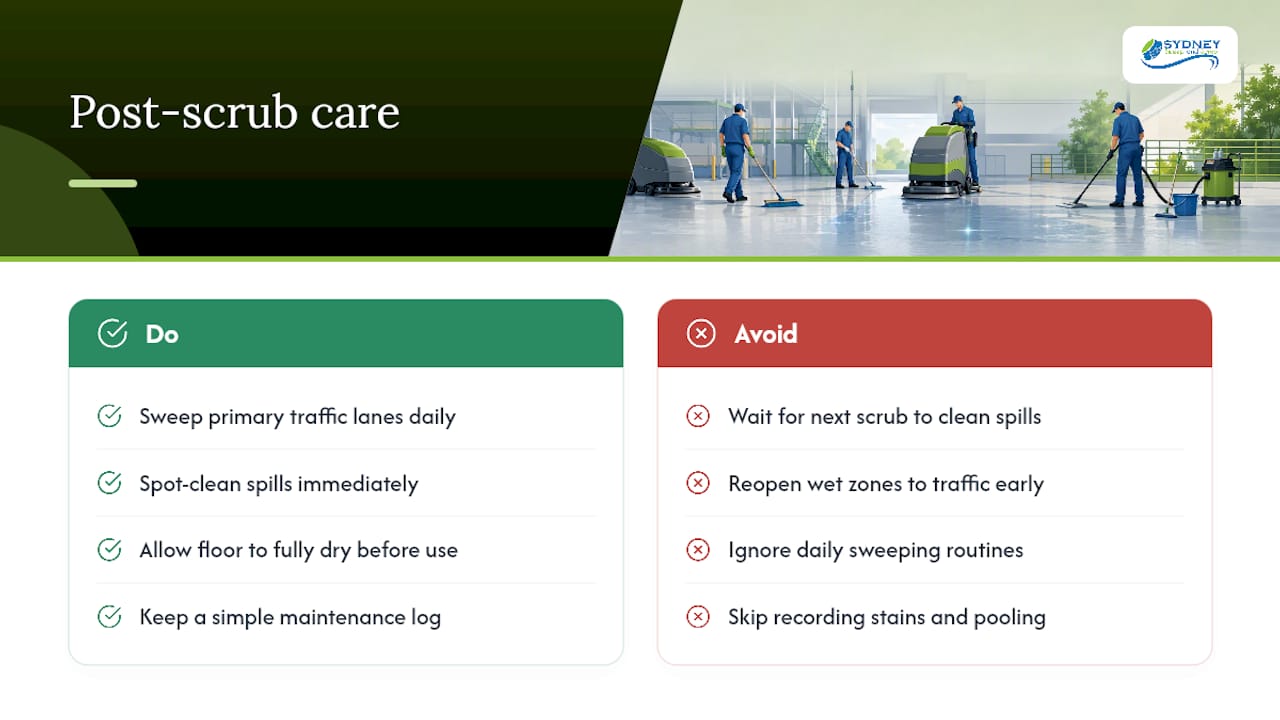
Daily sweeping matters more than most facility managers assume. It’s grit and dust, not the scrub itself, that grinds into sealants and coatings between professional visits. If your site runs forklifts, a quick sweep of primary traffic lanes each morning does more for coating longevity than any single deep clean.
Spot-clean spills as they happen rather than waiting for the next scheduled visit. Oil and chemical spills left to sit stain concrete and eat into epoxy coatings faster than general wear does, and by the time the next scrub rolls around the stain may be permanent.
Watch your drying protocols too. Reopening a wet zone to forklift traffic too early doesn’t just risk a slip, it can grind tyre marks into a freshly scrubbed surface before the coating’s had a chance to settle.
Finally, keep a simple maintenance log. Note the date of each scrub, any new stains or wear patches, and where drainage or pooling issues appeared. That log becomes useful leverage when you’re negotiating your next contract, because it shows exactly where the floor’s holding up and where it isn’t. Facilities that treat post-scrub care as a genuine routine, not a one-off event, typically stretch the interval between deep resurfacing jobs considerably further than sites that scrub once and forget it.
Which floor types and conditions suit industrial scrubbing?
Not every floor responds to scrubbing the same way, and knowing your floor type changes how you brief a provider.
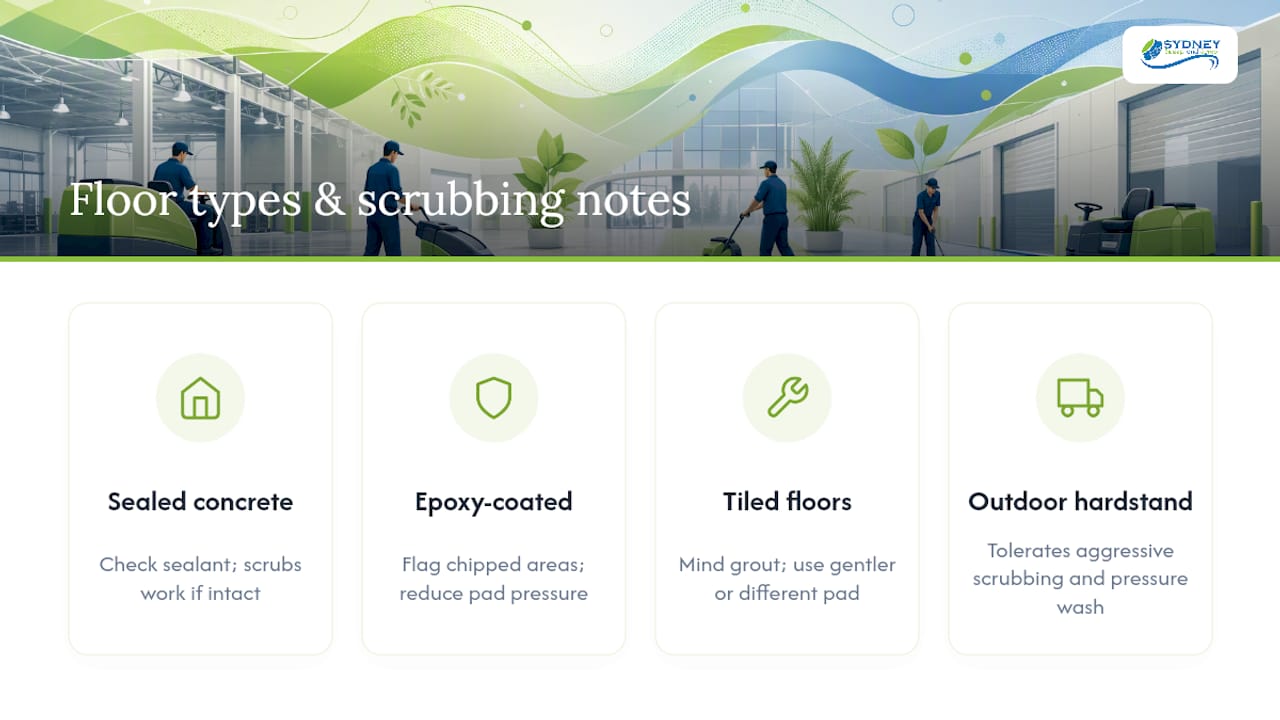
Bare or sealed concrete is the most common industrial floor and handles scrubbing well, provided the sealant is intact. Unsealed concrete is porous, so oil and chemical spills soak in rather than sitting on the surface, meaning scrubbing alone won’t fully lift old stains. A sealant check is worth doing before your first booking.
Epoxy-coated floors are common in workshops, food-processing plants and cleanrooms. They scrub up well when the coating is sound, but a scrubber’s rotating pads can accelerate wear on any patch where the epoxy’s already lifting or chipped. Flag damaged sections to your provider before the job starts, so they can adjust pad pressure or avoid abrasive attachments there.
Tiled industrial floors, less common but present in some processing and retail-adjacent facilities, need attention to grout lines. Standard scrubbing pads clean the tile surface fine, but grout often needs a different pad or a lower-pressure pass to avoid stripping it out.
Hardstand and outdoor concrete, think car parks and loading yards, generally tolerate more aggressive scrubbing and pressure washing than internal floors, since there’s no coating to protect and weather already does most of the wear.
Tell your provider the floor type and coating condition upfront. It changes the equipment and pad choice more than almost any other variable.
What common problems come up during industrial floor scrubbing, and how are they fixed?
Stubborn stains are the most frequent complaint. Old oil stains that have soaked into unsealed concrete rarely lift in a single scrubbing pass. The fix is usually a degreasing pre-treatment left to dwell for several minutes before the scrubber runs over it, sometimes repeated across two visits rather than forced in one.
Uneven surfaces cause a different problem: scrubber pads ride the high points and skip the low ones, leaving patchy results across an otherwise clean-looking floor. On sites with settled concrete or old patch repairs, a walk-behind unit with a floating head handles the unevenness better than a rigid ride-on deck.
Chemical residue left behind after scrubbing is usually a rinse or dilution problem, not a scrubbing problem. If a floor feels tacky or shows a hazy film once dry, the detergent wasn’t sufficiently rinsed or diluted correctly for the floor type. Ask your provider what dilution ratio they run and whether their machines have a dedicated rinse pass, not just a single scrub-and-recover cycle.
Cold-storage and refrigerated facilities bring their own challenge: standard detergents thicken or lose effectiveness at low temperatures. A competent provider adjusts chemical selection for the site’s actual operating temperature rather than running a standard mix regardless of conditions.
What’s the actual sequence of an industrial floor scrubbing job?
Most jobs follow the same rough order, whether it’s a small workshop or a full-shift warehouse clean.
- Walkthrough and hazard check. The crew confirms floor type, coating condition, drainage points and any exclusion zones.
- Isolation and signage. Work areas are cordoned off, with wet-floor signage placed ahead of the scrubbing pass.
- Sweeping. Loose debris and dust are cleared first, so the scrubber isn’t just grinding grit into the surface.
- Pre-treatment. Degreaser or spot treatment is applied to stained or heavily soiled patches and left to dwell.
- Machine scrubbing. The ride-on or walk-behind scrubber runs its pass, agitating and lifting embedded contaminants.
- Water recovery. Wastewater is vacuumed up by the machine’s recovery tank rather than left to evaporate or run to a drain.
- Inspection and sign-off. A final check confirms coverage, drying time and any spots needing a second pass.
Knowing this sequence helps you ask sharper questions when comparing quotes, particularly around step six, since that’s where sloppy providers cut corners.
Is industrial floor scrubbing better than manual mopping or polishing?
Manual mopping has its place for small spot cleans and daily touch-ups, but it can’t match a machine scrubber’s agitation and water-recovery capability across a large industrial floor. A mop redistributes dirty water almost as often as it lifts it, and it does nothing for embedded grime ground into concrete pores or coating texture.
Floor polishing solves a different problem entirely: it restores shine and adds a protective top layer, but it doesn’t remove the oil, dust and grime that scrubbing lifts. Polishing a dirty floor just seals contamination underneath a glossy layer, which tends to look fine for a few weeks before the underlying dirt shows through again.
The two aren’t really competing services. Scrubbing is the cleaning step, polishing is a finishing step that works best once a floor’s already properly scrubbed. For a facility manager weighing where to spend budget, industrial-grade scrubbers deliver far more coverage per hour than manual methods, and they’re the only realistic option for warehouse-scale floor areas on a repeating schedule.
Book a site assessment with Sydney Sweep and Scrub
Everything in this guide points to the same starting move: get a site assessment booked with an industrial-capable cleaner before you commit to a schedule or a price. A family-owned operator built specifically around mechanical sweeping, scrubbing and pressure washing, not general commercial cleaning stretched to cover industrial floors.
The equipment fleet includes ride-on and walk-behind scrubbers, sweepers and pressure washers sized to warehouse floors, car parks and construction sites. Eco-conscious, carbon-neutral operations are run. So the sustainability questions raised earlier in this guide come with actual answers rather than green marketing. Competitive pricing and an online booking system make the quoting and booking process accessible.
Before you book, have your floor area, primary soil type (oil, dust, general grime) and preferred access windows ready. Get a hard surface cleaning quote from Sydney Sweep and Scrub and have a site assessment scheduled within the week.
Sources
- Industrial cleaning services: what’s included & how to choose
- Warehouse Floor Scrubbing Services: 7 Key Benefits
- Benefits Of Industrial Floor Scrubbers For Large Facilities
- The Cost Benefits of Regular Industrial Floor Cleaning
- How to choose an industrial cleaning service provider