
Scrape or heat soft residues, use a matched solvent for mastic and epoxy traces, and bring in a grinder or a professional for thick, old, or large-scale glue jobs. If the slab is older than the early 1970s and the adhesive is black and bituminous, stop and get it checked for asbestos before you touch it. For big areas or anything hazardous, calling in mechanical cleaning specialists is the safer, faster route.
TL;DR:
- Identify the adhesive type accurately using texture, heat, solvent, and water tests before choosing the removal method.
- Use mechanical scraping for most residues, finishing with chemical removers for stubborn traces, and avoid immediately resorting to solvents.
- When handling black bituminous mastic or old adhesives, treat them as suspected asbestos and hire a licensed professional for inspection and removal.
- For large or thick glue layers, a diamond grinder with PCD tooling and dust extraction provides the fastest, safest removal compared to standard pads.
- Always thoroughly clean and dry the slab after removal, check for moisture or residual films, and consider professional help for high-risk or extensive jobs.
Table of Contents
- At-a-glance: choose the right method for the adhesive you have
- How do you identify the adhesive before removing it?
- DIY step-by-step: scraping, heat and chemical removers
- Heavy-duty options: grinding, floor strippers and hiring gear
- Safety first: PPE, asbestos and environmental controls
- Finishing: cleaning, patching and prepping the slab
- When to hire a pro, and how Sweepandscrub can help
- Sources
At-a-glance: choose the right method for the adhesive you have
Not every sticky mess on a concrete slab is the same substance, and treating them all the same way wastes time or ruins the surface. Water-based carpet adhesives usually lift with warm water and elbow grease. Mastic and bituminous glues need heat or solvent. Epoxy and urethane residues are the stubborn ones, often needing mechanical grinding once they’ve cured hard.
Adhesive type and first-line method:
- Water-based/acrylic residue: warm water, scraper, mild detergent
- Soft mastic or wax-based adhesive: heat gun then scraper
- Black bituminous mastic or old carpet glue: solvent-based remover, then scrape
- Epoxy or urethane: mechanical grinding, often after a softening chemical pass
A small patch (roughly one square metre) of soft residue might take fifteen minutes with a scraper. The same area in cured epoxy can eat an hour of grinding time, which is why identifying the adhesive before you start saves real effort. Mechanical scraping typically clears most of a heavy adhesive layer before chemicals finish the stubborn traces, so lean on the scraper first rather than reaching for solvent immediately.
Your basic toolkit: a floor scraper with replaceable blades, a heat gun, a citrus or solvent-based remover suited to the glue type, and if you’re going mechanical, access to a grinder with the right disc. Renting the grinder makes more sense than buying for a one-off job.
How do you identify the adhesive before removing it?
Look and touch before you reach for any chemical. Soft, waxy, yellow-brown residue that smears under a fingernail is usually an old carpet adhesive or mastic. A hard, glassy, dark coating that chips rather than smears is more likely epoxy or urethane. Black, tar-like material with a strong bitumen smell is the one to treat with caution, especially in older properties.
Run these checks in order:
- Texture test — press a scraper edge into a small corner; soft give suggests mastic, resistance suggests epoxy.
- Heat test — apply gentle warmth from a heat gun to a coin-sized spot; urethane and some mastics soften visibly within seconds.
- Solvent dab — dab a cotton swab with acetone or a citrus solvent on a hidden patch; if the residue starts to lift or smear within a minute, a solvent-based approach will work.
- Water test — a splash of warm water on the spot; if it softens, it’s likely a water-based acrylic adhesive.
Before treating the whole floor, mark out a patch roughly 150mm square, apply your chosen method, and wait the full recommended dwell time. Testing a small patch before committing to the whole slab avoids staining or driving glue deeper into the concrete’s pores.
Pro Tip: Photograph each test patch with a note of the method and dwell time. When you scale up to the full floor, you’ll know exactly what worked without repeating the guesswork.
DIY step-by-step: scraping, heat and chemical removers
Start mechanical, finish chemical. That order almost always beats going straight for solvent on a big area.
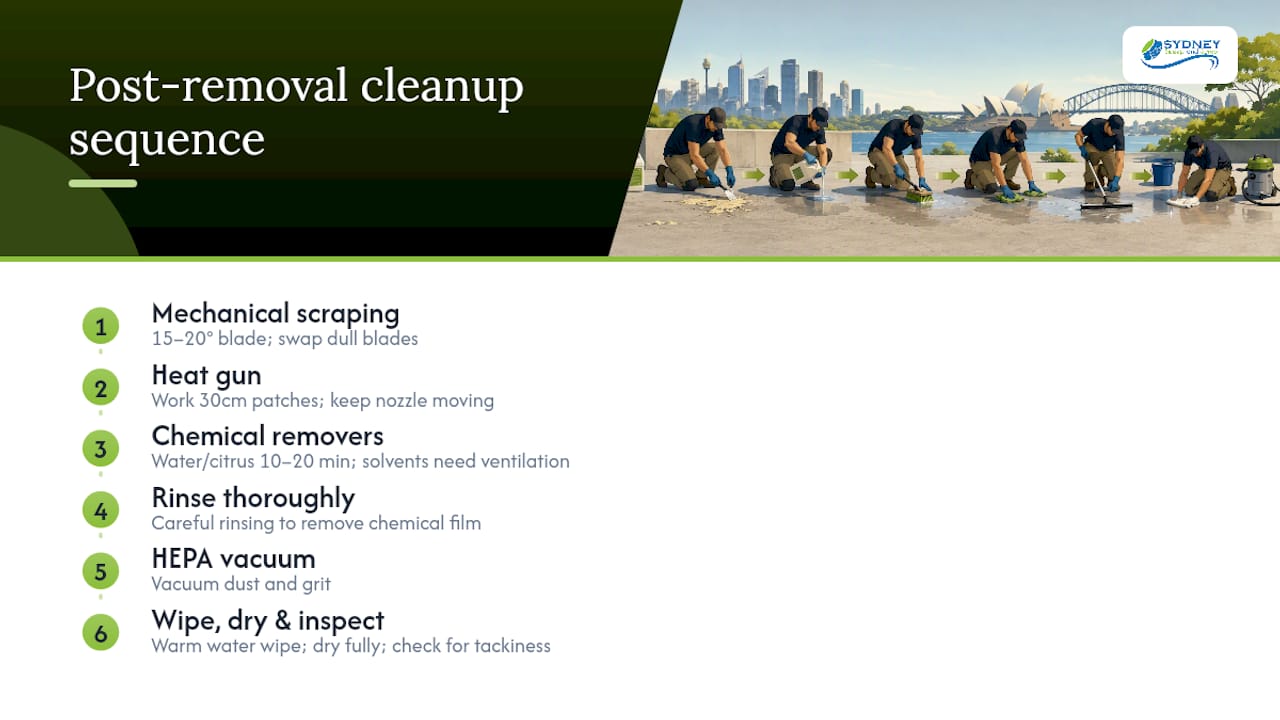
Hand scraping. Use a stiff-bladed floor scraper held at a low angle, close to 15 to 20 degrees, to shave the adhesive without gouging the concrete. Swap blades the moment they dull; a sharp edge does the work, a blunt one just skids and tears at your wrist. On a domestic-sized room, expect to burn through several blades.
Heat gun approach. Work in patches no bigger than 30cm square, keeping the nozzle moving at a moderate heat setting; too much heat too fast scorches adhesive into a gummier mess and risks fumes. Keep windows open and never use a heat gun near solvent residue, since vapours can ignite.
Chemical removers. Water-based and citrus removers handle milder mastics and acrylics with dwell times of ten to twenty minutes. Solvent or caustic removers are needed for black mastic and epoxy, but they demand real ventilation, extended dwell time, and careful rinsing afterwards so no chemical film is left to interfere with whatever finish goes down next.
Once the bulk is gone, HEPA vacuum the dust and grit, then wipe the slab with warm water. Let it dry fully and inspect for leftover sheen or tackiness before you think about primers or levelling compound.
Heavy-duty options: grinding, floor strippers and hiring gear
Standard diamond floor pads are built for polishing concrete, not chewing through old carpet glue, and they clog fast when asked to do a job they weren’t designed for. If a disc gums up mid-job, touching the blade briefly to bare concrete or a house brick can clear it enough to keep cutting, though it’s a stopgap, not a fix.
For anything beyond a small room, PCD (polycrystalline diamond) segments or dedicated stripping discs handle sustained adhesive removal far better than general-purpose pads. A walk-behind grinder fitted with PCD tooling is usually the fastest reliable option for thick or long-standing glue across a larger floor.
- Ask the hire company specifically for PCD or metal-bonded discs, not general concrete grinding pads.
- Insist on a dust extraction attachment; a bare grinder throws fine particulate everywhere.
- Set up negative pressure with an exhaust fan in enclosed rooms to keep dust from drifting through the house.
- Wear hearing protection alongside your respirator; these machines run loud for hours at a time.
Pro Tip: If you’re quoted a grinder without an extraction shroud, walk away and ask for the right setup. Chasing dust around a room afterwards costs more time than the grinding itself.
Safety first: PPE, asbestos and environmental controls
Age is the biggest red flag. If the concrete underlay or adhesive was laid before the early 1970s, particularly a black, bituminous-type glue, treat it as suspected asbestos-containing material and stop before any scraping or grinding.
Black, bituminous-type adhesives are a high-risk indicator for non-friable asbestos, and professional inspection is advised for older properties before any disturbance of the material.
Where asbestos is even suspected, the correct next step is a competent inspection followed by accredited lab sampling, not a home test kit or a quick internet check. Household precautions don’t substitute for that process.
For everything else, gear up properly:
- Wear a respirator rated for particulates and vapours, not a basic paper dust mask, when scraping or grinding any adhesive.
- Use goggles and gloves rated for the solvent you’ve chosen, checking the product’s own safety data.
- Bag suspect debris separately and don’t put it in general waste if asbestos hasn’t been ruled out.
- Call a licensed asbestos removalist rather than attempting removal yourself if the material tests positive.
Finishing: cleaning, patching and prepping the slab
Getting the glue off is only half the job. What’s left on the slab decides whether your next floor covering or coating actually bonds.
- HEPA vacuum the entire area to lift fine dust and any grinding residue trapped in the pores.
- Wash with warm water and a mild detergent, rinsing thoroughly to remove any trace of solvent film.
- Let the slab dry completely, which can take a day or more depending on ventilation and humidity.
- Check for low spots or gouges from scraping and patch them with a suitable concrete filler.
- Test moisture and porosity before applying primer, since residual dampness or leftover solvent film is one of the most common causes of coating and levelling compound failure.
Skipping the drying and moisture check is the mistake that shows up months later as bubbling vinyl or a coating that peels in sheets.
When to hire a pro, and how Sweepandscrub can help
Some jobs are DIY. Others aren’t, and knowing the line saves you money and a trip to hospital. Call in a professional when you suspect asbestos, when the area runs past a garage floor into a warehouse or car park, when the adhesive keeps gumming up rented equipment, or when you simply don’t have dust extraction sorted for an enclosed space.
Professional crews bring PCD grinding tooling that doesn’t clog on contact, HEPA-fitted dust extraction, licensed handling or referral for confirmed asbestos, and the equipment to finish the slab properly afterwards rather than leaving you guessing about moisture levels.
Sweepandscrub takes on exactly this kind of large or high-risk adhesive removal across Sydney, using industrial-grade mechanical cleaning and pressure-washing equipment built for concrete surfaces that a domestic scraper and heat gun simply can’t handle. Where a rental grinder gums up after twenty minutes on old carpet glue, a properly geared crew works the whole floor in one pass with dust control built in, and where solvent removers leave you second-guessing the drying time, a professional pressure-washing finish gets the slab ready for its next coating on the spot.
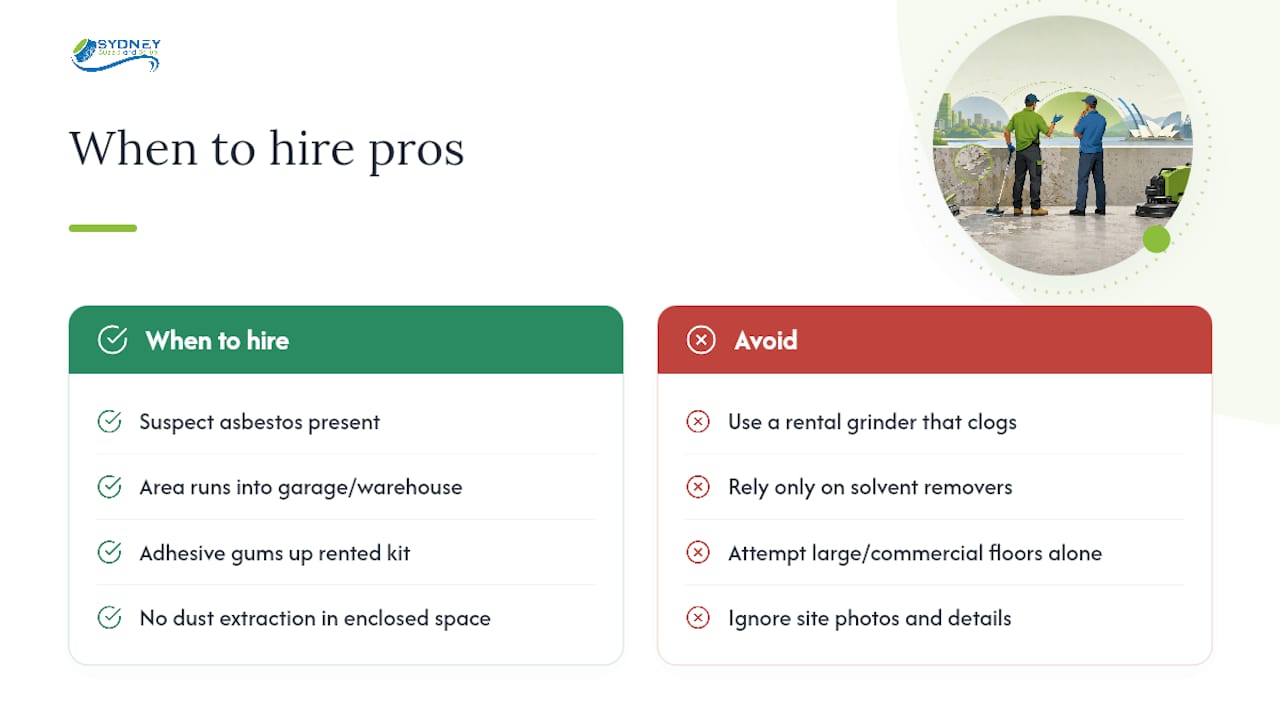
If you’re weighing up a car park, warehouse floor, or any large concrete area, consider contacting a professional service for a quote or site inspection. Providing photos of the residue, an estimate of the area involved, the approximate age of the adhesive if known, and any access constraints on site can help scope the job and price it properly before a single tool touches the slab.
Sources
- Asbestos removal guidance (NT government)
- Bunnings workshop discussion and equipment notes
- Stubborn floor glue — contractor advice