
A commercial cleaning scope of work must list every task, every area and every frequency against a named accountable party, with WHS duties and measurable KPIs built in so performance can be audited, not argued about. Get that structure right and quotes become comparable. Get it wrong and you’re refereeing disputes for the length of the contract. Use the checklist below as your starting template.
TL;DR:
- Accurate scope details, including task frequencies and responsible parties, are essential to prevent disputes and enable fair comparisons between cleaning bids.
- Site-specific information such as access, security procedures, and duty responsibilities must be clearly documented because responsibilities cannot be transferred via contract.
- Clear, measurable KPIs and SLAs with defined measurement methods are necessary to objectively assess cleaning performance and avoid ambiguity.
- Equipment, chemicals, and consumables require precise specifications and ownership agreements to prevent conflicts and maintain safety standards.
- Regular review and on-site compliance checks are vital to ensure the scope of work aligns with site conditions and to implement improvements based on documented performance.
Table of Contents
- What goes in a commercial cleaning scope of work checklist?
- Site details, access and who’s responsible for what
- What does “clean the office” actually mean in a contract?
- How do you set KPIs and SLA targets for cleaning contracts?
- Equipment, chemicals and consumables: who supplies what?
- How do WHS duties fit into a cleaning scope of work?
- What should be excluded from a cleaning contract?
- How should commercial cleaning pricing and contract terms work?
- What reporting should a cleaning contractor provide?
- How often should a cleaning scope of work be reviewed?
- How does a supplier put a scope of work into practice on site?
- Get a scope of work built around your site, not a generic template
- Sources
What goes in a commercial cleaning scope of work checklist?
A working scope of cleaning services checklist runs room by room, not floor by floor. Vague line items like “clean common areas” are exactly what cause disputes once the contract starts, and a room-by-room breakdown with copy-ready task wording heads that problem off before it starts.
Cover these zones at minimum:
- Reception and foyer (floors, glass, furniture, entry mats)
- Offices and workstations (desks, bins, floors, high-touch points)
- Meeting rooms (tables, chairs, glass walls, AV equipment surfaces)
- Kitchen and tea points (benches, sinks, appliances, fridge checks)
- Bathrooms and end-of-trip facilities (fixtures, floors, consumable restocking)
- Stairwells and fire egress paths
- Loading dock and carpark (sweeping, spill response, line marking visibility)
Default frequency bands look like this:
| Band | Typical inclusion |
|---|---|
| Daily | Bathrooms, kitchens, high-touch surfaces, bin emptying |
| Weekly | Glass, skirting, detailed dusting, carpark sweep |
| Monthly | Window internals, upholstery spot clean, hard-floor scrub |
| Quarterly | Deep strip and seal, carpet extraction, high-level dusting |
| Ad-hoc | Spill response, event turnovers, post-construction clean |
Customise fixture counts (how many cubicles, how many kitchenettes), after-hours access windows, and any sensitive areas (server rooms, labs) before you send the tender out. A downloadable full template with editable fields belongs in your procurement folder, not scattered across email threads.
Site details, access and who’s responsible for what
Every commercial cleaning specifications document should open with administrative facts, not tasks. This is the section that lets three quotes actually be compared against each other, because it fixes the size, hours and access conditions everyone is quoting against.
Include:
- Site address, floor count, net lettable area and a current floor plan
- Named contact points for both parties, including after-hours emergency contact
- Operating hours, tenant occupancy patterns and blackout windows
- Fixture counts (toilets, showers, kitchenettes) so pricing has a real basis
- Access arrangements: keys, swipe cards, alarm codes, sign-in procedures
- Security and induction requirements, including any site-specific inductions before staff start work
This section should also state plainly who holds which duty. Under the Work Health and Safety Act 2011, the person conducting a business or undertaking, the PCBU, carries health and safety responsibility that cannot be handed off in a contract clause. A tenant business and a cleaning contractor can both be PCBUs on the same site simultaneously, each with its own duty. Write that shared status into the SOW explicitly rather than assuming it’s understood, because “we thought that was your job” is the single most common admin failure in facility contracts.
What does “clean the office” actually mean in a contract?
Cleaning tender specifications fail most often on wording, not on intent. “Clean toilets daily” tells a supplier nothing about whether that means wipe visible surfaces or a full disinfectant protocol on every touchpoint, every visit. Write the actual action: disinfect cubicle doors, taps, dispensers and floor drains; restock consumables to par level; report any fixture faults within the same visit.
A sample frequency table might specify disinfecting toilet fixtures and touchpoints daily, vacuuming carpeted office floors daily, wiping kitchen benches and sinks daily, dusting workstations and partitions weekly, and deep cleaning tasks like stripping and sealing hard floors or carpet extraction periodically, with clear standards for cleanliness.
Match frequency to touchpoint risk. High-contact surfaces like door handles and lift buttons justify daily or twice-daily attention over the weekly pass a stairwell handrail might get.
How do you set KPIs and SLA targets for cleaning contracts?
Cleaning contract details need measurable pass/fail thresholds, not adjectives like “spotless” or “thorough.” An SLA without a measurement method is just a hope.
Practical KPI examples worth building into any office cleaning requirements document:
- Inspection pass rate (target: 95% of audited items pass on first inspection)
- Rectification time (target: same-day fix for failed items, next-visit fix for minor issues)
- Visual or ATP swab scores on high-touch surfaces, sampled monthly
- On-time attendance against the agreed service schedule
Sampling should be random, not announced, and cover a representative slice of the site each visit rather than the same three rooms every time. Build in remedies as well as targets: a service credit for missed KPIs, a defined rectification window (24 to 48 hours is common), and a small bonus mechanism for suppliers who consistently exceed the pass rate over a quarter. Draft every task line so it can be audited on the spot, with a stated measurement method and acceptance criteria attached to it, not left to interpretation after the fact.
Pro Tip: Ask for the last three months of a supplier’s own KPI reporting from an existing client before you sign. If they can’t produce it, they’re probably not measuring anything either.
Equipment, chemicals and consumables: who supplies what?
Cleaning contract specifications should nail down plant and product standards, because “bring your own gear” invites corner cutting on exactly the equipment that protects floors and staff.
Set out:
- Minimum equipment specifications (backpack vacuums with HEPA filtration, auto scrubbers rated for the floor substrate) and a maintenance log the contractor must produce on request
- Chemical requirements referencing Safety Data Sheets and, where disinfectants are used, alignment with relevant Therapeutic Goods Administration listings
- Which surfaces need higher-grade disinfection based on touch frequency and user vulnerability, a risk-scored approach rather than a blanket product across every surface
- Consumables ownership: who buys toilet paper, soap and bin liners, and who tops up par stock levels between visits
Get this in writing before the contract starts. Disputes over “who was supposed to order more hand towels” are tedious and entirely avoidable.
How do WHS duties fit into a cleaning scope of work?
WHS compliance isn’t a bolt-on clause, it’s the backbone of the document. Safe Work Australia’s guidance sets out four principles that apply directly here: duties can’t be transferred away by contract, more than one party can carry the same duty simultaneously, all duty holders must consult and coordinate with each other, and risks must be managed so far as is reasonably practicable.
Translate that into contract mechanics:
- Request Safe Work Method Statements, relevant licences and a training matrix before work starts, not after an incident
- Reference the SWMS identifier directly inside each task clause, alongside required PPE and any pre-task check, rather than pointing to a generic “safety folder” nobody opens
- Require incident and near-miss reporting within a set timeframe, with a retained register the client can audit
- Confirm document retention periods for risk assessments and training records
The Model Code of Practice on managing the work environment and facilities also requires workplaces to be kept in a clean and safe condition, which gives you a legislative anchor for the cleaning frequency clauses in welfare areas specifically.
Pro Tip: Embedding a SWMS ID into the task line itself, not just an appendix, forces the contractor to produce a task-specific risk control at onboarding rather than a generic document nobody’s read in months.
What should be excluded from a cleaning contract?
Scope creep starts the moment “extra” work gets done for free once and becomes the expectation forever after. List common exclusions clearly: fumigation and pest control, specialist carpet or stone restoration, biohazard cleanup, and high-rise window cleaning requiring rope access all belong in separately quoted work orders. For fumigation specifically, ask any specialist provider for their pre-job safety checks before engaging them.
Write a simple chargeable-extras clause: any request outside the listed scope requires a written quote and sign-off before work proceeds, with a nominated approver named on both sides.
How should commercial cleaning pricing and contract terms work?
Pricing structures generally run three ways: fixed-price per visit, rate-per-square-metre, or an hourly labour model with separate consumables billing. Whichever model you choose, the quote must itemise labour, consumables, plant and travel separately so you can actually compare bids rather than comparing bottom-line numbers that hide wildly different inclusions.
Build these clauses in from the start:
- Indexation terms tied to a named index (CPI or an award rate) so annual increases aren’t a surprise negotiation
- A variation clause covering scope changes, plus overtime and after-hours rates stated as a multiplier, not “to be discussed”
- Public liability and workers’ compensation insurance evidence, refreshed annually
- Subcontracting rules: whether it’s permitted, and whether the client must be notified and approve
- Contract term, renewal conditions and a termination clause with a defined notice period
Fixture counts and service hours belong in the pricing schedule too, since they let you trial outcome-based pricing later without renegotiating the whole contract from scratch.
What reporting should a cleaning contractor provide?
Reporting cadence should scale with risk. Daily logs signed off at completion, weekly summaries flagging any missed tasks, and a monthly KPI pack against the agreed SLA targets is a sensible baseline for most sites.
- Escalation ladder: site contact first, then account manager, then a formal rectification notice with a fixed response time
- Audit triggers: a failed KPI pack, a client complaint, or an incident report should each automatically trigger a site review
- Onboarding checklist before the first service: keys issued and logged, induction completed, equipment on site, SWMS received and filed
How often should a cleaning scope of work be reviewed?
Set formal review points rather than leaving the document static for the life of the contract. Quarterly reviews, a tenancy change, or any incident should each trigger a scope check. If a new product or method is proposed, trial it on a limited area first and measure the result against your existing KPI baseline before rolling it out site-wide. Version every change with a date and a signature from both parties, so the SOW you’re auditing against is always the one everyone actually agreed to.
How does a supplier put a scope of work into practice on site?
A written SOW only works if the crew on the ground follows it the same way every visit. Site supervisors run onboarding against a fixed checklist: training records confirmed, SWMS embedded into each task line rather than filed separately, and equipment logged against the job before the first visit starts.
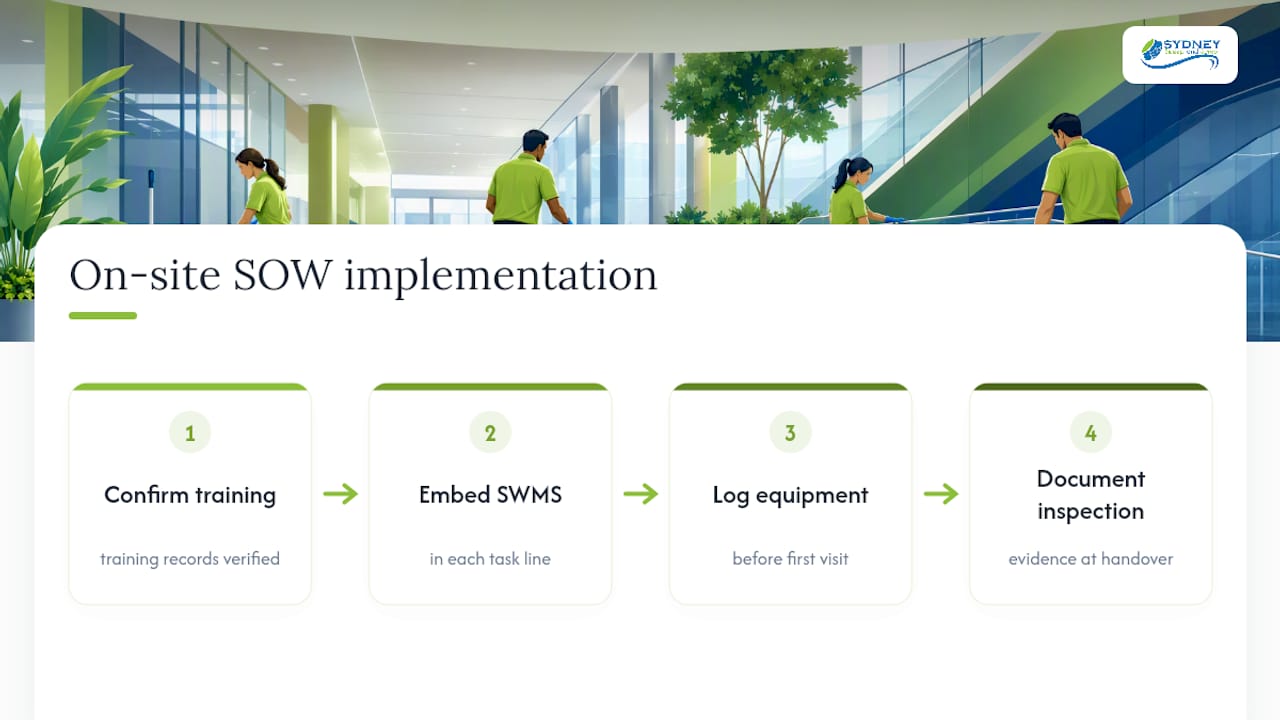
Inspection evidence gets documented at handover so there’s a record from day one, not just a promise. Case studies and client references for specific site types are available on request when you’re comparing suppliers against your own tender specifications.
Get a scope of work built around your site, not a generic template
Reading a template is one thing. Getting a scope of work written against your actual carpark, warehouse floor or loading dock is another, and that’s the gap service providers fill for facility managers who don’t want to draft twenty pages of specifications from a blank page. We work across hard surface cleaning, carpark scrubbing, warehouse floors and scheduled deep cleans, and every one of those services can be dropped straight into the SOW structure covered above, with frequencies and KPIs already matched to industrial-grade equipment rather than guesswork.
If you’re drafting a tender and want the technical detail checked against what’s actually deliverable on the ground, consider contacting a cleaning services provider for a site-specific scope of work or a straight quote. Start with our hard surface cleaning page to see how the specifications above translate into an actual booked job.
Sources
- Principles that apply to WHS duties — Safe Work Australia (factsheet)
- Work Health and Safety Act 2011 — Federal legislation
- Commercial cleaning contract guide — XIRI Facility Solutions