
For fresh, small rust marks, vinegar or WD-40 might shift the problem. For anything older or heavily set, you need a concrete-specific rust remover built on oxalic or phosphoric acid, applied with a proper dwell time and rinsed until the run-off is clear.
Before you treat anything, remove whatever is causing the rust: a rusty pot stand, a corroding balustrade bracket, an old tool left on the slab. Then test your chosen product on a small, hidden patch first.
- Purpose-made rust removers outperform pantry acids on set-in stains.
- Always test patch, then follow the label’s dwell time exactly.
- Protect nearby plants, drains and metal fittings before you start.
- Wear gloves and eye protection; these are genuine acids.
Safety first: oxalic and phosphoric acid blends are effective precisely because they’re reactive. Splash-back on skin or eyes needs immediate rinsing, and run-off into garden beds can scorch plants.
Key Takeaways
Purpose-made concrete rust removers with oxalic or phosphoric chemistry outperform household acids on anything older than a few days.
| Point | Details |
|---|---|
| Match product to stain age | Fresh marks respond to vinegar or WD-40; set-in stains need a dedicated concrete rust remover. |
| Test patch every time | Trial the product on a hidden spot and record the dwell time before treating the whole stain. |
| Never use a wire brush | Wire filings re-oxidise and cause fresh spotting; a stiff nylon brush protects the surface. |
| Fix the source and seal | Remove the rusting item and seal the concrete to stop the stain returning and ease future cleaning. |
| Call in Sweepandscrub for large or old stains | Sweepandscrub handles commercial-scale rust removal with matched chemistry and low-pressure extraction. |
Table of Contents
- Quick DIY options: vinegar, lemon, baking soda and WD-40
- How do you apply a concrete rust remover step by step?
- Which commercial rust removers work best on concrete?
- How do you stop rust stains coming back?
- When should you call a professional for rust stains?
- Sydney Sweep and Scrub: professional rust treatment for hard surfaces
- Frequently asked questions
- Sources
Quick DIY options: vinegar, lemon, baking soda and WD-40
Household fixes have their place, mostly on rust that’s a few days old and hasn’t had time to soak into the concrete’s pores.
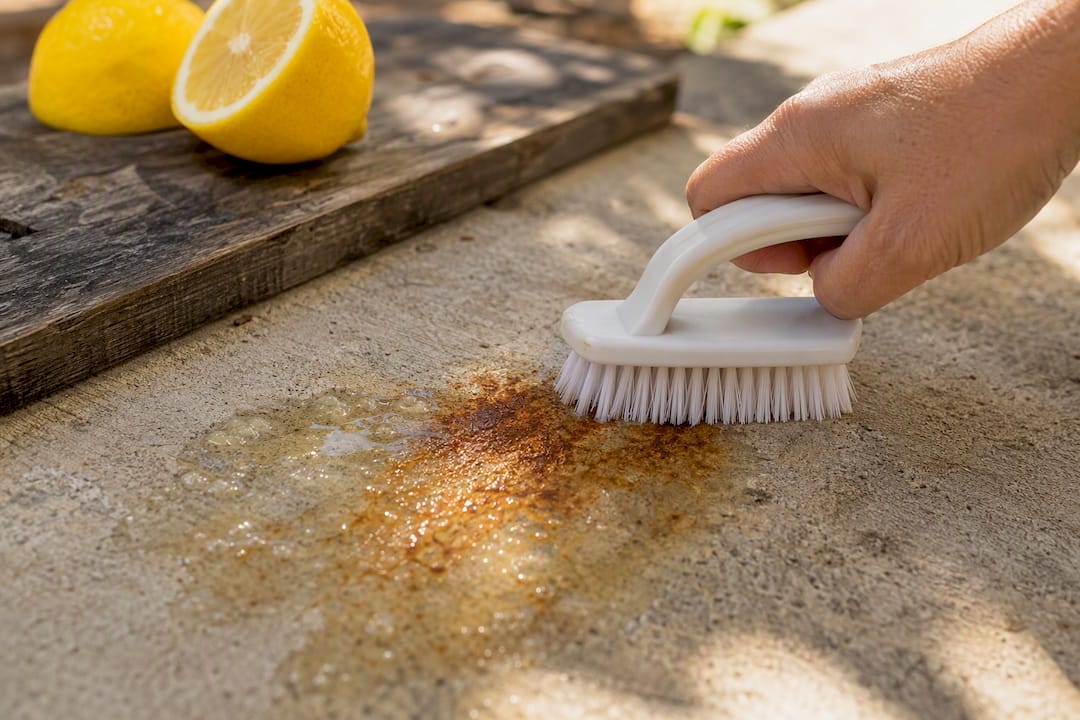
Vinegar or lemon juice: pour it directly onto the stain, let it sit for 5 to 15 minutes, then scrub with a stiff nylon brush and rinse with water. The acid is mild, so it rarely damages the slab, but it also rarely shifts anything beyond a surface tint.
Baking soda paste: mix with a little water into a thick paste, spread over the mark, leave for 10 to 15 minutes, then scrub and rinse. It works better as a mild abrasive booster than as a rust dissolver.
WD-40: spray onto the stain, wait a few minutes, then scrub and hose off. WD-40 Australia’s own guidance frames this as a solution for small rust stains on concrete rather than a fix for anything extensive or old.
Where these options fall short is predictable:
- Old stains that have soaked deep into porous concrete
- Rust with embedded metal fragments in the surface
- Decorative, honed or acid-sensitive finishes, where any acid (even a mild one) can etch or discolour the surface
If you’ve tried one of these for 15 minutes with no visible lift, that’s your signal to move to a dedicated concrete rust remover rather than repeating the same weak method for another hour.
How do you apply a concrete rust remover step by step?
Buying the right chemistry is half the job. Applying it properly is the other half, and it’s where most DIY attempts go wrong.
- Remove the source. Take away the rusting item, tool, or fitting causing the stain. Sweep loose debris and grit off the slab.
- Protect the surrounds. Wet down nearby garden beds, cover drains if the product sheet advises it, and move or shield anything metal that could react with overspray.
- Test patch first. Apply a small amount to an inconspicuous corner of the stain, note the time, and check the result after the label’s minimum dwell period.
- Apply and time the dwell. Follow the product label. Fresh stains often lift within a short dwell time; older, deeply set rust may need a longer soak, because the acid has to work its way through the pores where the iron has settled.
- Agitate gently. Use a stiff nylon brush, never a wire brush. Wire brushing leaves microscopic metal filings behind that can re-oxidise and create fresh rust spots right where you just cleaned.
- Rinse and neutralise. Flush thoroughly until the run-off runs clear. Leftover acid keeps reacting and can leave its own faint discolouration if it isn’t fully washed away.
- Repeat if needed. Professional workflows favour several controlled passes over one aggressive treatment, because repeated gentle applications protect the slab better than pushing dwell time or pressure too hard in one go.
Pro Tip: Technicians judge dwell time by testing a patch and reading the surface’s porosity, not by a fixed clock. Cutting that test short is the single biggest reason rust “removal” jobs quietly reappear a few weeks later.
Which commercial rust removers work best on concrete?
Most in-market products fall into three camps: acid blends, non-acid formulas, and general household products pressed into service.
Chemtech 1L Rust Off Remover, sold through Bunnings, is marketed specifically for rust and bore water stains on concrete, pavers and terrazzo, making it a straightforward pick-up for a single driveway or patio job.
RSR (Rust Stain Remover) from ET Industrial is positioned as a fast-acting option for trade and property-management use, suited to larger or repeat jobs where speed matters.
Rust Away, from Sealers Plus, includes non-acid and acid-blend formulations for iron and bore stain removal, with specific guidance for surfaces where a strong acid isn’t appropriate.
WD-40 remains the fallback for a tiny, fresh mark you want gone in ten minutes with what’s already in the shed.
A quick checklist before you buy:
- Match the formulation to your surface: coloured, honed or sealed concrete often needs a gentler, non-acid product.
- Older, set-in stains generally need an acid blend, not a household workaround.
- Check the safety data sheet and label directions for dwell time and dilution.
- Consider whether you need spray, brush-on gel or concentrate, depending on the size of the area.
How do you stop rust stains coming back?
Treating the stain without fixing the cause is a losing game. Rust marks return because the metal source is still sitting there, and practitioner guidance is consistent on this point: fix the source first.
- Fit rubber or plastic pads under furniture legs, pot stands and tool racks.
- Check balustrades, irrigation fittings and gate hardware for early corrosion.
- Seal bare concrete: a sealer reduces porosity, so rust sits on the surface rather than soaking in, which makes any future clean-up faster and less aggressive.
- Reseal every few years depending on foot traffic and weather exposure.
- Deal with tiny new marks immediately, before they have time to bind into the pores.
When should you call a professional for rust stains?
Some jobs are genuinely DIY-sized. A single small mark on a driveway, tackled within a day or two of appearing, usually responds to a household or off-the-shelf product.
Call a professional when you’re dealing with a large area, stains that have been there for months or years, embedded metal fragments, or decorative and coloured concrete where the wrong chemistry could do real damage. A commercial car park with rust streaking from old bollards or drainage grates is a different scale of problem entirely.
Professional treatment typically follows a tighter version of the DIY process: on-site assessment, multiple test patches to match the right chemistry to that specific slab, controlled dwell times based on porosity, and low-pressure extraction rather than high-pressure blasting that can etch or pit the surface.
Rust removal on a commercial scale isn’t about stronger chemicals or more pressure. It’s about matching the right product to the right surface and giving it the time it needs to work properly, then extracting it cleanly so nothing re-stains the slab a week later.
Property managers dealing with recurring rust across car parks, loading docks or public walkways get more consistent results from a scheduled professional pass than from repeated one-off DIY attempts.
Sydney Sweep and Scrub: professional rust treatment for hard surfaces
If a driveway rust mark is a ten-minute job, a car park streaked with rust from old drainage grates and steel bollards is a different problem altogether, and it’s exactly where Sweepandscrub earns its keep. Rather than sending a crew in with a pressure washer and hoping for the best, Sweepandscrub matches chemistry to the surface, tests dwell times on-site, and extracts the dissolved rust with industrial-grade, low-pressure equipment that won’t etch or degrade the slab.
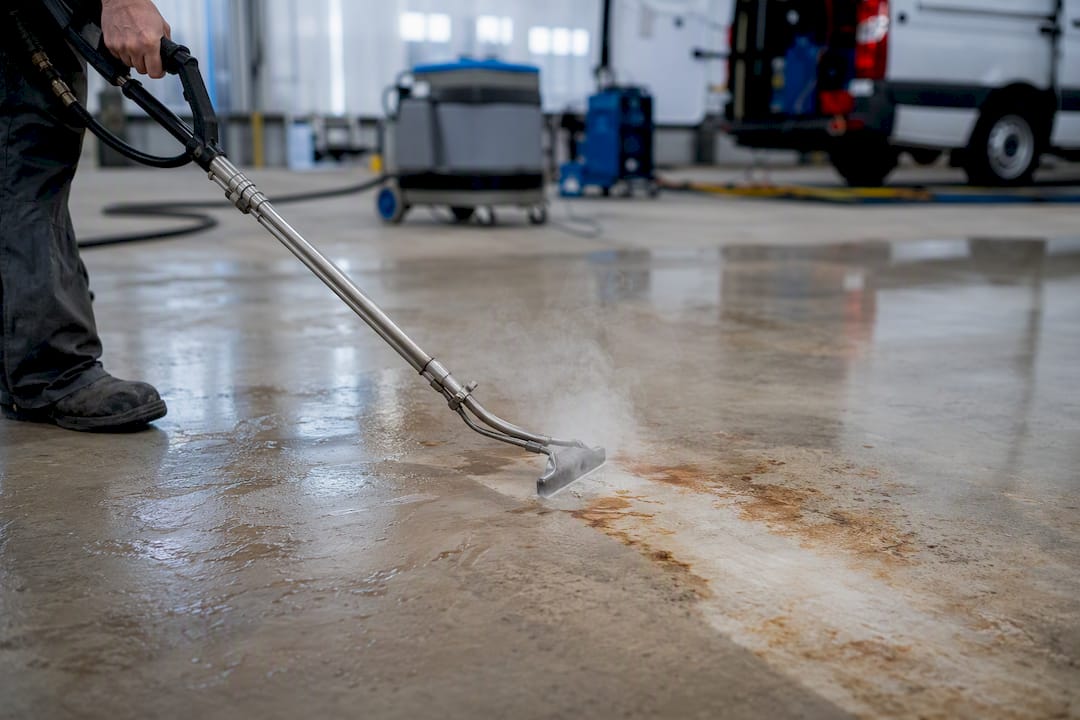
Every job runs on a carbon-neutral basis, so clients get rust-free concrete without adding to the problem they’re trying to fix. Pricing is competitive and quoting is straightforward online, no back-and-forth required.
If your car park, warehouse floor or public walkway has rust staining that keeps coming back, get a quote through the hard surface cleaning page and book a site assessment.
Frequently asked questions
What removes rust stains from concrete fastest?
A concrete-specific rust remover with oxalic or phosphoric acid works fastest on set-in stains, often lifting a mark within one dwell cycle when applied correctly.
Can vinegar remove rust stains on concrete?
Vinegar can fade very fresh, shallow rust marks after a short soak, but it rarely shifts stains that have soaked into the concrete for more than a few days.
Is WD-40 safe to use on concrete for rust removal?
Yes, for small, fresh stains. It’s a household workaround rather than a specialist rust remover, so don’t expect it to handle large or long-standing marks.
Will a pressure washer remove rust stains on concrete?
High pressure alone can spread rust particles or etch the surface. Professionals use low-pressure extraction paired with the right chemistry instead of pressure alone.
How do I stop rust stains coming back on my driveway or car park?
Remove the metal source causing the stain, fit protective pads under furniture and fittings, and seal the concrete to reduce how much rust the surface absorbs.
Sources
- Removing Rust Stains from Concrete –
- Chemtech 1L Rust Off Remover
- How to remove rust from concrete using WD-40
- Rust stain removal | The Stain Eaters
Recommended
- Post-Event Cleaning: Concrete Surfaces – Sydney Sweep and Scrub – Commercial Cleaning – Carpark Cleaning – Warehouse Cleaning
- Cleaning Your Concrete Before Line Marking – Sydney Sweep and Scrub – Commercial Cleaning – Carpark Cleaning – Warehouse Cleaning
- Post-Construction Concrete Cleaning – Sydney Sweep and Scrub – Commercial Cleaning – Carpark Cleaning – Warehouse Cleaning
- Tips on Cleaning Your Concrete Event Space – Sydney Sweep and Scrub – Commercial Cleaning – Carpark Cleaning – Warehouse Cleaning