
The best epoxy floor cleaning routine is simple: clear grit daily, damp mop or auto-scrub to a set schedule with a pH-neutral cleaner, and always recover the dirty solution rather than letting it dry back into the coating. The one rule that protects your warranty is chemistry, not elbow grease. Check the cleaner’s pH before it touches the floor and never run an abrasive grit pad across it without your coating manufacturer’s sign-off.
Here’s what that looks like in practice:
- Sweep or vacuum first, every time. Grit under a mop head scratches epoxy the same way sand scratches a car windscreen.
- Use microfibre or soft pads only. Anything rated for stripping vinyl composition tile (VCT) is too aggressive for resin coatings.
- Check pH with test strips before you apply anything new to the floor.
- Recover the wash solution with a wet vacuum or auto-scrubber rather than letting it pool and evaporate.
Pro Tip: Keep a laminated pH chart near your cleaning cupboard. A five-second strip test before mopping day saves a five-figure recoat bill later.
Get this one habit right and an epoxy floor will comfortably outlast the cleaning products used on cheaper coatings, largely because the damage that shortens epoxy life is almost always chemical, not physical.
Key Takeaways
Epoxy floors last longest when grit is removed daily, cleaning chemistry is pH-verified before use, and wash solution is fully recovered rather than left to dry on the coating.
| Point | Details |
|---|---|
| Sweep before you mop | Remove dry grit first; it’s the main cause of surface scratching on epoxy. |
| Match cleaner to coating | Use pH-neutral, low-foam cleaners and confirm compatibility before applying anything new. |
| Follow the five-step process | Sweep, apply, agitate, dwell for five to ten minutes, then fully recover the solution. |
| Choose soft pads only | White, tan, blue or soft nylon pads suit epoxy; VCT-grade grit pads will abrade it. |
| Call a specialist early | Persistent tackiness, delamination or recurring stains call for professional assessment, and Sweepandscrub’s hard-surface cleaning service is built for exactly that job. |
Table of Contents
- How often should you sweep, vacuum and mop epoxy floors?
- What’s the safest way to remove grease, oil and tyre marks?
- What’s the correct process for auto-scrubbing an industrial epoxy floor?
- How do you clean exterior epoxy and textured anti-slip surfaces?
- When should you call in a specialist epoxy cleaning contractor?
- Get your epoxy floor cleaned by the team that does this daily
- Frequently asked questions
- Sources
How often should you sweep, vacuum and mop epoxy floors?
Frequency depends on foot and vehicle traffic, not the calendar. A loading dock that sees forklifts all shift needs dry cleaning every shift; a quiet storage bay might only need it weekly, a distinction Millfac’s guidance on matching frequency to soil load makes clear.
Match your tools to the traffic level:
- Low-traffic areas (offices, showrooms, quiet corridors): a dust mop or microfibre flat mop daily, damp mop weekly.
- Medium-traffic areas (retail floors, light warehousing): an industrial vacuum for grit removal daily, damp mop or single-disc scrub two to three times a week.
- High-traffic areas (loading docks, production floors, car parks): a walk-behind sweeper each shift, followed by auto-scrubbing on a schedule set by soil load rather than a fixed weekly slot.
Damp mopping suits smaller footprints and lighter soil. Once a floor exceeds a few hundred square metres or carries oil and tyre residue, an auto-scrubber does the job faster and rinses more evenly, which matters because pooled detergent left to dry is one of the more common causes of a hazy, slippery film on epoxy.
On cleaner chemistry, start with a pH-neutral, low-foam product and confirm compatibility against the coating manufacturer’s own list. Sherwin-Williams’ maintenance guidance recommends neutral cleaners for general foot-traffic zones and reserves stronger degreasers for oil-heavy areas only. Dilute to label strength, wring mop heads properly rather than soaking the floor, and skip the rinse step unless the label specifically calls for one. Keep a simple log of the products used and the pH readings taken. That record becomes the only neutral evidence you have if a coating fails prematurely and the manufacturer or installer questions your cleaning practice.
What’s the safest way to remove grease, oil and tyre marks?
Contain the spill before you clean it. Absorb fresh liquid with granular absorbent or pads and scrape off any solids first. Spreading fresh oil around with a mop head just widens the stain and pushes it into the coating’s surface texture.
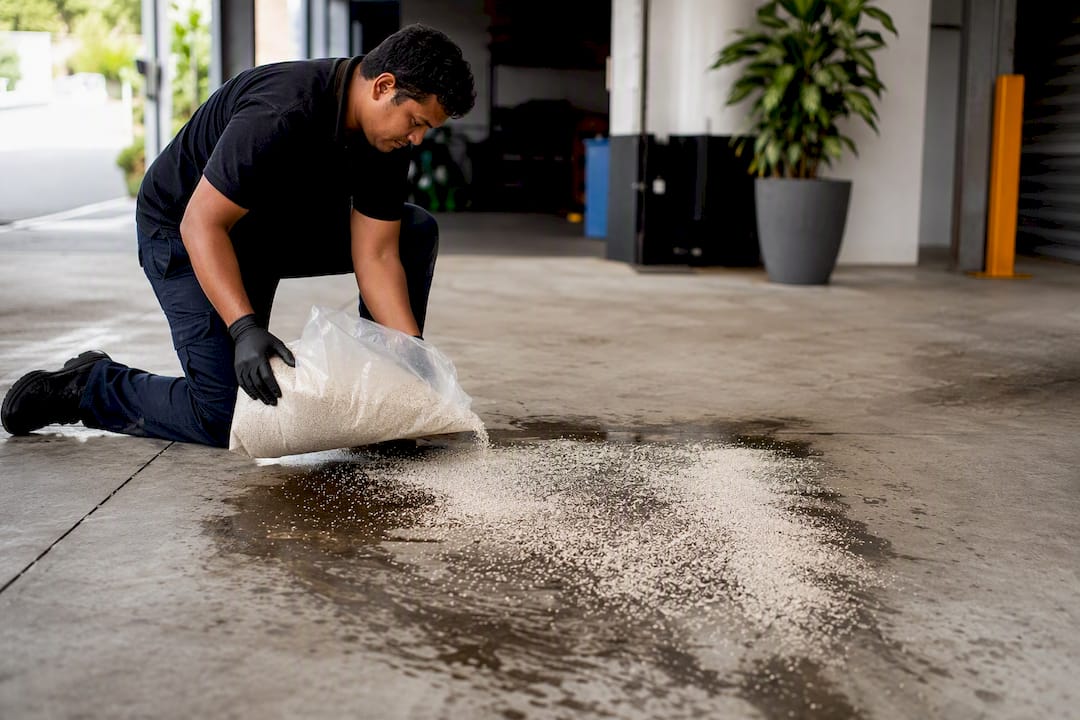
For oil and grease, use a cleaner rated as epoxy-safe rather than a generic industrial degreaser. Apply it, give it a short dwell time, agitate gently with a soft pad, and wet-vac the residue away rather than mopping it dry. Our guide to removing grease and oil in warehouses covers the dwell-and-recovery method in more detail.
Tyre marks are different. They’re usually plasticiser transfer from the rubber rather than true grease, so a mild alkaline degreaser or a purpose-made tyre-mark remover works better than a solvent. Always patch test in a corner first. If the mark still won’t lift, light mechanical scraping with a plastic blade is the last resort, not the first move.
- Never reach for solvent-based spotters or high-pH strippers unless the epoxy manufacturer has approved that exact product.
- Wrong chemistry doesn’t just fail to clean; over repeated use it can saponify and break down amine-cured epoxy, leading to delamination that looks nothing like a cleaning problem until it’s too late.
Pro Tip: Keep a small tray of dry absorbent granules near loading bays. Containing a spill in the first sixty seconds is worth more than any cleaner you apply an hour later.
What’s the correct process for auto-scrubbing an industrial epoxy floor?
Pad choice makes or breaks a heavy-duty program. Epoxy wants soft to medium pads, white, tan, blue or soft nylon, not the black or red grit pads built for stripping VCT. Millfac’s floor-care program guidance is blunt about this: match the pad to the coating, not just the soil level, because an aggressive pad will dull an epoxy finish long before it looks visibly worn.
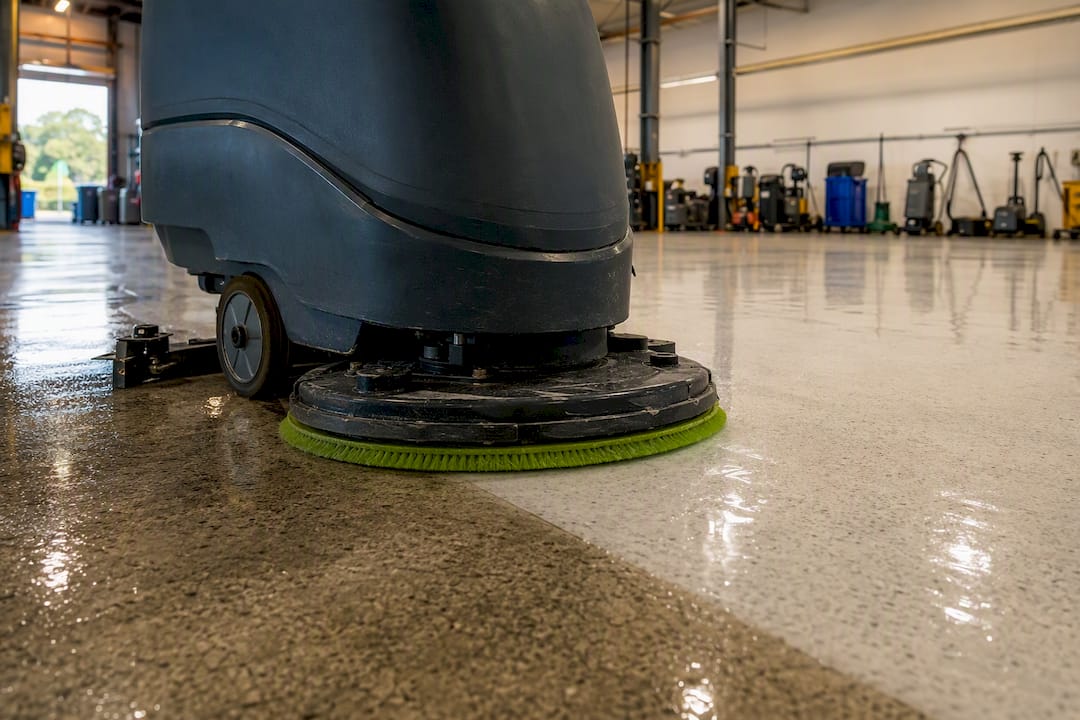
Whether you run a walk-behind or a ride-on scrubber depends on floor area and traffic pattern. Walk-behinds suit tighter aisles and areas under 1,000 square metres; ride-on units earn their cost on larger warehouse floors where operator fatigue and time become the real constraint.
The cleaning sequence itself follows a five-step method that Sherwin-Williams recommends for resinous flooring:
- Sweep to clear loose grit before any liquid touches the floor.
- Apply the cleaner at the label’s stated dilution, never stronger.
- Agitate with a soft pad or brush, using the scrubber’s lowest effective head pressure.
- Dwell for roughly five to ten minutes so the chemistry does the work, not the scrubbing.
- Remove the solution completely with a wet vacuum or scrubber-dryer.
A few operational checks make this repeatable rather than a one-off effort:
- Spot-test any new cleaner or pad combination in an inconspicuous corner first.
- Carry pH strips on the scrubber cart and check them against the product’s safety data sheet periodically.
- Recover wastewater properly. Sydney-specific industrial cleaning guidance is explicit that wash water must never enter stormwater drains and should go to sewer or trade waste per local trade-waste rules.
How do you clean exterior epoxy and textured anti-slip surfaces?
Exterior epoxy and broadcast anti-slip finishes need a gentler touch than a standard warehouse floor, not a harsher one.
- Use low-pressure, wide fan tips outdoors. Euclid Chemical’s maintenance guidance warns that high-pressure narrow nozzles worked close to joints or lifting edges can worsen delamination rather than just clean the surface.
- Keep the nozzle moving and well away from expansion joints, doorways and any edge where the coating meets a different substrate.
- For textured or broadcast floors, a soft nylon brush or foamer reaches into the recesses that a flat mop simply glides over, and full wet recovery stops oils being pushed back into the texture instead of lifted out.
- Only pressure wash where the run-off can be legally contained and recovered, never onto open ground or into a public drain.
When should you call in a specialist epoxy cleaning contractor?
Some signs mean the mop and bucket stage is over. Persistent tackiness after cleaning, visible delamination or bubbling, deep gouges from forklift traffic, or a stain that keeps reappearing after you’ve treated it twice are all reasons to bring in a specialist rather than escalate your own chemical strength.
A contractor worth hiring documents what a caretaker crew usually doesn’t:
- Verified pad and chemical compatibility against your specific coating system.
- Controlled mechanical agitation rather than guesswork with a scrubber dial.
- Compliant wastewater capture and disposal.
- A written condition report you can hand to your coating manufacturer if a warranty claim ever comes up.
Sydney Sweep and Scrub builds its service around exactly that discipline, running hard-surface cleaning, pressure washing and automated scrubbing with carbon-neutral operations across warehouses, car parks and public spaces. Our team explains more of the reasoning in why a professional scrub outperforms a DIY warehouse clean. To get an accurate quote, have your floor type, some photos of current condition, and a rough traffic pattern ready before you call.
Get your epoxy floor cleaned by the team that does this daily
If you’d rather not stock pH strips, train staff on pad selection, and track soil load across a whole site, that’s precisely the gap Sweepandscrub fills. We run hard-surface cleaning with equipment matched to resin coatings, not general-purpose gear borrowed from carpet or tile work, and every job includes proper wastewater recovery so you’re never left explaining a stormwater breach to council.
For sites weighing a mop-and-bucket routine against mechanical scrubbing, our breakdown of sweep and scrub versus mop and bucket for warehouses is worth a read before you commit staff hours to either. If you’re unsure whether your coating needs a gentler chemical program, our page on cleaning chemicals to avoid covers the products that cause the most warranty disputes.
Book a site visit through our hard-surface cleaning page and we’ll assess your floor type, traffic pattern and current condition before quoting a schedule that actually fits your soil load.
Frequently asked questions
What is the best cleaner for epoxy floors?
A pH-neutral, low-foam industrial cleaner is the safest default. Confirm it against your coating manufacturer’s approved products list before using it on the whole floor, since even a mild alkaline product used repeatedly can affect amine-cured epoxy over time.
How often should epoxy floors be cleaned?
It depends on traffic and soil load rather than a fixed calendar. High-traffic loading areas often need dry sweeping every shift and scrubbing several times a week, while quiet storage bays might only need weekly attention.
Can you pressure wash an epoxy floor?
Yes, with caution. Use low-pressure, wide fan tips and keep the nozzle away from joints and edges. Narrow, high-pressure nozzles worked close to seams are a common cause of delamination on both interior and exterior epoxy.
Why does my epoxy floor feel sticky after cleaning?
Sticky residue usually means detergent buildup from an incorrect dilution, incomplete rinsing, or wash water that was left to pool and evaporate rather than being wet-vacuumed away. Persistent tackiness after correcting the cleaning method is a sign to call a specialist.
How do you clean painted concrete floors differently from epoxy?
Painted concrete generally tolerates a wider range of cleaners than epoxy, but it’s more prone to surface wear from abrasive pads and high foot traffic. The same core rule applies to both: match the pad and chemical strength to the coating rather than defaulting to whatever’s on the shelf.
Sources
- Epoxy-coated concrete floor care — Opora (ASTM D6962 context)
- Manufacturing floor care program guidance — Millfac
- How to clean epoxy warehouse floors — KCLEAN (Sydney industrial guidance)
Recommended
- Warehouse Flooring: Polished Concrete vs Epoxy Coatings – Sydney Sweep and Scrub – Commercial Cleaning – Carpark Cleaning – Warehouse Cleaning
- Tips on Cleaning Your Concrete Event Space – Sydney Sweep and Scrub – Commercial Cleaning – Carpark Cleaning – Warehouse Cleaning
- Post-Event Cleaning: Concrete Surfaces – Sydney Sweep and Scrub – Commercial Cleaning – Carpark Cleaning – Warehouse Cleaning
- Tips to Protect Your Concrete Floor: Warehouses – Sydney Sweep and Scrub – Commercial Cleaning – Carpark Cleaning – Warehouse Cleaning