
A compliant commercial construction dust cleanup combines mechanical sweeping, M or H class HEPA vacuuming, wet suppression, pressure or hot-water washing, and lawful waste segregation, all governed by a documented SWMS and site-specific dust control plan. Skip any of these and you’re carrying WHS and environmental risk, not just a dust problem.
What you’re buying generally falls into three tiers:
- Basic maintenance — scheduled sweeping and vacuuming to keep an active site safe day to day.
- Targeted abatement — focused dust removal after a specific high-dust task (cutting, grinding, demolition of a section).
- Comprehensive post-demolition abatement — full site decontamination before handover or re-occupation.
Pro Tip: Before signing anything, ask the contractor to show you their M or H class vacuum certification and a site-specific SWMS. If they can’t produce either on request, keep looking.
Key Takeaways
A compliant commercial construction dust cleanup pairs mechanical sweeping, M or H class HEPA vacuuming and wet suppression with a documented SWMS to control both airborne silica risk and stormwater pollution.
| Point | Details |
|---|---|
| Match service to project stage | Use maintenance sweeping on active sites, targeted abatement after cutting work, and full abatement post-demolition. |
| Verify vacuum class | Confirm M or H class HEPA vacuums are used, especially where silica-generating tasks have occurred. |
| Demand documentation | Require a site-specific SWMS, insurance certificates, and disposal documentation before work starts. |
| Sequence matters | Suppression must happen before sweeping and vacuuming, never dry sweeping or compressed air. |
| Compare quotes on specifics | Request a line-item equipment list and time estimate rather than accepting a lump sum. |
| Consider a compliant provider | Sweepandscrub offers mechanical sweeping, M/H class HEPA vacuuming, hot-water pressure washing and recurring maintenance booking for commercial sites. |
Table of Contents
- What professional construction dust-cleanup services include
- What WHS and environmental rules must a contractor meet?
- How do contractors actually run a cleanup on site?
- When should you schedule construction dust cleanup?
- What drives the cost of a construction dust cleanup?
- What should you ask for in every quote?
- How should you prepare your site before the crew arrives?
- Why consider Sydney Sweep and Scrub for construction dust cleanup
- Sources
What professional construction dust-cleanup services include
Commercial dust cleanup isn’t one job, it’s a stack of methods applied in the right order. Mechanical sweeping clears loose debris from large hard surfaces fast. Ride-on scrubbing lifts bonded grime and residue that sweeping alone won’t shift. M or H class HEPA vacuuming captures the fine, breathable dust that settles after cutting or grinding, including respirable crystalline silica. Wet sweeping and wet mopping stop dust re-entering the air during cleanup itself. Pressure washing, hot or cold, handles baked-on residues and oil contamination on concrete and asphalt. Add rubbish removal and lawful disposal, robotic or automated sweepers for large repetitive areas, and a high-level final surface scrub before handover, and you’ve got the full service stack.
Which combination you need depends on where the site sits in its lifecycle:
| Package tier | Core tasks included |
|---|---|
| Ongoing maintenance | Mechanical sweeping, spot vacuuming, routine wet mopping |
| Targeted abatement | M/H class HEPA vacuuming, wet suppression, pressure washing of affected zones |
| Post-demolition abatement | Full site vacuuming, hot-water washing, waste segregation, final inspection clean |
A general overview of construction site dust cleanup is worth reviewing if you’re mapping which tier your project actually needs, particularly for sites running multiple trades concurrently.
What WHS and environmental rules must a contractor meet?
Dust isn’t just a cleanliness issue, it’s a regulated hazard. Under Australian WHS law, PCBUs have a duty to manage dust risks at the workplace, and that duty extends to whoever they engage for site cleaning. For projects valued at $350,000 or more, principal contractors carry an explicit duty to maintain hygiene protocols covering dust and debris control, not just the general site tidy-up.
There’s an environmental angle too. Sites carry a general environmental duty to prevent pollutants entering stormwater systems, which means uncontained wash water or dry sweeping into open drains can trigger a separate compliance problem entirely.
Before you sign a contract, ask for:
- A written, site-specific SWMS covering dust and, where relevant, silica risk controls.
- Evidence of M or H class vacuums with current HEPA filtration testing.
- Public liability and workers’ compensation insurance certificates.
- Health monitoring protocols and RPE standards for workers on silica-generating tasks.
Queensland’s Code of Practice for managing respirable crystalline silica dust commenced on 1 May 2023 as Australia’s first dedicated silica code for construction, and it specifically recommends H class vacuums where practicable for cleanup work.
Pro Tip: If the site has any history of silica-generating work (cutting, grinding, drilling engineered stone or concrete), ask for recent air monitoring or filter test records, not just a verbal assurance.
How do contractors actually run a cleanup on site?
A competent crew doesn’t just show up and start sweeping. The sequence matters, and it’s worth knowing so you can spot a shortcut being taken.
It starts with site assessment and risk scoping: identifying which zones have generated silica dust, where settled dust is heaviest, and what surfaces need what treatment. Next comes containment and access control, restricting non-essential foot traffic, signposting hazard zones, and where needed, erecting dust partitions.
Suppression happens before cleaning starts. Water suppression and on-tool extraction knock dust down before it’s disturbed further. Only then does the cleaning sequence run: mechanical sweeping of loose debris, M or H class vacuuming of settled fines, targeted pressure or hot-water washing of hard surfaces, contained rinse water collection, waste segregation, and sealed transfer to an authorised disposal site. A final inspection against agreed acceptance criteria closes the job out.
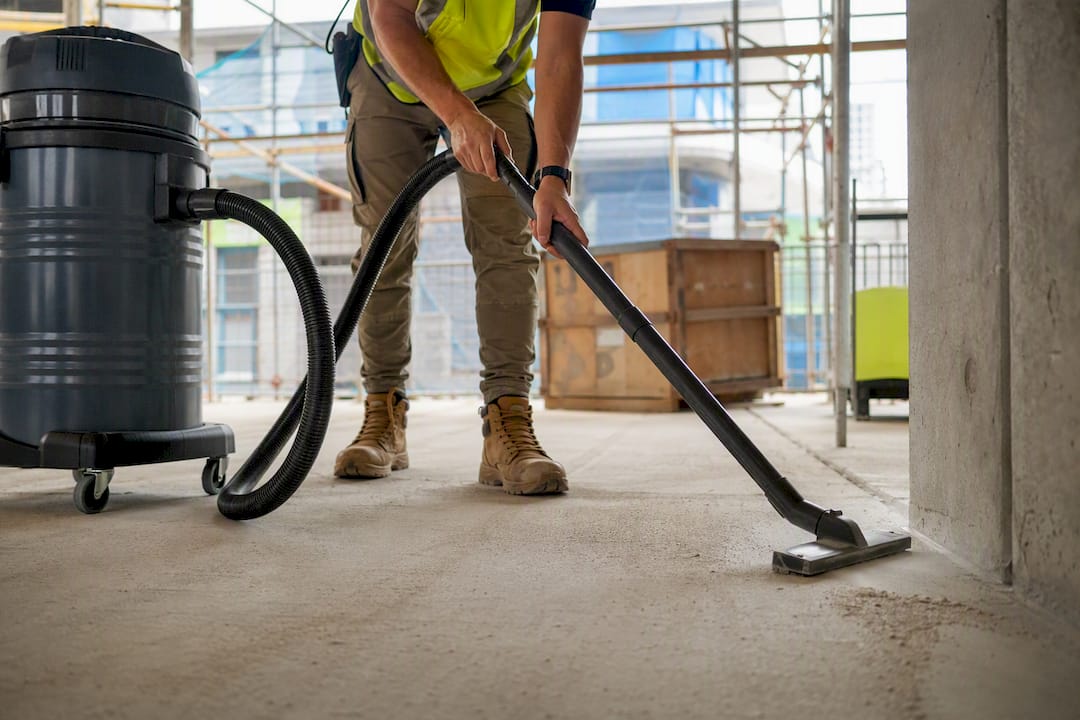
Pro Tip: Dry sweeping and compressed air are the two shortcuts that cause the most trouble. Both re-aerosolise dust that’s already settled. If a quote mentions either, that’s a red flag, not a cost saving.
When should you schedule construction dust cleanup?
Timing shapes both cost and risk. Active sites with heavy foot or vehicle traffic generally need sweeping and vacuuming daily to weekly, while a single, comprehensive abatement clean is the right call immediately after demolition or major cutting work.
Other common triggers: pre-handover final cleans before a tenant or occupier moves in, post-event cleans for stadiums and concourses, and remediation after a dust-control system failure or an unplanned heavy-dust task.
Scheduling rules of thumb worth locking in:
- Daily or weekly light cleans for active, high-traffic construction sites.
- One full abatement clean after demolition, before any re-occupation.
- Night or weekend windows where disruption to adjacent tenants or public areas is a concern.
For sites near public foot traffic, post-event cleaning approaches offer useful parallels on minimising downtime.
What drives the cost of a construction dust cleanup?
Quotes vary more than most buyers expect, and it’s rarely about the sweeper itself. Site size and total surface area set the baseline, but dust load and contamination type (silica versus general debris) matter just as much, since silica-contaminated waste often needs licensed handling.
Other cost drivers worth watching:
- Access difficulty, particularly multi-level sites needing vertical work or lift access.
- Equipment class required, M versus H class vacuums, ride-on scrubbers, hot-water units.
- Containment and traffic management setup time.
- Waste transport and disposal fees, especially for reportable or hazardous waste streams.
- Labour hours and any after-hours or weekend surcharges.
Hazardous residues, certain masonry dusts included, need transport permissions and disposal at authorised facilities, which adds cost that a generic sweep-and-go quote won’t reflect.
Pro Tip: Ask every contractor for a line-item equipment list and a time estimate, not just a lump sum. It’s the only way to compare quotes on an apples-to-apples basis.
What should you ask for in every quote?
A proper quote is really a compliance document with a price attached. Before accepting one, make sure it includes:
- A written SWMS or dust control plan specific to your site.
- An equipment list showing M or H class or HEPA-rated vacuum proof.
- Current public liability and workers’ compensation certificates.
- References, or before/after case photos from comparable jobs.
- A proposed work sequence and realistic timing.
- Written acceptance criteria and a final inspection process.
- Disposal destination documentation for any waste streams generated.
A post-construction cleaning checklist is a handy reference to run against any quote you receive.
Pro Tip: Ask for a short site walk-through or photo survey before the quote is finalised. A price built on an actual look at the dust load beats a guess every time.
How should you prepare your site before the crew arrives?
A little prep on your end saves time and cost once the contractor is on site. Clear non-essential items from work areas, mark any known contaminant zones, and secure clear access routes for wheeled equipment like ride-on scrubbers.
Isolate or provide containment for stormwater drains before wet cleaning begins, and tag or remove fragile finishes and unstable overhead materials. Assign a single site contact who can walk the crew through an induction.
Have this ready before they arrive:
- Current site plans.
- SWMS documentation from other trades, if available.
- Access, parking and induction rules for the site.
Why consider Sydney Sweep and Scrub for construction dust cleanup
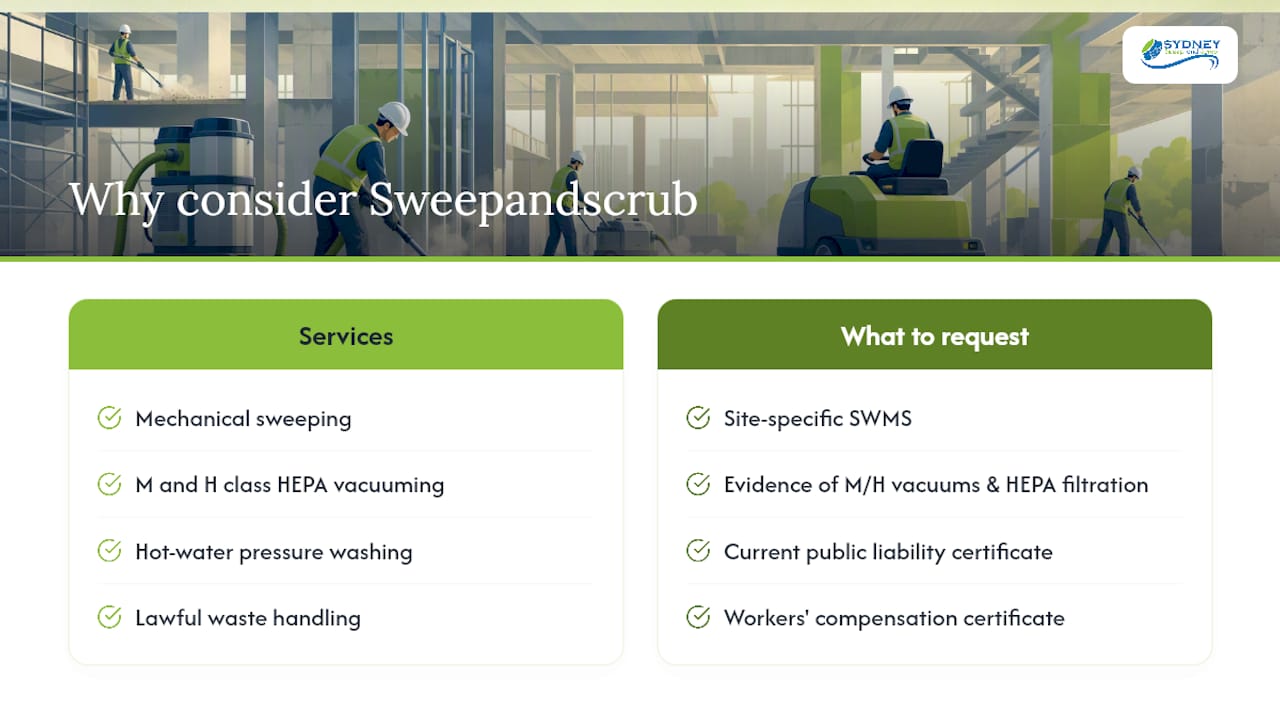
Sweepandscrub is the practical route to a compliant cleanup without chasing separate contractors for sweeping, vacuuming and pressure washing. One provider covers mechanical sweeping, M and H class HEPA vacuuming, hot-water pressure washing, lawful waste handling, and robotic sweepers for large repetitive areas, all under one booking.
Before you commit, it’s fair to ask any provider, Sweepandscrub included, for a site-specific SWMS, evidence of M/H class vacuums and HEPA filtration, current public liability and workers’ compensation certificates, and before/after photos or case studies from comparable sites. An acceptance checklist should be part of the offer, not an afterthought.
Pro Tip: If you’re managing multiple sites or a long-running project, ask about recurring maintenance contracts. Online booking through Sweepandscrub means you can lock in scheduled cleans without chasing quotes every time dust builds up.
For hard surface work specifically, the hard surface cleaning service covers the mechanical scrubbing and pressure washing most commercial sites need, and it’s the natural starting point for getting a quote against your own site’s dust load.
Sources
This article is general information, not a substitute for advice from a qualified doctor. Consult a qualified healthcare professional about your own circumstances before acting on anything here.
Recommended
- Home – Sydney Sweep and Scrub – Commercial Cleaning – Carpark Cleaning – Warehouse Cleaning
- Professional Post-Event Cleaning Tips – Sydney Sweep and Scrub – Commercial Cleaning – Carpark Cleaning – Warehouse Cleaning
- Sweep and Scrub Your Construction Site – Sydney Sweep and Scrub – Commercial Cleaning – Carpark Cleaning – Warehouse Cleaning
- Post-Construction Cleaning Checklist – Sydney Sweep and Scrub – Commercial Cleaning – Carpark Cleaning – Warehouse Cleaning