
Hiring a contractor to pressure wash concrete without a written Concrete Washout Management Plan (CWMP) is how property managers end up wearing an EPA fine that belonged to their contractor. The one‑sentence brief for procurement is this: engage a commercial contractor who provides a written CWMP, deploys operators trained to CPPCLO3020 competence, and can prove wastewater is managed to a pH between 6.5 and 8.5 or removed to a licensed facility.
Put these four items in the purchase order before anyone books a truck:
- A site‑specific CWMP covering the washout area and disposal route
- Evidence of operator training against the CPPCLO3020 unit
- Current insurance certificates and equipment specifications
- A pre‑start site plan showing traffic management and access
Expect the contractor to hand over a trade waste agreement or disposal record, a traffic management plan, and an OHS method statement alongside the quote. If any of those four are missing, you’re not comparing quotes, you’re comparing risk exposure.
Key Takeaways
A compliant commercial concrete pressure wash depends on a written CWMP, CPPCLO3020‑trained operators, and documented wastewater management to pH 6.5–8.5 or licensed disposal.
| Point | Details |
|---|---|
| Require a CWMP upfront | Make the Concrete Washout Management Plan a condition of the purchase order, not a follow‑up request. |
| Verify operator competence | Ask for evidence against the CPPCLO3020 unit before awarding the job. |
| Check equipment metrics | Confirm bar, L/min and hot water capability, not just a pressure figure on its own. |
| Score bids on compliance, not just price | Weight documented washout controls and disposal receipts alongside cost. |
| Choose a contractor with reclamation built in | Sweepandscrub supplies a CWMP, pH testing and operator training evidence with every commercial quote. |
Table of Contents
- What professional concrete pressure washing actually involves
- What must the concrete washout management plan cover?
- How do you verify operator safety and competency?
- What should go in the scope of works and quote request?
- What drives cost and timeline on a commercial job?
- How Sydney Sweep and Scrub handles the compliance side
- Sources
What professional concrete pressure washing actually involves
Commercial concrete pressure washing covers car parks, warehouse aprons, loading docks, footpaths, event concourses and stadium accessways, work that differs from a homeowner spraying a driveway in scale, equipment and legal obligation. The surfaces are bigger, the contamination is heavier (diesel, rubber, oil, food waste), and the runoff has to go somewhere accountable.
Contractors typically run one of four methods: cold high‑pressure washing for general grime, hot‑water pressure washing for oil and grease, a low‑pressure chemical pretreat followed by a high‑pressure rinse for stubborn staining, or a full water reclamation setup that captures and filters runoff on the spot. Hot‑water pressure washing breaks down grease bonds that cold water just pushes around, while cold water remains the cheaper option for surface dirt and dust.
A quote should state hard numbers, not adjectives. Look for:
- Maximum operating pressure in bar
- Flow rate in litres per minute (L/min)
- Hot water capability and temperature range in °C
- Water reclamation capacity and vehicle or trailer class
Pro Tip: Always ask for the flow rate alongside the pressure figure. A machine running high bar but low L/min will struggle on large car parks. Two units with the same pressure rating can clean at very different speeds because output volume, not pressure, does most of the actual lifting work.
What must the concrete washout management plan cover?
Concrete washout is the part of the job most quotes gloss over, and it’s the part regulators actually enforce. Washout runoff typically sits at pH 11 to 13, alkaline enough to kill vegetation and contaminate waterways, and it must never be discharged to ground, stormwater or drains. That’s the entire reason a written CWMP is non‑negotiable, not an optional add‑on to the scope of works.
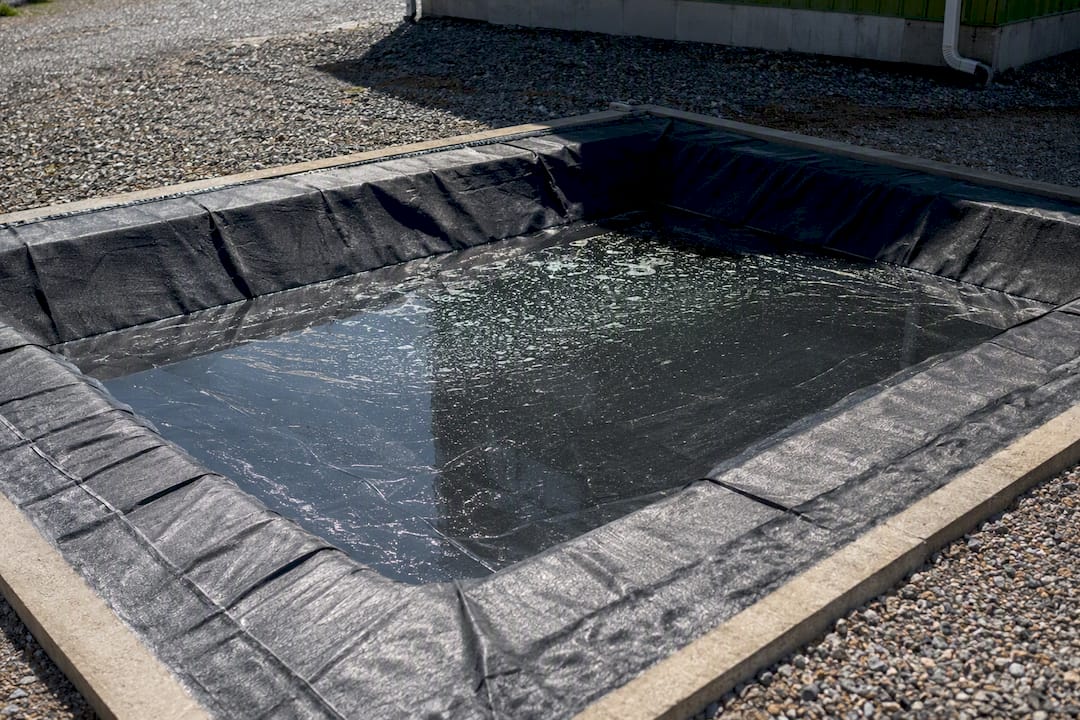
Acceptable washout management falls into four categories: lined on‑site pits, portable serviced containers, return‑to‑plant arrangements, or on‑site treatment involving pH neutralisation and dewatering. If a contractor proposes a lined pit, the CWMP should specify an HDPE liner of at least 0.5 mm, rising to 1.0 mm with geotextile protection on larger commercial jobs where aggregate can puncture thinner sheeting.
The design detail worth checking is capacity. Queensland’s own batching guidance recommends first‑flush capture equal to 0.02 metres (20 mm) multiplied by the contaminated area, with a safety margin built in so pits don’t overflow mid‑job. Western Australian regulations go further, requiring dirty water to route through slurry pits or settling ponds%20Regulations%201998%20-%20%5B01-00-00%5D.pdf?OpenElement=) before any discharge, with silt traps as a mandatory backstop.
Your CWMP checklist should require:
- Pit lining type, thickness and freeboard/berm details
- 125% pit capacity margin above the calculated first‑flush volume
- Named disposal route (landfill, recycler, or licensed treatment facility)
- pH target of 6.5–8.5 and NFR limits where irrigation or reuse is proposed, as set out in EPA guidance on concrete wastes
- Trade waste agreement if any discharge goes to sewer
- Site plan marking the washout area, plus driver and pump operator induction records
Enforcement isn’t theoretical. On‑the‑spot penalty notices for washout non‑compliance in NSW typically run $8,000 to $15,000 for corporations, and prosecutions can climb well beyond that. A missing CWMP is a live financial liability sitting on your site.
How do you verify operator safety and competency?
Ask for evidence against CPPCLO3020 (formerly CPPCLO3020A), the vocational unit covering surface assessment, hazard identification, equipment and chemical selection, and compliant pressure‑washing technique. It’s the single most efficient way to check competence without trawling through individual CVs.
High‑pressure jetting carries genuine hazard, and once output crosses into industrial thresholds, AS 4233.1 sets the expected controls: safe operation procedures, maintenance schedules and incident reporting. A contractor working at that scale should be able to produce a method statement that references it.
Site safety items worth demanding upfront:
- A PPE list matched to the job (eye, hearing, footwear, high‑vis)
- Exclusion zones and spotter arrangements around active jetting
- A traffic management plan for occupied car parks or loading docks
- Drain isolation procedures before washing begins
- Electrical safety measures for equipment in wet conditions
Before signing, request copies of operator training certificates, equipment maintenance logs, current insurance certificates and a written incident and near‑miss reporting procedure. Common on‑site failures, from unsecured hoses to unprotected landscaping, are covered in more detail in common pressure washing mistakes worth reviewing before you finalise a method statement.
Pro Tip: Ask for a photo or schematic of the actual unit proposed for your job, not a generic brochure shot. It’s the fastest way to confirm the flow rate, pressure and reclamation capability actually match what’s written in the quote.
What should go in the scope of works and quote request?
A comparable quote needs the same structure every time, otherwise you’re comparing apples to forklifts. Build your tender document around these mandatory line items:
- Service description naming every surface and area to be treated
- Equipment specification: bar, L/min, hot water temperature if applicable
- Water source and metering arrangement
- Wastewater handling method and named disposal route
- CWMP attached as a schedule, not referenced vaguely
- Site induction and access arrangements
- Traffic management plan
- Start and finish times, plus weather contingency
Then write these clauses into the contract itself:
- Compliance with CWMP and relevant EPA requirements as a condition of payment
- Right to audit waste transfer records on request
- Requirement for pH test results supplied on job completion
- Holdback of final payment until disposal evidence is provided
- Indemnity clause covering pollution incidents caused by the contractor
At handover, request a photographed site plan of the washout area, signed waste transfer or disposal receipts, pH test records, operator sign‑offs and the incident log for the job. When scoring bids, weight documented environmental controls as heavily as price. A structured evaluation approach that scores both reduces enforcement risk far more than picking the cheapest number on the page.
What drives cost and timeline on a commercial job?
Price swings mostly on five factors: area size in square metres, the type of soiling (oil, rubber and paint cost more to shift than general dust), site access, whether hot water or reclamation equipment is required, and how the wastewater gets treated and disposed of.
Timelines follow the same logic. A small car park is often a one‑day job. A large warehouse floor, loading bay, or event concourse can need mobilisation, traffic management setup and staged work across several days, particularly where the CWMP requires dewatering between shifts.
Compliance costs money, and that’s fine as long as it’s itemised rather than buried. Portable container servicing, lab testing and licensed disposal all add to the invoice but cut your enforcement risk substantially.
- Ask for a breakdown by activity: pre‑spray, dwell time, high‑pressure rinse, reclamation and dewatering, disposal
- Treat washout servicing and pH testing as separate line items, not folded into a lump sum
- Compare quotes on documented compliance cost, not just headline price per square metre
How Sydney Sweep and Scrub handles the compliance side
Everything covered above, the CWMP, the pH testing, the operator competency records, is what Sweepandscrub builds into every commercial quote as standard, not as an add‑on you have to request. Sweepandscrub runs industrial‑grade hot and cold pressure washing equipment with water reclamation built in, so wastewater is captured and handled on site rather than left to chance. Operators work to CPPCLO3020‑aligned training, and every commercial job comes with a documented CWMP before work starts.
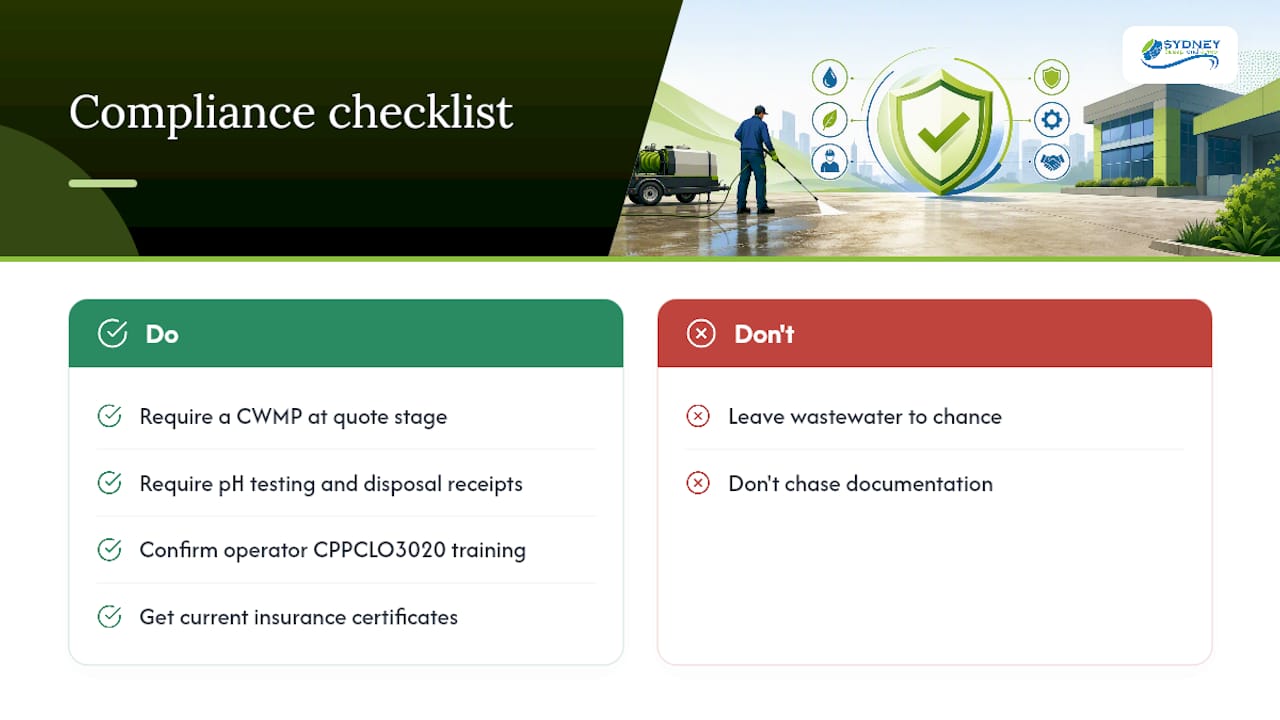
At quote stage, you should expect a full CWMP, pH testing and disposal receipts, evidence of operator competency, and current insurance certificates handed over without having to chase them. That’s the standard set out across this article, and it’s the standard Sweepandscrub works to on car parks, warehouses and industrial hard surfaces across every job it books.
If you’re preparing a scope of works for an upcoming concrete pressure wash, request a site inspection or a template scope of works from Sweepandscrub. It’s the quickest way to get a compliant, comparable quote on your desk without redrafting a tender document from scratch.
Sources
Attach or reference these in the CWMP and method statement whenever a contractor submits one:
Require contractors to attach the relevant items from this list directly in their CWMP and method statement, rather than citing them from memory in a cover email.
Recommended
- Pressure Washing: A Versatile Option – Sydney Sweep and Scrub – Commercial Cleaning – Carpark Cleaning – Warehouse Cleaning
- Cleaning Concrete: Domestic vs Commercial – Sydney Sweep and Scrub – Commercial Cleaning – Carpark Cleaning – Warehouse Cleaning
- Pressure Washing with Cold Water – Sydney Sweep and Scrub – Commercial Cleaning – Carpark Cleaning – Warehouse Cleaning
- Pressure Washing with Hot Water – Sydney Sweep and Scrub – Commercial Cleaning – Carpark Cleaning – Warehouse Cleaning