
Hire a licensed commercial pressure-washing contractor for routine parking garage cleaning. If that’s genuinely not possible right now, a strict DIY protocol can hold you over, but it comes with real regulatory and safety exposure that most facility managers underestimate.
Here’s the verdict in brief:
- Frequency: high-traffic garages (retail, transport hubs) need a full wash fairly frequently; medium-traffic office buildings can usually space washes several months apart.
- Wastewater: any contractor you hire must capture washwater and either hold a trade-waste agreement for sewer discharge or arrange licensed pump-out. Letting it run into a stormwater drain is an offence in most Australian jurisdictions, not just bad practice.
- Safety: expect traffic control, non-slip footwear, and isolated drains and lighting as standard, not an add-on you have to request.
The one action to take today: call a contractor and ask specifically for a hot-water pressure wash with a documented wastewater recovery plan, then ask them to send proof of public liability insurance and any relevant environmental licences before you book. If they can’t answer that in one phone call, keep looking.
Key Takeaways
Compliant parking garage pressure washing requires hot-water equipment for grease removal, a documented wastewater recovery plan, and scheduling matched to traffic volume to control both safety risk and cost.
| Point | Details |
|---|---|
| Hire a compliant contractor | Confirm hot-water capability and a wastewater recovery plan before booking, not after. |
| Schedule by traffic band | Wash monthly to quarterly for high-traffic garages, quarterly to biannual for lower-traffic sites. |
| Require disposal proof | Ask for pump-out dockets or a signed trade-waste agreement before work begins. |
| Check safety and traffic control | Confirm PPE, drain protection, and pedestrian diversion are part of the standard scope. |
| Sydney Sweep and Scrub option | A family-owned Sydney contractor offering hot-water cleaning with eco-minded, compliance-focused wastewater handling. |
Table of Contents
- What parking garage pressure washing actually achieves
- How often should a parking garage be pressure washed?
- What contaminants need which cleaning technique?
- Equipment and supplies a commercial job actually needs
- How do you legally dispose of parking garage washwater?
- Site prep, traffic control, and worker safety on the day
- What drives the cost of a parking garage clean?
- How do you choose the right contractor?
- Why an eco-minded contractor with hot-water and recovery capability matters
- What safety protocols protect workers and the public during the wash?
- How do you check the job was actually done properly?
- What if the wash uncovers structural damage?
- What regulatory boxes does a compliant garage clean need to tick?
- The Sydney Sweep and Scrub option for managers who want this handled properly
- Frequently asked questions
- Sources
What parking garage pressure washing actually achieves
The obvious win is that a clean garage looks better. That’s real, but it’s the smallest part of the case for regular pressure washing.
Oil and hydraulic fluid on concrete turn tyre grip into a lottery, and grease patches near ramps and entry points are where most slip-and-fall claims originate. Removing them isn’t cosmetic; it’s a direct hit on your incident rate. Corrosion is the second driver worth tracking. Salt, brake dust, and standing moisture eat into concrete and exposed rebar over years, and pressure washing at the right interval slows that degradation meaningfully compared with letting contaminants sit and cure into the surface.
There’s a lighting angle that’s easy to miss. Grime-coated walls and floors absorb light rather than reflect it, so a garage that hasn’t been washed in a year can feel noticeably darker even with the same globes running. Cleaner, lighter surfaces bounce more of that light back, which improves how safe the space feels after dark, and facility managers consistently report fewer incidents in garages that visibly look actively managed.
Tie these outcomes to the metrics you already report on: safety incident counts, tenant complaint volumes, and asset replacement cycles for concrete and expansion joints. A well-timed wash schedule moves all three in the right direction.
Pro Tip: Pair a weekly or fortnightly mechanical sweep with your scheduled deep pressure wash. Sweeping strips loose grit and dust before it embeds in oil stains, which cuts the contamination load your pressure-washing contractor has to fight, and it stretches the interval between full washes without any drop in appearance or safety.
How often should a parking garage be pressure washed?
Cadence depends on traffic volume, climate, and what the garage is attached to, not a single blanket rule.
- High-traffic facilities (retail centres, transport interchanges, stadium car parks): monthly to quarterly washes, given how fast oil, rubber, and food waste accumulate.
- Medium-traffic facilities (commercial office towers, mixed-use buildings): quarterly to biannual, adjusted upward if you’re in a coastal or industrial area with heavier grime buildup.
- Low-traffic facilities (residential strata, small commercial): biannual to annual, topped up with spot cleans as needed.
Beyond the standing schedule, certain events should trigger an out-of-cycle wash regardless of where you sit in that band: a fuel or chemical spill, storm surge that’s pushed debris and silt into the structure, graffiti that needs prompt removal before it weathers into the concrete, or a structural inspection that requires a clean surface to assess properly.
When you’re booking, work zone by zone rather than treating the whole garage as one job. Ramps, entries, and pedestrian walkways carry the heaviest contamination and the highest safety stakes, so prioritise them first. Staging the work this way also keeps more of the facility operational during cleaning, simplifies your traffic control plan, and gives you cleaner cost breakdowns if you’re billing different zones to different cost centres. Lock in after-hours windows early, notify tenants with enough lead time that nobody’s surprised by a closed ramp, and confirm any permit timing your council requires before the crew turns up.
What contaminants need which cleaning technique?
Not every stain responds to the same treatment, and a contractor who proposes one generic wash for every surface is cutting corners.
| Contaminant | Pre-treatment | Water temp | Method | Notes |
|---|---|---|---|---|
| Oil and grease | Biodegradable degreaser, dwell time | Hot | Surface cleaner + agitation | Hot water is materially better here; cold water often just spreads the stain |
| Tyre marks | Usually none needed | Hot or cold | Rotary surface cleaner | Fresh marks lift easily; aged marks need higher pressure or degreaser |
| Chewing gum | Freezing agent optional | Hot | Focused wand, scraping | Avoid excessive heat that melts gum deeper into porous concrete |
| Rust staining | Rust-specific chemical treatment | Cold | Wand application, rinse | Chemical does the work; high pressure alone won’t shift it |
| Graffiti | Paint stripper or solvent, tested first | Hot or cold | Wand, sometimes soda blasting | Test a hidden patch first; some paints require repeated passes |
| Efflorescence | Mild acid wash where appropriate | Cold | Wand, controlled rinse | Needs care on older concrete to avoid surface damage |
| Bird droppings | Disinfectant pre-spray | Hot | Wand or surface cleaner | Treat as a biohazard, not just a stain, given health risk |
Hot water earns its premium almost entirely on oil and grease. It breaks down hydrocarbon bonds that cold water just pushes around the slab, and if your garage sits under a loading dock or services heavy vehicles, hot-water capability isn’t optional. For hot-water pressure washing, that’s the whole value proposition.
Pro Tip: Always test a small, inconspicuous patch before running a full pass, especially on aged or already-degraded concrete. A zero-degree turbo nozzle looks efficient but can strip surface mortar and open up hairline cracks that then need structural repair, turning a routine clean into an unplanned capital expense.
Equipment and supplies a commercial job actually needs
If you’re vetting a contractor’s proposal, the equipment list tells you more than the price does.
Hot-water units running at commercial-grade pressure and temperature are the backbone of any serious garage clean, paired with rotary surface cleaners for flat concrete and wands for edges, walls, and vertical surfaces where a wall and edge clean needs more precision. Recovery units, sometimes called water capture systems, are what separate a compliant operator from one who’s quietly hoping nobody checks where the runoff went.
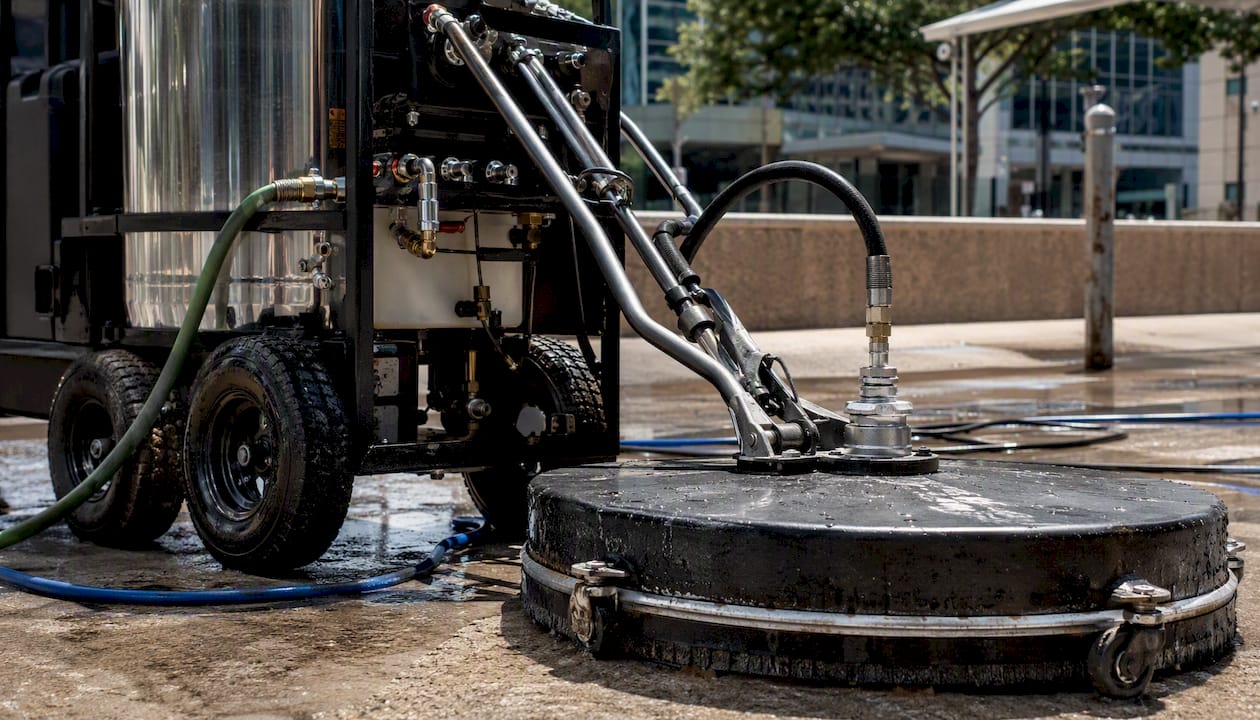
On the acceptance checklist for site visits, look for an oil-water separator on the recovery unit, silt traps or portable containment for any temporary wash area, positive displacement pumps for pump-out, correct PPE for the crew, and Safety Data Sheets available on-site for every chemical in use. A contractor who can’t produce SDS documentation on request shouldn’t be handling chemicals on your property.
How do you legally dispose of parking garage washwater?
This is where most facility managers get caught out, because washwater looks like plain runoff but legally it isn’t.
Queensland guidance classifies pressure-wash runoff as a prescribed water contaminant, meaning it must never enter stormwater systems and often needs to be handled as regulated or liquid trade waste with licensed removal. There are broadly three compliant pathways, and which one applies depends on your site and your council.
Pathway A: trade-waste or sewer discharge. This requires a formal trade-waste agreement, pre-treatment (grease traps, silt traps, oil-water separators), and often flow metering. SA Water’s guidance specifies minimum pump sump volumes and requires roofed wash areas where sewer discharge is proposed. It’s the most convenient option long-term but the slowest to set up.
Pathway B: capture, holding tank, and licensed pump-out. This avoids sewer approvals altogether, which suits garages without an existing trade-waste connection. It shifts the obligation to transport and record-keeping instead. Trade Enviro’s guide to wash bay approvals lays out this decision tree clearly: sewer discharge needs the paperwork upfront, pump-out needs the paperwork ongoing.
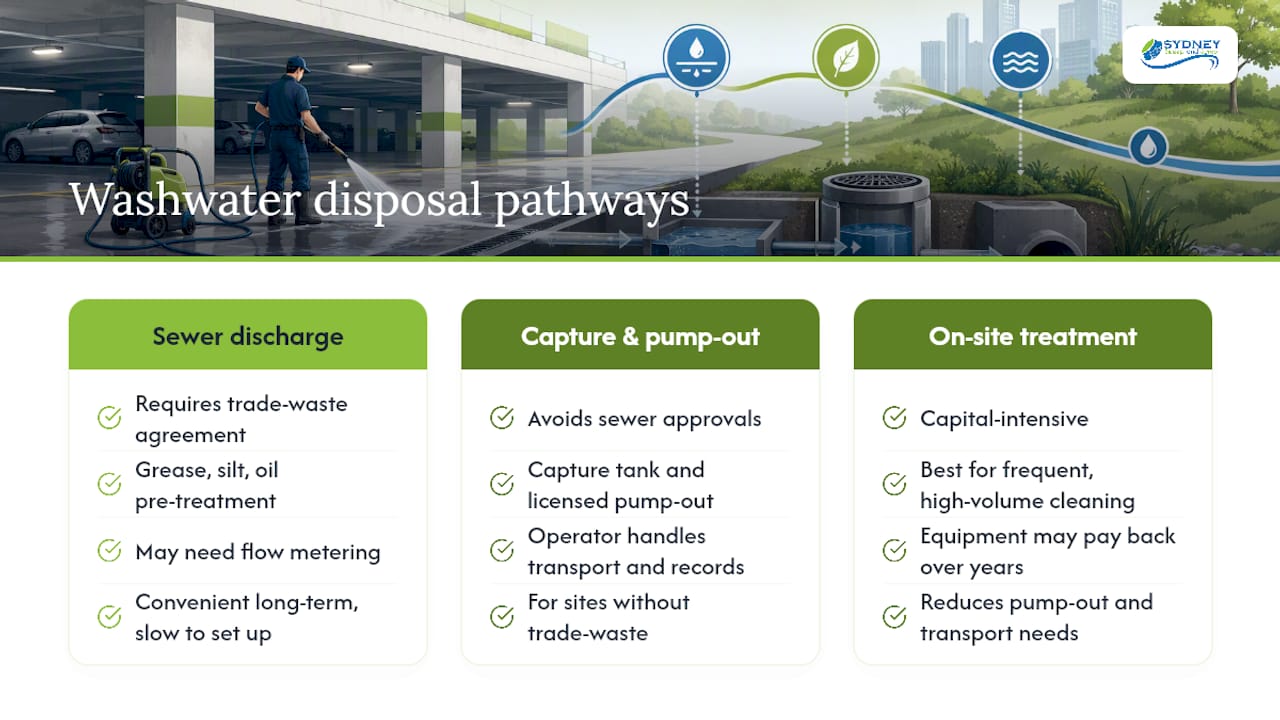
Pathway C: on-site treatment systems. More capital-intensive, generally only worthwhile for facilities running frequent, high-volume cleaning where the equipment pays for itself over several years.
Whichever path applies, your compliance checklist should include the relevant permits, a signed trade-waste agreement if discharging to sewer, sampling or flow-metering records, and pump-out dockets retained for several years. SA EPA guidance is explicit that pre-treatment devices, graded channels, silt traps, and settling chambers aren’t optional extras on a wash bay; they’re the baseline design.
Washwater from vehicle and equipment cleaning can severely harm waterways if it enters stormwater untreated, which is why containment, pre-treatment, and lawful disposal sit at the centre of every state guideline on this topic, not as an afterthought bolted onto the cleaning job.
Pro Tip: Write a clause into every cleaning contract requiring the contractor to supply pump-out dockets and proof of licensed waste removal, and retain those records for three to five years. If council or the EPA ever audits your site, that paperwork is what protects you, not a verbal assurance from the crew leader.
Site prep, traffic control, and worker safety on the day
A parking garage is a live environment during cleaning, with cars, pedestrians, and often tenants moving through it while the crew works, so the prep matters as much as the equipment.
Traffic management comes first: staged closures, clear signage, cones, and a pedestrian diversion route that doesn’t funnel people past wet, slippery concrete. Crews need correct PPE, including eye protection, non-slip footwear, and hearing protection where equipment noise warrants it. Electrical isolation matters more than people expect around basement-level garages, where drains, lighting circuits, and boom gates sit close to where water is being sprayed at pressure. Working at height controls apply too, particularly on ramps, canopies, and any elevated walkway sections.
The pre-clean site checklist should cover:
- Protection or temporary sealing of stormwater inlets before any water hits the ground.
- Isolation of nearby electrical equipment, including lighting circuits and access control systems.
- Tenant notification with enough lead time to reroute vehicle movements.
- Confirmation of after-hours access windows and building management sign-off.
- A clear signage and cone plan mapped to the zones being worked that day.
Skipping any one of these is how a routine clean turns into an insurance claim.
What drives the cost of a parking garage clean?
Quotes vary more than most managers expect, and the gap usually comes down to a handful of specific cost drivers rather than one contractor simply being pricier across the board.
- Facility size in square metres is the baseline, but contamination level moves the price more than size alone.
- Hot-water requirement adds cost because the equipment and fuel are more expensive to run than cold-water units.
- Water recovery systems add a line item, particularly if pump-out or trade-waste fees apply on top of the wash itself.
- Access complexity, such as low ceiling clearance or narrow ramps that limit equipment size, pushes labour time up.
- After-hours or weekend work carries a premium most contractors apply openly rather than hide in the base rate.
Routine washes typically price per square metre at a lower rate than heavy remediation jobs involving years of embedded oil or graffiti removal. When comparing quotes, ask every bidder for equipment specifications, a written wastewater management plan, proof of insurance and licences, and a scope of works that states exclusions explicitly, not just what’s included. A quote missing any of these isn’t necessarily cheaper; it’s just less transparent.
How do you choose the right contractor?
Run every bidder through the same checklist rather than judging on price and gut feel.
- Ask for proof of public liability insurance and any environmental or trade-waste licences relevant to your council area.
- Request their full equipment list, specifically confirming hot-water capability and a recovery/capture system.
- Ask to see Safety Data Sheets for any chemicals they plan to use, and confirm operator training records exist.
- Get a straight answer on wastewater disposal method: sewer discharge with a trade-waste agreement, or capture and licensed pump-out.
- Request sample pump-out dockets from a previous job and at least one reference from a similar facility.
- Confirm insurance limits and ask how they handle incident reporting if something goes wrong on site.
Watch for red flags during that conversation:
- Vague or evasive answers about where the washwater goes.
- Reluctance to provide pump-out dockets or trade-waste paperwork from past jobs.
- No clear equipment specs when you ask directly about pressure, temperature, or recovery capacity.
- Insurance limits that seem too low for the size of your facility, or hesitation to produce a certificate of currency.
A contractor with nothing to hide answers all of this without prompting twice.
Why an eco-minded contractor with hot-water and recovery capability matters
Sydney’s own commercial garages face a specific combination of pressures: dense traffic volumes, tight council scrutiny on stormwater, and tenants who notice when common areas look neglected. Sydney Sweep and Scrub is built around exactly that combination, running hot-water cleaning equipment alongside eco-minded practices rather than treating sustainability as a marketing line.
Before requesting a quote, have this ready:
- Approximate floor area in square metres, plus number of levels if it’s a multi-storey structure.
- The contamination level you’re dealing with, whether that’s routine dust and tyre marks or years of embedded oil and grease.
- Access constraints, including ceiling height, ramp width, and any equipment that can’t be moved during the clean.
- Preferred cleaning windows, particularly if the work has to happen after hours or on a weekend.
Any contractor worth hiring should hand over retained pump-out dockets on request, a signed trade-waste agreement where sewer discharge applies, and current proof of public liability cover before the first booking is confirmed. Sydney Sweep and Scrub’s approach to wall and edge cleaning reflects the same standard: proper technique matched to the surface, not a single generic pass regardless of what’s being cleaned.
What safety protocols protect workers and the public during the wash?
The safest jobs follow a sequence, not a checklist ticked off in random order.
It starts before the truck arrives, with a site walk to confirm traffic control points, drain locations, and any electrical hazards specific to that garage. Once the crew is on site, signage and cones go up first, before any equipment is unloaded, so pedestrians and vehicles are redirected before water starts flowing. Operators then isolate nearby electrical fixtures and confirm stormwater inlets are protected or temporarily sealed.
During the wash itself, crews work in a defined sequence, typically starting at the highest point of a zone and working down and toward the drainage or capture point, so contaminated water flows toward containment rather than spreading across dry areas. Wet floor signage stays up well beyond the visibly wet area, because concrete holds moisture longer than it looks like it does, and residual dampness on a ramp is a slip risk hours after the visible sheen disappears. Once a zone is finished, it gets barricaded until fully dry rather than reopened on a time estimate.
Throughout, PPE stays on: eye protection against splash-back, hearing protection near high-pressure equipment, and non-slip footwear given the crew is working on wet concrete for hours at a stretch. A contractor following staying-compliant guidance for pressure cleaning treats this sequence as standard operating procedure, not a variable depending on how rushed the day is.
How do you check the job was actually done properly?
A finished wash should be inspected the same day, while access to every zone is still easy and any missed patch is obvious under proper lighting.
Walk the garage floor zone by zone, checking specifically for residual oil sheen near parking bays, tyre marks that weren’t fully lifted, and any staining that’s simply been diluted rather than removed. Corners, wheel stops, and expansion joints trap contamination that a fast pass with a surface cleaner can miss, so check those specifically rather than judging the job by the open floor area alone. Confirm drains and stormwater protection have been removed and reinstated correctly, since a forgotten drain seal is an easy oversight that creates a flooding risk the next time it rains.
Ask the contractor for photographic before-and-after records of each zone, which gives you a paper trail for tenant communication and for your own facility records if a dispute arises later. Request their wastewater disposal confirmation at the same time, including the pump-out docket or trade-waste discharge record for that specific job, not a generic assurance that it was “handled properly.” A contractor confident in their work has no issue producing this on the spot.
What if the wash uncovers structural damage?
Pressure washing occasionally reveals problems that were hiding under years of grime, and that’s not a reason to panic, but it does need a clear response.
Spalling concrete, exposed rebar, or hairline cracks that widen once the surface dirt is stripped away are the most common findings. A competent contractor should stop work in that specific zone, document the area with photos, and flag it to you immediately rather than continuing and hoping it’s not their problem. This is also exactly why choosing a contractor who tests pressure settings on a small patch first matters: aggressive nozzle settings on already-compromised concrete can turn a minor surface issue into a larger repair.
Once flagged, treat it as a structural engineering question, not a cleaning one. Bring in a structural engineer or building certifier to assess whether the deterioration is cosmetic or load-bearing before any further cleaning happens in that zone, and keep the contractor’s photographic documentation as part of your maintenance record. It’s a genuinely useful side effect of regular pressure washing: problems that would otherwise stay hidden under grease and dirt for years get caught while they’re still a repair job rather than a replacement job.
What regulatory boxes does a compliant garage clean need to tick?
Pull the paperwork together before the contractor starts, not after council asks for it.
At minimum, confirm the contractor holds public liability insurance appropriate to the size of your facility, and any state-specific environmental or trade-waste licence required for washwater handling in your council area. Confirm which of the three disposal pathways applies to your site (sewer discharge with trade-waste agreement, capture and pump-out, or on-site treatment) and get that documented in writing before work begins. Large garages, particularly those attached to retail or transport facilities, may also fall under broader stormwater or industrial stormwater permitting requirements, similar to the MS4 and industrial stormwater frameworks that apply to large parking facilities more broadly.
Keep sampling or flow-metering records where sewer discharge applies, retain pump-out dockets for three to five years, and require SDS documentation for every chemical used on site. None of this is optional paperwork you can chase up later; it’s the record that protects you if there’s ever an environmental incident or a council audit.
This article provides general guidance only and isn’t a substitute for advice from your local council or a qualified environmental consultant on the specific rules that apply to your site.
The Sydney Sweep and Scrub option for managers who want this handled properly
There are DIY routes and there are contractors who treat wastewater compliance as an afterthought. Sydney Sweep and Scrub takes a different position: hot-water cleaning capability paired with genuine wastewater recovery and eco-minded operating practices, run by a family-owned business that specialises specifically in mechanical cleaning and pressure washing rather than treating it as a side service.
For a facility manager comparing quotes, the practical difference shows up in the detail: proper equipment for oil and grease removal, a documented recovery plan instead of a vague assurance, and pricing that reflects the actual job rather than a one-size-fits-all rate card. If your garage carries embedded grease near loading docks or graffiti that keeps reappearing, that’s where hot-water capability and proper technique matter most.
Get a quote for hard surface cleaning with your floor area, contamination level, and preferred access windows ready, and Sydney Sweep and Scrub will scope the job against your specific site rather than a generic template.
Frequently asked questions
Is it legal to let pressure-wash runoff drain into the street or stormwater system?
No. Runoff from a parking garage clean is treated as a prescribed contaminant in most Australian jurisdictions and must be captured rather than allowed into stormwater, with disposal via sewer discharge under a trade-waste agreement or licensed pump-out.
Do I need hot water for parking garage pressure washing, or will cold water do?
Cold water handles dust, dirt, and light tyre marks fine. Oil and grease, particularly around loading docks and ramps, respond far better to hot water because heat breaks down the hydrocarbon bonds that cold water simply spreads around.
How much does professional parking garage pressure washing cost?
Pricing depends on square metreage, contamination level, whether hot water and recovery systems are required, and access complexity. Ask every bidder for a scope of works with exclusions clearly stated so you’re comparing like for like.
Can I pressure wash a parking garage myself without a licence?
You can, but you take on the wastewater disposal obligation yourself, along with the traffic control, PPE, and equipment costs a contractor would otherwise handle. Given the regulatory exposure around washwater disposal, hiring a licensed contractor is the lower-risk option for most facilities.
Sources
- Procedural guide: water release from small sites (Queensland Government)
- Vehicle, machinery and equipment washdown guidance (SA EPA)
- Vehicle washing guidance (SA Water)
- Wash bay approvals in Australia (Trade Enviro)
- Parking environmental compliance: stormwater, hazmat and ADA operations (Parking Professional)
Recommended
- Common Mistakes to Avoid When Pressure Washing – Sydney Sweep and Scrub – Commercial Cleaning – Carpark Cleaning – Warehouse Cleaning
- Pressure Washing Your Car Park – Sydney Sweep and Scrub – Commercial Cleaning – Carpark Cleaning – Warehouse Cleaning
- Carpark Cleaning: Common Contaminants – Sydney Sweep and Scrub – Commercial Cleaning – Carpark Cleaning – Warehouse Cleaning