
Hire a professional post-event cleaning contractor before the last guest leaves. Sweepandscrub is the recommended provider for venue operators who need rapid, insured, mechanical cleaning with carbon neutral operations. Have your event date, approximate headcount, and a list of activated spaces ready, then request a quote online to lock in your crew.
Why it matters at a glance:
- Speed: a properly sized crew typically restores most corporate venues overnight within a same-day timeframe
- Safety: insured contractors carry public liability and workers’ compensation coverage
- Equipment: ride-on scrubbers, pressure washers, and industrial vacuums handle debris no manual crew can match
- Compliance: verified WHS/OHS processes protect you and the venue from incident liability
Pro Tip: Book your post-event cleaning crew at the same time you confirm your venue. Crews fill fast around major event weekends, and a late booking often means a smaller team and a longer turnaround.
Key Takeaways
Hiring a specialist post-event cleaning contractor with mechanical equipment, written turnaround SLAs, and verified insurance is the fastest and safest way to restore a venue after an event.
| Point | Details |
|---|---|
| Book early, book specialist | Secure a contractor with ride-on scrubbers and pressure washers, not a general cleaner, before the event date. |
| Turnaround SLA in writing | Require a written completion time; post-event turnover typically runs 4–8 hours for corporate events, 4 hours for large stadiums. |
| Verify insurance and WHS | Confirm public liability, workers’ compensation, and WHS compliance documents before signing any agreement. |
| Prepare the site in advance | Share floor plans, access codes, hazard notes, and a designated waste staging area at least 48 hours before the crew arrives. |
| Sweepandscrub for Sydney venues | Sweepandscrub offers carbon-neutral, fully insured mechanical cleaning with online booking and fast quote turnaround. |
Table of Contents
- What does post-event cleaning actually include?
- How do you choose a post-event cleaning contractor?
- What does post-event cleaning cost, and how long does it take?
- What should you prepare before the cleaning crew arrives?
- How do you verify a contractor’s eco-friendly claims?
- A post-event clean in practice: what the numbers look like
- The case for specialist contractors over general cleaners
- Sweepandscrub: book your post-event clean today
- Sources
What does post-event cleaning actually include?
“Event waste management” in this article means one specific thing: the mechanical sweeping, scrubbing, pressure washing, and on-site debris removal that restores a venue after an event. It does not cover bin hire, recycling logistics, or waste-diversion planning. Those are separate services with separate contractors.
Professional post-event cleaning typically runs across three phases:
- Pre-event prep: suite preparation, restroom stocking, concession-area setup, bowl sweep, and exterior pressure washing. Staffing at this stage runs roughly 1 worker per 2,000–3,000 sq ft of activated space, with setup beginning 2–4 hours before gates open.
- Day-of porter service: continuous restroom maintenance, spill response, and biohazard response during the event. Industry staffing density sits around 1 worker per 750–1,500 sq ft of public space, with trained teams on standby for bloodborne-pathogen (BBP) incidents per OSHA guidelines.
- Post-event turnover: the highest-intensity phase. Crews collect and bag all trash from every zone, break down and remove boxes, sweep under and behind furniture, spot-treat carpet spills, vacuum edges, and machine-scrub or buff hard floors.
Specific services included: mechanical sweeping, ride-on scrubbing, cold and hot-water pressure washing, rubbish removal, restroom sanitation, and breakdown support. For large venues, this extends to bowl/seat sweeps across every seating section.
How do you choose a post-event cleaning contractor?
The difference between a good contractor and a liability starts with paperwork, not price. A qualified provider should offer pre-event and post-event cleaning, day-of porter service, deep cleaning, restroom sanitation, and the ability to deploy large teams quickly against a customized plan.
Checklist before you sign anything:
- Proof of public liability insurance and workers’ compensation
- Written WHS/OHS compliance documentation
- BBP protocol training certificates for all on-site staff
- Equipment list: ride-on scrubbers, pressure washers, industrial vacuums
- Staffing model with a named contingency plan for no-shows
Questions worth asking every bidder:
- What is your guaranteed turnaround time, and will you put it in writing?
- Do you subcontract any roles, and if so, how are those workers vetted?
- Who supplies consumables (bags, chemicals, paper products), and where does waste stage before removal?
- How do you handle freight elevator booking and after-hours alarm/lockout procedures?
- What is your environmental policy, and do you operate carbon-neutral?
Red flags to walk away from:
- Scope described in vague terms (“general cleaning”) with no task list
- Subcontracting without a named vetting process
- No written turnaround SLA
- Unclear or verbal-only disposal methods
- No environmental or chemical-use policy
Pro Tip: Ask for a site-specific cleaning plan before you sign. Any contractor worth hiring can produce one within 24 hours of a site walkthrough. If they can’t, that tells you everything about their operational depth.
What does post-event cleaning cost, and how long does it take?
Pricing for post-event cleaning is almost never a flat per-square-foot rate. Stadium and large-venue cleaning is typically structured as a per-event fee that bundles labor, supervision, consumables, and equipment use into a single figure. That model protects you from surprise add-ons and makes budget forecasting straightforward.
Primary cost drivers:
- Total activated area (sq ft) and number of distinct zones
- Headcount and catering extent (food service multiplies debris volume significantly)
- Degree of soiling: bulk waste versus light litter
- Equipment required: ride-on scrubbers and pressure washers cost more to deploy than manual crews
- Specialty services: biohazard response, grease removal, or overnight security escort
Timeline expectations by event type:
| Event type | Crew size (approx.) | Turnover window |
|---|---|---|
| Corporate event (mid-size) | 8–20 workers | 4–8 hours overnight |
| Stadium or arena (large) | 300–600 workers | 4-hour post-event close |
A corporate-event post-event cleanup typically takes a properly sized crew four to eight hours, with square footage and catering extent as the two biggest variables. At NFL-scale venues, the numbers shift dramatically: crews of 300–600 workers are common for a 4-hour close, and a single large game can generate roughly 6–8 tons of trash.
Labor costs concentrate at the post-event turnover phase, where staffing density rises to around 1 worker per 500–750 sq ft. That is where the bulk of your per-event fee goes.
What should you prepare before the cleaning crew arrives?
A cleaning crew that arrives to a locked loading dock or a venue with no water access loses an hour before they sweep a single square foot. Avoid that with a short pre-arrival checklist.
- Confirm site access: provide keys, swipe cards, or a named after-hours contact. Book freight elevators and loading docks in advance.
- Arrange parking: ride-on scrubbers and pressure-wash units need a vehicle and trailer space close to the entry point.
- Identify water and power points: confirm locations and whether the venue or contractor supplies consumables.
- Designate a waste staging area: crews need a clear, accessible zone to consolidate debris before removal.
- Share documentation: event map, back-of-house contacts, hazard notes (spills, broken glass, biohazard zones), and any permit or alarm codes.
- Provide insurance certificates: exchange certificates with the contractor before the crew arrives, not after.
Pro Tip: Send the contractor a floor plan with zone labels 48 hours before the event. It lets them pre-assign crew to zones and shave 30–45 minutes off the turnover start.
How do you verify a contractor’s eco-friendly claims?
Sustainability claims are easy to print on a website and hard to verify without asking the right questions. Sustainable cleaning practices at a credible contractor include low-chemical or biodegradable detergents, water-saving pressure-wash settings, and high-efficiency vacuums that reduce particulate release.
What to look for and ask about:
- Low-chemical detergents: ask for the product data sheets and confirm they are biodegradable
- Water reduction: water-saving industrial cleaning methods include pressure-wash settings calibrated to surface type, avoiding over-spray on permeable surfaces
- Hot-water spot cleaning: used selectively for grease and heavy soiling rather than as a default, which reduces both water and chemical volume
- Carbon-neutral operations: ask for a third-party emissions statement or offset certificate, not just a marketing claim
- Equipment efficiency: ride-on scrubbers with onboard water recovery reduce runoff compared to manual mopping at scale
Why it matters beyond optics: venues with green procurement policies increasingly require contractor environmental credentials as a condition of engagement. A contractor who cannot produce documentation is a procurement risk, not just an environmental one.
A post-event clean in practice: what the numbers look like
To make the scope concrete, consider a large stadium event: 50,000 attendees, roughly 400,000 sq ft of activated space across concourses, seating bowls, restrooms, and concession areas.
| Metric | Example figure |
|---|---|
| Activated area | 400,000 sq ft |
| Post-event crew deployed | 400–500 workers |
| Shift length (post-event) | 4 hours |
| Debris volume | 6–8 tons |
| Turnover target | Ready by next morning |
Crew deployment follows a zone model: concourse teams run ride-on scrubbers and mechanical floor scrubbing on hard surfaces while restroom teams work simultaneously. Pressure washers handle exterior concourses and loading areas. A supervisor per zone coordinates sign-off against a checklist before the space is released.
For a mid-size corporate event, the same logic applies at a smaller scale: 8–20 workers, 4–8 hours, with the biggest variable being how heavily the catering areas were used. A sit-down dinner for 500 in a carpeted ballroom takes longer to restore than a standing cocktail reception in a tiled foyer.
The case for specialist contractors over general cleaners
Most venue operators who regret their post-event cleaning choice made the same mistake: they hired a general commercial cleaner and assumed the scope would translate. It rarely does.
General cleaners carry mops and vacuums. Post-event cleaning at any serious scale requires ride-on scrubbers, industrial pressure washers, and a crew that knows how to work top-down and dry-to-wet across multiple zones simultaneously. The three-phase structure of pre-event, porter, and post-event work is not something a generalist crew improvises on the night.
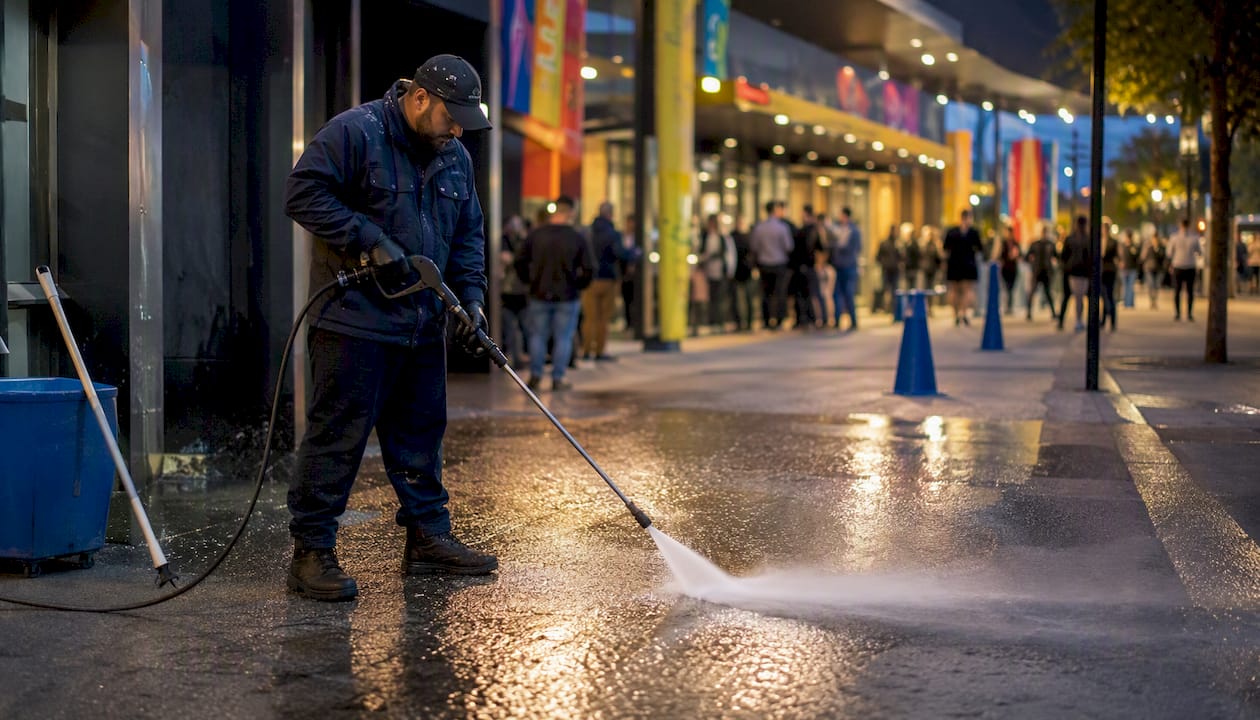
The other thing most operators underestimate is the turnaround SLA. A venue that needs to open at 8 AM cannot absorb a crew that finishes at 10 AM. That SLA needs to be in writing, with a named consequence if it is missed. A specialist contractor treats it as a core deliverable. A general cleaner often treats it as a best effort.
Carbon-neutral operations matter here too, not just for procurement compliance but because venues are increasingly held to their own sustainability commitments. A contractor who cannot document their environmental footprint puts your venue’s credentials at risk alongside their own.
Sweepandscrub: book your post-event clean today
Sweepandscrub gives venue operators and event organizers a single, insured, carbon-neutral contractor for the full post-event scope: mechanical sweeping, ride-on scrubbing, hard surface cleaning, pressure washing, rubbish removal, hot-water cleaning, and automated cleaning options for large footprints.
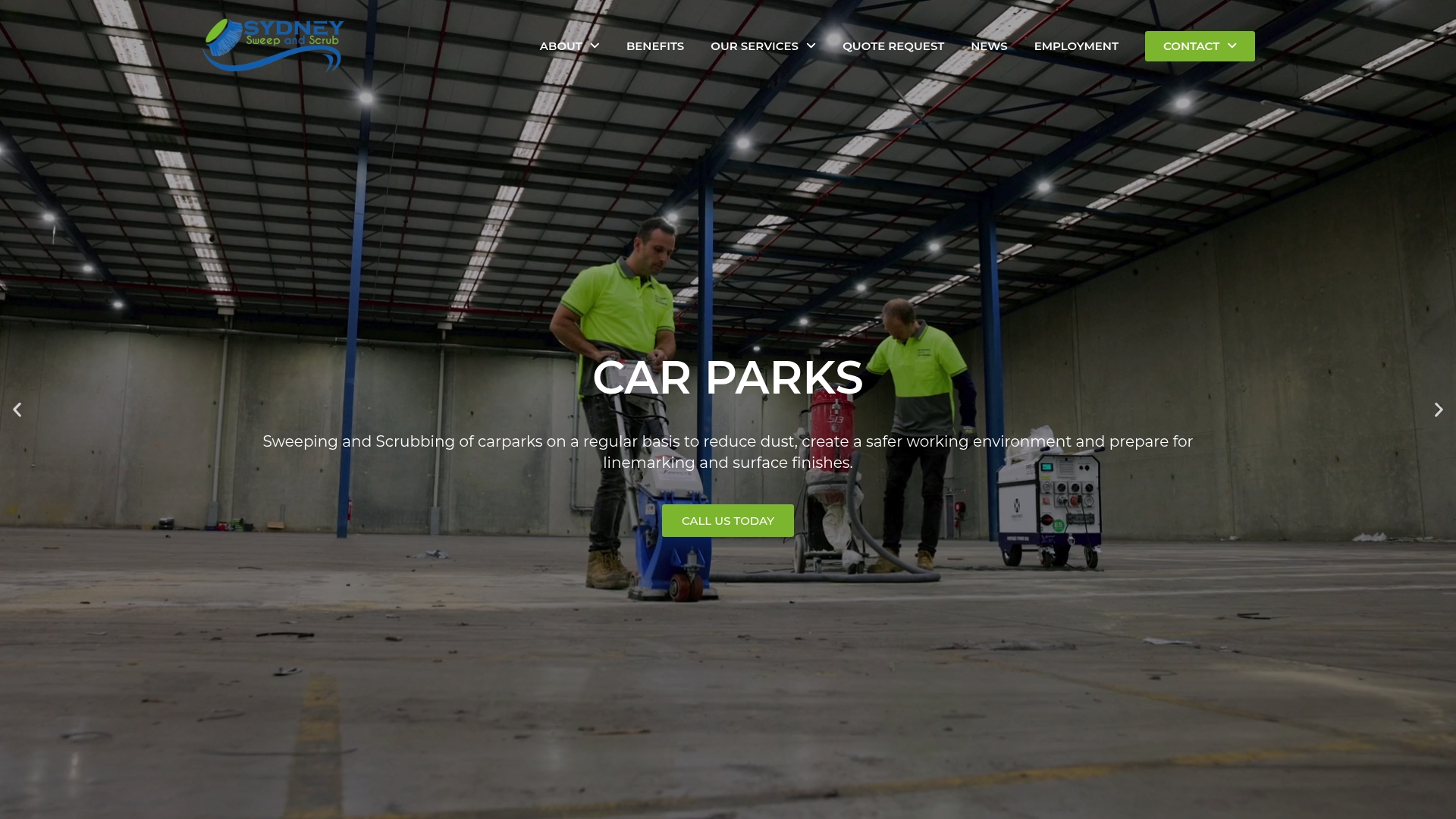
The booking process is direct: provide your event date, headcount, activated spaces, and any access notes, and Sweepandscrub returns an accurate quote fast. The team is family-owned, fully insured with public liability and workers’ compensation, WHS-compliant, and operates carbon-neutral. Equipment includes industrial ride-on scrubbers and pressure-wash units sized for venues from corporate conference spaces to stadiums. To get a quote or schedule your post-event clean, visit Sweepandscrub and book online.
Sources
- Stadium and Arena Cleaning: 2026 EPA and OSHA Standards – Opora Supply
- Event Cleaning & Post-Event Checklist | Park Slope Cleaning
- Parking Garage Sweeping, Scrubbing & Pressure Washing | Rosenberger Cleaning Services | Metro & Central Minnesota
Recommended
- Professional Post-Event Cleaning Tips – Sydney Sweep and Scrub – Commercial Cleaning – Carpark Cleaning – Warehouse Cleaning
- This is Why Professional Post-Event Cleaning is Crucial – Sydney Sweep and Scrub – Commercial Cleaning – Carpark Cleaning – Warehouse Cleaning
- Post-Event Cleaning: Concrete Surfaces – Sydney Sweep and Scrub – Commercial Cleaning – Carpark Cleaning – Warehouse Cleaning
- Sydney Post-Event Cleaning: Leave Your Event Space Sparkling – Sydney Sweep and Scrub – Commercial Cleaning – Carpark Cleaning – Warehouse Cleaning