
Car park ventilation grilles are cleaned by isolating power, setting up a barrier-protected work area, dislodging dust with brushes while capturing it with a vacuum, and wiping the faces with a damp cloth and mild detergent. Keep high-pressure water away from electrical and porous parts. Inspect the grilles at least every 12 months, and more often in a dusty or harsh car park. Schedule the work together with the surrounding floor and wall clean, so dust is not washed or blown straight back onto clean grilles.
This guide is for building managers, strata managers and owners who are responsible for a basement or multi-level car park in Sydney and want grilles that look clean and keep air moving.
TL;DR
- Isolate power and barricade the work zone before anyone touches a grille. Traffic and pedestrians are the first hazard, electrics the second.
- Use brushes with a vacuum, then a damp, non-abrasive cloth and mild detergent. Avoid solvents, steel wool and high-pressure water near electrical or porous parts.
- AIRAH’s maintenance schedule lists grille cleanliness inspections every 12 months. Car parks are a harsh environment, so many sites check more often.
- Cleaning the grille face is different from cleaning ducts, fans or sensors. Match each job to the right trade.
- Book grille cleaning in the same visit as the floor, wall and edge wash, with the grilles cleaned last.
Table of Contents
- What car park ventilation grilles do, and why they get dirty
- How often to inspect and clean car park grilles
- Safety first: before anyone touches a grille
- How to clean the grille faces, step by step
- Grille cleaning versus duct and system cleaning
- Cleaning the car park without damaging grilles or disrupting airflow
- Who should do what: a simple split of responsibility
- When to arrange specialist cleaning
- Planning the work with Sydney Sweep and Scrub
- A short checklist for your next car park clean
- FAQ
- Sources
What car park ventilation grilles do, and why they get dirty
A car park is an enclosed or semi-enclosed space where vehicles release exhaust gases. Mechanical ventilation moves that air out and brings fresh air in. Grilles, louvres and registers are the visible openings of that system: the point where air enters or leaves the space, or passes into a duct.
Safe Work Australia’s code of practice on managing the work environment expects ventilation to supply fresh air that is not contaminated by discharge outlets and to keep air moving, as set out in its Managing the work environment and facilities code of practice. A grille choked with lint, cobwebs and tyre and brake dust is not helping that aim. It can restrict flow and make the whole space look neglected.
Car parks also load grilles with dirt faster than an office does. Tyre rubber, brake dust, oily residue, road grit and spider webs all drift toward moving air. Grilles near entry ramps collect the most, because that is where outside dust enters.
Understanding what each element does helps you plan the work:
- Grille or louvre faces. The visible bars or blades. These are the part most often cleaned by a facility team or a cleaning contractor.
- Dampers and screens behind the grille. Often trap debris and may need access from inside the ductwork. Some designs add an access door near the louvre for exactly this reason, as noted in this HPAC piece on screen cleaning.
- Fans and jet fans. Mechanical equipment that belongs to a mechanical services contractor. Jet fans need no ductwork and are generally easier to maintain, according to the AMCA’s overview of parking garage ventilation design.
- Carbon monoxide sensors. In systems controlled by CO sensors, the fans modulate with demand. CCC Engineering notes that these sensors must be calibrated at commissioning and re-calibrated annually. Keep wet cleaning well away from them.
How often to inspect and clean car park grilles
There is no single number that suits every car park, but there is a sound baseline and a sensible way to adjust it.
The baseline. AIRAH’s maintenance schedule in DA19 Appendix A lists cleanliness inspections of supply, return and relief air grilles every 12 months at maintenance levels A, B and C. Treat an annual inspection as the minimum, and clean whenever the inspection shows build-up.
The adjustment. A UK maintenance firm points out that car parks are often classed as high-risk or harsh environments, which can justify servicing ventilation more often than in a standard commercial building, in its car park ventilation maintenance article. The same article suggests a visual check for obstructed grilles and dampers in an incorrect standby position daily or weekly. That is a UK source, so treat it as good practice rather than an Australian requirement.
In practice, a simple rhythm works for most Sydney sites:
| Task | Who | Typical rhythm |
|---|---|---|
| Walk-through look at grilles for obstruction | Building or site staff | Weekly |
| Wipe-down and vacuum of grille faces | Cleaning contractor or trained staff | At least annually, more often if visibly dirty |
| Grille cleanliness inspection against the maintenance schedule | Mechanical services contractor | Every 12 months |
| CO sensor calibration | Mechanical or controls contractor | Annually |
| Duct, fan and damper servicing | Mechanical services contractor | As set by your maintenance plan |
The rhythm should be shorter if your car park is next to a construction site, a main road, a loading dock or an open ramp. Dust from those sources reaches the grilles quickly.
Safety first: before anyone touches a grille
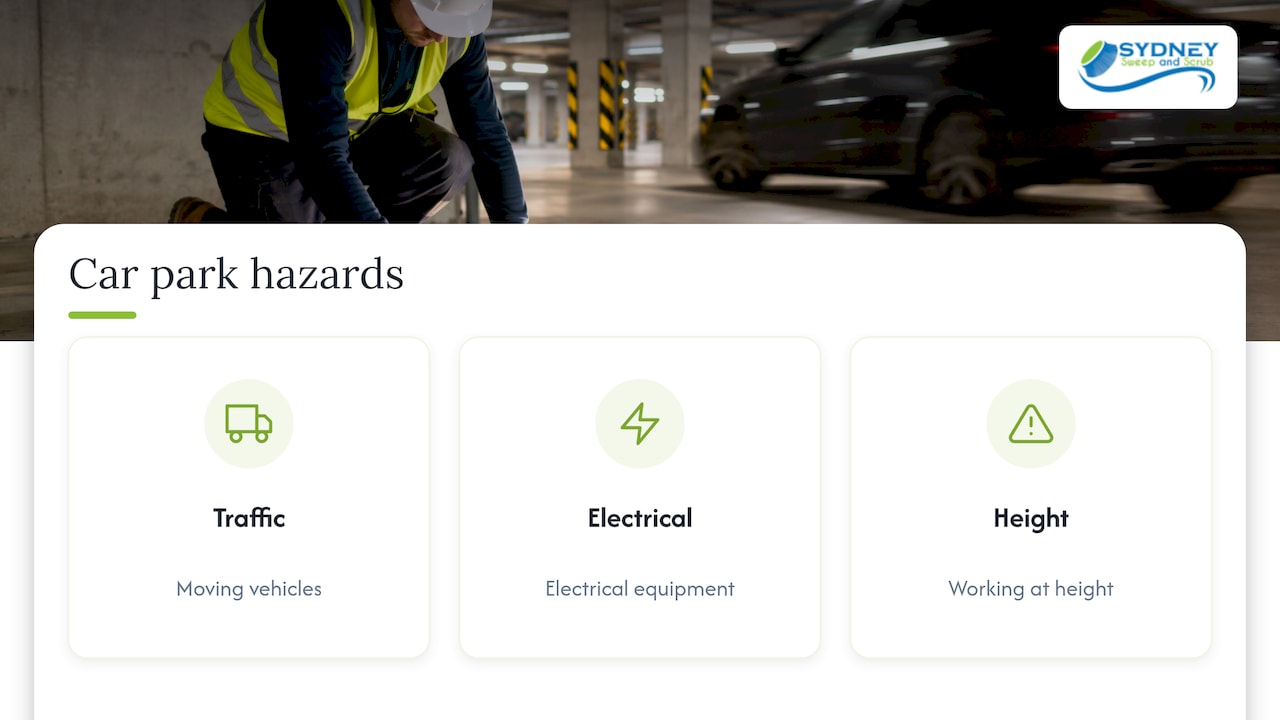
Grille cleaning looks like a light job. In a car park it carries three real hazards: moving vehicles, electrical equipment and height.
Isolate power and control the work zone
The cleaning procedure in the NADCA ACR 2021 standard starts with isolating power and setting up a secure work area. In a car park, that means barriers, cones or signage that protect the worker from traffic and keep pedestrians out. Close or restrict the bay or aisle in front of the grille. Do not clean while cars are manoeuvring nearby.
Use equipment according to the manufacturer’s instructions and make sure no liquid enters electrical components. Internal access to the system should be limited to competent people.
Working at height
Many grilles sit high on a wall or near the ceiling. WorkSafe Victoria’s small business handbook warns that working at heights over two metres significantly raises the risk of serious injury or death and calls for proper fall prevention, in 12 ways to make small business safer. It is a Victorian document, but the principle applies anywhere. In NSW, check requirements with SafeWork NSW and use a licensed contractor with the right access equipment (an elevated work platform or a stable platform ladder, never a makeshift step). Do not balance on a car bonnet or a bin.
Your duty as the person in control
Workplaces are expected to maintain ventilation and control electrical hazards during maintenance, and good housekeeping helps remove hazards at the source, including fire risk. The HSE Direct WHS checklist summarises these points for Australian workplaces. For a strata scheme or building owner, that means keeping a record of who cleaned what and when, and asking contractors for their safe work method statements before they start.
How to clean the grille faces, step by step
This is the method for fixed grilles that can be reached safely. It follows the guidance in the NADCA standard and the installation and maintenance manual from HVC for grilles, diffusers and louvres.
- Plan the job. Identify each grille, whether it is supply or exhaust, and who owns the system. Ask the mechanical contractor whether anything is interlocked with fire or smoke control.
- Isolate power and set up barriers. Cordon off the area and make sure the system cannot start mid-clean if you will be working close to fans or dampers.
- Remove the grille if it is designed to come off. NADCA advises removing grilles, registers and diffusers where possible, to avoid cross-contamination, and returning them to their previous positions. Note the orientation of each one before removal. Bolted or fire-rated grilles should be left to the installer.
- Dislodge dust mechanically. Use a soft brush to loosen particles and a vacuum with a hose or brush attachment to capture them, so debris does not enter the airstream.
- Wipe the surfaces. HVC recommends a non-abrasive sponge or cloth dampened with water and mild detergent. Avoid solvents and abrasive tools. Microfibre cloths work well on louvre blades.
- Dry and refit. Wipe dry, check that blades and fixings are intact, then refit the grille in its original position.
- Restore the system and record it. Remove isolation, check the fans start as expected, and log the date, grille locations and any defects.
What to avoid
- Steel wool, scouring pads and harsh solvents. They scratch finishes and can damage coatings.
- High-pressure water near electrical or porous parts. Water pushed into a duct, a motor housing or a CO sensor creates a fault, not a clean.
- Compressed air blown straight at the grille. It sends dust deeper into the duct or across the car park.
- Cleaning from the wrong side. If a screen sits behind a louvre, clean it from where it can be reached safely, not by forcing tools through the blades.
Grille cleaning versus duct and system cleaning
A lot of confusion, and a lot of wasted money, comes from mixing up these jobs.
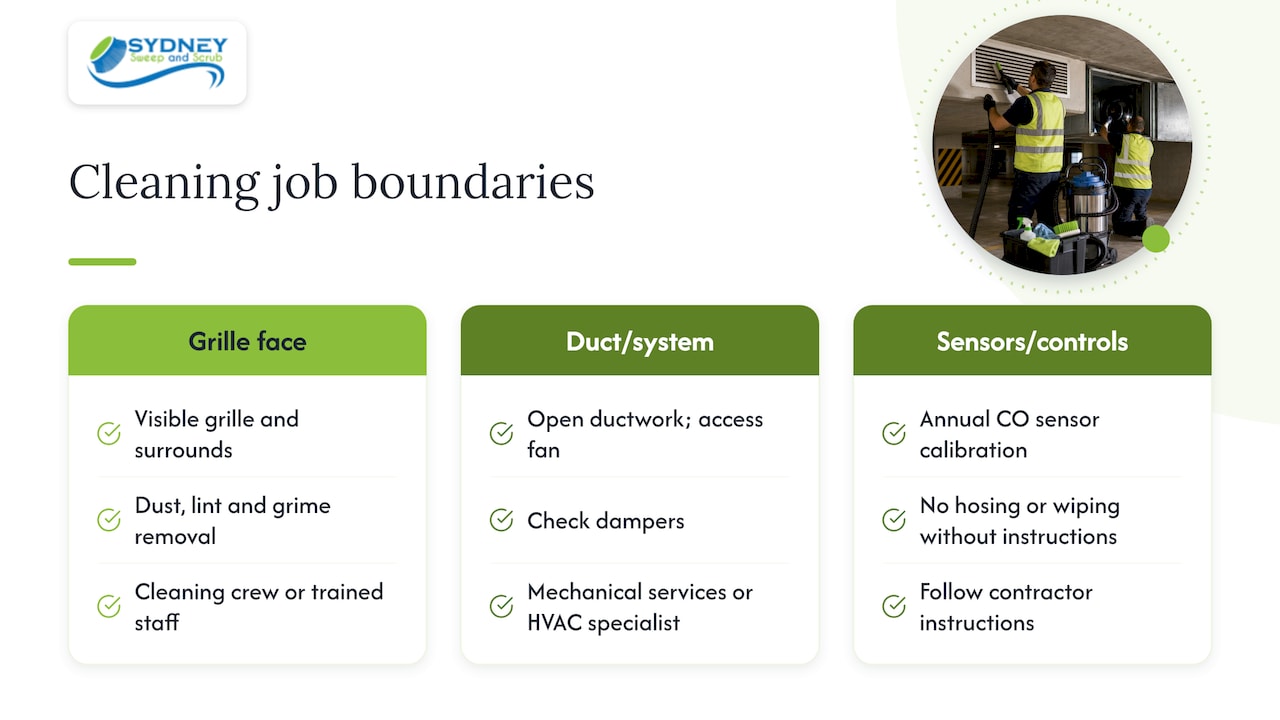
Grille face cleaning is surface work: removing dust, lint and grime from the visible grille and its immediate surrounds. A competent cleaning crew or trained facility staff can do it, within the safety limits above.
Duct, fan and damper cleaning is system work. It involves opening the ductwork, accessing the fan and checking dampers, and it belongs to a mechanical services or HVAC hygiene specialist. If your grilles hide heavy build-up behind them, or the fans are noisy, vibrating or underperforming, call that trade first. Restricted airflow is a safety matter in a car park, because ventilation is there to control exhaust gases.
Sensor and controls work is a third category. If the system is controlled by CO sensors, an annual calibration is needed to keep the system responding correctly, and nobody should hose or wipe those devices without the contractor’s instructions.
A good rule: if a job needs a tool to open a panel, a ladder above two metres, or an electrician, it is not a floor-cleaning crew’s task. If a building also has a commercial kitchen exhaust or a plant room, those are separate systems with their own cleaning specialists.
For property owners who want a second view on how cleaning is arranged across a mixed-use building, this overview of cleaning for property owners and housing associations shows the range of services a facility may bundle together.
Cleaning the car park without damaging grilles or disrupting airflow
The floor, walls and edges of the car park produce most of the dust that ends up on grilles. If you only wipe the grilles, the next cycle of traffic refills them. The cleaner approach is to treat the whole space as one system.
Order of work matters
A sensible sequence for a car park clean that includes grilles:
- Remove loose litter and debris. Sweep or collect so that it is not pushed toward air intakes.
- Dry-sweep the floor mechanically. This lifts surface dust and grit before any water goes down. Our page on mechanical sweeping explains how that works.
- Clean walls and edges. Edges, wall bases and columns hold dirt that gets re-circulated. Our guide to pressure washing walls and edges in your car park covers this stage.
- Clean the grilles last from the top down. Anything you knock loose should fall onto a floor that will still be cleaned, not onto one that is already finished.
- Scrub or wash the floor. Finish with the floor so that no grille dust is left behind.
Keep water where it belongs
If a pressure wash is part of the job, tell the crew where grilles, sensors, switchboards and fan housings are before they start. Directing spray away from them, and using low-pressure settings or hand cleaning close up, avoids water being driven into places that were never designed to get wet. Our overview of pressure washing explains the options, and the hot water approach is described under pressure washing with hot water.
Dust control in the air
Dust that is stirred up will land somewhere. Mechanical sweeping and wet methods help keep it low. For a longer checklist of dust sources and how to deal with them, see our guide on how to remove dirt and dust from your car park.
Who should do what: a simple split of responsibility
For a Sydney strata scheme or commercial building, the cleanest arrangement usually looks like this:
- Building manager or strata manager: owns the schedule, the budget and the records. Confirms which contractor is responsible for which part of the system.
- Mechanical services contractor: inspects grilles against the maintenance schedule, services fans and dampers, calibrates CO sensors and checks airflow.
- Car park cleaning contractor: looks after floors, walls, edges, drains and surface dust, and coordinates the grille wipe-down within the agreed safe limits.
- Electrician: called when any electrical component needs to be opened or isolated beyond a simple switch-off.
Ask each contractor for their scope in writing. Gaps appear when everyone assumes someone else handles the grilles.
Our article on expert carpark cleaning versus in-house cleaning goes through that decision in more detail. For a broader maintenance routine, the 15 best cleaning practices for multi-storey car parks is a useful companion.
When to arrange specialist cleaning
Call a specialist rather than wiping the grille yourself when:
- grilles are above two metres and you have no safe access equipment;
- you can see dust or oily deposits inside the duct or on the fan blades;
- the system is tied to smoke or fire control;
- airflow has dropped, the fans are noisy, or CO alarms are tripping more often than before;
- the grille is fixed, painted shut or damaged;
- you are preparing for an audit, a sale, a lease handover or a strata inspection and need a documented result.
A sustainable approach to cleaning chemicals and water use also matters to many owners. This guide to sustainable cleaning explains the concept. Our own approach is covered in carpark cleaning and sustainability.
Planning the work with Sydney Sweep and Scrub
We clean car parks across Sydney: mechanical sweeping, scrubbing, pressure washing, rubbish removal and line marking, with recurring maintenance contracts available for large facilities. When you ask for a quote, tell us where the ventilation grilles, fan housings and sensors are, and whether an HVAC contractor will be on site, so the wash can be planned around them and sequenced with their work. Pricing is quoted per job and is not published, so request a quote for your site.
See our carpark cleaning service or, if you run a larger or recurring program, the regular carpark cleaning page. For a whole-of-facility approach, our commercial cleaning team can help with common areas and lobbies as well.
A short checklist for your next car park clean
- Confirm which grilles are supply, which are exhaust, and who maintains them.
- Mark sensors, switchboards and fan housings as no-spray zones.
- Book a cleaning date outside peak traffic, with barriers and signage organised.
- Check the contractor’s insurance and safe work method statement for work at height.
- Sweep and clean the floor and walls in the right order, and finish with the grilles.
- Record the date and any defects, and schedule your 12-month inspection.
FAQ
Can I pressure wash car park ventilation grilles?
Usually not directly. Guidance for grilles recommends non-abrasive tools and mild detergent, and warns against high-pressure water near electrical or porous parts. A pressure wash is fine for the surrounding floor and walls if the spray is kept away from grilles, sensors and fan housings.
How often should car park grilles be cleaned?
AIRAH’s maintenance schedule lists grille cleanliness inspections every 12 months, so that is a sound minimum. Car parks are often a harsher environment than an office, so sites near roads, ramps or construction often need cleaning more often. Let the inspection findings set the frequency.
Who is responsible for cleaning ventilation grilles in a strata car park?
The owners corporation is generally responsible for common property, which is normally managed by the strata manager. Practically, a mechanical services contractor handles the system and a cleaning contractor handles surfaces. Confirm each scope in writing so nothing is missed.
Do I need a licensed contractor for grilles high on the wall?
If the work is above two metres, you need proper fall prevention and access equipment, and a trained crew that has a safe work method statement. Check the current requirements with SafeWork NSW before you book.
Is grille cleaning the same as duct cleaning?
No. Grille cleaning covers the visible faces and immediate surrounds. Duct, fan and damper cleaning is specialist system work that belongs to a mechanical services or HVAC hygiene contractor.
Sources
- Managing the work environment and facilities code of practice, Safe Work Australia
- Screen cleaning, HPAC
- Design of parking garage ventilation, AMCA
- Car park ventilation design, CCC Engineering
- DA19 Appendix A, AIRAH
- Car park ventilation maintenance, FDS Maintenance
- 12 ways to make small business safer, WorkSafe Victoria
- Universal WHS Checklist, HSE Direct
- NADCA ACR 2021 standard
- Installation, operation and maintenance manual for grilles, diffusers and louvres, HVC