
A stadium concourse cleaning programme must run as three linked phases, pre-event, during-event and post-event, sitting on top of a base-build routine that never stops. Get moving today by assigning a zone lead to every concourse section and confirming your ride-on scrubbers and wide-area sweepers are fuelled, charged and rostered for the next turnover. Slip-risk controls and Safety Data Sheet access need sign-off before doors open, not during the rush.
TL;DR:
- Assign one zone lead per concourse section to ensure accountability and reduce missed spots during the cleaning process.
- Prepare external walkways, main concourse, and loading docks with pressure washing and machine scrubbing at least 72 hours before the event.
- Use fixed patrol loops every 15 to 20 minutes during peak times to catch spills, trash, and hazards before patrons notice them.
- Complete a top-down, wet-to-dry deep cleaning sequence within five hours post-event, prioritizing waste removal and restroom stabilization.
- Match cleaning equipment and chemicals precisely to surface types and adhere to safety protocols, especially regarding wet floor signage and chemical SDS access.
Table of Contents
- Programme overview: phases, objectives and turnover windows
- Pre-event preparation checklist and staging
- During-event operations: porter coverage, patrols and rapid-response protocols
- Post-event turnaround: bowl reset, concourse recovery and deep-clean priorities
- Equipment, materials and supplies for concourse cleaning
- Staffing, rostering and the zone-ownership model
- Safety, WHS compliance and chemical control
- Quality control, inspections and KPIs that matter
- Base-build and non-event day routines that prevent event-day failure
- Implementation example and operations proof points from Sydney Sweep and Scrub
- How Sweep and Scrub can help with your next stadium turnaround
- Sources
Programme overview: phases, objectives and turnover windows
Every stadium concourse cleaning guide worth using breaks the work into three distinct phases, each with its own owner and deadline. The pre-event phase covers everything from the 72-hour pressure wash down to the two-hour final walkthrough. During-event is porter coverage, patrols and rapid response while gates are open. Post-event is the reset: bowl to bin, concourse to shine, ready for the next booking, sometimes within hours.
Turning an event timetable into a staffing plan starts with the gates-open and last-exit times, then working backwards. If last exit is 10:30pm and the next event’s gates open at 5pm the following day, that 18-hour window has to fit deep cleaning, restocking, machine scrubbing and dry time. Miss a step and the fallout is immediate: a slip near a food court exposes the venue to a workplace safety claim, a blocked bin overflow drives complaints on social media before the final siren, and a concourse that still smells like last week’s event damages repeat ticket sales.
Responsibilities split cleanly across the three phases:
- Pre-event: staging equipment, stocking consumables, confirming machine readiness, briefing zone leads.
- During-event: patrol loops, restroom support, spill response, live communication with event operations.
- Post-event: exit-route waste clearance, restroom stabilisation, top-down bowl clean, machine scrub, dry-time management.
Getting this sequencing right is the difference between a five-hour turnaround and a fifteen-hour one.
Pre-event preparation checklist and staging
Preparation for a stadium concourse cleaning guide to actually work in practice starts three days out, not three hours out. Here’s the staged approach that keeps machines, staff and supplies converging at the right point without a last-minute scramble.
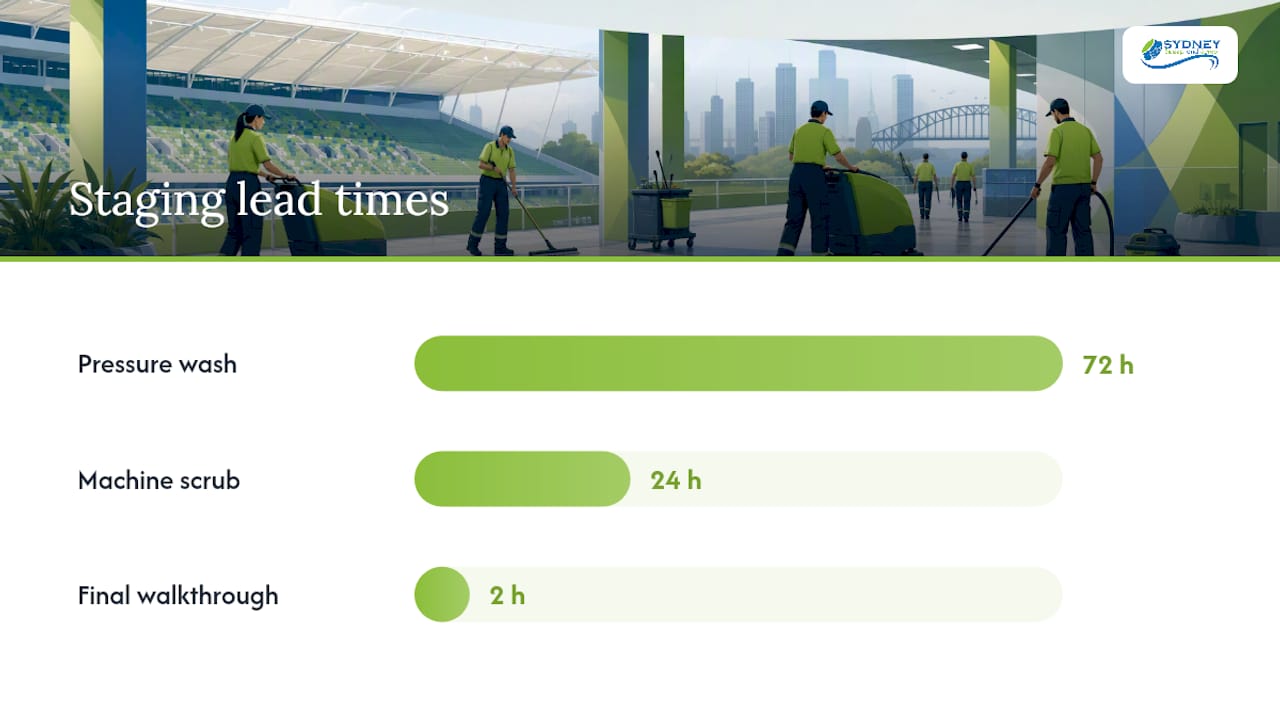
- 72 hours out: schedule the full pressure wash of concourse floors, loading docks and external walkways, particularly where grease or gum has built up since the last event.
- 24 hours out: run the machine scrub pass with ride-on scrubbers on the main concourse loops, confirming battery charge cycles or fuel levels so nothing dies mid-shift.
- 2 hours out: complete a full walkthrough of every zone, checking floor dryness, signage placement and bin liner stock against expected attendance.
- Pre-open: stage spill kits, extra liners and PPE at fixed points around the concourse so porters aren’t hunting for supplies during the rush.
Supply staging has to scale with expected crowd size. A sold-out final needs bin capacity and liner stock at a different order of magnitude to a midweek fixture, and running short on liners two hours into an event means porters improvising with whatever’s on hand, which rarely ends well for hygiene standards.
Machine checks matter just as much as supply checks. Every scrubber, sweeper and pressure washer needs a pre-event function check, and every chemical on site needs its Safety Data Sheet accessible to the crew using it, not filed away in an office. Routine physical cleaning with detergent and water is sufficient for most non-healthcare workplace surfaces, which simplifies chemical staging considerably, but restrooms and food-contact surfaces still need the right sanitiser at the right dwell time.
Pro Tip: Keep a laminated staging map at each concourse zone showing exactly where spill kits, extra liners and radios live. New casual staff waste less time hunting for gear when the map does the thinking for them.
During-event operations: porter coverage, patrols and rapid-response protocols
Once gates open, the job shifts from preparation to constant, visible presence. Concourses under load generate mess faster than most managers expect, spilled drinks near bar queues, food wrappers drifting from seating areas, wet floors near entry points on a rainy night, and the crew on the ground needs a rhythm that catches problems before a patron does.
Patrol loops work best on a fixed cycle, roughly every 15 to 20 minutes through peak periods like halftime and post-siren exits, with restroom checks running on a tighter cycle again given how quickly paper towel and soap dispensers empty under heavy use.
Clear roles keep the patrol structure from collapsing into everyone doing a bit of everything:
- Porters handle general concourse patrol, spot cleaning and bin management.
- Restroom attendants focus solely on stall checks, consumable restocking and floor condition.
- Spill team responds within minutes to any wet-floor or breakage call, working as a dedicated unit rather than pulling porters off their loops.
- Zone leads own a defined section of the concourse, coordinating their crew and escalating anything beyond routine cleaning.
- Supervisor floats across zones, verifies standards and handles communication with event operations.
A rapid-response kit needs to be genuinely rapid, not a trolley someone has to fetch from a storeroom. Stock it with absorbent granules, wet-floor signage, a mop and bucket, gloves and a radio, and position several around the concourse rather than centralising everything in one spot. Effective slip and trip control depends on having the right methods, schedules, equipment and trained staff in place before the mess happens, not after, which is exactly what a distributed spill kit network delivers. Radio protocol should be short and standard: zone, hazard type, action taken, all clear.
Post-event turnaround: bowl reset, concourse recovery and deep-clean priorities
The clock starts the moment the last patron exits, and the sequence you follow determines whether you’re done in five hours or fighting the schedule at 3am. Work top-down and wet-to-dry, always, because cleaning a floor before debris above it settles just means redoing the floor.
- Deploy exit-route waste crews immediately while patrons are still filtering out, clearing the heaviest bins along main thoroughfares before they become trip hazards.
- Stabilise restrooms first, restocking consumables and mopping high-traffic stalls, since these get inspected earliest by any overnight staff or early-morning contractors.
- Run the top-down bowl clean, clearing seating rows, stairwells and handrails before debris migrates down to concourse level.
- Sequence the machine scrub across concourse zones once bulk debris is cleared, working ride-on scrubbers in a logical loop rather than backtracking across wet floors.
- Control dry time by scheduling scrub passes early enough in the turnaround window that floors are fully dry before the next load-in begins.
Deep-clean tasks like grout restoration, high-level dust clearance or drain descaling almost always get deferred to dark-day cleaning rather than squeezed into a same-night turnaround. Ride-on scrubbers and wide-area sweepers are the standard recommendation for large concourses precisely because they compress this kind of work into a tight turnaround window, cutting manual labour hours where mopping alone would blow the schedule. Sydney Sweep and Scrub’s guide on post-event cleaning tactics covers this sequencing in more granular detail for teams building out their own checklist.
Equipment, materials and supplies for concourse cleaning
Matching the machine to the surface and the timeframe is where most turnaround delays actually get solved. Ride-on scrubbers earn their place on large, flat concourse runs where a walk-behind machine would simply take too long. Wide-area sweepers clear bulk debris, food wrappers, confetti, spilled ice, ahead of any wet cleaning pass. Backpack vacuums handle stairwells, corners and areas ride-on equipment can’t reach. Pressure washers deal with external walkways, loading docks and ingrained grease that no amount of scrubbing touches.
- Use ride-on scrubbers for main concourse loops and food court flooring.
- Use wide-area sweepers ahead of any wet clean to clear loose debris first.
- Use backpack vacuums for stairwells, corners and confined restroom areas.
- Use pressure washers for external surfaces, loading docks and stubborn grease build-up.
Consumables need the same discipline. Degreasers for kitchen and bar zones, food-safe sanitisers for concession surfaces, and general-purpose detergents for concourse flooring should all be checked against the flooring supplier’s material compatibility guidance before they’re rolled out venue-wide, since the wrong chemical on sealed concrete or polished stone can strip a surface faster than any amount of foot traffic. WorkSafe Victoria’s cleaning guidance recommends isolating equipment before cleaning and choosing mechanical aids that reduce manual handling, a principle that applies directly to how ride-on machines and pressure washers get deployed around live event infrastructure.
Spill kits, physical barriers, wet-floor signage and PPE round out the kit. Sweep and Scrub’s guide to concrete event space cleaning is a useful reference for matching chemical choice to concourse surface type.
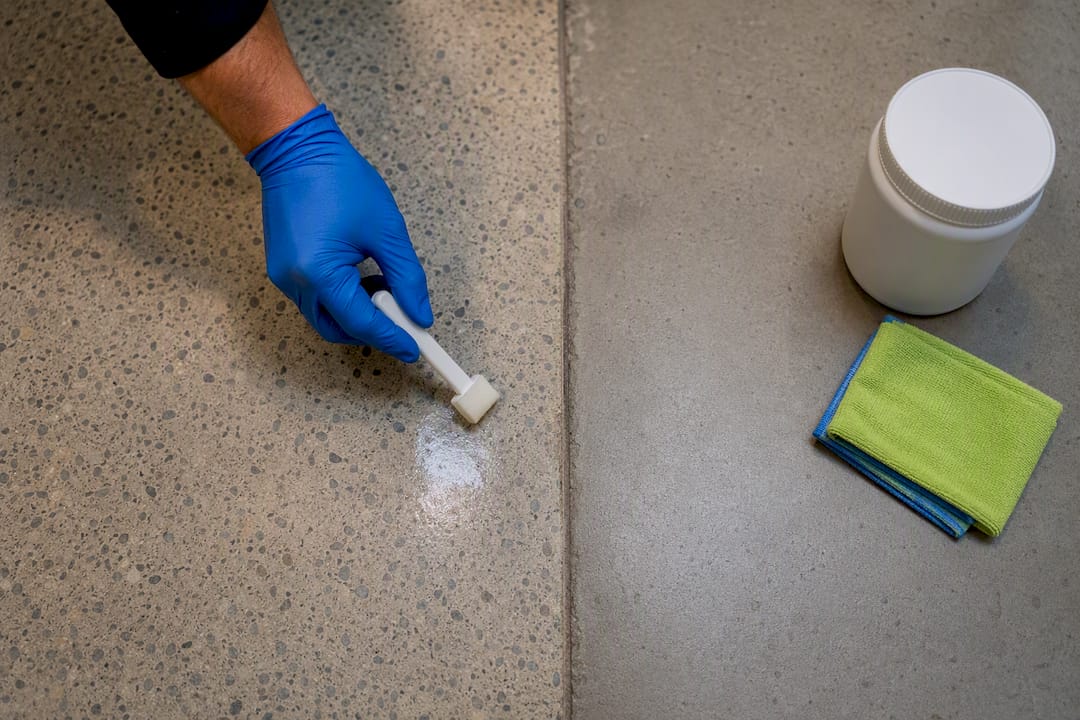
Pro Tip: Test any new degreaser or sealant on a small, hidden section of concourse flooring first. A product that works fine on painted concrete can dull or discolour polished stone within one application.
Staffing, rostering and the zone-ownership model
Roaming crews without ownership are how sections get missed. A zone-ownership model fixes this by assigning each zone lead a specific, bounded area they’re accountable for from gates-open to lock-up, rather than a general instruction to “cover the concourse.” When something’s missed, there’s one name attached to that zone, not a shrug and a shift change.
Industry benchmarks suggest a baseline of 45 cleaners for a 12,000-attendee event, scaling up by one additional cleaner for every 500 extra seats sold. That figure works as a starting point for budgeting crew size, not a fixed rule, since concourse layout, number of concession points and restroom density all shift the real number up or down.
Rostering needs built-in contingency for back-to-back events, where post-event turnaround from Saturday runs straight into pre-event prep for Sunday with almost no buffer. Slight overstaffing on a venue’s first few events is worth the cost while supervisors learn genuine turnaround times before trimming the roster back. Sweep and Scrub’s breakdown on planning a successful machine scrub covers crew sizing against machine deployment in more depth.
- Assign one zone lead per defined concourse section, not per shift.
- Use the 45-cleaner baseline for 12,000 attendees as your starting calculation, then scale per 500 additional seats.
- Build in rostering slack for back-to-back event weekends.
- Overstaff slightly for the first few events at a new venue until real turnaround data comes in.
Safety, WHS compliance and chemical control
Concourse cleaning sits squarely inside WHS obligations, and the controls that matter most are the ones that stop an incident before it happens rather than the paperwork that follows one. A documented risk assessment and Safe Work Method Statement for any pressure washing activity is non-negotiable given the water pressure and chemical exposure involved, and every chemical on site needs its Safety Data Sheet genuinely accessible to the crew using it.
The clean-to-dry principle is the single most important floor-care rule on a concourse: never leave a wet floor unsigned or unattended, and never let staff walk away from a mopped section before it’s dry or barricaded. Effective slip and trip control depends on the right combination of method, schedule, equipment and trained staff, and skipping the dry-time step is where most concourse slip claims originate. Certain floor treatments and degreasers can also strip slip resistance from sealed surfaces over repeated use, which is another reason to check compatibility before rollout.
- Complete a risk assessment and SWMS before any pressure washing task.
- Keep SDS documents accessible at point of use, not filed centrally.
- Enforce the clean-to-dry rule with visible signage and barricades.
- Log induction currency and training records for every crew member handling machinery or chemicals.
Quality control, inspections and KPIs that matter
Inspections only earn their keep when they produce evidence, not just a tick on a clipboard. A concourse walkthrough checklist should cover floor dryness, bin fill levels, restroom consumable stock, signage placement and any residual debris in corners or under seating, with each zone lead signing off their section before handover to the supervisor.
Time-stamped photo sign-off tied to rectification rates, rather than simple attendance counts, is what separates a genuinely accountable cleaning programme from one that just looks busy. The KPIs worth tracking include rectification-on-first-return (how often a flagged issue is fixed without a second visit), trends in slip-related incidents over successive events, response time to spill calls, and ATP hygiene test results in high-touch restroom and concession zones.
- Require photo and time-stamped sign-off from each zone lead before shift close.
- Track rectification-on-first-return rate as your primary contractor accountability metric.
- Monitor slip-incident trends event over event, not just after a claim.
- Feed inspection data directly into SLA reviews and performance meetings rather than filing it away.
Commercial cleaning operators outside the stadium sector, including services like Din Hvide Handske’s commercial cleaning model, apply similar zone-accountability structures, worth benchmarking against if you’re building your own inspection framework from scratch.
Base-build and non-event day routines that prevent event-day failure
The days between events are where most event-day failures actually get created or avoided. Venues that separate base-build cleaning from event-day turnover, and back it with zone matrices and measurable KPIs, consistently avoid the buildup that causes visible problems on event day.
A task and frequency matrix should specify daily sweeping and spot cleaning, weekly machine scrubbing of high-traffic zones, and periodic deep cleans for drains, grout and high-level dust.
- Treat drains with descaling agents on a periodic cycle to prevent odour buildup.
- Schedule gum removal as a standalone weekly task, not an afterthought during scrubbing.
- Clear high-dust areas, vents, light fittings, upper handrails, on a periodic basis before they become visible.
- Review non-event performance data monthly to catch drift before it shows up on a match day.
Implementation example and operations proof points from Sydney Sweep and Scrub
Mechanical sweeping, ride-on scrubbing and pressure washing are commonly used across large public venues, using industrial-grade equipment designed for high-volume concourse cleaning rather than scaled-down commercial gear. Machine-led concourse recovery is the standard approach for turnaround windows tight enough that manual mopping simply can’t keep pace.
Carbon-neutral operations can provide venue operators with a sustainability credential beyond marketing claims. Bookings often run through online quoting systems, where providing details such as concourse size, surface type, expected attendance, and turnaround window helps improve quote accuracy.
How Sweep and Scrub can help with your next stadium turnaround
Running a concourse turnaround with your own crew and rented gear works until attendance spikes or a machine breaks down mid-shift. Outsourcing with providers that have staged and maintained ride-on scrubbers, wide-area sweepers and pressure washing units can be an alternative to building in-house cleaning capacity for large events.
We handle hard surface cleaning for concourse floors, mechanical scrubbing for main thoroughfares, and pressure washing for loading docks and external walkways, all run on carbon-neutral operations if sustainability reporting matters for your venue. For venues wanting cleaning between events rather than just on event day, our routine cleaning service covers the base-build side of the programme too.
Requests for cleaning quotes are typically made through online booking systems, with concourse dimensions, surface type, and typical attendance provided to receive accurate estimates quickly.
Sources
- Bidding stadiums, arenas and sport venues (Cleaning Business)
- Cleaning (WorkSafe Queensland)
- How to clean and disinfect your workplace (Safe Work Australia)
- Cleaning | WorkSafe Victoria