
Carbon neutral cleaning means the emissions from the cleaning work, such as truck and sweeper fuel, electricity and water heating, have been measured, cut where possible and the remainder offset. For a Sydney property manager, the claim is only worth paying for if the supplier can show you how it was calculated, and if the work also keeps wash-water out of the stormwater system. This guide explains what to ask, what actually lowers the footprint of a car park or warehouse clean, and where we fit.
TL;DR
- “Carbon neutral” is a method (measure, reduce, offset), not a product label. Ask any cleaner to show the method behind the claim.
- The Australian Government has announced plans to end Climate Active certification, so many carbon neutral claims in future will be voluntary and unreviewed. Your contract has to do the checking.
- On industrial sites the biggest environmental risks are often wastewater, water use and fuel, not the detergent.
- Dry mechanical sweeping first, then targeted scrubbing or washing, cuts water use and pollutant load.
- Sydney Sweep and Scrub runs carbon-neutral operations and offers optional waste offset initiatives. Request a quote to see how that applies to your site.
Table of Contents
- What carbon neutral actually means for a cleaning contractor
- A change worth knowing about: Climate Active is closing
- Ten questions to put to any cleaning supplier claiming carbon neutral
- Where the real footprint of a clean sits
- What to write into the service contract
- How this plays out by site type
- What Sydney Sweep and Scrub does
- A simple plan for the next 90 days
- FAQ
- Sources
What carbon neutral actually means for a cleaning contractor
Carbon neutral is a three-step idea. According to the government’s Climate Active program page, participants calculate the greenhouse gas emissions of their activity (fuel, electricity, travel), reduce them where possible by changing equipment or the way they operate, and offset what remains by buying carbon offset units.
The order matters. A supplier that skips straight to offsets has bought a label, not changed its operation. The Climate Active Carbon Neutral Standard for Products and Services is a voluntary standard that treats measurement and reduction as the foundation, with offsets covering what is left.
For a cleaning business the emissions come from a short list:
- Diesel or petrol in sweeper trucks, utes and support vehicles
- Electricity used for charging battery equipment and running depots
- Gas or diesel used to heat water for hot water pressure cleaning
- Consumables, waste disposal and the transport of collected debris
Notice what is not on the list: the brand of detergent. Product choice matters for toxicity and wastewater, but it is rarely the largest line in a carbon account.
A change worth knowing about: Climate Active is closing
For years, the simplest answer to “is this supplier really carbon neutral?” was “check whether it is Climate Active certified”. That answer is changing. The Department of Climate Change, Energy, the Environment and Water says the government plans to end Climate Active certification and will no longer review or monitor businesses’ voluntary climate claims. It is also seeking feedback on whether to close the program fully or keep some voluntary standards and guidance.
Check the current status of the program before you write certification into a tender, because it is under review as of this article’s date. What this means in practice:
- A supplier can still follow a recognised method and publish its numbers, even if no government body certifies them.
- You should ask for the calculation boundary, the reduction actions and the offset details in writing.
- Where your own organisation reports emissions or has a net zero target, your sustainability team will want records it can stand behind.
We are not going to pretend this makes the claim simpler. It makes your questions more important.
Ten questions to put to any cleaning supplier claiming carbon neutral
Use these in a tender, a quote request or a renewal meeting.
- What is included in the emissions calculation: vehicles, electricity, water heating, waste?
- Who prepared the calculation, and for which period?
- What have you changed in the last 12 months to reduce emissions, rather than just offset them?
- What are the offsets, how many units were retired, and can you show the record?
- Is the carbon neutral claim about the whole business or only one service?
- Can I opt in or out of offsetting for waste on my site, and what does it cost?
- How is wash-water captured and disposed of on each job?
- What training do your operators have on equipment and spill response?
- Will you report chemical use and waste volumes to me regularly?
- What happens if you fail to meet the commitments in the contract?
A supplier that answers these plainly is worth shortlisting. One that answers with a logo and a leaf is not.
Where the real footprint of a clean sits
Water and energy use
The Queensland Government’s sustainable procurement guide for cleaning services is written for government buyers, but its message suits any facility manager: look at how the service is delivered, including water and energy use and efficient equipment, not only at which products are used.
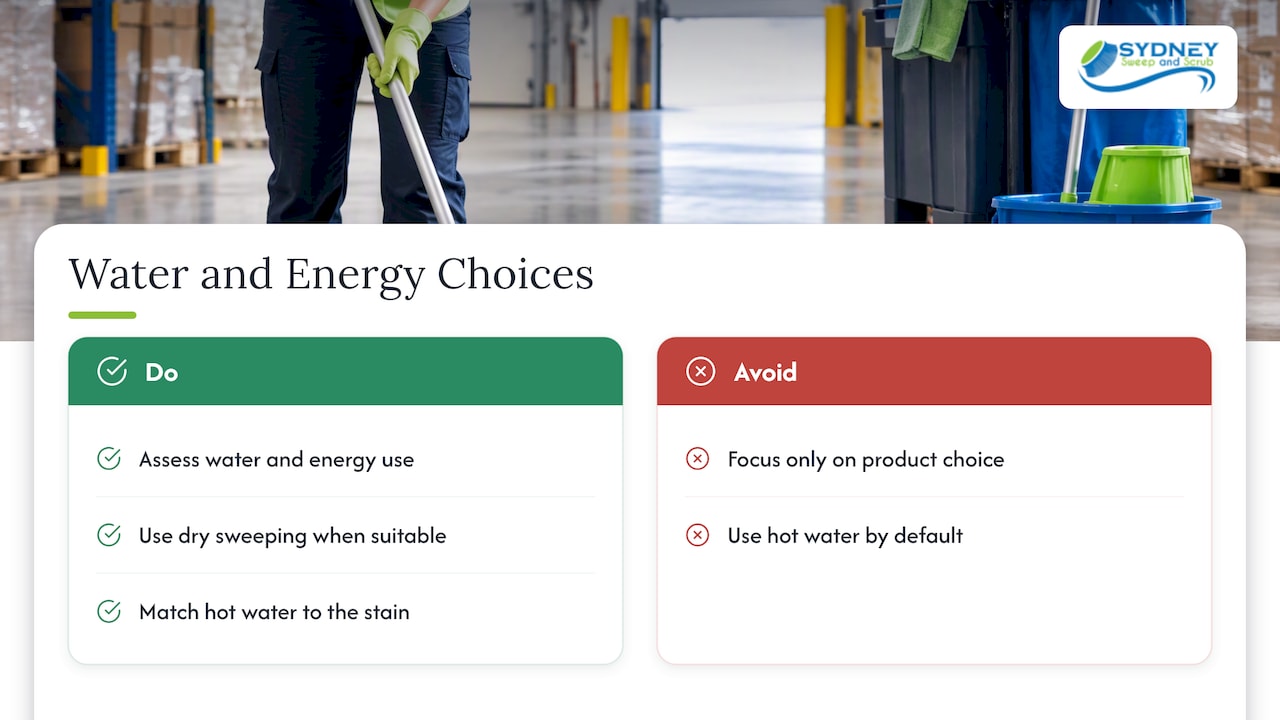
On a large car park or warehouse floor, this is where choices add up. A mechanical sweeper that collects dust and debris dry uses no water for that pass. A ride-on scrubber dispenses and recovers cleaning solution in one pass, so there is no pooled run-off to chase. Hot water is powerful on oil and grease, but heating it costs energy, so it should be used where the stain needs it rather than as the default.
Wastewater and stormwater
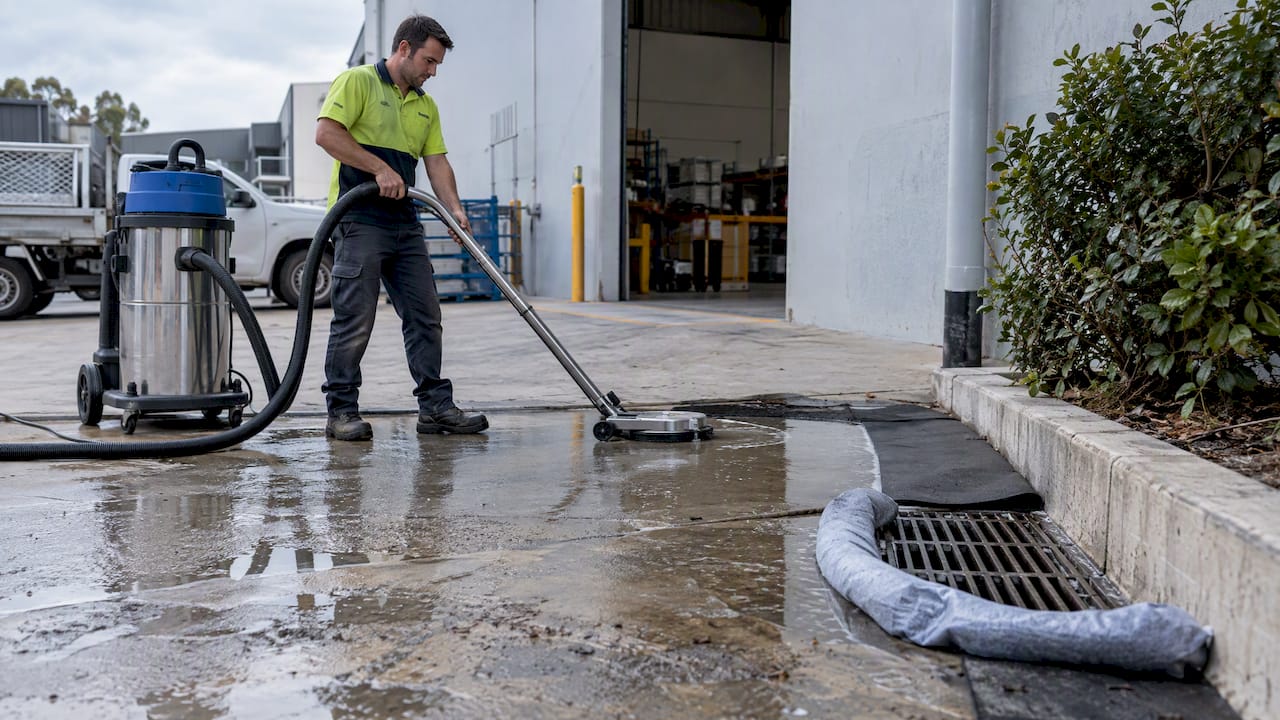
This is the issue property managers most often overlook, and it is a legal one. The NSW EPA states that on commercial premises it is an offence to wash a car in a place where the water drains to the stormwater system, whether or not detergents are used, and the same page makes clear that oil, grease and other pollutants must not enter it either. The page is aimed at smash repairers, but the principle applies to any hardstand: stormwater drains to waterways without treatment.
The penalties are not trivial. A NSW law firm’s summary of the Protection of the Environment Operations Act 1997 says the maximum penalty for corporations is $2,000,000, with on-the-spot fines of $30,000 possible for water pollution offences. Treat that as general information and speak to a lawyer or the EPA about your specific site.
The practical point for your contract: a cleaner who tells you the water is “just water” is not managing your risk. Ask how drains are blocked or protected, how wash-water is collected, and where it is taken. We cover the checks in more detail in our guide to pressure washing wastewater for Australian businesses and in stopping pollutants at the source.
Sweeping before washing
Dry sweeping first removes the loose sediment, litter and fine dust that would otherwise become slurry. Less solid material in the wash-water means less to capture and treat, and a lower pollutant load if something goes wrong. This is the main reason a scheduled mechanical sweep is often the cheapest sustainability step for a car park. See how it works on our car park sweeping and mechanical sweeping pages.
Chemicals
Where chemicals are used, Safe Work Australia’s model Code of Practice on managing hazardous chemicals gives practical guidance for businesses on controlling the risks, including written procedures for handling and spills. Your contractor should have a safety data sheet for every product on your site, and your WHS adviser should confirm what applies to your premises.
What to write into the service contract
The most useful sustainability levers are contractual. Good practice for a facility with an outsourced cleaner includes:
- Reporting. Regular reports on chemical quantities used and waste or recycling volumes, for example quarterly.
- Training. Documented training for operators on the site’s waste system and on the safe use of energy-efficient equipment.
- Workflow fit. Waste and recycling arrangements that do not slow cleaners down, because anything that adds time tends to be skipped under pressure. The NSW EPA’s better practice guidelines for waste management in commercial and industrial facilities stress that systems should be easy for tenants and cleaners to use and for collection contractors to service.
- Wastewater conditions. A written method for containing and disposing of wash-water on each job.
- Equipment. A preference for efficient or automated machines where they suit the floor.
We have turned this into a checklist in our procurement-ready sustainable cleaning guide for facility managers.
How this plays out by site type
| Site | Main footprint drivers | Sensible approach |
|---|---|---|
| Strata or commercial car park | Oil staining, dust, run-off to drains, night access | Dry sweep, scrub with recovery, spot hot water on oil, capture wash-water |
| Warehouse | Fine dust, forklift tyre marks, large floor area, end-of-lease condition | Scheduled sweeping and scrubbing, robotic cleaning for routine passes |
| Construction site | Sediment, mud tracked onto roads, stormwater | Frequent sweeping, de-watering where needed |
| Event venue or public space | Litter spikes, short turnaround | Mechanical sweep and rubbish removal around the event window |
Car parks
Car parks collect oil, rubber dust and litter, and most have floor drains that lead somewhere. Sweeping on a schedule keeps material out of the drains, and scrubbing with recovery lifts what sweeping cannot. See our pages on car park cleaning and carpark cleaning and sustainability.
Warehouses
A warehouse floor is a safety asset: dust and spills affect grip and forklift handling. Regular mechanical cleaning tends to be better value than occasional heavy cleans. Our green warehouse cleaning page explains the approach, and tenants preparing to hand back premises can look at end of lease warehouse cleaning in Sydney.
Automated cleaning
Automated robotic cleaners suit large, predictable floors such as car parks and warehouses, where the same route is run repeatedly. They can take over routine passes and free people for the detail work. Read more in automated cleaning for sustainable businesses.
What Sydney Sweep and Scrub does
We are a family-owned Sydney business specialising in mechanical sweeping, scrubbing and pressure washing for car parks, warehouses, construction sites, public spaces, stadiums and event venues. Our operations are carbon neutral, and clients can choose to take part in optional waste offset initiatives, so a clean can contribute to your own sustainability goals.
We also run the equipment that helps with the issues above: mechanical sweepers and scrubbers, hot water pressure cleaning, rubbish removal and automated robotic cleaning. Bookings are online, and large facilities can arrange recurring maintenance.
If you want a documented answer rather than a promise, ask us the ten questions above when you request your quote. The wider thinking behind our approach is in the importance of sustainable cleaning and a guide to sustainability for Sydney commercial cleaning.
Ready to price a job? Tell us the site, the surface and how often it needs cleaning, and we will quote. Get a commercial cleaning quote, or go straight to car park cleaning or warehouse cleaning.
A simple plan for the next 90 days
- Week 1. List every site, its surfaces, drains and current cleaning frequency.
- Weeks 2 to 3. Request quotes and send the ten questions to each supplier.
- Week 4. Compare the answers on method, wastewater handling and reporting, not only price.
- Weeks 5 to 8. Run a trial clean at one site and ask for the report.
- Weeks 9 to 12. Move to a scheduled arrangement, with reporting and wastewater conditions written in.
FAQ
Is Australia carbon neutral?
No. Carbon neutral is a status claimed by individual businesses, products, events or buildings, not a description of the country as a whole. The government’s Climate Active program has been the voluntary route for those claims, but it is planned to end, as covered above.
Does carbon neutral cleaning cost more?
We do not publish prices, because they depend on the site, surface, access and frequency. Ask for a quote and ask what part, if any, relates to optional offsets. Efficient methods such as dry sweeping first can also reduce water and handling costs.
Is a green detergent enough?
No. Detergent is one factor, but fuel, water use and wastewater handling often matter more on car parks and warehouses. In NSW, letting wash-water reach the stormwater system can be an offence even without detergent, so containment matters whatever product is used.
What should I ask for in writing?
Ask for the scope of the carbon neutral claim, the reduction actions, the offset record, the wastewater method and a regular report on chemicals and waste. Put them in the contract so they can be checked at renewal.
Sources
- Climate Active, DCCEEW
- Climate Active Carbon Neutral Standard for Products and Services, DCCEEW
- Sustainable procurement guide: Cleaning services, Queensland Government
- Smash repair industry, NSW EPA
- Water pollution: the crime that’s hard to avoid, Coleman Greig
- Model Code of Practice: Managing risks of hazardous chemicals in the workplace, Safe Work Australia
- Better Practice Guidelines for Waste Management and Recycling in Commercial and Industrial Facilities, NSW EPA