
Soot comes off a car park floor with the right sequence. Dry-remove loose deposits first. Then use hot water pressure cleaning or scrubbing with a degreaser. Capture every drop of wash water, and keep the crew ventilated and protected. Skipping any of those steps is how a soot job turns into a stormwater breach, a workplace safety problem or a permanently stained slab.
This guide is for property managers, strata committees and building owners who have blackened concrete in a basement or open-air car park. The soot might come from years of exhaust, a vehicle fire or nearby burning. It explains how to size up the job, which methods suit which deposit, what the rules say about wash water in NSW, and when to bring in a specialist. We are Sydney Sweep and Scrub, and we clean car parks across Sydney, so the practical detail comes from that work.
TL;DR
- Work out what the soot is first. Years of exhaust film, diesel grime and fire residue need different treatment, and a fire-damaged structure needs checking before anyone cleans.
- Remove loose soot dry (sweeping or vacuuming), then wash. Hot water pressure cleaning with a degreaser handles most bonded deposits on sealed or unsealed concrete.
- Test a small, hidden patch first. Aggressive methods such as grinding or acid etching remove surface concrete, not just the stain.
- Wash water must not reach the stormwater drain. Plan capture and disposal before the first pass.
- In enclosed basements, ventilation and the hierarchy of control matter as much as the cleaning method.
Table of Contents
- What the soot actually is
- Assess the site before you clean
- Methods that work, in order of aggression
- Where the wash water goes
- Keeping workers and the public safe
- Preventing soot from building up
- How we handle car park soot
- FAQ
- Sources
What the soot actually is
Car park soot is rarely one thing. Three types cover most Sydney jobs:
- Chronic exhaust film. Years of idling and queueing vehicles leave a dark, greasy layer on ceilings, beams, columns and the aisle floors near ramps and boom gates. It is part carbon, part oil, which is why water alone moves it around rather than lifting it.
- Diesel and heavy-vehicle deposits. Loading docks, truck bays and warehouse forecourts collect heavier, oilier carbon that bonds into the concrete pores.
- Fire residue. A vehicle fire or a fire in an adjoining area leaves soot that can be acidic or oily, and often spreads across ceilings, services and walls well beyond the burn area.
The first two are routine cleaning work. The third is a different category, covered below.
The type matters because it decides the chemistry. A degreaser that dissolves oily exhaust film will do little to a dry, powdery fire deposit, which smears if you wet it before dry removal. Our guide to the top stains in car parks and how to combat them covers how oil, rubber and carbon marks differ on concrete.
Assess the site before you clean
A proper assessment takes a short walk-through and saves money. Work through these points:
- Source and age. Fresh fire soot, a decade of exhaust, or both? Ask the building manager for the incident history.
- Extent. Map which floors, ceilings, columns, walls and services are affected. Soot on the ceiling will fall onto a floor you have already cleaned if you work in the wrong order.
- Surface type. Bare power-floated concrete, sealed concrete, painted line marking, epoxy coatings and asphalt behave differently. Aggressive cleaning can strip line marking and coatings.
- Drainage. Find out which drains go to sewer and which go to stormwater. NSW EPA guidance says staff should be able to clearly identify which drains on the site go straight to stormwater.
- Occupancy. Is the car park live? Vehicle movement, pedestrians and lift lobbies all shape work hours and traffic control.
- Ventilation. Basements with mechanical ventilation behave very differently from open-air decks. Confirm the system is running and working.
When it needs a fire restoration specialist
Routine exhaust and diesel soot is cleaning work. After a fire, treat the site as a restoration job first. Concrete, fire-affected electrical services, sprinkler systems and possibly damaged materials need clearance from the appropriate engineer, insurer and fire authority before any cleaning crew goes in. Older buildings may also contain asbestos or lead paint that fire damage and clean-up can disturb, so those checks come before stripping or scrubbing.
Once the site is cleared for cleaning, we can take on the surface work: removing deposits from floors, walls and columns with the methods below. If you are unsure which category your car park falls into, describe the history when you request a carpark cleaning quote and we will tell you whether it is a cleaning job.
Methods that work, in order of aggression
The safest approach is to start gentle and escalate only as far as the deposit demands. Each step below also changes how much wash water you create.
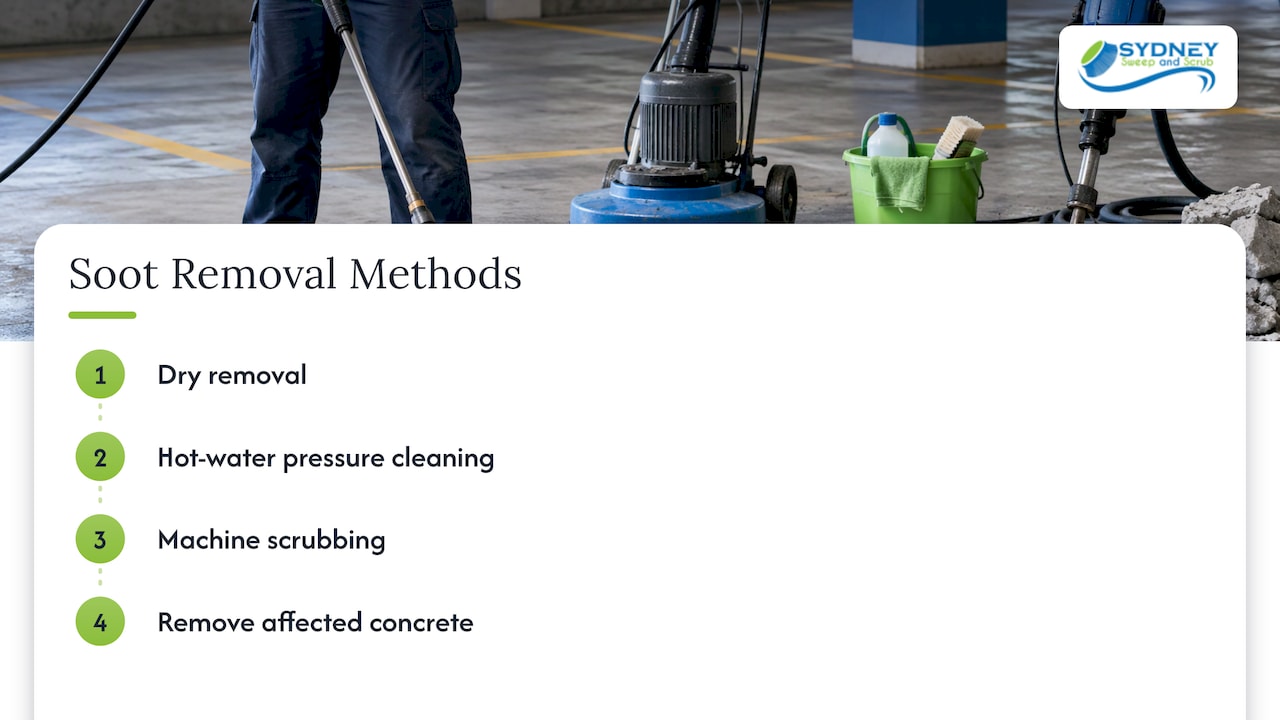
Step 1: dry removal
Loose soot, dust and debris come off first. Mechanical sweeping with dust suppression removes the bulk without adding water, and it is the step that most reduces what has to be captured later. NSW EPA guidance for workshops notes that dry-sweeping floors wherever possible and cleaning spills with absorbent material is the preferred approach. The same logic applies in a car park. Our mechanical sweeping service covers this stage.
For dust that settles on outdoor surfaces, Safe Work Australia’s air pollution advice says wet wiping or a HEPA filtered vacuum is the way to clean it off once conditions improve. That is a useful guide for fine soot on ledges, signs and fittings, where blowing or dry brushing would put it back into the air.
Step 2: hot water pressure cleaning with a degreaser
Most bonded exhaust and diesel soot needs heat and a surfactant or degreaser to lift the oily binder. Hot water pressure cleaning is designed for exactly this: heat loosens the grease so less pressure is needed, which is gentler on the concrete surface than a cold-water blast. Our pages on pressure washing with hot water and pressure washing with cold water explain where each fits.
Typical working order on a multi-level car park:
- Dry-remove loose soot from ceilings, beams and columns, working top to bottom.
- Apply degreaser to walls, columns and the floor, and let it dwell for the time the product specifies.
- Pressure clean top to bottom, directing wash water to the capture point.
- Recover the water with vacuum equipment, not by letting it run to a drain.
- Rinse and recover again, then inspect once dry, because stains often look different wet.
Step 3: scrubbing
Where pressure alone leaves shadows, machine scrubbing with a suitable pad or brush works the degreaser into the pores and lifts what a jet skips over. Scrubber-dryers recover most of the solution as they go, which helps with water control. See our mechanical scrubbing and sweeping services for what we run on larger floors.
Step 4: removal of the surface itself
Some deep-set carbon will not come out without taking a layer of concrete with it. The Cement Concrete & Aggregates Australia data sheet on removing stains from concrete says that abrasive blasting, grinding and acid etching remove stains by removing affected concrete, which changes its texture and colour. Use that fact when deciding. A patch that is cleaner but visibly different in texture can look worse in a lit basement than an even, slightly stained floor.
Test first, always
The same data sheet advises testing a small, inconspicuous area to assess the cleaning method and the proposed chemicals, and planning for removal or disposal of wash water and contaminants before the stain removal begins. A test patch in a corner or behind a column tells you three things: whether the soot lifts, whether the surface changes, and how much water you will need to capture.
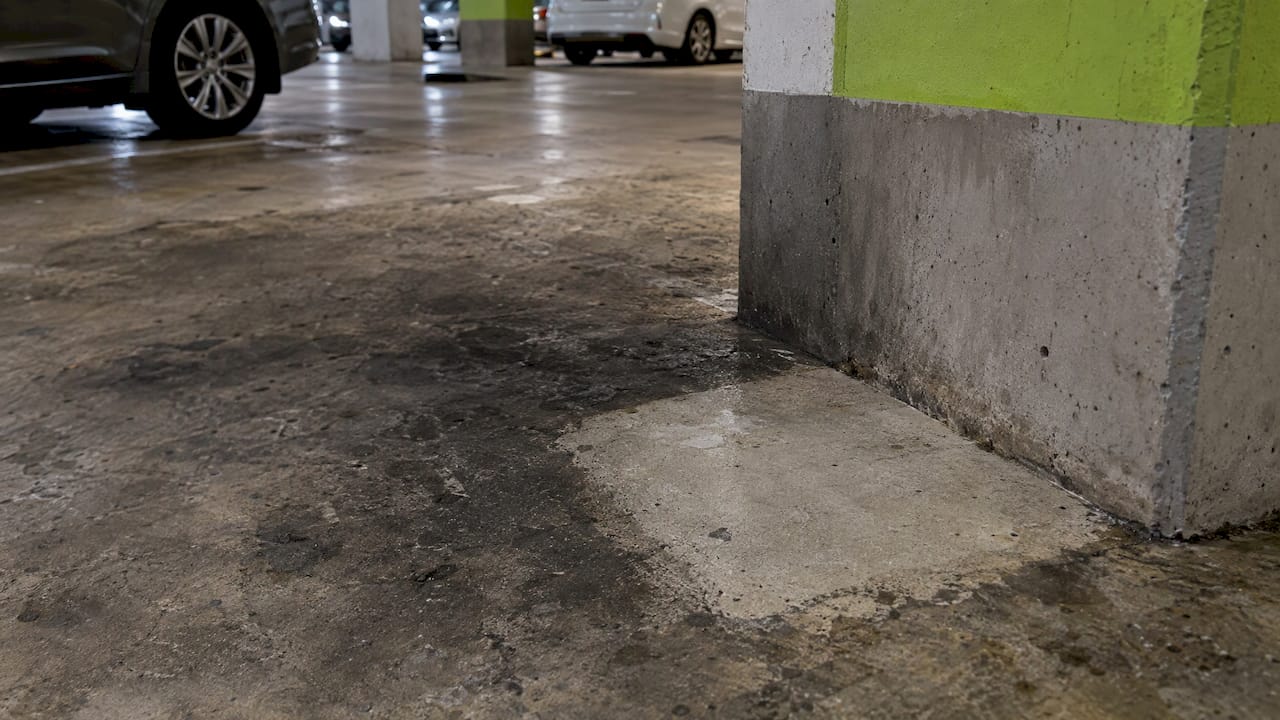
For related concrete issues such as oil, see our guide to oil stain removal from concrete carparks, and for a broader view of what comes off, what we can remove from your concrete surfaces.
Where the wash water goes
This is the part that catches site managers out. Soot wash water carries carbon, oil, degreaser and fine particles. In NSW, that cannot go down the street drain.
The NSW EPA’s stormwater guidance says runoff from any washing activity must not enter stormwater drains. It points to a designated wash bay, with wastewater going to a collection pit and then to sewer under a Local Council Trade Waste Agreement, or being treated and recycled. Its liquid waste guidance adds that only clean water can enter the stormwater system, and that liquid waste must not be discharged to sewer without appropriate treatment and consent from the relevant sewage authority.
In practice for a car park job:
- Block and bund. Seal stormwater pits and use bunds or barriers so wash water stays on the work area.
- Capture by vacuum. Recover water as you go with a vacuum system, rather than flushing to a low point.
- Check sewer access. Discharge to sewer needs approval from the utility or council. Do not assume a floor drain in a basement is permitted to take it.
- Store chemicals properly. The EPA says chemicals belong in closed, labelled containers in a designated area away from stormwater drains, preferably covered, sealed and bunded.
We have written a checklist for this: pressure washing wastewater, five checks for Australian businesses. Use it as a briefing for any contractor, including us.
Waste classification
Captured sludge and wash water are waste. The NSW EPA’s Waste Classification Guidelines say generators must chemically assess waste to determine its class, and that waste not assessed must be treated as hazardous. Where degreasers or fire-related contaminants are involved, ask your contractor how the waste will be classified and where it will go, and keep the paperwork. If liquid waste is stored on site before collection, the EPA expects dangerous goods to be segregated under the Australian Dangerous Goods Code, with adequate secondary containment for tanks and drums.
As the occupier, you carry responsibility for what happens on your site. The EPA notes that for owners and tenants, soil contamination is a serious issue, and that it can order an occupier to take remedial action under the Environmentally Hazardous Chemicals Act 1985. Clean disposal protects you as much as the contractor.
Keeping workers and the public safe
Soot jobs are workplace health and safety jobs. The Safe Work Australia air pollution advice states that the model WHS laws require air pollution risks to be managed: eliminate exposure first, and if that is not reasonably practicable, minimise it through isolation, administrative controls and PPE as the last resort. For a car park, that translates to:
- Isolate. Close the level being cleaned to vehicles and pedestrians, with barriers and signs, and schedule work outside peak hours.
- Ventilate. The CCAA data sheet says to wear suitable protective clothing, work only in well-ventilated areas and use fans to provide fresh air to the work area. In a closed basement, confirm that the mechanical ventilation is running and that exhaust from cleaning equipment is not adding to the load. Battery-powered or electric machines are the usual choice underground.
- Control vehicle interaction. A live car park has moving vehicles. Traffic management and spotters are part of the job plan, not an extra.
- Manage injection and slip risks. High-pressure water can cause serious injuries, and wet, degreased concrete is slippery. Dedicated, trained operators and clear exclusion zones address both.
- Light the work area. Safe Work Australia’s code of practice on the work environment says adequate lighting after dark may be required for outdoor paths and car parks, so workers can move without risk of falling. Check lighting before an after-hours clean.
If solvents are part of a stain-removal plan, treat that as a separate hazard assessment: they call for strong airflow and the right respiratory protection, and your contractor’s safe work method statement should say so.
For property managers, the contractor’s SWMS is the document to ask for. It should cover the hazards above, the wash water plan and the traffic arrangements. Our guide to what procurement must require for pressure washing concrete lists what a good scope contains.
Preventing soot from building up
Heavy soot is mostly a maintenance backlog. A car park that gets regular sweeping rarely needs a deep, expensive recovery clean. A practical rhythm looks like this:
- Frequent: litter and hazard checks, spot treatment of fresh spills, sweeping of aisles and ramps in busy car parks.
- Regular: degreasing of stained bays, cleaning of low walls, columns, signs and line marking, and clearing grates and drains.
- Periodic: a full scrub or pressure clean of each level with wash water captured, plus cleaning of ceilings and high-level surfaces.
Exact frequency depends on traffic volume, whether the car park is enclosed, and how much oil and diesel use it sees. A small strata basement and a busy retail car park will not share a schedule. Our carpark concrete maintenance page and top ten carpark cleaning tips cover maintenance in more detail, and why regular carpark cleaning signals a professional organisation covers the case for scheduling it.
If you manage an enclosed site, a regular clean also supports the building’s air quality, and the same principle applies to lobbies and shared spaces where the soot gets carried in on shoes and vehicles. Approaches such as commercial deep cleaning follow the same logic of working from high surfaces to low ones and treating each area in a set order.
Line marking is another part of the job. Cleaning can fade markings, so plan relinemarking after a deep clean. We cover that under carpark cleaning and line marking.
How we handle car park soot
We are a family-owned Sydney business offering mechanical sweeping, scrubbing, pressure washing and hot water cleaning, plus robotic cleaning and rubbish removal, for car parks, warehouses and public spaces. For a soot job we would typically assess the site, test a small area, and propose a sequence of dry removal, hot water cleaning and scrubbing suited to the surface.
We work for building managers, strata committees and owners across Sydney. Our carpark cleaning service is the place to start, and you can look at automated robotic cleaning if you want a regular, low-water routine to keep soot from returning. Quotes are requested and bookings made online, and we offer optional recurring maintenance for larger facilities. Send us photos and the site history through the Sydney Sweep and Scrub website and we will tell you what the job involves.
FAQ
Can soot be removed from a car park floor without damaging the concrete?
Most exhaust and diesel soot can be removed with dry sweeping, hot water and a degreaser, which leaves the concrete surface intact. Grinding, abrasive blasting and acid etching remove surface concrete and change its texture and colour. Test a small hidden area first to see how the surface responds.
Is it legal to wash soot residue into the stormwater drain?
No. The NSW EPA says runoff from washing activity must not enter stormwater drains, and only clean water belongs there. Wash water should be captured and either sent to sewer with the right approval or treated and recycled.
How do I know if soot needs a fire restoration specialist?
If the soot came from a fire, get the structure, electrical services and any asbestos or lead paint risk assessed before cleaning starts. Chronic exhaust and diesel grime is routine cleaning work. Describe the history to your contractor and they can advise which applies.
What safety measures should a contractor have in place?
Expect a SWMS covering vehicle interaction, high-pressure water, chemical exposure and contaminated runoff. In enclosed car parks, it should also address ventilation and control of airborne contaminants. Safe Work Australia’s hierarchy of control puts eliminating exposure first and PPE last.
Can I reduce how much water a soot clean uses?
Yes. Sweep and vacuum first, use hot water so less pressure and volume are needed, and recover water by vacuum as you go. Dry methods reduce what has to be captured and disposed of later.
Sources
- Removing Stains from Concrete, Cement Concrete & Aggregates Australia
- Managing the risks from air pollution: advice for PCBUs, Safe Work Australia
- Managing the work environment and facilities code of practice, Safe Work Australia
- The drain is just for rain, NSW EPA
- Guidance for the liquid waste industry, NSW EPA
- Waste classification guidelines Part 1, NSW EPA
- Smash repair industry, NSW EPA
- Commercial deep cleaning