
A warehouse deep clean is a one-off, top-to-bottom reset of the building: floors scrubbed back to their original grip, high dust removed, racking and loading areas cleared of build-up, and all waste taken away. It is different from the daily sweep, and it is a job for machines and a trained crew, not a weekend roster. Sydney Sweep and Scrub is a family-owned Sydney business that does this work with mechanical sweeping, scrubbing, pressure washing and rubbish removal, so a facility manager or tenant gets one team and one booking for the whole job.
TL;DR
- A deep clean restores floors, high surfaces, racking, docks and amenities. Routine cleaning only maintains them.
- SafeWork NSW says a thorough deep clean is often needed to bring flooring back to its original level of grip, so it is a safety task as well as a tidy-up.
- Plan around operations: clean when foot traffic is low, barrier off wet areas, and keep disposal records.
- At lease end, the tenant carries the burden of showing that damage is fair wear and tear, so dated photos and tip dockets matter.
- Large floors are best done by machine. We offer warehouse cleaning and end of lease commercial cleaning across Sydney.
Table of Contents
- What a warehouse deep clean includes
- Why the floor is the safety issue
- Choosing methods and equipment
- Planning around a working warehouse
- Cleaning a leased warehouse at the end of the term
- How we handle it
- FAQ
- Sources
What a warehouse deep clean includes
Routine cleaning keeps a building at a baseline: sweeping aisles, emptying bins, wiping amenities, dealing with spills. A deep clean goes where routine work does not reach and removes what has been building up for months or years.
A typical scope covers:
- Floors: machine scrubbing to lift ingrained dirt, tyre marks, oil film and product residue, followed by drying. Where there are heavy build-ups on pathways and docks, pressure washing is used.
- High-level surfaces: dust from beams, ledges, light fittings, ducting and the tops of racking. Dust falls, so this is done before the floor.
- Racking and storage zones: bases, uprights and the floor beneath pallets once the area is cleared.
- Loading docks and external aprons: sweeping, scrubbing and pressure washing of areas that collect grit, leaks and rubbish.
- Staff facilities: kitchens, amenities and lunchrooms.
- Waste and debris: removal of rubbish, dunnage, broken pallets and abandoned stock.
The order matters. Work top-down, so dust from the ceiling space does not land on a freshly scrubbed floor, and finish with the floor and the exterior. Our guide to the toughest parts of cleaning a warehouse floor goes through the problem spots in more detail.
Why the floor is the safety issue
An untidy workplace causes injuries, particularly slips and trips, according to Safe Work Australia’s model Code of Practice on the work environment and facilities, which also says spills should be cleaned immediately, walkways kept clear and waste regularly removed. The same code notes that workers can be expected to leave their own work area tidy, but that other options for general cleaning, such as engaging cleaners, should be considered.
SafeWork NSW’s slips, trips and falls guide says that beyond regular cleaning, a thorough deep clean is often required to restore flooring to its initial grip. It also lists what a sound cleaning schedule contains:
- the right products and procedures for the floor type and the contamination, following manufacturer instructions;
- clean, suitable equipment;
- cleaning when foot traffic is minimal;
- barriers keeping people off areas that are not fully dry;
- periodic deep cleaning;
- spill kits near likely spill points;
- procedures that are written down, documented and kept up to date.
WorkSafe Queensland’s cleaning guidance is useful as a self-check. Its signs of a poor cleaning system include floors that are not fully dry and accessible, unattended spills, product residue building up and reducing slip resistance, cords and equipment across walkways, ad hoc unplanned cleaning and the wrong products or procedures. If three or more of those describe your site, a deep clean is due.
Choosing methods and equipment
On a large floor, machine cleaning is the practical choice. WorkSafe Queensland’s comparison of cleaning methods says machines are good at removing dirt and contamination and suit large areas, with the trade-offs that they need correct chemical concentrations and well-maintained equipment, and are noisier and more disruptive than other methods. That is why timing matters (see below) and why the operator’s equipment condition counts.
How the methods fit a warehouse:
- Mechanical sweeping removes loose dust, grit and debris across large areas quickly. See our mechanical sweeping service.
- Mechanical scrubbing lifts the film and ingrained dirt that sweeping leaves. Our article on commercial floor scrubbing machines for warehouses explains the advantages.
- Pressure washing, including hot water, deals with oil, grease and heavy build-up on docks, aprons and pathways. We cover pressure washing with hot water and cold water separately.
- Rubbish removal clears the debris before any of the above can start.
Product choice matters as much as the machine: residue left on the floor reduces slip resistance, so the aim is a clean-to-dry finish with no film left behind. Pest pressure also affects what you clean and how, and this commercial pest control guide for warehouses is a US-based reference on how pests are managed in storage buildings.
Planning around a working warehouse
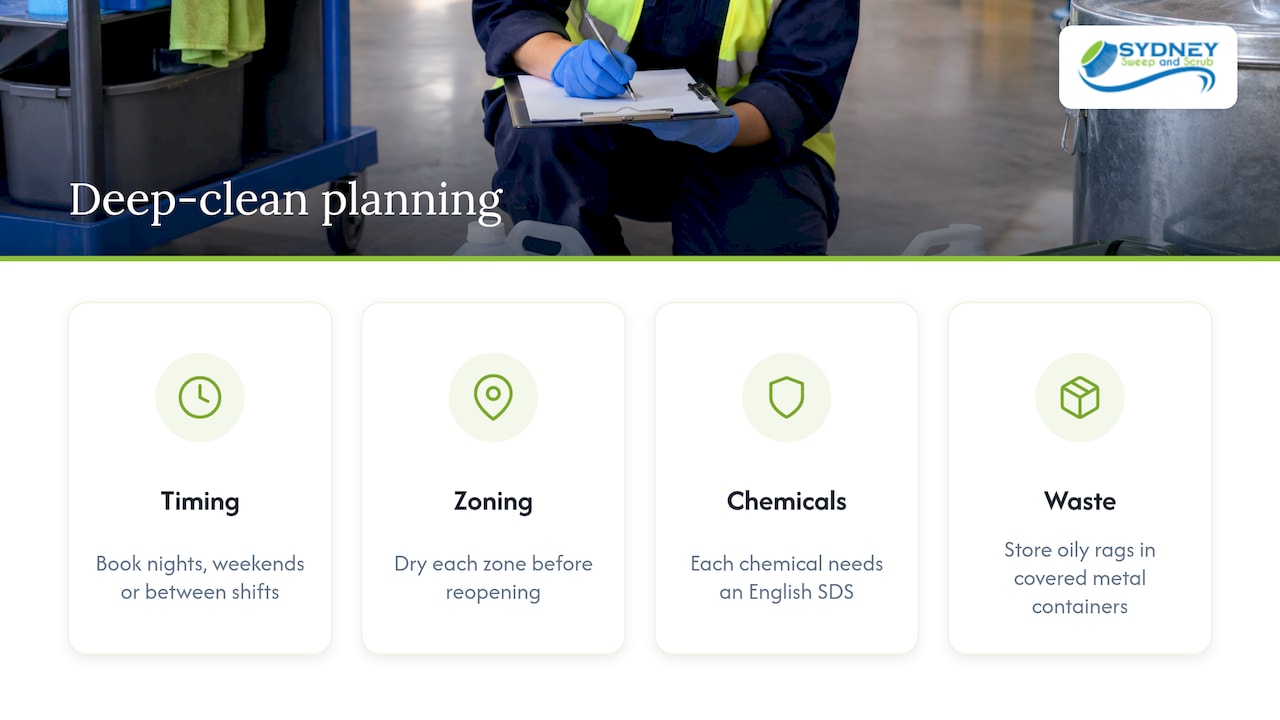
Most sites cannot shut down. A workable plan covers four things.
Timing. Book for nights, weekends or between shifts so that foot and forklift traffic is minimal, as SafeWork NSW recommends. Machine work is noisier, so agree hours that suit neighbours and staff.
Zoning. Clear one zone at a time, scrub it, dry it and reopen it. Barriers and signs keep people and vehicles off wet floor until it is fully dry.
Chemicals. Safety data sheets (SDSs, the manufacturer’s hazard sheets) need to be available for every chemical used on site. Under Safe Work Australia’s model code on safety data sheets, an SDS must be in English, use Australian units, show its last review date and have 16 sections. Also note that workplace exposure limits replace the old exposure standards on 1 December 2026, with health-based limits added for 31 airborne contaminants, which is relevant where dust is generated.
Waste. Decide who removes what, where it goes and what paperwork you keep. Waste should be stored in proper containers and removed regularly, and oily rags and combustible refuse belong in covered metal containers, as set out in the HSE Direct WHS checklist.
If a spill or leak is part of what prompted the clean, our spill response playbook shows how to contain it before the deep clean starts.
Cleaning a leased warehouse at the end of the term
Handing back a warehouse is where a deep clean becomes a financial matter. Lease wording varies, so read your own make-good clause first. A typical standard lease, such as Burnside City Council’s standard lease, requires the tenant to keep the premises clean and free of pests during the term, arrange regular waste removal at its own cost and, before expiry, remove all its equipment, repair damage from the removal, give a written summary of alterations at least one month ahead, reinstate alterations if required and complete obliged repairs.
In Victoria, the court in Fenridge v Retirement Care Australia held that the make-good obligation is measured against the condition at the start of the lease, fair wear and tear excepted, and that the tenant must prove that damage falls within that exception. Your lawyer or leasing adviser should confirm how this applies to your lease.
A practical exit sequence:
- Review the lease and the condition report from the start of the term.
- Clear the premises: stock, racking, signage and equipment, with repairs to any damage from removal.
- Remove debris and waste left from the clear-out.
- Deep clean floors, high surfaces, docks, amenities and exterior.
- Document the result with dated photos of every area.
- Keep disposal records. NSW waste management plans, such as the one for the ALDI Sydney Automated development, show the standard: descriptions and amounts of waste, the contractors and receiving facilities, vehicle movements and tip dockets.
The photos and dockets are your evidence trail if the landlord disputes the condition. Doing the clear-out, debris removal and clean through one provider keeps the records in one place.
How we handle it
Sydney Sweep and Scrub provides warehouse cleaning using mechanical sweeping and scrubbing, pressure washing, hot water cleaning and rubbish removal, and our end of lease commercial cleaning covers tenants handing back premises. Bookings are made online, and recurring maintenance contracts are available for larger facilities, so a deep clean can be followed by a schedule that keeps the floor in condition. Our guide on how often to clean warehouse floors helps set that frequency. We also run carbon-neutral operations, with optional waste offset initiatives.
FAQ
How is a deep clean different from regular warehouse cleaning?
Regular cleaning maintains the building day to day through sweeping, bins and spill response. A deep clean restores it: machine scrubbing of floors, dust removal from high surfaces and racking, and cleaning of docks and amenities. SafeWork NSW notes a deep clean is often needed to return floors to their original grip.
How often should a warehouse be deep cleaned?
It depends on traffic, stock type and floor condition. Many sites schedule periodic deep cleans alongside routine sweeping and scrubbing, as SafeWork NSW’s guidance on cleaning schedules suggests. Our floor cleaning frequency guide sets out how to choose.
Can a deep clean happen while the warehouse is operating?
Yes, with planning. Work in zones, schedule it for low-traffic periods and use barriers and signs on wet floors until they are fully dry. Machine cleaning is noisier, so agree hours in advance.
What do I need to do before handing back a leased warehouse?
Check your make-good clause, remove all your equipment and repair any damage from removal, clear debris, deep clean and photograph every area. Keep tip dockets and disposal records, and ask your lawyer about your specific lease.
Sources
- Cleaning, WorkSafe Queensland
- Guide to preventing slips, trips and falls at work, SafeWork NSW
- Managing the work environment and facilities, Safe Work Australia
- Preparation of safety data sheets for hazardous chemicals, Safe Work Australia
- Changes to Workplace Exposure Limits, Safe Work Australia
- HSE Universal WHS Checklist
- Standard Lease Agreement, Burnside City Council
- ALDI Sydney Automated waste management plan