
Concrete slurry cleanup comes down to one order of work: stop the slurry reaching a drain, recover the liquid and solids while they are still wet, dispose of them through a lawful route, then clean the surface it touched. Skip the first step and the cleanup becomes a pollution matter, not a cleaning job. Sydney Sweep and Scrub provides pressure washing, mechanical sweeping and scrubbing, rubbish removal and concrete grinding for Sydney sites, so the last stage, a clean and safe slab, is a job you can hand over once the slurry itself is under control.
TL;DR
- Contain first: block drains and gutters with a boom, sandbags or a bund before you touch the slurry.
- Recover it wet. Vacuum or pump liquid into a container, scrape up the solids and never hose it away.
- Slurry water is highly alkaline, so treat skin and eye contact as a chemical burn risk and wear the right PPE.
- Disposal depends on your state and the volume: soak-in, skip, licensed recycler, or trade waste approval for sewer.
- Once the bulk is gone, residue and dust on the slab need mechanical sweeping or washing with the water captured.
Table of Contents
- What concrete slurry is and why it is treated as pollution
- The penalties are real and recent
- Step 1: Stop the slurry reaching drains
- Step 2: Recover the slurry while it is still wet
- Step 3: Protect the people doing the work
- Step 4: Separate and dispose of it lawfully
- When slurry blocks pipes and pits
- Step 5: What to do when slurry has dried on the slab
- Where a cleaning contractor fits in
- A checklist for property managers and site supervisors
- FAQ
- Sources
What concrete slurry is and why it is treated as pollution
Concrete slurry is the milky mix of cement, fine aggregate and water that comes from washing out trucks and tools, wet cutting, coring, grinding and polishing. It looks like dirty water. It behaves like a chemical.
The NSW Transport washout guideline states that concrete wash water is alkaline at around pH 12 and contains high levels of chromium, and that it can pollute land, leach into groundwater, raise the pH of waterways and harm aquatic life. The same guideline notes that solids put down the wrong way can clog stormwater drains and cause flooding.
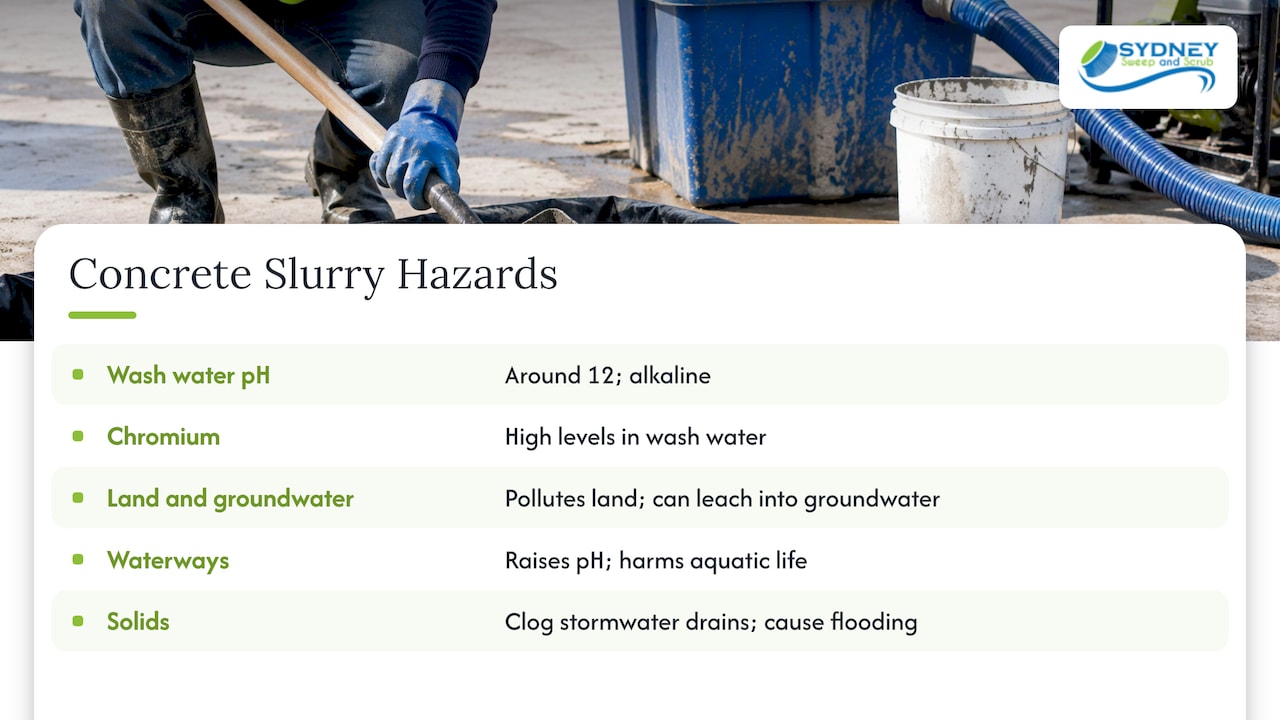
That is why a slurry spill on a construction site, in a carpark after core drilling, or in a warehouse after floor grinding is not just a mess. A stormwater drain in Sydney leads to a creek or harbour without treatment, so anything that enters it is a discharge to a waterway.
The penalties are real and recent
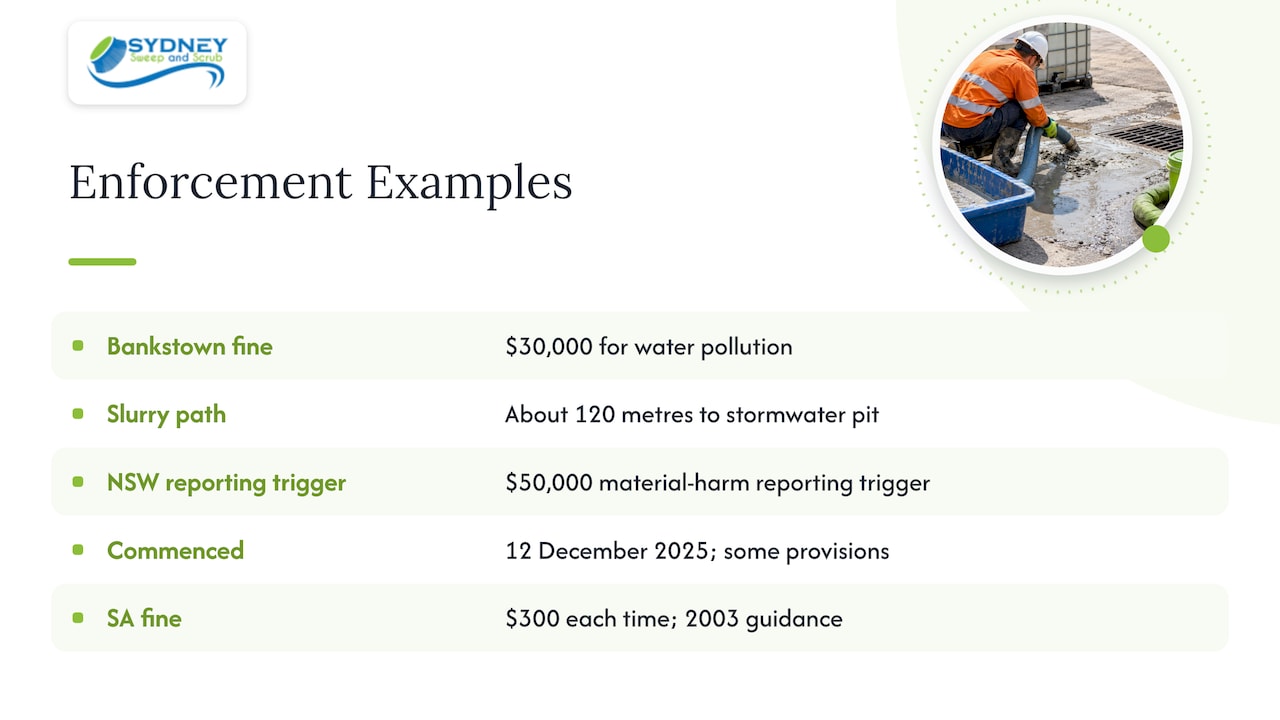
Councils inspect for this. In a May 2026 media release, City of Canterbury Bankstown reported that a builder was fined $30,000 in Bankstown Local Court for water pollution under the Protection of the Environment Operations Act 1997. A 2025 inspection had found slurry running from a site into a gutter and about 120 metres into an exposed stormwater pit, with no sediment controls and the slurry not removed.
Two lessons sit in that case. The offence was not only the spill: no controls were in place and the slurry was left. And the person responsible was the builder, not whoever was holding the hose.
NSW has also been tightening its environment laws. Law firm Ashurst reports that the Act passed in September 2025 and that some provisions, including repeat waste offences and a $50,000 material-harm reporting trigger, commenced on 12 December 2025, while other provisions, such as higher waste penalties, were still to commence. Check the NSW EPA site for the current position before you rely on any penalty figure.
Smaller fines exist in other states too. South Australia’s EPA warns concreters that without appropriate equipment they risk a $300 fine each time, plus council street-sweeper costs. That guidance dates from 2003, so treat the amount as an illustration of how enforcement works, not a current schedule.
Step 1: Stop the slurry reaching drains
Do this before anything else, and do it within minutes. Slurry travels with gravity.
- Find the drains. Locate every stormwater pit, gutter and grate downhill of the spill, including those in the street.
- Block them. The SA EPA guidance says to use a baffle or boom, such as sandbags, foam or spill equipment, to stop slurry and wastewater entering stormwater drains.
- Build a barrier on the downhill side. Gravel sausages or plastic bunds work on hard surfaces. On soil, a sediment fence or straw bales below the work area, with a diversion channel uphill, keep clean runoff away from the mess, as NSW Water Sensitive Cities guidance sets out.
- Stop the source. Turn off the saw, coring rig or hose before you start recovering what has already escaped.
Where you can, plan the work area so this step is built in. The same NSW guidance says the cutting or mixing area should sit away from drains and be large enough to contain all excess water, residue and waste.
Where it goes wrong
- Drains are blocked at the site boundary but the slurry has already reached the kerb.
- Sandbags are placed on the wrong side of a drain, so water pools against them and flows round.
- Someone hoses the slurry “just to dilute it”. Dilution does not neutralise it and it spreads the problem.
Step 2: Recover the slurry while it is still wet
Wet slurry is far easier to remove than slurry that has dried. Once it is contained:
- Liquid: vacuum it with a wet vacuum or pump it into a container. The SA EPA guidance describes exactly this once the wastewater is trapped.
- Thick slurry and solids: scrape or shovel into a bin or lined container. A UK safety data sheet for concrete advises recovering bulk spillage while it is still in its non-hardened state, by suction or mechanical shovel.
- Residue: the ACT Government’s concreting guidance says spillage should be swept up, not hosed, before sediment controls are removed.
Keep the controls in place until the area is clean. Removing the sandbags too early is a common way for a finished cleanup to turn into a discharge.
Step 3: Protect the people doing the work
Wet cement is caustic. Safety content for Australian sites lists chemical burns to skin and eyes from highly alkaline wet cement, slips on wet or setting surfaces, manual handling of containers, moving parts of vacuums and pumps, electric shock near water, and dust from dried residue as the main hazards of slurry work, as in this slurry management procedure aligned to Australian WHS legislation.
The Texas Department of Insurance’s cement safety program, a US source, states that wet cement has a pH between 12 and 14 and that cement trapped against the skin in boots or gloves can cause first-, second- or third-degree chemical burns. Its PPE list is a sound baseline:
- alkali-resistant gloves, with long sleeves tucked into them
- full-length trousers tucked into waterproof boots
- goggles or side-shield safety glasses, and no contact lenses
- a P, N or R 95 respirator where dust cannot be avoided
If slurry contacts skin, wash it off thoroughly with clean water straight away. For eye contact, the UK data sheet advises irrigating with clean water for at least 10 minutes and getting immediate medical attention. Call 000 for a serious exposure or if someone is in distress.
Dust matters as well. Slurry from cutting and grinding concrete carries crystalline silica, which becomes airborne when it dries. Read our note on silica dust as a workplace hazard and how silica dust is removed and managed in the workplace. Tyrolit Australia notes that the 2022 Code of Practice on managing respirable crystalline silica in construction requires dust control during collection and transport of coring waste.
Step 4: Separate and dispose of it lawfully
There is no single national answer. Rules differ by state, council and volume, and the person who generates the waste stays responsible for it. Tyrolit also warns that contractors remain liable after waste leaves site if documentation has gaps, so keep dockets.
| Material | Typical lawful route in Australian guidance |
|---|---|
| Small volumes of slurry water | Tipped into a plastic- or geofabric-lined ditch to evaporate or soak in, per NSW Water Sensitive Cities and the ACT guidance |
| Settled solids | Skip bin, or recycled as clean fill or road base |
| Larger volumes | Licensed recycler or landfill |
| Water to sewer | Only with a trade waste approval from the water utility (in South Australia, SA Water) |
| Water to stormwater | Only after filtering to less than 50 mg/L total suspended solids, per the NSW Water Sensitive Cities guidance |
For a washout area, the NSW Transport guideline says to contain all wash-down water in a designated impervious bund away from drains and water bodies, scrape excess concrete off equipment first to cut the water produced, use a high-pressure, low-volume nozzle, and inspect the area weekly in dry weather and around rain, removing set concrete to restore capacity.
If you hold a trade waste approval, the conditions apply to quantity, quality and rate. Queensland Urban Utilities’ trade waste environmental management plan is one example: discharge only from approved processes, pre-treated and monitored as the approval requires. Your own water utility sets the equivalent terms.
Guidance for the premixed concrete industry goes further. Victoria’s EPA expects plants to recycle washwater back into production and bars process water from stormwater drains except in tightly controlled emergencies. That standard is written for concrete plants, but it shows where regulators are heading.
When slurry blocks pipes and pits
Slurry that has already gone down a pit or pipe sets like a plug. Clearing it means jetting and a camera inspection, and the discharge itself may need reporting to your council or the EPA. Builders and developers who have plumbing affected by site debris can look at plumbing for builders and developers, including blocked drain clearing.
Step 5: What to do when slurry has dried on the slab
Dried slurry is a thin, hard, cement-rich film. It will not hose off, and the dust it produces carries silica. A sensible order of work:
- Keep the area wet-controlled and keep people away from the dust. Do not dry sweep or use compressed air.
- Remove the bulk by scraping, then collect with a vacuum fitted for fine dust.
- Wash the remaining film in a contained area with the wash water captured, not released to a drain.
- For stubborn bonded layers, grinding takes off the surface. Treat that grinding slurry as a new batch of slurry and start from Step 1.
- Finish with sweeping or scrubbing so no loose fines remain for the next rainfall to carry away.
Specific products and methods vary with the surface (raw concrete, sealed floor, line-marked carpark), so confirm the method with whoever is responsible for the finish before you start.
Where a cleaning contractor fits in
The slurry itself belongs to the person who generated it. But the surfaces left after the slurry is removed, such as dusty slabs, stained carpark bays, residue around a washout and debris in a loading area, are where a cleaning contractor earns its place.
Sydney Sweep and Scrub offers pressure washing, mechanical sweeping and scrubbing, rubbish removal and hot water cleaning, as well as concrete grinding, core drilling and de-flooding sites. For construction sites, see our pages on sweeping and scrubbing your construction site and post-construction concrete cleaning. If you are a strata manager or building owner with a stained carpark, our carpark cleaning page is the place to start, and warehouse occupiers closing out a lease can see end of lease commercial cleaning. You can request a quote on our website.
Why it matters for the surface: a slab that is only wetted and pushed around keeps its film of cement fines, which re-dusts and tracks into buildings. Mechanical sweeping and scrubbing take the fine material off the surface rather than moving it along, which is the outcome you want before handover or inspection. Read why cleaning concrete after construction matters.
A checklist for property managers and site supervisors
Before work starts:
- Mark every drain and pit and confirm drain protection is on site.
- Set up a bunded washout or containment area away from drains.
- Confirm where slurry will go: soak-in, skip, recycler or trade waste approval.
- Have the safety data sheet, PPE and spill kit at the work area.
During work:
- Scrape before washing to reduce the water produced.
- Use low-volume, high-pressure nozzles.
- Recover liquid with a vacuum or pump as it is produced.
After work:
- Sweep residue rather than hosing it.
- Keep drain protection in place until the area is clean.
- File disposal dockets and the washout inspection record.
FAQ
How do you clean up a concrete spill?
Block nearby drains first, then recover the wet material by vacuum, pump or shovel before it sets. Sweep up residue rather than hosing it, and dispose of the slurry through a lawful route for your state.
Can I wash concrete slurry down a stormwater drain?
No. Stormwater drains lead to waterways untreated, and slurry water is highly alkaline. NSW guidance allows discharge to stormwater only after filtering to under 50 mg/L total suspended solids, and many councils prosecute for slurry in gutters.
Can slurry go to sewer?
Only with a trade waste approval from your water utility, which sets limits on quantity, quality and rate. Without that approval, use soak-in, a skip for solids or a licensed recycler.
Is concrete slurry dangerous to touch?
Yes. Wet cement can cause chemical burns, and the pH is between 12 and 14. Wear alkali-resistant gloves, long sleeves, waterproof boots and eye protection. Wash skin with clean water immediately and seek medical attention for eye contact.
Sources
- Concrete Washout Guideline, NSW Transport
- Builder cops $30,000 fine for water pollution, City of Canterbury Bankstown
- Amendments to NSW environmental laws, Ashurst
- Stormwater Management for Concrete Cutters, SA EPA
- Concrete, Brick, Tile Cutting, NSW Water Sensitive Cities
- Preventing pollution from concreting operations, ACT Government
- Hazard information sheet for concrete
- Slurry Management and Disposal SOP, Everything OHS
- Cement Safety Training Program, Texas Department of Insurance
- Coring Waste Disposal Strategies for Concrete Projects, Tyrolit Australia
- Trade Waste Environmental Management Plan, Queensland Urban Utilities
- Reducing risk in the premixed concrete industry, EPA Victoria
- Plumbers for builders and developers