
A sweeper collects loose, dry material sitting on top of a surface: grit, leaves, litter, dust and gravel. A scrubber washes the surface itself, lifting the film, oil and tyre marks bonded to the concrete. Most commercial floors carry both kinds of dirt, so most sites need both jobs done, in order: sweep first, scrub second. We provide mechanical sweeping and mechanical scrubbing across Sydney, so you can book the right method for your site without working out machine specifications yourself.
This guide is for property managers, strata and building owners, warehouse owners and occupiers, councils, event organisers and construction firms. It explains the difference in plain terms, matches each method to the dirt on your site and shows how to decide what to book.
TL;DR
- Sweeping is dry work: it removes loose debris such as grit, leaves, litter and dust into a hopper. It does not remove oil or bonded film.
- Scrubbing is wet work: water, detergent and brushes or pads lift grime off the slab, and the dirty water is recovered in the same pass.
- Scrubbing over loose grit wears out blades and brushes and leaves streaks, so the order matters: sweep first, then scrub.
- Open carparks, yards and loading docks lean towards sweeping. Oily workshop floors, forklift routes and sealed warehouse slabs lean towards scrubbing. Many sites need a routine that combines both.
- Match the method to the dirt, the surface and the schedule, not to the machine name.
Table of Contents
- What a sweeper does
- What a scrubber does
- Side by side
- Why the order matters: sweep first, scrub second
- Which method suits which site
- How floor, size and frequency change the answer
- Safety, water and chemicals
- Worked example: a warehouse in the south-west
- Is a combined approach better than separate visits?
- What this means for your booking
- FAQ
- Sources
What a sweeper does
An industrial sweeper works like a broom and a vacuum combined. Rotating brushes flick material into the machine and suction draws up the fine dust, so everything ends up in an onboard hopper. No water is involved, which is why a sweeper works well on large outdoor areas and on dry, hard surfaces such as concrete and asphalt.
What it picks up is material that is sitting on the surface rather than stuck to it:
- sand, grit and small stones
- leaves and general litter
- packaging offcuts, wood shavings and metal filings
- construction spoil and dust
A sweeper does not deal with liquids, oil or sticky residue. It leaves a dry, debris-free floor, but a floor with a film on it will still look and feel dirty afterwards.
Sweeping is also the faster, lower-maintenance job. There are no tanks to fill or empty and no squeegees or pads to replace, which is one reason it suits frequent, regular visits to large areas.
What a scrubber does
A scrubber, often called a scrubber-dryer, puts down water and detergent, agitates the surface with a brush or pad, then picks the dirty solution straight back up with a squeegee and vacuum. The floor is washed and left nearly dry in one pass, so it can be walked on or driven over soon after.
This is the method for what sweeping cannot shift:
- oil and grease film
- forklift and tyre rubber marks
- traffic film and built-up workshop grime
- dirt worked into textured concrete
- food residue, coolant and spills
Scrubbing is the right answer where a floor has to be properly clean rather than just free of debris: food handling areas, workshops, loading bays with spill history and the sealed slab of a warehouse you are about to hand back at the end of a lease.
It is a more involved process than sweeping. Detergent has to suit the surface, the machine has to be set up and the waste water has to be handled properly. That is part of the reason property managers book it as a service rather than treating it as a task for site staff.
Side by side
| Sweeping | Scrubbing | |
|---|---|---|
| Method | Dry: brushes and vacuum into a hopper | Wet: water, detergent, brush or pad, then water recovery |
| Removes | Loose grit, leaves, litter, dust, gravel | Oil, grease, tyre marks, film, ingrained soil |
| Typical places | Carparks, yards, loading docks, footpaths, plazas | Warehouse slabs, workshops, loading bays, food areas |
| Leaves behind | Stains and bonded film | A washed, near-dry floor |
| Best on | Dry, hard outdoor and indoor surfaces | Sealed hard floors, with a brush for bare or porous concrete |
| Routine | Frequent, to keep debris down | Periodic deep clean, or after spills |
Why the order matters: sweep first, scrub second
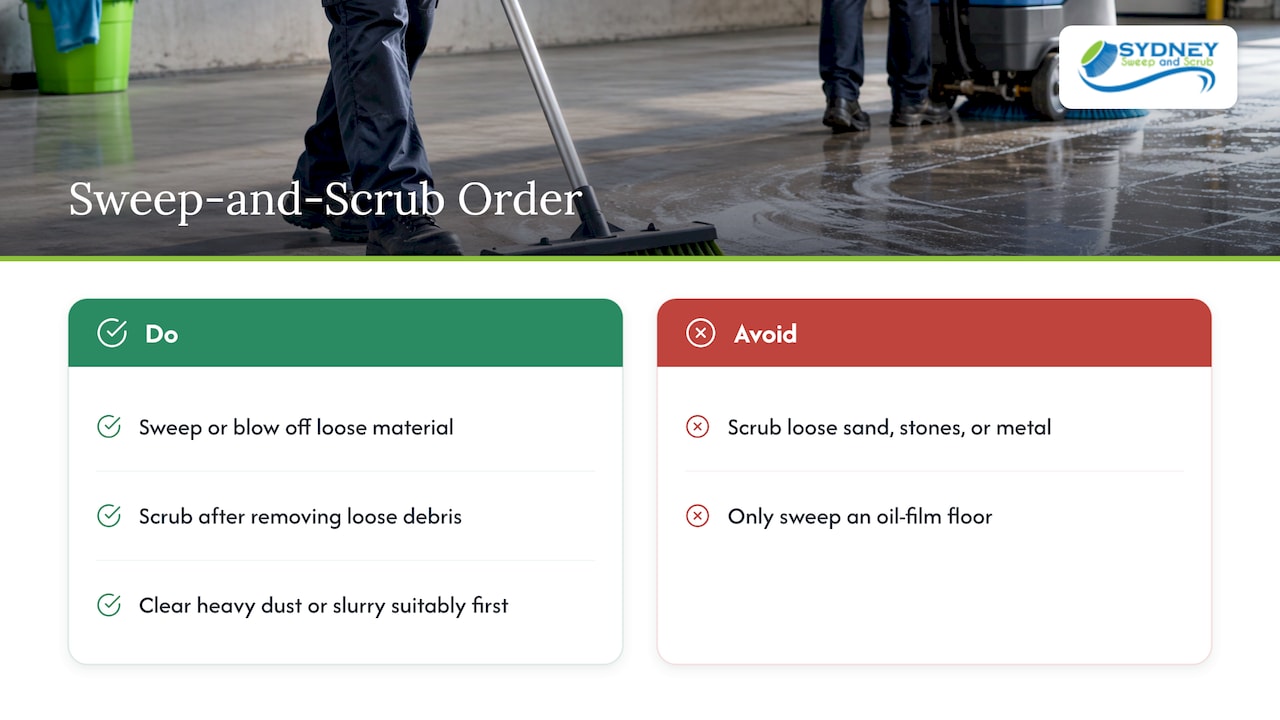
The most common mistake with floor cleaning is using one method to do the other’s job. Run a scrubber over loose sand, stones or metal fragments and the debris is dragged under the squeegee. Blades nick and wear early, the recovery system clogs, brushes wear faster and the floor is left with streaks, dirty patches or a layer of muddy slurry, because wet dust turns to mud.
Sweeping first removes that problem. It also means the scrubber’s brushes and pads spend their effort on the film that is actually bonded to the slab, rather than pushing grit around. On a site where debris and grime coexist, which describes most warehouses, carparks and loading areas, the sequence is simple: sweep or blow off the loose material, then scrub.
The reverse also holds. If you only sweep a floor with an oil film, you get a floor with no debris and an unchanged slip risk. We cover the sequence in more detail in sweep then scrub: the right order for commercial floors.
There is one case where neither method is right on its own: heavy construction dust or slurry. Running a wet machine through it causes damage, so it needs clearing in a way that suits the material before any scrubbing is considered. If your site is mid-build or finishing a build, tell us what is on the floor when you ask for a quote.
Which method suits which site
Carparks
Carparks are usually bare or lightly sealed concrete, large, and dirty with a particular mix: tyre rubber, oil drips, grit, leaves and litter. That calls for both methods in sequence. Sweeping handles the debris that builds up fastest and that blocks drains, while scrubbing or pressure washing deals with oil and tyre marks. Our carpark cleaning service covers cleaning and line marking, and our guide on how to remove dirt and dust from your car park explains where the dust comes from. If you manage a strata building, dust control for carparks is a useful companion.
For stains that have set into the surface, hot water pressure cleaning is often the next step up. We offer pressure washing, including hot water cleaning, for those jobs.
Warehouses
Warehouse floors tend to be large sealed concrete slabs with forklift traffic, so they collect dust and grit from the dock and rubber and film from the wheels. Regular sweeping keeps dust off racking, pallets and stock. Periodic scrubbing removes the film that builds in the traffic lanes. Large open floors suit larger machines, while narrow aisles and tight corners need smaller ones, so the layout of your racking matters as much as the floor area.
We provide warehouse cleaning on a one-off or recurring basis. Our article on regular warehouse cleaning and efficiency explains why routine matters for operations.
End of lease
If you are handing back a warehouse, the landlord’s inspection looks at the slab. Loose dust is the easy part. Tyre marks, oil spots and built-up film are what a sweep will not fix. A sweep and a scrub, in that order, is the logical sequence, and our end of lease commercial cleaning service is built for that handover.
Public spaces, footpaths and venues
Councils and event organisers deal mostly with dry litter, leaves, grit and general rubbish across plazas, malls, footpaths and depots, so sweeping is the daily workhorse. Scrubbing or pressure washing comes in for gum, food spills and stains after events, or for a periodic reset of high-traffic paving. Our mechanical sweeping suits regular, wide-area upkeep, and for the larger spaces we also offer automated robotic cleaning.
Construction sites
Sites collect grit, spoil, offcuts and dust, so sweeping is usually the main need during works, with scrubbing or washing reserved for the final clean before handover. Our Commercial Cleaning and rubbish removal services work together here.
How floor, size and frequency change the answer
A useful way to decide is to ask five questions about your site.
- What is the dirt? Loose and dry points to sweeping. Oily, filmy or stuck points to scrubbing. Both points to a combined routine.
- What is the surface? Sealed concrete takes a scrubber well. Bare or porous concrete needs a brush rather than a soft pad and may need more passes. Outdoor asphalt and paving are sweeping territory first.
- How big and how cramped is the site? Large open floors reward bigger machines that cover ground quickly. Narrow aisles, corridors and corners need compact ones, with hand work at the edges.
- How often does it get dirty? Debris builds continuously, so sweeping is scheduled often. Film builds slowly, so scrubbing is scheduled periodically or after a spill.
- Indoors or out? Sweeping works indoors and outdoors on dry surfaces. Scrubbing is mostly an indoor and covered-area method, though outdoor slabs can be washed with the right equipment and drainage.
Season matters in Sydney too. Storms through the warmer months can drop sand, grit and organic debris across yards and carparks, which turns a scrubbing job into a sweeping job almost overnight. Humid summer weather can also keep porous slabs damp, which makes old film harder to lift and can call for a heavier brush or more passes.
Safety, water and chemicals
The reason to care about floor cleaning is not only appearance. Safe Work Australia’s model code for the work environment requires regular floor inspection and maintenance so slip and trip hazards are eliminated or minimised. It also says cleaning methods should take into account that some cleaning agents can increase slip risk. A floor with grit is a trip and slip risk, and a floor with an oil film is a slip risk, so each method addresses a different hazard.
If you are a business owner with workers on site, chemical handling is part of the picture. WorkSafe Victoria’s cleaning guidance tells employers to obtain safety data sheets for hazardous chemicals, substitute less harmful products where possible and provide protective equipment such as gloves and protection from hot water burns. Rules differ by state, so check your own state regulator’s requirements for your site. Booking a specialist contractor does not remove your duty to manage site risk, so ask your contractor which products will be used and when the floor will be safe to walk on again.
Water and product use also count if you manage a government or council site. The Queensland Government’s sustainable procurement guide for cleaning services says cleaning techniques should minimise products, water and electricity use and its contract clause asks for a cleaning-product register and water-efficient equipment. It is a Queensland document, but the same questions are fair to put to any contractor in New South Wales.
Our approach here is to use eco-friendly equipment and to run carbon-neutral operations, with optional waste offset initiatives for clients who want to contribute to sustainability. You can read more on carpark cleaning and sustainability.
Worked example: a warehouse in the south-west
Take a distribution warehouse with a sealed concrete floor, a loading dock open to the street and forklifts running most of the day. By Friday afternoon, the dock apron has grit, leaf litter and packaging offcuts. The traffic lanes inside have dark rubber marks and a thin greasy film, and a pallet of oil drums leaked near one bay.
- A sweep alone clears the dock and the dust, but the lanes still look black and the oil patch stays slick.
- A scrub alone, run over the unswept dock apron, would drag stones under the squeegee and leave streaks.
- A sweep followed by a scrub gives a clean dock, washed lanes and a treated spill zone, in a sensible order.
The practical routine is then easy to describe: frequent sweeping to hold debris down, a periodic scrub of the traffic lanes, and extra attention to spill zones. That is the pattern we can set up as a recurring maintenance contract for larger facilities.
Is a combined approach better than separate visits?
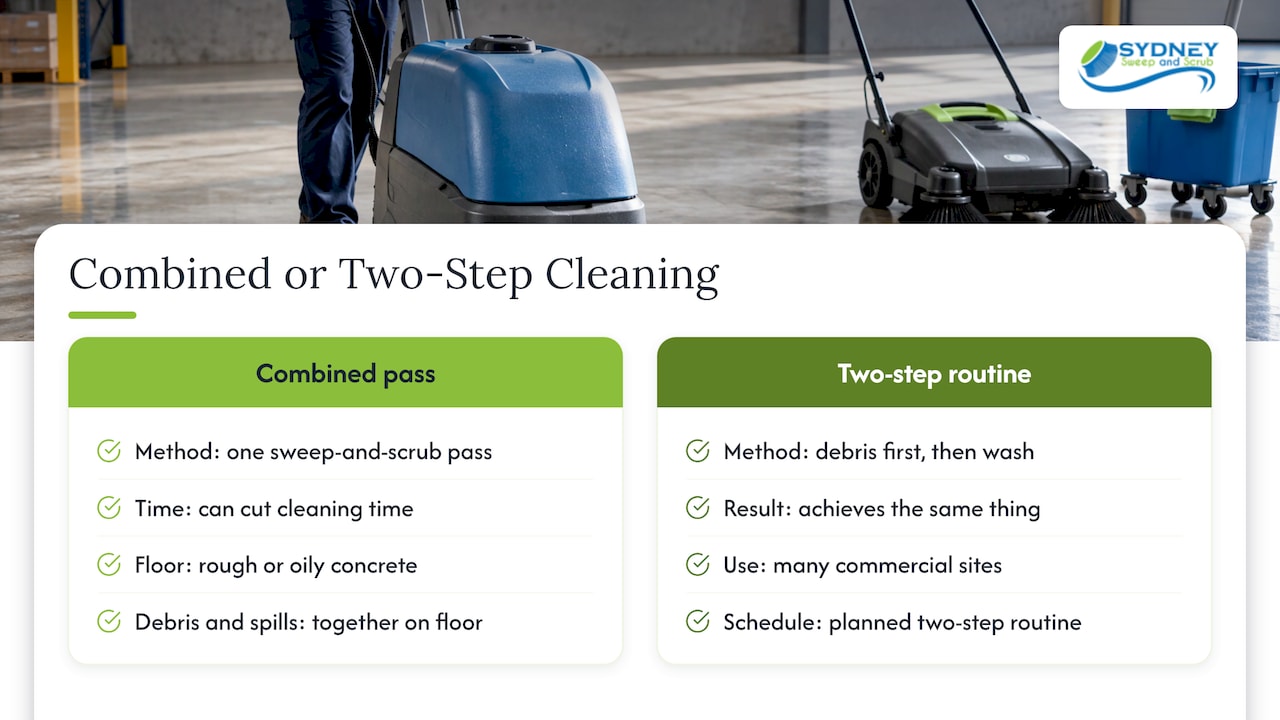
Some machines sweep and scrub in the same pass, and they can cut cleaning time where dust, grit and liquid spills sit together on the same floor. They suit rough or oily concrete where sweeping first would otherwise be mandatory. For many commercial sites a planned two-step routine achieves the same thing: debris gone first, then the wash. What matters to you as a manager is the result and the schedule, not the machine. When you request a quote, describe the floor, the dirt and the traffic, and we can advise on the method.
What this means for your booking
Start from the dirt on your floor, not the name of a machine. Walk the site and note what you can see:
- Mostly grit, leaves, litter and dust: book regular mechanical sweeping.
- Mostly film, oil, tyre marks or spills: book scrubbing or hot water pressure cleaning.
- Both, which is the usual case: book a sweep then scrub, and ask for a recurring schedule if the site is busy.
- Handing back a warehouse: book an end of lease clean, so the slab is cleared and washed before inspection.
If your property is in Sydney, you can request a quote and book through our website. We do not publish fixed prices because the right quote depends on site size, surface and the condition of the floor. For larger facilities we can arrange recurring maintenance, so you do not have to rebook each time. Start from our services page or go straight to carpark cleaning or warehouse cleaning.
FAQ
Is a scrubber better than a sweeper?
Neither is better overall, because they remove different dirt. A sweeper clears loose, dry debris and a scrubber washes off film, oil and tyre marks. For most commercial floors the best result comes from using both, sweeping first.
Can I scrub a floor without sweeping it first?
Only if the floor has no loose debris, such as a clean indoor slab. Where grit, stones or metal fragments are present, scrubbing drags them under the squeegee, wears the blades and brushes and leaves streaks. Sweeping first protects the equipment and gives a cleaner result.
Which is better for a carpark?
Carparks need both in sequence. Sweeping handles grit, leaves and litter, and scrubbing or hot water pressure washing handles oil and tyre marks. How often each is needed depends on traffic, trees nearby and how quickly oil builds up in the bays.
How often should a warehouse floor be swept and scrubbed?
It depends on traffic and what is stored. Sweeping is usually more frequent because dust and debris build constantly. Scrubbing is more periodic, or after a spill. A site with forklift traffic and open dock doors will usually need both on a regular schedule.
Is a sweeper the same as a vacuum?
Not quite. A mechanical sweeper uses rotating brushes to move material into a hopper and uses suction for fine dust. It is built for heavier debris such as gravel, leaves and litter across large areas. Our article on mechanical sweeping vs vacuum covers the choice.
Sources
- Safe Work Australia: Managing the work environment and facilities, model code of practice (November 2024)
- WorkSafe Victoria: Cleaning
- Queensland Government: Sustainable procurement guide, cleaning services (August 2025)