
Pressure washing around vehicles is a controlled work-zone job, not a quick rinse. Three things decide whether it goes well: a cleared and barricaded spray area, a nozzle and distance that will not harm paint, tyres or glass, and wash water that never reaches the stormwater drain. We carry out pressure washing and car park cleaning across Sydney, and this guide sets out what a property manager, strata manager or site supervisor should expect from the job, step by step.
TL;DR
- Walk the whole spray and runoff zone first, including the far side of the surface, and mark out vehicles, pedestrians, doors, blind corners and services.
- Barriers and signs go up before hoses and wet surfaces appear. Keep a signed walkway if public access must stay open.
- Never use a 0-degree red nozzle near vehicles. Manufacturer guidance for car washing is a flat jet, at least 15 cm from paintwork and 30 cm from tyres.
- Protect drains before washing starts. In NSW and Queensland, letting wash water reach stormwater can lead to heavy penalties.
- Operators should be trained and wear eye and face protection. Booking a specialist crew puts all of this in one job.
Table of Contents
- Why vehicles change the job
- Step 1: Assess the whole spray and runoff zone
- Step 2: Close off the zone and tell people
- Step 3: Protect the drains before you wash
- Step 4: Choose the nozzle, pressure and distance
- Step 5: Operator training and protective equipment
- Step 6: Collect and dispose of waste
- How the job usually runs on a car park
- What we take off your hands
- Planning around tenants, trucks and events
- FAQ
- Sources
Why vehicles change the job
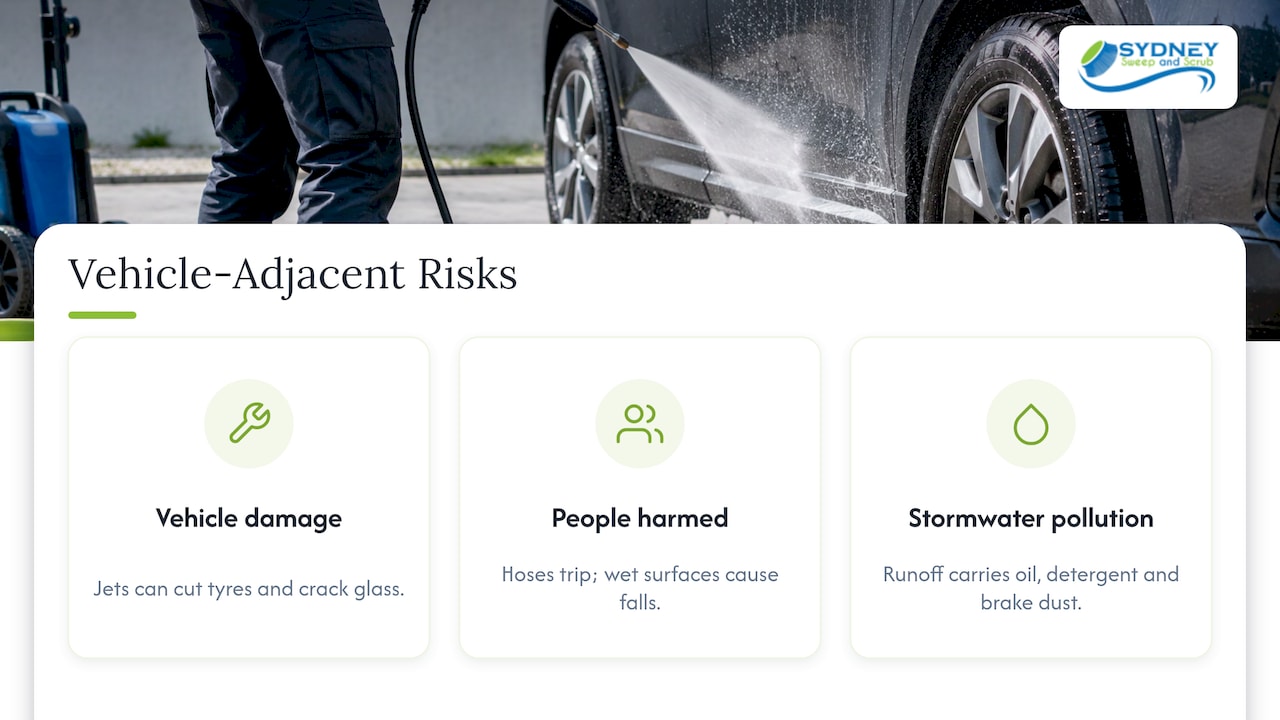
A clean, empty slab is a simple task. A car park with parked cars, a loading dock with trucks reversing or a construction site with utes along the fence line is not. Three risks appear at once.
Damage to vehicles. A concentrated jet can strip clear coat, cut a tyre sidewall, force water behind trims and seals, and crack or etch glass. Kärcher’s G 3200 operator manual states that the red 0-degree point jet must not be used on soft, sensitive or painted surfaces or on vehicles.
Harm to people. Hoses create trip hazards, wet surfaces are slippery, and spray travels further than most people expect. Drivers returning to their cars are the group most likely to walk into a work zone unprepared.
Pollution. Dirt, oil, rubber, detergent and brake dust wash off with the water. Hornsby Shire Council lists car wash detergents entering stormwater drains among common pollution sources and notes that high-pressure cleaning without containment sends dirt, chemicals and debris into stormwater.
The owner, manager or occupier of the site is responsible for the outcome, so the planning below belongs to you as much as to the crew.
Step 1: Assess the whole spray and runoff zone
Before any equipment is set up, someone should walk the area. Walk the side you are cleaning, the opposite side of the wall or column, and the path the water will take downhill.
A useful walk-through lists:
- parked and moving vehicles, including trucks and forklifts
- pedestrians, doors, lift lobbies and blind corners
- falling debris, fragile surfaces, sharps and any biological material
- overhead services, electrical equipment, confined areas and work at height
- drains, pits and the fall of the slab
This is the approach set out in one Australian workplace pressure washing checklist, and it matches the national training unit for pressure washing. The PRMCL20B unit of competency requires operators to confirm and reassess hazards, install signage and barriers for public safety, and cover and secure items that need protection from the spray.
Where it goes wrong: the assessment is done once at the start and never repeated. A tenant moves a car into a cleared bay, a delivery arrives early, or the wind turns. Hazards need reassessing as the job moves through the car park.
Asbestos check. On older buildings, confirm the condition of materials such as fibre cement sheeting before any high-pressure work. SafeWork NSW states that using high-pressure water or compressed air on asbestos-containing materials is prohibited, except for firefighting or fire protection. If you are unsure what a wall or roof is made of, get that answered by a licensed assessor before the wash is booked.
Step 2: Close off the zone and tell people
Set up barriers and signs before hoses are laid and surfaces get wet, not after. Rigid barriers, cones, bunting and warning signs should isolate the wash area, the hose route, any area below elevated work and the overspray zone. The exclusion zone should cover the full hose length, not just the patch being cleaned. This is the standard layout in an Australian exterior cleaning SWMS sample, which also recommends a trained spotter where plant is reversing or sight lines are restricted, and a clear, signed alternative walkway where public access must remain open.
In practice, for a multi-level car park or a strata basement:
- Notify in advance. Tell residents, tenants and staff which levels or bays are affected, on which day and for how long. A notice at the boom gate and the lift lobby works better than an email few people read.
- Clear the bays. Cars should be out of the wash area, not simply parked nearby. Moving vehicles is the single biggest way to remove paint, glass and sensor risk.
- Control entries. Close ramps or stairwells to the affected level, or position a spotter at every entry the operator cannot see.
- Keep a safe route. If a walkway must stay open, sign it and keep it dry and well outside the spray.
For a warehouse yard or loading dock, the same logic applies to truck movements: agree a hold time with the transport companies and the dock supervisor.
Where it goes wrong: barriers set up for the area being cleaned today, but not for where the water and spray will end up. A ramp rinsed from the top sends water into the level below.
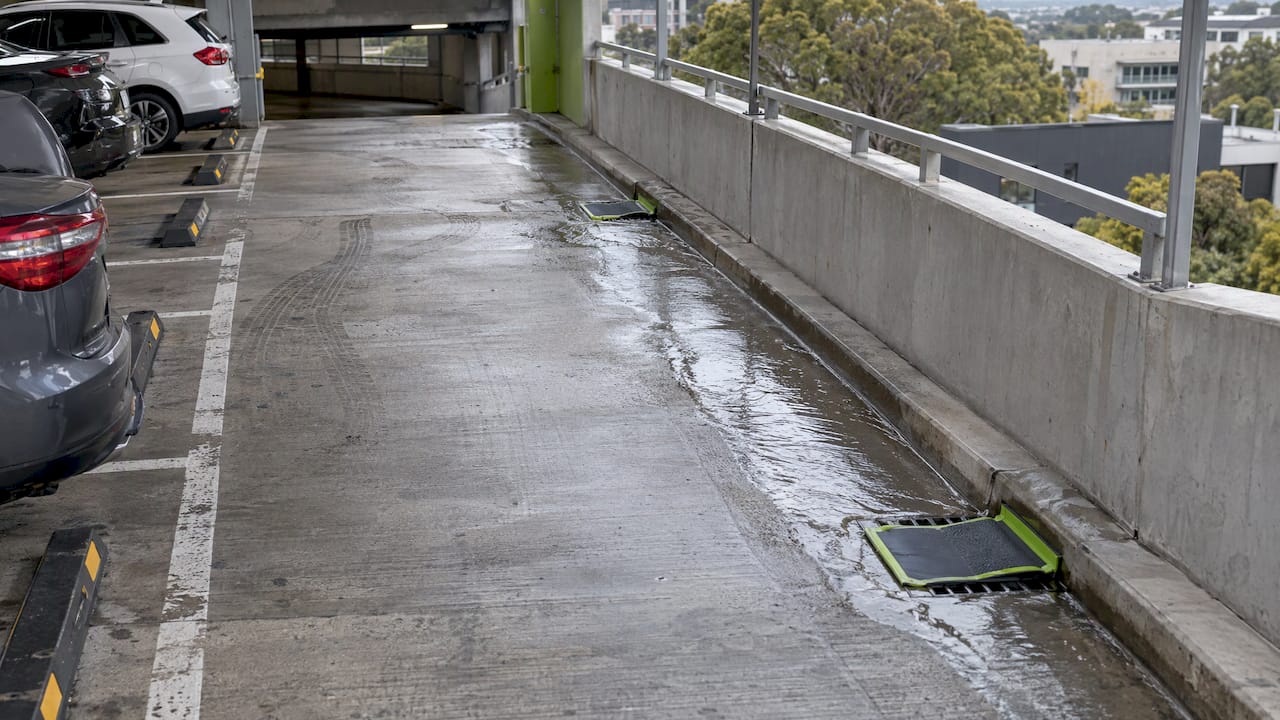
Step 3: Protect the drains before you wash
This is where most avoidable fines start. Stormwater is not treated. Hornsby Shire Council explains that it carries pollutants from roofs, roads and open spaces straight into creeks, rivers and the ocean.
The legal position depends on the state:
- NSW. Section 120(2) of the Protection of the Environment Operations Act 1997 makes it an offence to cause or permit waters to be polluted. Coleman Greig explains that the maximum penalty is $2,000,000 for corporations, with up to $240,000 more per day for a continuing offence, and that the definition of pollute is broad enough to catch soil, leaves, motor oil or litter. The same article notes almost anyone could receive a $30,000 on-the-spot fine.
- Queensland. Tablelands Regional Council explains that pressure cleaning wastewater is a prescribed water contaminant and that it is unlawful to let it enter roadside gutters and stormwater systems.
The same council describes two accepted approaches: redirect the water to a holding tank or garden where suitable, or protect stormwater drains with sandbags or a portable bund and remove the captured water with a vacuum or bilge pump. In a car park, the second approach is the realistic one, and it only works if the drain is protected before the first pass, not after dirty water is already running.
If your site is in Sydney, our guides on pressure washing wastewater checks for Australian businesses and trade waste requirements for Sydney sites go through what that means for a property owner, and stopping pollutants at the source explains why sweeping loose material first reduces what the water carries.
Where it goes wrong: a drain cover goes down at one pit and the crew forgets the gutter along the ramp. Walk the fall of the surface and follow the water to every point where it leaves the slab.
Step 4: Choose the nozzle, pressure and distance
When vehicles are anywhere near the work, nozzle choice is the difference between a clean slab and a paint claim.
| Setting | What the manufacturer guidance says | Why it matters near vehicles |
|---|---|---|
| Nozzle type | Use the flat jet nozzle, not the rotor nozzle, for cars (Kärcher) | A flat fan spreads the force over a wider area |
| 0-degree red nozzle | Not for painted surfaces or vehicles (G 3200 manual) | A point jet can cut paint, rubber and seals |
| Distance to paintwork | At least 15 cm | Closer risks damage to the finish |
| Distance to tyres | At least 30 cm | Sidewalls are softer than they look |
| Angle to the surface | About 45 degrees at roughly 15 to 20 cm for general cleaning (G 3200 manual) | A glancing angle lifts dirt without driving it in |
| Technique | Work from the bottom up; do not stay in one spot; test on an inconspicuous area first | Avoids streaking, spot damage and missed patches |
These figures are written for washing a car. For a commercial slab, the practical rule is stricter: keep the high-pressure lance well away from any vehicle that cannot be moved, such as a locked fleet truck on a loading bay, and use shielding or masking rather than getting close. Cover and secure what needs protecting, as the national pressure washing unit requires.
On a car park floor, the target is oil stains, tyre marks and ingrained grime on concrete. That calls for the right mix of pressure, hot or cold water and surface-appropriate cleaning products, rather than maximum pressure on everything. We explain the difference in pressure washing with hot water and pressure washing with cold water.
Keep the hose away from sharp edges and moving vehicles, too. A hose dragged across a ramp edge or under a reversing truck is a leak or a burst waiting to happen, and a pressurised leak is dangerous.
Where it goes wrong: the operator switches nozzles while the system is still under pressure, or leans in to “finish the last bit” near a bumper. Both are fixed by procedure, not by good intentions.
Step 5: Operator training and protective equipment
High-pressure water is a recognised workplace hazard, and the standards are clear about who should be operating it.
- WorkSafe Victoria states that eye protection should always be worn near jetting operations, the operator controlling the water flow should wear at minimum safety glasses and a face shield, and leg and body armour should be worn where there is a risk of injury. It also says refresher training must be completed and recorded at least every two years.
- The national unit MSMWJ304, Operate a high pressure water jetting system, applies to operators of Class B systems as defined by AS 4233.1, requires 120 hours of supervised work, and requires knowledge of the Safe Work Australia guide for managing risks from high pressure water jetting.
- AS 4233.1:2013 classes systems by output: Class A between 800 and 5,600 bar litres per minute, Class B above 5,600. The standard is pending revision.
These references are from Victoria and national bodies. If you manage a site in another state, check the regulator’s own page for your jurisdiction. The practical point for a property manager is that you are entitled to ask who will be on your site and what they are trained to do, and a crew should be able to answer without hesitation.
Step 6: Collect and dispose of waste
Washing is not finished when the water stops. Loose debris, sludge and collected wash water must be dealt with. The national pressure washing unit requires operators to dispose of collected soil and waste in line with environmental, legislative, OHS and company requirements.
For property managers, that means asking before the job:
- What happens to the water and sediment collected at the drains?
- Is loose rubbish and debris cleared before washing, so it does not end up in the water?
- Who is responsible for removing the waste off site?
Our guide to waste recovery after pressure washing covers what Australian sites need to do, and we also offer rubbish removal as part of our services.
How the job usually runs on a car park
A typical car park wash has a sensible order, and the order matters as much around vehicles as anywhere:
- Sweep first. Mechanical sweeping lifts loose dirt, leaves and litter so the water is not carrying it to the drain. See our page on mechanical sweeping.
- Clear and barricade the level or section, and protect the drains.
- Wash walls and edges where water can run onto the floor below. We cover that in pressure washing walls and edges in your car park.
- Wash the floor in sections, working so that water moves toward the protected collection point and not toward people or cars.
- Pick up and dispose of the waste, then remove barriers and reopen the area.
For a broader view of the job, see pressure washing your car park.
What we take off your hands
Sydney Sweep and Scrub is a family-owned business providing mechanical cleaning and pressure washing across Sydney for car parks, warehouses, construction sites, public spaces and event venues. Our pressure washing service covers hot water pressure cleaning, and our car park cleaning brings sweeping, scrubbing, pressure washing and line marking together under one booking. We also offer optional recurring maintenance for larger facilities, so level-by-level washing can be scheduled around tenants and not squeezed in around them.
You can request a quote and book online through our site. Tell us the site type, how many levels or bays, and where vehicles will be, so the day is planned around them.
Planning around tenants, trucks and events
A few scheduling habits make vehicle-heavy sites easier:
- Strata and residential car parks. Give residents at least several days’ notice, offer a level-by-level schedule and give people a place to park while their level is closed.
- Commercial and office car parks. Work in the quietest hours, and put the closure notice at the entry boom gate.
- Warehouses and docks. Agree truck hold times and a clear loading plan with the transport operators. For lease exits, see end of lease commercial cleaning.
- Event venues and public spaces. Clean after vehicles and crowds have gone, with a separate route kept for deliveries and emergency access.
- Construction sites. Treat plant, utes and deliveries as moving hazards, and agree who is the spotter for each entry.
FAQ
Is pressure washing safe for car paint?
It can be, with the right setup. Manufacturer guidance for cars is a flat jet nozzle, at least 15 cm from the paintwork and 30 cm from tyres, never the 0-degree red nozzle. On a commercial site the safer approach is to clear vehicles from the wash area entirely.
How far should a pressure washer be from a vehicle?
For washing a car, Kärcher’s guidance is at least 15 cm from the body and 30 cm from the tyres, using the flat jet. When cleaning floors or walls near vehicles that cannot be moved, keep the high-pressure lance well away and mask or cover the vehicle.
Can wash water go down the stormwater drain?
Not safely. In NSW, causing waters to be polluted is an offence under the POEO Act, and in Queensland wastewater from pressure cleaning must not enter gutters or stormwater. Protect drains before washing starts and collect the water.
Do pressure washing operators need training?
Yes. WorkSafe Victoria states that refresher training must be done and recorded at least every two years, and national units such as MSMWJ304 set out the training for high pressure water jetting operators. Operators should also wear eye and face protection.
Sources
- PRMCL20B Clean using pressure washing, training.gov.au
- Commercial Pressure Washing Safety Checklist for Australian Workplaces
- Exterior Cleaning, Pressure Washing and Graffiti SWMS sample
- Car washing: Tips and tricks, Kärcher
- G 3200 operator manual, Kärcher
- High-pressure water jetting, WorkSafe Victoria
- MSMWJ304 Operate a high pressure water jetting system, training.gov.au
- AS 4233.1:2013, Standards Australia Store
- Pollution incident or a concern, Hornsby Shire Council
- Water Pressure Cleaning, Tablelands Regional Council
- Water pollution: The crime that’s hard to avoid, Coleman Greig
- Managing risks of exposure to asbestos, SafeWork NSW