
Hot water gum removal uses heated water at working pressure to lift chewing gum off concrete, pavers and bricks. It is the standard approach for large areas such as carpark entrances, loading zones, footpaths and event precincts. It also carries the most risk: scalding, high-pressure injury and wastewater that must never reach a stormwater drain. For a site with more than a handful of spots, the sensible route is to have trained operators do the work and capture the water. This guide covers how the method works, the settings that protect your surface, and the checks to run before anyone starts.
TL;DR
- Hot water pressure cleaning loosens gum faster than cold water because heat helps break the gum down. Pressure and nozzle distance still have to be matched to the surface.
- Professional-grade machines run at about 14,000 to 18,000 kPa (2,000 to 2,600 psi), with the nozzle held 200 to 450 mm from the surface, according to the concrete industry body.
- Runoff must not enter stormwater drains. In NSW the EPA says washing water must be contained and directed to a collection pit, then to sewer or treatment.
- Hot water and high pressure injure people quickly, so the work belongs with trained operators using the right protective gear.
- For carparks, footpaths and warehouse approaches, we can handle hot water pressure cleaning and the wastewater side as one job.
Table of Contents
- Why hot water is the usual answer for gum
- The numbers that matter: pressure, distance and temperature
- How hot water gum removal is done, step by step
- Hot water pressure cleaning or steam?
- Safety: what hot water and high pressure do to people
- Wastewater and residue: the rules that catch sites out
- Removing gum from a concrete footpath without damaging it
- When to book a crew
- FAQ
- Sources
Why hot water is the usual answer for gum
Chewing gum is a sticky polymer. On a footpath it gets trodden flat, picks up grit and bonds into the pores of the surface. A scraper takes hours per square metre and tends to gouge the finish. Cold water pressure alone can struggle because the gum stays firm and resists the jet.
Heat changes that. The Concrete & Cement Association of Australia (CCAA) notes that some pressure washers can deliver higher-temperature water, and that detergents emulsify dirt more effectively and faster as temperature increases. Gum is not simply dirt, but the principle is the same: warm the contaminant and it releases from the surface more readily.
That is why the method suits the places property managers worry about most:
- entrances and pedestrian paths into carparks and shopping precincts
- paved plazas, outdoor dining areas and event forecourts
- council footpaths and transit areas
- loading docks and warehouse forecourts where staff eat and take breaks
If you want the property-manager view of when spot treatment stops making sense, our page on pavement gum removal and the three triggers to hire a pro sets it out.
The numbers that matter: pressure, distance and temperature
Most damage to concrete during gum removal comes from one of three mistakes: too much pressure, a nozzle held too close, or a jet that dwells in one place. The CCAA’s August 2026 data sheet on cleaning concrete gives the reference figures.
| Setting | Domestic machines | Commercial/professional machines |
|---|---|---|
| Typical pressure | about 10,000 kPa (1,450 psi) | 14,000 to 18,000 kPa (2,000 to 2,600 psi) |
| Nozzle distance | 100 to 250 mm | 200 to 450 mm |
Source: CCAA, Cleaning Concrete. The same document says fan nozzles are the most common choice and that distance should be adjusted so the surface cleans effectively without being damaged.
Two practical points follow from this:
- Higher pressure is not the goal. A commercial machine can do more harm than a domestic one if the operator works close and slow. Gum comes off through heat and sweep, not by blasting a single spot.
- The surface decides the settings. Broom-finished concrete, exposed aggregate, pavers with sand joints and sealed surfaces all react differently. Test a small, inconspicuous patch first and judge the result before committing to a whole footpath.
Sand-filled paver joints deserve particular attention. A close, high-pressure jet strips the sand and leaves pavers loose, which turns a gum job into a repair job.
How hot water gum removal is done, step by step
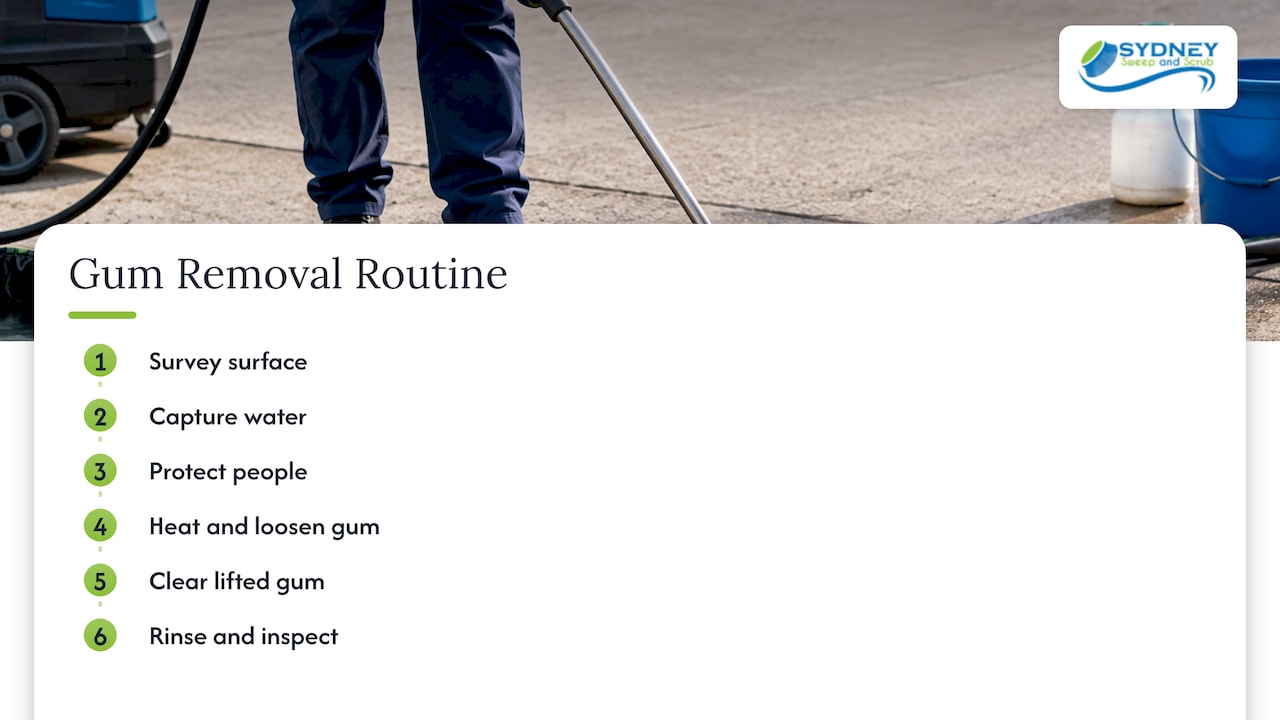
Here is the routine, with what each step demands and where it goes wrong.
1. Survey the area and the surface
Walk the site. Note the surface type (plain concrete, coloured or sealed concrete, pavers, bricks), the gum density, any oil or grease, and where water will flow. Mark drains, pits and garden beds.
Where it goes wrong: treating every surface alike. Sealed or coloured finishes can be marked by heat and pressure. Also, missing a stormwater pit downhill of the work area turns a cleaning job into a pollution incident.
2. Plan water capture before you plan the clean
In NSW, the EPA’s guidance is that runoff from washing must not enter stormwater drains. Practically, that means blocking or covering drains, bunding the work area and recovering water with a vacuum or a collection system. We cover the Sydney specifics in our pages on pressure washing wastewater checks and trade waste in Sydney.
Where it goes wrong: planning the water last. Gum fragments and residue travel with the runoff, and a sock across a drain is not a plan.
3. Set up the area and protect people
Close or cone off the work zone. Hot water jets are noisy, throw debris and spray further than most people expect. Operators need appropriate protective clothing and footwear. Pedestrians, tenants and customers need a clear route that stays outside the splash zone.
Where it goes wrong: working in live pedestrian areas. For carparks and retail frontages, this is why gum removal is usually scheduled out of trading hours.
4. Heat and loosen
Start with the water at working temperature and the nozzle at the upper end of the distance range for the machine. Move the jet in steady passes so the heat softens the gum before the pressure acts on it. The CCAA notes that fan nozzles are the most common choice, and a fan pattern spreads the force across a wider strip of surface.
Where it goes wrong: going straight in close. If a spot resists, hold the pass a little longer at a safe distance rather than moving the nozzle in.
5. Clear the lifted gum
Gum that has been knocked off the surface does not disappear. It can lodge in joints, land on adjoining surfaces or end up in the wash water. Recover it with the wastewater, or sweep and collect it straight away.
Where it goes wrong: leaving it for the wind or the next shower to move it.
6. Rinse, inspect and treat any residue
Let the surface dry and inspect it in daylight. Look for ghost marks where the gum sat, a dull patch where heat or pressure was applied too long, and any residue. Heavily trafficked areas often benefit from a sweep afterwards to pick up what is left. Our mechanical sweeping service is often booked together with pressure cleaning for that reason.
Where it goes wrong: signing the job off wet. Many marks only show once the concrete dries.
Hot water pressure cleaning or steam?
You will see both offered for gum. They are not the same.
The CCAA says steam cleaning can use higher temperatures than high-temperature water or pressure washing and, depending on temperature, can dissolve substances such as chewing gum that resist other methods. It adds that steam is typically considerably slower than pressure washing and is often used together with water or pressure washing for specific stains or stubborn deposits (CCAA).
That gives a simple rule of thumb:
| Situation | Better fit |
|---|---|
| Many gum spots across a footpath, plaza or carpark entrance | Hot water pressure cleaning, for speed over area |
| A small cluster of stubborn, compacted gum | Steam or targeted heat, used alongside water cleaning |
| Gum mixed with oil, grease or other staining | Hot water pressure cleaning, with the surface assessed for the stain type |
For most commercial sites the first row is the one that applies, and it is why hot water pressure cleaning is the core of any gum program. You can read more on our hot water pressure cleaning page.
Safety: what hot water and high pressure do to people
This is the part of the job that is easiest to underestimate.
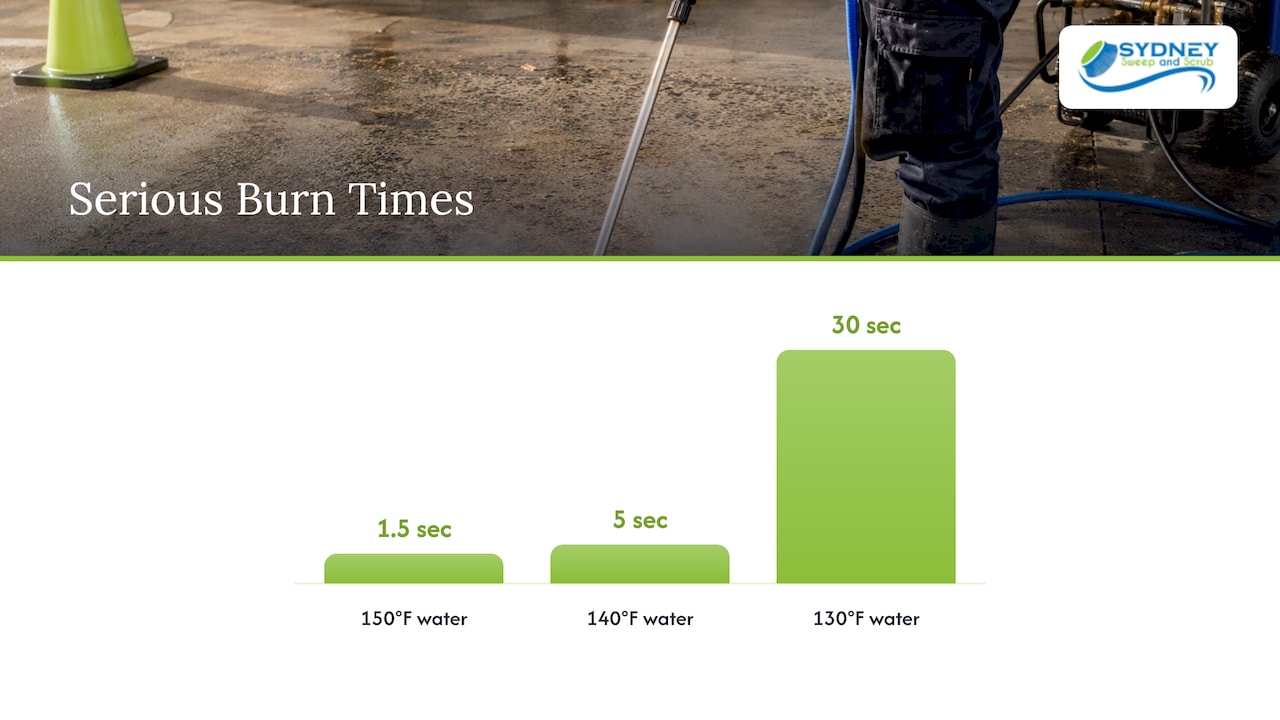
Scalding. A US pressure-washer safety guide from Power Line Industries gives a burn-time table: water at 150°F (about 66°C) can cause a serious burn in about 1.5 seconds, at 140°F (60°C) in about 5 seconds, and at 130°F (about 54°C) in about 30 seconds. It also states that water above 120°F (about 49°C) can cause severe burns or scalding-type injuries (Power Line Industries safety guidelines, 2023). Hot water pressure cleaners run well above those temperatures at the nozzle.
Injection injuries. The UK’s Water Jetting Association reports that a fluid injection injury can be caused by a jet at a pressure as low as 100 psi (7 bar). It also describes an experienced operative who suffered fourth-degree burns when a steam pressure washer jet at 3,000 psi and 110°C cut through his boot (Water Jetting Association, 2022). The entry wound can be tiny, so the seriousness is easy to miss.
What that means in practice:
- Never point a jet at any part of anyone’s body, and never test it on a boot or glove.
- Anyone hit by a jet should get urgent medical attention, even when the wound looks minor. Tell the doctor it was a high-pressure water injury.
- Keep bystanders, tenants and customers well outside the work zone.
- Use trained operators with the right protective equipment.
We have also put together a short piece on high pressure cleaning risks in Australia for site managers who want to brief their teams.
The figures above come from US and UK sources; check your own site safety plan and your state’s work health and safety requirements for the controls that apply to your workplace.
Wastewater and residue: the rules that catch sites out
Gum removal produces a slurry of water, gum fragments, grit and whatever else was on the surface. That water has legal status.
In NSW, the EPA’s guidance says that for any kind of washing activity the runoff must not enter any stormwater drains. It recommends confining washing to a designated bay with wastewater going to a collection pit and then either to sewer, which needs approval from the local council under a trade waste agreement, or to treatment and recycling.
Other states take the same position. In Queensland, for example, Tablelands Regional Council explains that wastewater from pressure cleaning is a prescribed water contaminant. It is unlawful under the state’s Environmental Protection Act 1994 to let it enter roadside gutters or stormwater systems, and significant fines apply.
For a property manager, the practical checks are:
- Identify every stormwater pit and gutter inlet within the flow path of the work area.
- Confirm who is recovering the water and where it goes, whether that is sewer under a trade waste agreement or treatment.
- Ask for that to be in writing in the quote or the safe work method statement.
- Keep records of the disposal, because you are the site owner or manager.
Our pages on waste recovery for pressure washing and stopping pollutants at the source go through the detail for Sydney sites.
Removing gum from a concrete footpath without damaging it
Footpaths are where most gum complaints come from, and they are also where damage is most visible. A few principles keep the surface intact:
- Work at the correct distance. Follow the 200 to 450 mm range for professional machines rather than moving in close on stubborn spots.
- Keep the jet moving. Dwell time is what etches concrete and marks coloured finishes.
- Choose the nozzle for the surface. A fan nozzle spreads force; a narrow, pinpoint jet concentrates it.
- Treat paver joints with care. Protect the joint sand, and check for loosened pavers afterwards.
- Do it as a program. Gum returns where foot traffic is high. A scheduled clean keeps the build-up thin, which makes each visit quicker and gentler on the surface.
For councils and centre managers weighing different methods across large networks of paths, our council footpath cleaning methods guide compares what works and when. If the marks on your paving are not all gum, the footpath stain removal guide helps you sort out which treatment fits.
When to book a crew
A single patch outside a staff entrance is one thing. Gum across a carpark entry, a plaza, a loading area or an end-of-lease forecourt is another, because you now have a scalding hazard, a high-pressure hazard and a wastewater obligation on your site at once.
Sydney Sweep and Scrub is a family-owned Sydney business offering hot water pressure cleaning and pressure washing alongside mechanical sweeping and scrubbing, rubbish removal and line marking. That mix lets one booking cover the clean, the sweep-up and the markings that often need refreshing afterwards. Requests for quotes and bookings can be made online.
The services that most often apply to gum:
- Pressure washing for footpaths, forecourts and plazas
- Carpark cleaning for building owners, strata and building managers
- Warehouse cleaning for loading areas and yards
- End of lease commercial cleaning for occupiers handing back a site
When you request a quote, describe the surface type, the approximate area, how heavy the gum is and where the nearest drains are. That lets the crew plan water capture and equipment before arriving.
FAQ
Does hot water remove gum better than cold water?
In practice, yes for large areas. Heat helps break the gum down, and the CCAA notes that cleaning agents work faster as water temperature rises. Hot water pressure cleaning is the usual method where there are many pieces of gum to remove.
What pressure should be used on concrete?
The CCAA gives about 10,000 kPa for domestic washers and 14,000 to 18,000 kPa for commercial machines. The nozzle should be held 200 to 450 mm away on higher-pressure machines. The right setting depends on the surface, so an operator should test a small area first.
Can I let the wash water run into the drain?
No. The NSW EPA says washing runoff must not enter stormwater drains, and other states, such as Queensland, treat it as a prescribed contaminant with significant fines. The water needs to be contained and sent to sewer under a trade waste agreement or treated.
Is steam better than hot water for gum?
Steam can reach higher temperatures and may dissolve stubborn gum, but the CCAA says it is considerably slower than pressure washing. It is generally used alongside water cleaning for small, stubborn deposits. For wide areas, hot water pressure cleaning is the faster option.
What should I do if someone is hit by a pressure washer jet?
Get medical attention straight away, even if the wound looks small. The Water Jetting Association reports that injection injuries can occur at pressures as low as 100 psi and that the entry point can be tiny. Tell the doctor it was a high-pressure water injury.
Sources
- CCAA, Cleaning Concrete data sheet
- NSW EPA, The drain is just for rain
- Tablelands Regional Council, Water pressure cleaning
- Power Line Industries, Pressure wash safety guidelines
- Water Jetting Association, Pressure on for safe cleaning