
Dust in an underground car park comes from the traffic itself: tyre wear, exhaust soot, brake debris and concrete that is slowly breaking down. With little airflow to carry it away, it settles on floors, walls, pipes and parked cars. It is cleared by removing it from the slab with machines, then fixing what keeps feeding it. At Sydney Sweep and Scrub we sweep and scrub Sydney car parks with mechanical equipment, so the dust is taken off the concrete instead of being pushed around.
This guide is for building managers, strata committees and owners. It explains where the dust comes from, why it is more than a cosmetic problem, how a proper clean is done, and how often to schedule it.
TL;DR
- Underground dust is a mix of tyre rubber, exhaust soot, brake debris and concrete dust, and poor airflow lets it accumulate.
- Research on underground garages has found toxic metals in surface dust that can be stirred up and breathed in or ingested, so cleaning is a workplace and resident health matter.
- Worn, carbonated concrete starts to dust by itself, so a dusty slab can be a sign of surface deterioration.
- Remove loose grit mechanically first, then scrub or wash. Skipping the first step wastes the second.
- Regular scheduled cleaning keeps dust from building up between clean-ups. Our carpark cleaning service covers Sydney sites.
Table of Contents
- Where underground car park dust comes from
- Why dust in a basement is a safety issue, not just a tidiness issue
- What dust does to the building
- How an underground car park should be cleaned
- What the job looks like in practice
- How often to clean
- Dust after construction or building work
- Reducing dust at the source
- Booking a clean in Sydney
- FAQ
- Sources
Where underground car park dust comes from
A basement car park is a closed box with moving vehicles in it. Every vehicle brings in fine road dirt on its tyres and leaves behind some of its own wear. The main contributors are:
- Tyre and road friction. A 2025 peer-reviewed study of underground garage dust found that friction between tyres and the road releases zinc and copper into surface dust (Wang et al., 2025).
- Fuel combustion. The same study links burning of fossil fuel to lead, nickel, mercury and arsenic in the dust.
- Ageing coatings. It also points to natural ageing of fire-retardant and floor coatings as a source.
- The slab itself. Traffic wear and abrasion on a concrete floor create concrete dust. Exhaust is high in carbon dioxide, which contributes to carbonation of the surface, and once concrete reaches that level of deterioration it starts to dust (Markham, 2021).
Airflow decides how fast this builds. Most basements have no wind, no rain and no natural washing. Whatever lands on the floor stays there until it is removed or until a vehicle lifts it back into the air.
Why it is worse in some car parks
Busy retail, commercial and residential towers put more vehicles through the same space each day, so more wear is deposited. Ramps, turning bays and boom gate queues concentrate braking and acceleration, and the dust is heaviest there. Car parks that are rarely cleaned also keep their older dust, which gets ground finer by each passing tyre and becomes easier to lift.
Water adds a second layer. Seepage dripping from walls or pipes carries minerals, and when it dries on a car’s paintwork it leaves marks that drivers often mistake for dust. If tenants or residents complain about marks on their cars, look at both the floor and the drips overhead.
Why dust in a basement is a safety issue, not just a tidiness issue
The visible grime is the least of it. The Wang et al. study concluded that toxic metals in underground garage dust can be re-suspended and enter the body through ingestion, inhalation and skin contact, where they can accumulate in tissues and organs (PMC, 2025). That study measured garages in China, so its figures do not transfer directly to a Sydney building. The mechanism, though, applies anywhere cars drive on a slab in an enclosed space.
France’s national health agency looked at the people who spend the most time in these spaces. ANSES concluded in 2013 that professionals working regularly in indoor car parks are exposed to health risks from air pollution. Acute risks come from carbon monoxide and nitrogen dioxide. Chronic risks come mainly from benzene and nitrogen dioxide, and to a lesser extent from fine particles (PM10) and formaldehyde. It also found that car park operations such as reception, surveillance and maintenance had the highest exposure of the activities studied, because those staff spend the longest hours there (ANSES).
That matters if you are the person responsible for a building. Attendants, security staff, cleaners and contractors are in the space all day, and your duty of care covers them.
Ventilation and gas monitoring
Dust and exhaust gases are separate problems that share one cause: air that doesn’t move enough. Australian Standards call for underground car parks to have mechanical ventilation that starts automatically when carbon monoxide levels rise, fixed gas sensors for continuous monitoring, and routine testing and calibration (AQMS Group, 2025). The same source notes that carbon monoxide and nitrogen dioxide can build up quickly where ventilation is poor, and that even short exposure can cause headaches, nausea or dizziness.
Cleaning does not replace any of that. If your fans, sensors or filters are overdue for service, speak to your building services contractor or a licensed mechanical engineer. Cleaning is the other half of the job: it removes the settled material that ventilation cannot.
What dust does to the building
Dust is abrasive. Grit under tyres acts like sandpaper on the slab and on line marking, and fine particles clog floor drains and sumps. That is one reason drain blockages and flooding are linked to car park maintenance.
There is also a structural angle. A US parking-structure specialist quoted in Cleaner Times explains that salts tracked in on tyres and not washed away soak into porous concrete and can eventually attack the reinforcing steel, leading to cracks and potential structural failure (Cleaner Times, 2025). Salt exposure differs from one site to another, but the principle is simple: whatever sits on the slab works into it over time, and removing it early protects the surface.
And there are the practical consequences for you as manager: dusty lobbies, tenant complaints, slippery patches where dust meets damp, and a car park that looks neglected to every visitor who drives in.
How an underground car park should be cleaned
There is a right order of work, and most disappointing results come from getting it wrong.
Step 1: Plan around the building
A basement cannot simply be closed off and hosed down. Decide which levels can be shut and when, how residents or tenants will be told, and where vehicles will go. Out-of-hours work is common for commercial buildings. Cleaning contractors working in enclosed spaces must also consider exhaust from their own plant. The same Cleaner Times article warns that if exhaust fans are not up to standard, workers face carbon monoxide risk, and that the hardest and most dangerous part of power washing a garage is doing it while the garage is open (Cleaner Times). A site briefing before work starts is part of a safe job.
Step 2: Mechanical sweeping first
Basements collect stones, cigarette butts, packaging and fine sand along with the dust. If you wash or scrub before that is removed, the grit is dragged across the floor and wears equipment. One equipment maker’s guidance on underground garages notes that sand can wear down scrubber squeegee blades and even scratch an epoxy floor, which is why mechanical pre-cleaning comes first (Laite Group, 2026). Our mechanical sweeping does this loose-debris stage with machines, and it covers more floor area per hour than any hand crew.
A broom or leaf blower is the wrong tool in a basement. It lifts the finest particles into the air, where they stay until they settle again on cars, walls and lobbies.
Step 3: Scrub the slab
Sweeping takes off what is loose. Fine dust, tyre marks and oil film bond to the surface and need scrubbing. Machine scrubbing cleans the concrete in one pass, so the floor ends up uniformly clean rather than streaked. Our guide to the benefits of a professional machine scrub explains what that does for the surface.
Step 4: Pressure wash where it is needed
Heavily stained bays, ramps, bin areas and spill zones may need pressure washing. Hot water helps on oil and grease, and our hot water pressure cleaning is offered for those areas. Wash water needs a plan: it must go to a drain or be collected, never be left to pond on the slab.
Step 5: Walls, pipes and edges
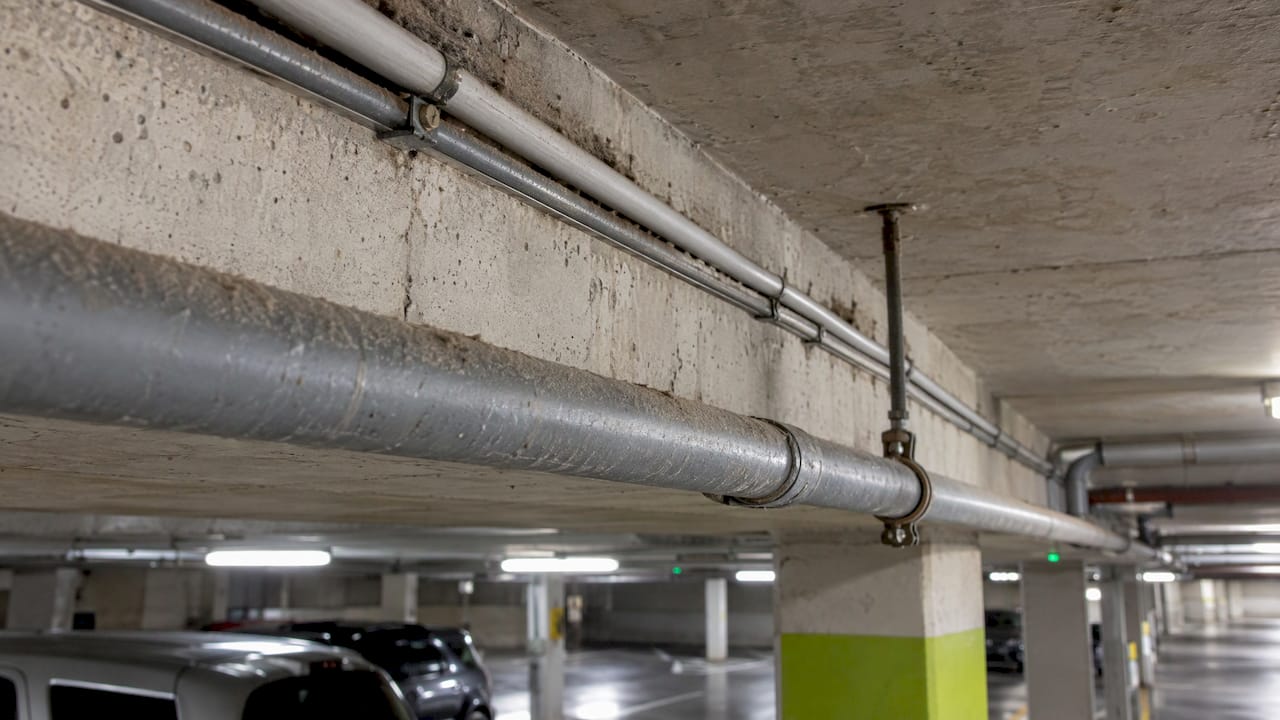
Dust settles on ledges, pipework, conduits and the tops of columns. If these are skipped, the first vehicle or draught puts the dust back on the clean floor. Include them in the scope.
Step 6: Check the result
Walk the car park under normal lighting. Look at the edges, ramps and corners, where machines reach least easily, and at the drains. A good result is a floor that is uniform in colour with no loose grit underfoot.
What the job looks like in practice
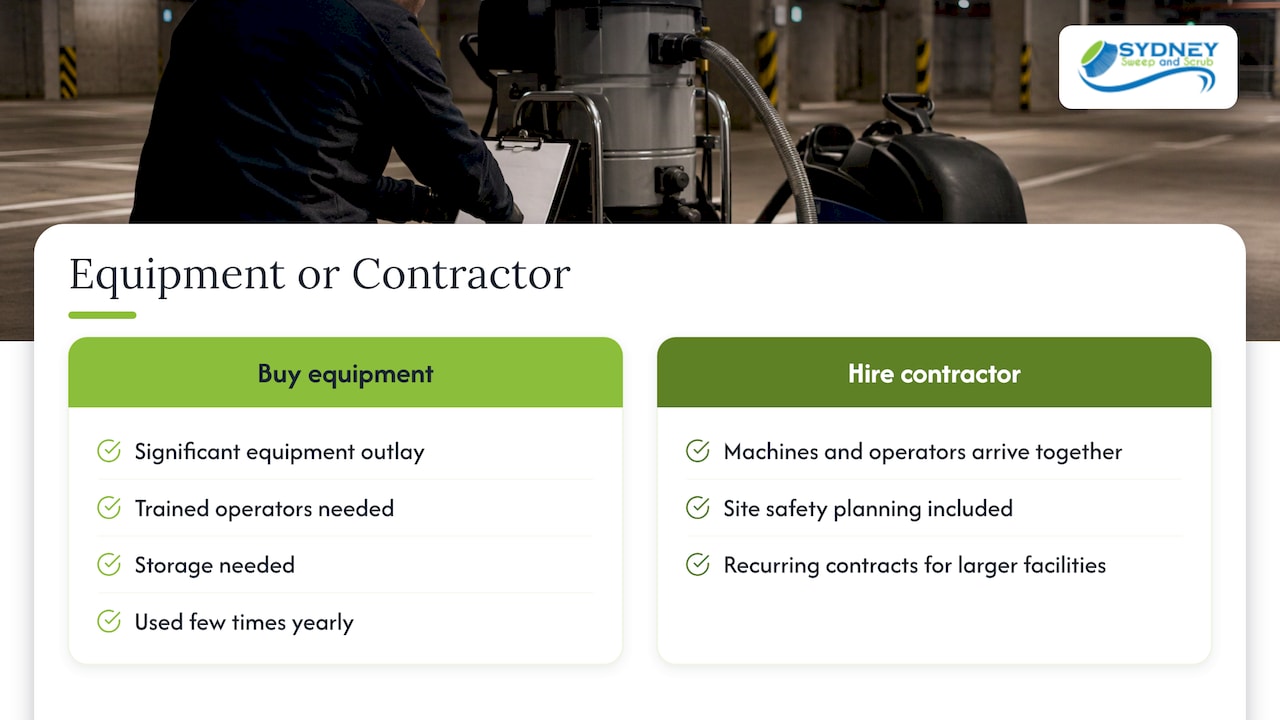
Building managers often ask whether to buy equipment or hire. A basement-sized sweeper-scrubber is a significant outlay, needs trained operators and storage, and gets used only a few times a year in most buildings. Booking a contractor means the machines, the operators and the site safety planning arrive together. We run mechanical sweeping, scrubbing and pressure washing across Sydney, and for larger facilities we offer optional recurring maintenance contracts so the work happens on a schedule rather than after complaints.
If you are comparing quotes, ask each provider the same questions: what machines will be used, which stages (sweep, scrub, wash) are included, how wash water is handled, how work is scheduled around vehicles, and what is done at edges and ramps. Our signs you need sweeper-scrubber services is a quick checklist for deciding when a clean is due.
How often to clean
There is no single Australian rule for this, and the right schedule depends on traffic, ventilation and how the car park is used. One useful benchmark comes from the US: the specialist quoted in Cleaner Times recommends sweeping a parking garage at least every other month and power washing every one to two years (Cleaner Times, 2025). Treat that as a starting point.
Factors that should bring the schedule forward:
- High vehicle turnover, such as retail, medical or commuter car parks
- Weak airflow or ventilation faults
- Visible dust on cars, lobbies or lift cores
- Nearby building work or demolition
- Wet patches, drips or drains that clog
A regular programme is cheaper in the end than occasional deep cleans, because dust that is removed often never has time to bond to the slab. Our scheduled carpark cleaning page describes how recurring work is set up, and why regular cleaning reflects well on a building is covered in a separate guide.
Dust after construction or building work
A new or refurbished basement carries a heavy load of fine mineral dust from cutting, grinding and concrete work. A Sydney post-build clean is generally done as a machine sweep and scrub so the concrete is cleaned across the whole slab. Because concrete dust can contribute to silicosis (Markham, 2021), avoid dry sweeping and compressed air on construction dust. Machine methods keep the dust from being thrown back into the air. Where work involves crystalline silica, the builder’s own safe work method statement and WHS obligations apply; your WHS adviser can confirm what applies to your site.
If you manage the building at handover, schedule the clean before residents or tenants move vehicles in. Dust that is left under traffic becomes much harder to remove. We also handle related concrete work such as line marking, which is usually done once the slab is clean.
Reducing dust at the source
Cleaning clears what has built up. These measures slow the next build-up:
- Keep ventilation working. A 2023 study of indoor car parks found that carbon dioxide, formaldehyde and PM-10 mostly met standards when ventilation functioned, while carbon dioxide and formaldehyde exceeded values where it failed (Journal of Asian Urban Environment, 2023). Arrange regular servicing of fans and sensors with your building services contractor.
- Check shared air paths. Underground retail car parks and entry lobbies often share the same ventilation system, so exhaust fumes, brake dust and fine debris can reach spaces meant to feel clean. Common faults include fresh-air intakes too close to trafficable areas, filters chosen for general dust rather than the mix of fine and coarse particles in car parks, and poor access for filter inspection (Total Air Filtration, 2026).
- Inspect filters often. The same source notes that filters in car park systems often load faster than expected, so inspection and pressure monitoring matter.
- Fix leaks. Water dripping from walls and pipes leaves mineral deposits and dampens dust into a film that is harder to remove.
- Repair worn slab surfaces. If concrete is dusting, sweeping will not stop it. Ask a structural or concrete specialist to assess the surface.
- Clean on a schedule. Dust removed monthly or bimonthly does not get ground in.
Booking a clean in Sydney
Sydney Sweep and Scrub is a family-owned business that cleans car parks, warehouses, construction sites and public spaces across Sydney with mechanical sweeping, scrubbing and pressure washing. Our operations are carbon neutral, and clients can opt into waste offset initiatives. You can request a quote and book online, and recurring maintenance contracts are available for larger facilities. If your basement has a dust problem, start with our carpark cleaning page or see the full range under our services. For sites with large floor areas, automated robotic cleaning is also available for car parks and warehouses.
FAQ
Is underground car park dust harmful?
It can be. Research on underground garages has found toxic metals in surface dust that can be re-suspended and enter the body by inhalation, ingestion and skin contact. Staff who spend long hours in car parks have the highest exposure, according to French agency ANSES. Keep ventilation working and remove settled dust regularly.
Why do cars get so dusty in a basement car park?
The air is still, so tyre, brake and exhaust particles settle on everything. Mineral-rich water dripping from walls or pipes can also leave marks on paintwork that look like dust. Cleaning the floor and fixing leaks addresses both.
Can I just hose down the car park?
Hosing alone moves dust and grit into drains and corners without removing it. Loose debris should be taken off mechanically first, then the slab scrubbed or washed, and wash water must be managed. That is why we sweep, scrub and wash in that order.
How often should an underground car park be swept?
A US specialist suggests at least every other month for sweeping and every one to two years for power washing. In Sydney the right frequency depends on traffic, ventilation and building use. Tell us about your site and we can suggest a schedule.
Does the dust ever come from the concrete itself?
Yes. Traffic abrasion wears the surface, and carbonation from exhaust can weaken it until it dusts. If the slab keeps producing dust after cleaning, have the surface assessed by a concrete specialist.
Sources
- Toxic Metals in Surface Dust in Underground Parking Garages (PMC, 2025)
- Indoor car parks, occupational risks (ANSES)
- Why Fixed Gas Detectors In Underground Car Parks Matter (AQMS Group)
- What can MARKHAM do for Concrete Car Parks?
- Keeping a Clean Garage (Cleaner Times, 2025)
- Cleaning Challenges and Solutions for Underground Garage Floors (Laite Group, 2026)
- Journal of Asian Urban Environment, 2023
- Air Filtration for Underground Retail Car Parks and Entry Lobbies (Total Air Filtration, 2026)