
Sweep first, scrub second, every time. Sweeping lifts the dry grit, dust and litter. Scrubbing then washes off what is bonded to the surface: grease, oil and grime. Reverse the order and the scrubber turns loose dirt into slurry, drags grit across the floor and clogs its own recovery system. This guide sets out the full sequence for warehouses, car parks and other hard floors, the safety and drying steps that go with it, and the wastewater rules a Sydney site needs to respect.
TL;DR
- Always pre-sweep the whole cleaning path before any scrubber touches the floor, so dirt is removed dry rather than pushed around wet.
- The working order is: clear the path, pick up large items, sweep, scrape sticky spots, scrub and dry, then empty and rinse the machines.
- Cordon off wet areas, put signs out, and keep them there until the floor is completely dry.
- Scrubbing wastewater must not enter stormwater drains. In NSW it needs to be contained and sent to sewer under a trade waste approval.
- Match the machine to the area: push sweepers for small car parks, ride-ons for large ones, combination machines for very large floors.
Table of Contents
- Why the sweep has to come first
- The sweep-then-scrub sequence, step by step
- Before you start: safety and preparation
- Choosing the right machine for the area
- Recovering dirty water and drying the floor
- Wastewater: where the dirty water goes
- How often to sweep and scrub
- Common mistakes to avoid
- Need the sequence done for you?
- FAQ
- Sources
Why the sweep has to come first
Most of what lands on a commercial floor is dry. A Kärcher North America training director, quoted by a sweeper industry publication, puts dry particulate at about 80% of the soil entering a warehouse or distribution centre. He also notes that scrubbing first strips gloss from the floor, and that soil left behind collects along the squeegee blade and hurts machine performance.
The practical problems of skipping the sweep are consistent across manufacturers and equipment suppliers:
- Mud. One floor-machine manufacturer says scrubbing a dusty floor can turn large amounts of dirt into mud that is spread around the site.
- Scratching. The same source warns that pebbles dragged under a scrubber can be ground into the floor and damage the finish. An Australian equipment hire guide makes the same point, adding that loose dirt can scratch polished concrete and tiles and clog squeegees, brushes and the recovery system.
- Streaks and re-work. When detergent meets large amounts of dust, it can leave mud streaks that have to be cleaned again. The extra pass costs labour and water.
- Machine wear. Debris pulled under the squeegee prevents a tight seal and nicks the rubber edge, and it adds strain on brushes, pad drivers and other moving parts.
There is also an air quality benefit. Removing dust before water goes down means less airborne dust for people working in or visiting the space, and the same supplier notes the scrubber’s solution can actually reach the floor surface instead of being absorbed by loose dirt, which gives a more even finish.
The sweep-then-scrub sequence, step by step
This is the order we work in on warehouse floors and car park decks. The detail changes with the site, but the logic does not.
- Clear the path. Move signs, bins, pallets on the floor, movable displays and loose mats. Anything the machine has to steer around leaves an uncleaned patch and a tidy line of dirt behind it.
- Remove large items by hand. Strapping, cardboard, pallet offcuts, bottles and similar items go into a bin first. Large objects jam sweeper brushes and tear squeegees.
- Sweep the whole area. Start at the far end and work towards the exit, so you never walk or drive over cleaned floor. Use the side broom or a hand broom on edges, corners and along walls, where grit collects.
- Scrape sticky spots. Dried food, chewing gum and dried spills need a scraper. These residues break the squeegee’s contact with the floor, leaving streaks and sticky patches and damaging the blade.
- Scrub and dry in one pass. Run the scrubber-dryer with adequate overlap between passes so no strip is missed. Keep wet floor signs out until the surface is dry.
- Empty and rinse the machines. Empty the sweeper hopper into general waste, drain the recovery tank to a suitable point (more on that below), and rinse it so residue does not set in the tank or hoses.
Where heavy staining changes the order
Oil, tyre marks and baked-on grime on a car park or loading dock sometimes need more than a standard scrub. The order still starts with a sweep. After that, pre-treatment, hot water or a pressure wash may come before the final scrub and recovery. Our hot water pressure washing is one option for those stubborn areas.
Before you start: safety and preparation
Wet cleaning creates the very hazard it is meant to remove. Slip risk rises the moment the floor is wet, and some cleaning agents make it worse.
Safe Work Australia’s Model Code of Practice says floors must be inspected regularly and maintained to minimise slip and trip hazards, and that cleaning methods should account for slips that may be increased by some agents. Its slips and trips fact sheet lists these administrative controls:
- cordon off wet areas while cleaning is in progress
- use signage to warn of wet or slippery floors
- dry floors thoroughly after cleaning
- clean up water or oily spills immediately
In NSW, SafeWork NSW names slippery surfaces caused by cleaning products or methods, spills, and loose cords and cables as common sources of slip, trip and fall risk indoors. It also requires regular floor cleaning and maintenance with appropriate products. WorkSafe Victoria adds that employers should provide non-slip footwear and have procedures for spills and wet cleaning, including warning signs and barriers. That is Victorian guidance, but the controls are sensible on any site.
Personal protective equipment and chemicals
Brushes can cut, and pressurised water and cleaning agents can injure. Kärcher Australia notes that at medium and high pressure you should avoid body contact because pressure may cause tissue damage. It also advises adding water to the container before the cleaning agent, so concentrate does not splash upwards, and wearing suitable PPE when handling agents.
A typical set for floor machine work, as set out in a sample Australian safe work method statement, includes:
- chemical-resistant gloves suited to the product
- slip-resistant enclosed footwear
- eye and face protection when decanting or where splashes are possible
- hearing protection near noisy machinery
- respiratory protection only where the risk assessment and safety data sheet identify an airborne exposure risk
The same document expects site induction and task-specific training on each machine model before use. Mechanical aids such as scrubbing machines also reduce repetitive and awkward manual work, and WorkSafe Victoria says employees should be trained in their selection and safe use.
Finally, charge batteries and check the machine before you begin, so it does not die halfway down an aisle and leave a wet strip across a walkway.
Choosing the right machine for the area
The sequence stays the same, but the equipment scales with the floor. Kärcher Australia’s guidance for car parks gives a useful guide:
| Area | Suggested sweeper type |
|---|---|
| Up to 300 m² | Push vacuum sweeper (up to 42 L dirt capacity) |
| Up to 1,000 m² | Push vacuum sweeper with traction drive and filter extraction |
| 1,500 m² and over | Ride-on vacuum sweeper |
| Very large car parks | Municipal vacuum sweeper as an alternative |
That table comes from Kärcher’s car park guidance. For very large floors, combination machines that sweep, scrub and dry in a single pass can save time. The same logic applies: the sweeping function still has to pick up dry debris before the wet scrub, whether that happens in one machine or two.
Two practical points for Sydney sites:
- Enclosed and multi-storey car parks suit battery-powered machines, because there is no exhaust to build up under a ceiling and noise is lower. We cover this in more detail in our guide to cleaning practices for multi-storey car parks.
- Oil-affected bays need a scrub after the sweep. Sweeping removes the grit that holds oil in place, and scrubbing then lifts the residue.
If you are unsure whether a floor needs a sweeper, a scrubber or both, our mechanical sweeping and carpark cleaning pages explain how we approach each surface.
Recovering dirty water and drying the floor
The scrubber-dryer applies solution, agitates it and recovers it in the same pass. When it works properly the floor is nearly dry behind the machine. Squeegee blades, hoses and filters have to be clear for that to happen, which is another reason the pre-sweep matters.
Before you pull the signs, run a quick check:
- Wipe test. Wipe a patch with a clean, dry microfibre cloth. If moisture transfers, wait or go over it again with clear water.
- Walk test. Walk the path in clean rubber-soled shoes and listen for squeaking or feel for skating.
- Low-spot check. Look at dips, expansion joints and corners where squeegees tend to skip and leave water behind.
This is a practical routine rather than a regulation. The requirement behind it is Safe Work Australia’s advice to dry floors thoroughly after cleaning, and keep signs up until that is done.
Wastewater: where the dirty water goes
On a Sydney site, what you scrub off must not end up in the street drain. The NSW EPA’s guidance says that when washing, runoff must not enter stormwater drains. It recommends that washing activities, including washing work floors, be confined to a designated wash bay. Wastewater from that bay goes to a collection pit and then to sewer, which requires approval from the local council through a trade waste agreement.
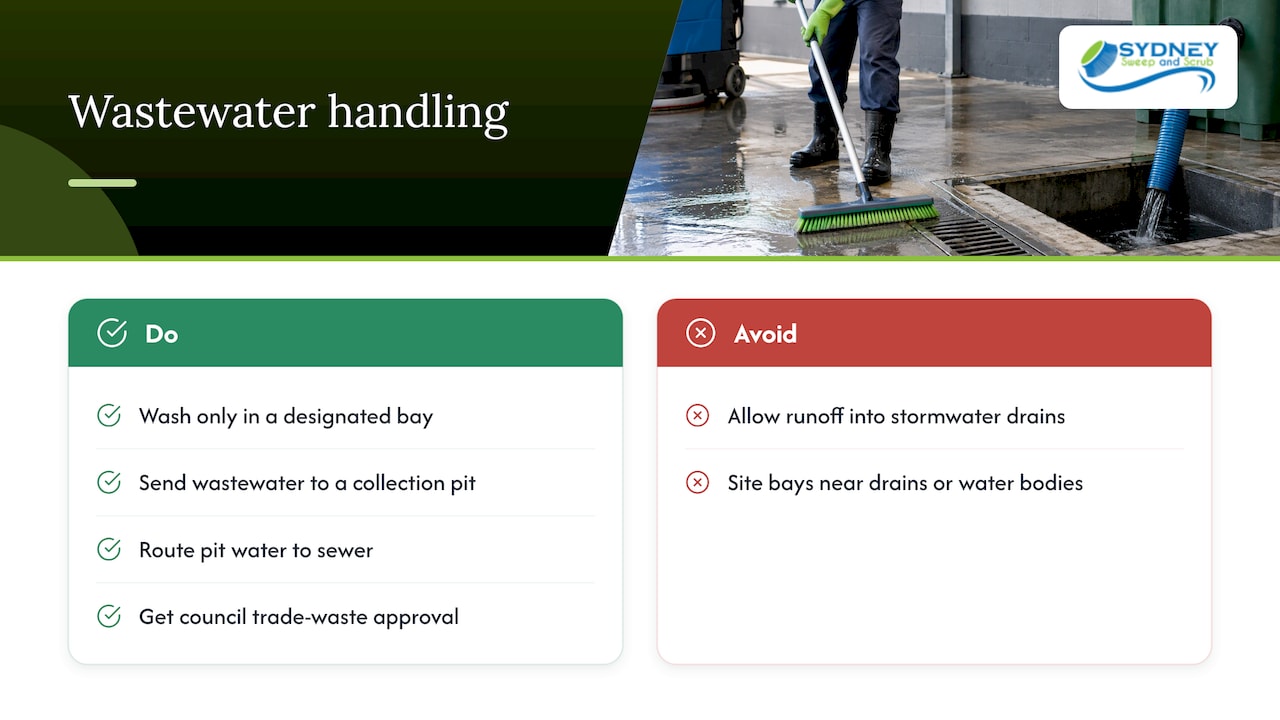
The same guidance says wash bays should be sited away from drainage lines, stormwater drains and water bodies, and that all staff should know where the bay is and how to use it. It is a shared responsibility between the cleaner and the site.
For property managers and strata committees, the takeaway is simple: ask how your cleaning contractor contains and disposes of wash water, and make sure your site has a compliant place to send it. Sweeping first helps here too, because dry debris is collected as solid waste instead of being rinsed into the water stream.
How often to sweep and scrub
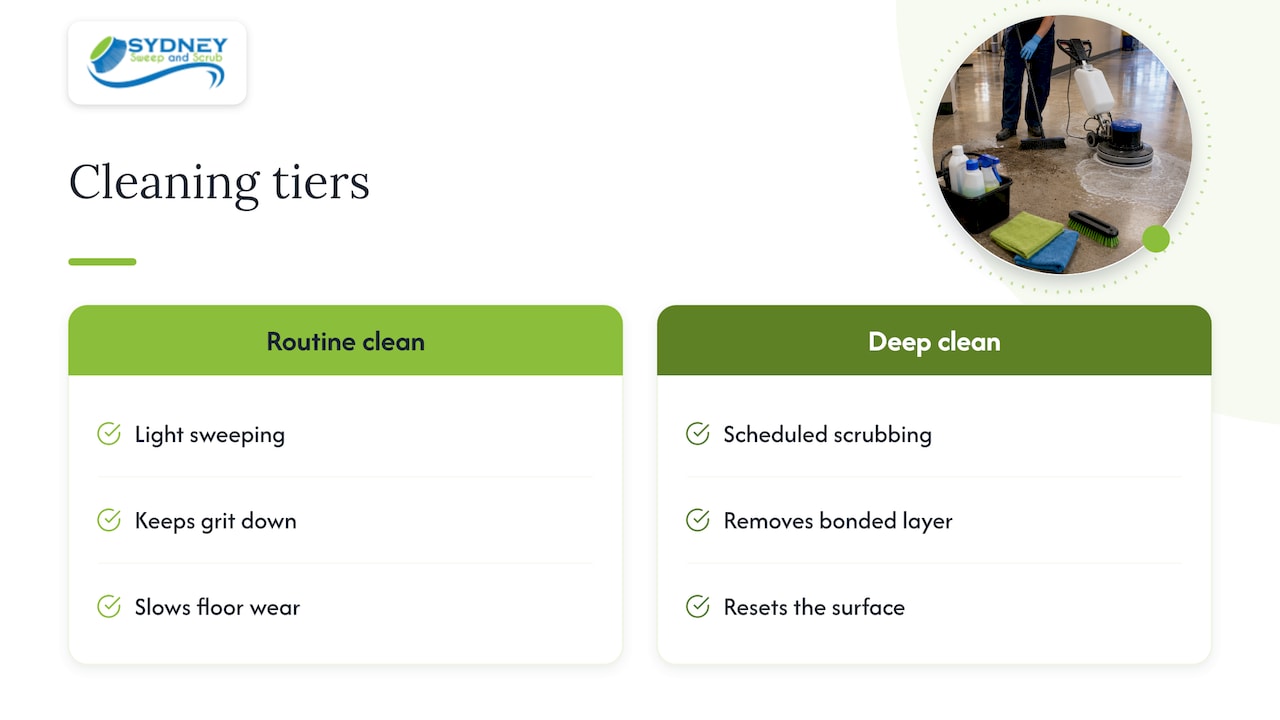
The right frequency depends on traffic, the weather, trees overhead and what the floor is used for. A busy retail car park, a loading dock and a quiet storage warehouse need very different schedules. Regular light sweeping keeps grit down and slows wear, while a scheduled scrub removes the bonded layer that sweeping cannot.
It helps to think in two tiers: a routine clean that keeps things under control, and an occasional deeper clean that resets the surface. The same thinking applies to any commercial space, and a guide to deep clean versus regular clean lays out how to decide between them. For car parks, our article on signs you need sweeper-scrubber services lists what to look for: oil patches, blocked drains, slippery pockets and a general tired look.
Poor car park housekeeping is more than cosmetic. Tyre dust, litter, leaves, grit and oil build-up creates slip hazards, blocks drainage channels and leaves a poor impression on visitors.
Common mistakes to avoid
- Scrubbing a dusty floor to save time. It costs time back in re-cleaning, blade replacement and slurry.
- Sweeping from the exit inwards. You end up walking over finished floor.
- Ignoring edges. Grit packs along walls and around columns, where the main brush cannot reach.
- Pulling signs early. Floors can look dry before they are. Use the checks above.
- Rinsing tanks down the nearest drain. Wash water belongs in a contained, sewer-connected point, not in stormwater.
- Skipping operator training. Each machine model has its own controls, and training should be documented.
Need the sequence done for you?
We run this order across Sydney warehouses, car parks, construction sites and public spaces, using mechanical sweeping and scrubbing, pressure washing and, where it suits the site, automated robotic cleaning. Recurring maintenance contracts are available for large facilities. For warehouse floors, see our warehouse cleaning service, or request a quote for carpark cleaning and tell us the area, surface and what is on the floor.
We are carbon-neutral in our operations, and clients can take part in optional waste offset initiatives. If you are comparing an in-house crew with a contractor, our comparison of professional and in-house carpark cleaning sets out the points to weigh.
FAQ
Can I scrub a floor without sweeping it first?
Only when the floor is genuinely free of loose dirt, and on most commercial floors it is not. Without a pre-sweep, grit can scratch the surface, mud can streak the finish, and debris can damage squeegees and brushes.
Does a combination sweeper-scrubber replace the sweep step?
No, it performs it in the same pass. Large debris still needs to be picked up by hand, and sticky spots still need scraping before the machine runs.
How long should I keep wet floor signs out?
Until the floor is completely dry. Safe Work Australia’s guidance is to dry floors thoroughly and warn people of wet areas. Check by wiping, walking the path and inspecting low spots rather than judging by eye.
Where can I dispose of scrubber wastewater in NSW?
Not into stormwater drains. The NSW EPA advises a designated wash bay that drains to a collection pit and then to sewer, with local council approval through a trade waste agreement. See the EPA guidance and confirm requirements with your council or water utility.
Do I need to sweep before pressure washing as well?
It is good practice. Removing loose debris first means the water works on the bonded dirt rather than moving litter and grit around, and it keeps solids out of the wash water.
Sources
- Sweep or Scrub Basics, World Sweeper
- 5 Steps to Prepare Floors for Scrubbing, Tennant
- A Sweeper or Scrubber: Which One is Right for Your Job?, Kennards
- How to successfully use a scrubber dryer, IPC
- Why Pre Sweeping Before You Scrub Matters, PS Janitorial
- Managing the work environment and facilities, Safe Work Australia (November 2024)
- Slips and Trips at the Workplace, Safe Work Australia
- Slips, trips and falls on the same level, SafeWork NSW
- Cleaning, WorkSafe Victoria
- Cleaning car parks and paths, Kärcher Australia
- Floor Maintenance and Cleaning Machinery SWMS sample
- The drain is just for rain, NSW EPA
- Car park sweepers and scrubbers, Australian Sweeper Company
- Deep clean or regular clean: which do you need?