
Good bollard paint prep comes down to four steps in order: identify the material and existing coating, wash off grease and grime, remove anything loose (flaking paint and rust), then wipe the surface clean and paint it while it is dry. Skip or rush any of them and the new coat lifts, usually within a season. This guide walks through each step for steel, galvanised and plastic bollards in car parks, warehouses and public spaces, with the safety rules that apply on Australian sites.
TL;DR
- Identify the substrate and the old coating first. Galvanised, aluminium and painted steel each need a different approach, and a small trial patch tells you whether your method is safe.
- Wash with water and a mild non-ionic detergent, rinse with fresh water and let the bollard dry completely before anything else.
- Remove rust and loose paint back to a sound edge, feather the edges, and prime bare areas the same day.
- Test any old paint for lead before sanding or stripping, and keep wash water and dust out of stormwater drains.
- Cleaning the surroundings (slab, kerb, line markings) at the same visit keeps fresh paint from picking up grit and oil.
Table of Contents
- Start by identifying what you are painting
- The prep sequence at a glance
- Cleaning: removing grease, grime and salts
- Removing flaking paint, rust and defects
- Galvanised and aluminium bollards
- Painting over existing paint
- Plastic bollard covers and non-metal bollards
- The wipe-down before paint
- Safety, lead paint and runoff on Australian sites
- Prep the ground as well as the post
- Who does what: where we fit
- Quick reference: prep by bollard type
- FAQ
- Sources
Start by identifying what you are painting
Before you pick a cleaner or an abrasive, work out three things: the substrate, the type and thickness of the existing paint, and its condition. A Queensland Government technical note on surface preparation advises identifying the paint type and thickness and the substrate, then trialling the removal method on a small area so you know it will not damage what is underneath.
In a typical Sydney car park or warehouse you will meet four kinds of bollard:
- Painted steel posts, often yellow, usually with chipped bases where vehicles have nudged them.
- Galvanised steel posts, either left bare or painted over the zinc.
- Steel posts with plastic or polyethylene sleeves, common in car parks and loading areas.
- Concrete-filled or aluminium bollards, less common but present in public spaces.
Walk the site and note the type, the worst damage and how many bollards share the same problem. Ten bollards with the same chipped bases can be prepared as a batch. One with deep rust pitting needs separate attention.
Check the coating condition
Sound paint that is only dirty needs washing and light abrasion. Paint that cracks, blisters or peels needs to come back to a firm edge. Rust with scale needs mechanical removal. Sorting your bollards into these three groups early keeps the job organised and your quote or labour estimate honest.
The prep sequence at a glance
- Identify substrate and coating, and test old paint for lead if the site or bollards are old.
- Clear the area: sweep grit and debris from the base so it does not get washed onto the bollard or into drains.
- Wash with detergent and water, or pressure wash, then rinse with fresh water.
- Let the bollard dry fully.
- Remove rust and loose paint by hand or power tool, and feather the edges.
- Abrade glossy sound paint so the new coat can grip.
- Dust off and wipe down.
- Prime bare metal, then topcoat.
The rest of this guide explains the reasoning at each point.
Cleaning: removing grease, grime and salts
Bollards collect tyre rubber, brake dust, oil splash and road film at the bottom, and diesel soot higher up. Paint will not bond over any of it. Erapol’s primer guide says every surface must be free of paint, oil, dust, dirt, mill scale, rust, mould, release agents and mildew, and clean and dry before primer or topcoat goes on.
Washing sound painted surfaces
For painted surfaces in good shape, the Queensland note recommends washing with water and detergent, rinsing thoroughly and letting the surface dry. Its suggested mix is half a cup of household detergent in four litres of water.
The choice of detergent matters. The same note warns that soda, soft soap and other highly alkaline soaps can leave harmful residues and attack new paint, and that non-ionic liquid laundry or automatic-dishwashing detergents are more suitable. Avoid heavy alkaline degreasers unless you are prepared to rinse repeatedly.
Pressure washing and hot water
For heavily soiled bollards, pressure washing does the work faster and more evenly than a bucket. Hempel’s surface-preparation guide notes that pressurised water cleaning, enhanced with detergent or heat where appropriate, removes oil, grease, soluble salts, dust and loose paint. It also says a detergent wash must be followed by a fresh-water rinse.
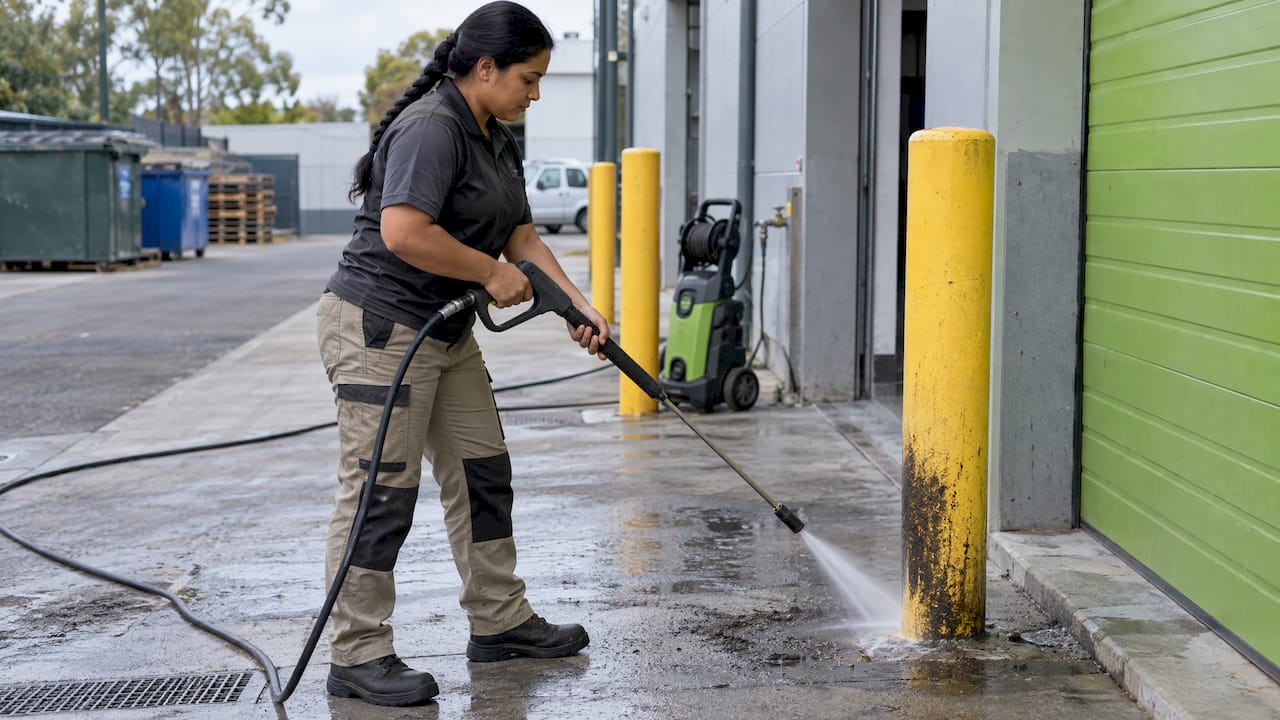
Hot water helps on oily bases, where cold water simply spreads the film around. If you want the detail, our pages on pressure washing with hot water and pressure washing with cold water explain when each suits a surface, and the dwell times for pre-treatment cover how long a cleaner should sit before you rinse.
Keep the pressure sensible near damaged paint. Aim the jet along the flaking edge rather than straight into it, or you will strip sound paint you meant to keep.
Coastal and industrial sites
Soluble salts are the hidden problem. Hammerite Australia’s technical guide says that in industrial or coastal areas soluble salts require repeated scrubbing and fresh-water rinsing. Bollards at Manly, Sans Souci or any waterfront car park, or near a busy arterial road, fall into this group. One wash is rarely enough there.
Mould and mildew in damp spots
Bollards in shaded, damp basements or beside drainage points can carry mould or mildew, which also has to go before painting. If that is your situation, this guide on fixing mould before you paint sets out the steps. Painting over it only hides the problem for a short time.
Removing flaking paint, rust and defects
Once the bollard is clean and dry, the real defects show. Hempel states that mechanical cleaning removes rust, loose and intact paint and weld spatter, while also creating a surface profile for the coating to grip. So hand or power tools do two jobs: they clear the failures and give the new coat something to hold.
Hand tools and power tools
- Wire brush or scraper for light rust and loose flakes.
- Sanding disc or flap wheel for heavier rust and thick paint.
- Sandpaper for feathering edges and scuffing gloss.
Tikkurila’s preparation procedure says defective coatings should be removed back to a sound surface, corroded areas power-disc prepared to a minimum of ST3, and rough edges feathered smooth. That is a good working standard for a chipped, rusty bollard base: go back to firm paint and bright metal, then smooth the transition so the chip does not show as a ridge under the topcoat.
Feathering and same-day priming
Resene’s guidance for exterior surfaces recommends scrubbing flaking areas with a short-bristled brush or Scotchbrite pad, sanding with 120 to 150 grit zinc-stearate paper, feathering the edges and spot-priming. It was written for timber, but the principle carries to metal: do not leave freshly abraded surfaces overnight. Resene notes that dew can get under the paint film and make edges curl and lift, so prime sanded areas the same day.
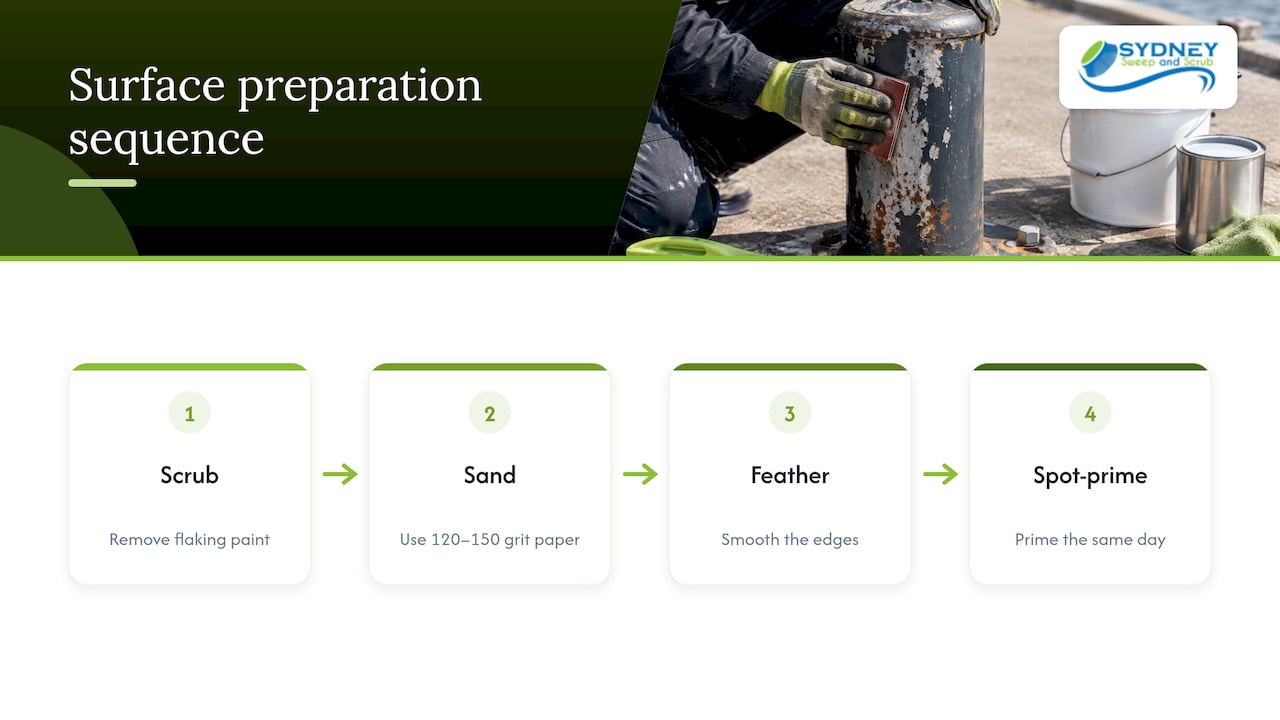
On bare steel, flash rust forms quickly, so the same-day rule matters even more. Plan a day’s work so that every bollard you open up gets primed before you leave.
Shiny and smooth metal
Hammerite Australia says shiny, smooth metal needs extra abrasion, and that bare metal must be dry and free of loose rust, dirt, dust, grease and salt. Polished stainless or glossy factory finishes will shed paint unless you scuff them first.
Galvanised and aluminium bollards
Galvanised bollards are the ones people get wrong most often, because they look clean and tough and seem to need nothing. They do need prep, and it depends on age.
The American Galvanizers Association says galvanised steel must first be classified as newly galvanised, partially weathered or fully weathered, because each condition has different cleaning and profiling requirements. The condition of the zinc decides whether zinc compounds should be removed, kept or just cleaned. The same source lists sweep blasting, wash primer, acrylic pretreatment and surface grinding as ways to give galvanised steel a paint key. Its guidance is American, so treat it as technical background and follow your paint manufacturer’s Australian data sheet for the product you choose.
For unpainted galvanised, aluminium and other non-ferrous metals, Hammerite Australia recommends a suitable special-metals primer. An ordinary steel primer is the wrong product here.
A practical routine for a galvanised bollard:
- Decide whether it is new, partly weathered or fully weathered.
- Wash and rinse it as above.
- Profile it using a method your paint supplier approves.
- Apply the primer the supplier names for galvanised or non-ferrous metal.
- Topcoat within the recoat window on the data sheet.
Painting over existing paint
Yes, you can often paint over already painted metal, provided the old coat is sound. Hammerite Australia says previously painted metal should be abraded to remove contaminants and gloss, washed with diluted detergent, rinsed with clean water and allowed to dry. It also recommends a small compatibility test before full application.
That test is cheap insurance on a site with many bollards. Paint one patch on one bollard, let it cure, and check for wrinkling, lifting or colour bleed before you commit the whole batch. Old coatings of unknown type are where surprises hide.
Plastic bollard covers and non-metal bollards
Plastic sleeves need a different approach. Reliance Foundry describes polyethylene covers as being made of HDPE or LDPE with colour throughout the material, and says such covers generally resist weathering and scratches better than painted steel. In many cases that means a thorough wash restores them without any painting.
If a cover is faded or marked and you do decide to paint:
- Krylon’s preparation guidance says plastic should be clean and dry, and lightly sanded if previously painted.
- Hammerite Australia says its paint can be used on certain plastics, and that you should apply a water-based plastic primer first.
- Always check the paint maker’s list of suitable plastics for your product, and trial a hidden patch.
For routine washing, warm soapy water and rags work on covers, with plenty of dry rags on hand to finish.
The wipe-down before paint
The last cleaning step is a wipe, and it is where people reach for acetone or alcohol. Hempel’s guidance says that for small areas you can use clean solvent-wetted rags to remove dust and remaining loose contaminants. It also warns that solvent cleaning can relocate hydrocarbons and does not remove soluble salts.
In practice that means:
- Wash and rinse first. Solvent is a finishing wipe, not a degreaser for a filthy post.
- Use clean rags and change them often, so you lift contamination instead of spreading it.
- Salts need fresh water, not solvent.
- Follow the paint manufacturer’s advice on which solvent suits the product, and work in ventilated areas.
Safety, lead paint and runoff on Australian sites
Bollards in older car parks, wharves and industrial estates may carry lead-based paint. Never sand or grind old paint on the assumption that it is safe.
Lead paint
WorkSafe Victoria says employers must control lead-paint removal risks using the hierarchy of controls, and that wet methods or chemical stripping are preferred to dry powered removal, with isolation, dust extraction, hygiene controls and suitable respiratory and protective equipment where required. Lead waste must be securely contained and disposed of, work areas cleaned with wet methods or Class M or H HEPA vacuuming, and workers must not eat, drink or smoke in the lead work area. That page is a Victorian regulator’s guidance. For a NSW site, confirm requirements with SafeWork NSW and your licensed hygienist or contractor.
Chemical strippers
The Queensland technical note says to follow the stripper manufacturer’s instructions for application, removal and disposal. Strippers are flammable and a health risk, so work in well-ventilated areas wearing protective clothing, gloves and facemasks. It adds that alkaline strippers based on caustic soda, potash or washing soda should be used only where other methods fail, because porous materials can absorb them, and several clear-water rinses are needed afterwards. Follow local and state hazardous-waste rules for disposal.
Keeping wash water out of drains
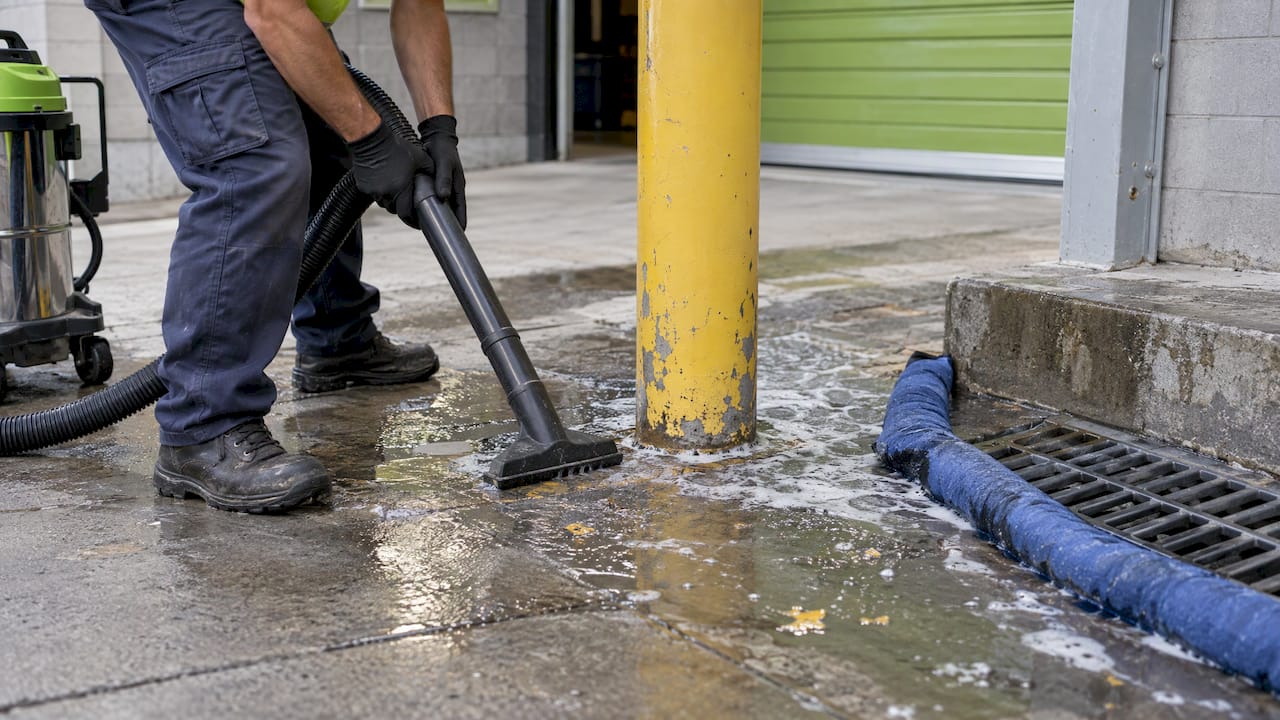
Wash water carrying paint flakes, detergent and grit should not run into stormwater. Construction management plans in NSW typically require sediment controls that stop sediment entering site drainage systems, along with methods to capture excess runoff. On a bollard job, that means sweeping first, using drain covers or socks, and capturing or vacuuming wash water where you can.
Prep the ground as well as the post
A freshly painted bollard standing in an oily, dusty bay will pick up grime and grit quickly, and wet paint will collect airborne dust. A few related jobs are worth doing at the same visit:
- Sweep and scrub the slab around the base, so wash water does not carry grit back onto the post. Our mechanical sweeping clears dust and debris across the whole car park or warehouse floor before painting begins.
- If the bollards sit beside painted markings, clean those too. See cleaning painted safety lines and cleaning concrete before line marking.
- Walls and edges near bollards collect the same film. Our notes on pressure washing walls and edges cover how we approach them.
- If someone has tagged a bollard, read about graffiti removal and safe practices before you paint over it.
Who does what: where we fit
We are a family-owned Sydney business that cleans commercial and industrial sites. For bollard work, the cleaning stage is ours: pressure washing, hot water cleaning, mechanical sweeping and scrubbing, and rubbish removal across car parks, warehouses and public spaces. We also offer line marking, so the slab and the surrounding bays can be left clean and ready for your painter or for markings.
If you manage a building, strata scheme or warehouse and want the bollards, floor and bays cleaned before repainting, see our carpark cleaning and warehouse cleaning pages, or request a quote through our site. We do not publish set prices, because scope, access and the number of bollards decide the job.
Quick reference: prep by bollard type
| Bollard type | Clean | Remove and abrade | Primer |
|---|---|---|---|
| Painted steel, sound paint | Detergent wash, fresh-water rinse, dry | Scuff gloss, feather chips | Spot-prime bare metal |
| Painted steel, flaking or rusty | Wash and rinse, dry | Back to sound edge, power-disc rust, feather | Prime same day |
| Galvanised | Wash and rinse, classify weathering | Profile by method the supplier approves | Special-metals or galvanised primer |
| Aluminium | Wash and rinse | Light abrasion | Special-metals primer |
| Plastic cover | Warm soapy water, dry | Light sand if previously painted | Plastic primer if painting |
FAQ
Can I paint over already painted metal?
Yes, if the old coat is sound. Abrade it to remove gloss and contaminants, wash with diluted detergent, rinse with clean water and let it dry. Test a small patch for compatibility before painting the whole bollard.
What should I wipe a bollard down with before painting?
Wash and rinse first, then finish with clean rags, using a solvent only if the paint maker recommends one. Solvent removes oil and grease but can spread hydrocarbons and does not remove salts, so fresh water must handle salts.
Do plastic bollard covers need painting?
Often not. Polyethylene covers carry colour through the material, so a good wash may be all they need. If you do paint, clean and dry the surface, sand lightly if previously painted, and use a plastic primer.
Is it safe to sand old bollard paint?
Not until you know it is lead-free. Older paint may contain lead, and regulators prefer wet methods or chemical stripping to dry powered removal. Use controls, protective equipment and proper waste containment, and check your state’s rules.
Sources
- Technical note: Painting, surface preparation (Queensland Government)
- Hammerite Metal Paint Technical Guide (Australia)
- Painting Galvanized Steel: Surface Preparation (American Galvanizers Association)
- Primers and Surface Preparation Guide (Erapol)
- Surface preparation (Hempel)
- Painting Exterior Timber (Resene)
- Preparation procedure (Tikkurila)
- Bollard colours and covers (Reliance Foundry)
- Surface preparation (Krylon)
- Managing lead-based paint removal (WorkSafe Victoria)
- Construction Management Plan (NSW Planning Portal)
- Fix mould before you paint