
In Australia, a business is responsible for its own waste. In most places councils do not collect it for you, and you must make sure it ends up at a lawful facility. The detail sits with each state and territory EPA and with your local council, so there is no single national rulebook. A few duties show up almost everywhere: arrange your own collection, keep waste streams separate, use a lawful transporter, and keep records for anything hazardous.
This guide is for property managers, strata managers, warehouse occupiers, builders and site operators. It explains who is responsible, what can go where, when approvals or tracking apply, and what the penalties look like. Examples lean on NSW and Sydney, where we work, with other states noted where the rules differ.
TL;DR
- Businesses generally arrange and pay for their own waste collection. Councils either do not offer it or offer it as an optional service that competes with private contractors.
- The waste producer carries the duty of care. You must take reasonable steps to make sure your waste is taken to a facility authorised to receive it.
- Hazardous, tracked and trade waste have extra rules, including paperwork, approvals and, in some states, consignment tracking.
- Illegal disposal penalties can be severe. In South Australia, corporations face fines of up to $250,000.
- Rules vary by state, territory and council, so always confirm the current requirements with your EPA and local council.
Table of Contents
- Who collects commercial rubbish: council or you?
- The duty of care: who is responsible for the waste
- What can go in general waste, recycling and organics
- Hazardous, tracked and construction waste
- When you need approval: trade waste and wastewater
- Penalties for getting it wrong
- What it costs: levies and pricing
- A practical compliance checklist
- End of lease and site clean-ups
- How Sydney Sweep and Scrub helps
- FAQ
- Sources
Who collects commercial rubbish: council or you?
The starting point is that commercial waste is a business cost, not a council service. Councils must provide domestic waste management in NSW, but service to businesses varies, and some councils run a business unit that competes with private contractors, according to the NSW EPA’s better practice guidelines.
Here is how that plays out in practice:
- City of Sydney: business council rates do not cover waste and recycling services, and businesses must arrange their own collections.
- Optional council services: Central Coast Council offers commercial waste and recycling, and businesses may also use private contractors. Camden Council offers an optional commercial garbage and recycling service.
- Councils that have stepped back: from 1 July 2025 the City of Fremantle in WA stopped its commercial and industrial waste services, so businesses there contact private providers.
The practical takeaway: do not assume the bin outside your premises is covered by your rates. Check your council’s business waste page before you sign a lease, set up a site or take over a building.
The duty of care: who is responsible for the waste
The business that produces the waste is the one the regulators look to. Victoria’s EPA, for example, says waste producers must take reasonable steps to ensure their waste is received by an authorised facility. It also notes that many businesses’ existing practices may already meet this duty. Victoria defines industrial waste broadly: waste produced by any business, excluding kerbside waste collected by councils, until it reaches a waste facility.
In plain terms, handing waste to a contractor does not end your responsibility. Your duty continues until the waste reaches a lawful destination. That is why the choice of who collects matters.
Who does what on a multi-tenant site
On sites with several tenants, responsibility is shared between the owner, the manager, the tenants and the cleaners. The NSW EPA notes that professional cleaning contractors are critical to successful waste management. They have direct access to tenants and can see whether waste is being separated properly.
A workable split looks like this:
| Party | Typical responsibility |
|---|---|
| Building owner or strata | Provides adequate bin storage, signage and a compliant collection contract |
| Property or facility manager | Chooses the collector, monitors contamination, keeps contracts and records |
| Tenant | Separates waste correctly, keeps hazardous items out of shared bins |
| Cleaning contractor | Collects from tenant areas, reports contamination and overflows |
| Waste collector | Transports to an authorised facility and issues documentation |
Check your lease and your strata by-laws. They often set who pays for collection and who must clean up when bins overflow.
What can go in general waste, recycling and organics
Bin rules are set by the collector and the facility it uses, so the list on your service agreement wins over any general guide. Still, the pattern is consistent across Australia.
General waste takes everyday mixed rubbish that cannot be recycled. Collectors commonly exclude liquids, chemicals, e-waste, medical waste and bulky items from general bins. Older collector rules also list rocks, bricks, tiles, concrete, paint, tyres, carpet and soil as unacceptable.
Recycling is for the materials your collector names, typically clean paper, cardboard, glass, metals and certain plastics. Contamination is the usual problem. A bin of food-soiled cardboard or a bag of general rubbish can lead to the whole load being treated as general waste, and your collector may charge for it.
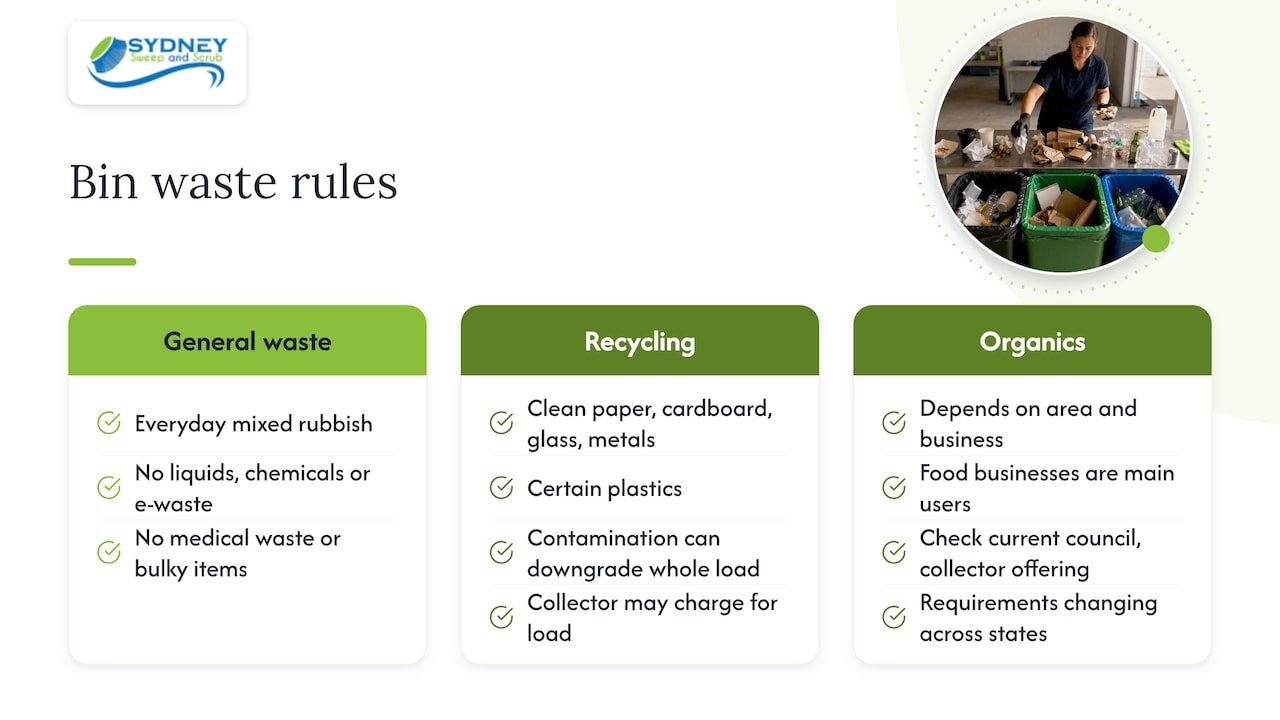
Organics services depend on your area and the type of business. Food businesses are the main users. Check your council’s and collector’s current offering, and the NSW EPA’s guidance for businesses, because requirements in this area are changing across states.
Items that never belong in a normal bin
- Paints, solvents, oils, batteries and chemicals
- Asbestos or anything suspected of containing it
- Electronic waste and fluorescent tubes
- Clinical and sharps waste
- Building and demolition waste in mixed bins
- Wet or liquid waste
Each of these has its own pathway. If you are unsure, classify the waste first (see the next section) rather than guess.
Hazardous, tracked and construction waste
Once waste is hazardous or regulated, the rules tighten.
Classification. In NSW, producers classify their waste under the EPA’s Waste Classification Guidelines. The guidelines pre-classify some wastes as hazardous, including certain containers that previously held specific dangerous substances. The classification decides where the waste can legally go.
Tracking. In NSW, waste producers such as construction companies and manufacturers are responsible for making sure hazardous waste is characterised, transported and tracked under Part 4 of the POEO (Waste) Regulation 2014. A producer may use an authorised agent to manage this.
Other states. In South Australia, waste transporters must have a consignment authorisation and a completed waste transport certificate in place before moving tracked waste. Victoria requires businesses producing industrial waste to take reasonable steps to ensure it is transported to and received at an authorised place.
Construction sites. Builders and site managers handle large volumes of mixed waste, so separation at the source matters. Our five-minute waste segregation checks for sites cover the routine checks that keep loads clean. For the wider picture, see our guide to running an environmentally friendly building site.
When you need approval: trade waste and wastewater
Not all commercial waste is solid. Washing, food preparation and cleaning produce liquids, and those usually need permission before they go down a drain.
- In NSW, businesses must meet requirements for pre-treatment equipment and grease trap management for commercial trade wastewater, often needing approval from the water provider.
- In Queensland, discharging trade waste into council sewerage without approval is an offence under the Water Supply (Safety and Reliability) Act 2008.
This catches out businesses that pressure wash carparks, loading docks and bin areas. Wash water carrying oil, grease, detergent or sediment should not run into stormwater drains. Our short guide to pressure washing wastewater checks sets out what to confirm before a wash, and the link between clean carparks and clean waterways is explained in keeping Sydney’s waterways clean.
Penalties for getting it wrong
Penalties depend on the state, the type of waste and whether the offence was deliberate. South Australia gives a clear example: waste producers or transporters who dispose of waste illegally could be fined up to $120,000 and face up to two years’ imprisonment. For corporations the maximum fine is $250,000.
Other states set their own penalty regimes under their own legislation. Councils can also issue fines for illegal dumping and for overflowing or contaminated bins on private property. The common thread is that the producer cannot simply point at the contractor. If the waste ends up somewhere unlawful, the business that created it may still answer for it.
What it costs: levies and pricing
The waste levy is a per-tonne charge on waste going to landfill, and it feeds into your collection price. In NSW, the Metropolitan Levy Area rate for 2025 to 2026 was $174.20 per tonne, with the Sydney metropolitan area, Illawarra and Hunter inside that area. The same report says metro rates rise by $10 per tonne each year until the general rate reaches $145 per tonne in 2027, and indexation follows. Check the NSW EPA for the rate that applies now.
For typical service costs, see our breakdown of Sydney commercial rubbish removal costs. Your quote will reflect bin size, collection frequency, waste type and access to your site.
A practical compliance checklist
Use this list to audit your site. It applies in any state, but confirm the local detail.
- Confirm who is responsible. Read your lease, strata by-laws and the council’s business waste page.
- Identify your waste streams. General, recycling, organics, hazardous, construction, liquids.
- Classify anything unusual before it leaves the site, using your EPA’s classification guidance.
- Choose a collector that takes waste to an authorised facility and can show you where your waste goes.
- Set up bin storage. Enough bins, clear signs, hard standing, and access for trucks.
- Keep records. Contracts, invoices, tracking certificates and consignment documents.
- Control wash water. No wash water to stormwater, and approval for trade waste where required.
- Review regularly. Contamination, overflow, changes in tenants or site activity.
Our overview of commercial waste disposal options for Australian businesses helps with step 4, matching bin types and services to your site.
End of lease and site clean-ups
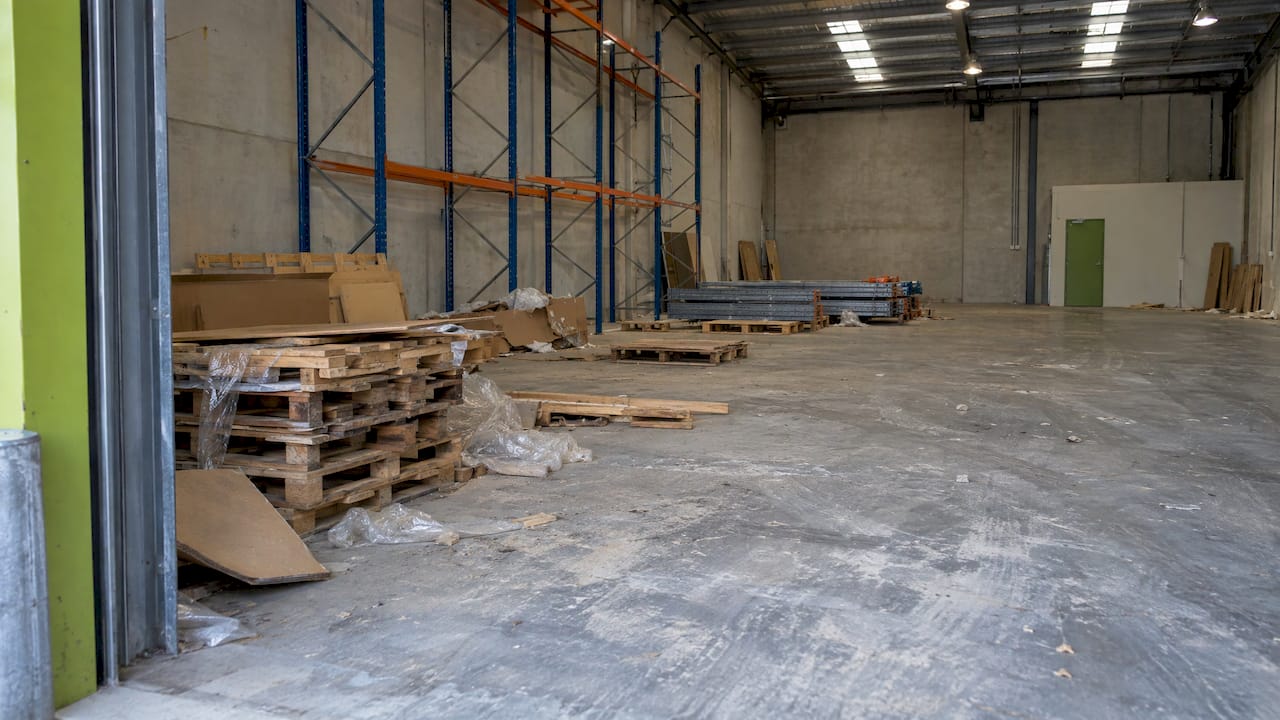
Rubbish rules matter most at handover. A warehouse occupier leaving a lease often has leftover pallets, packaging, dunnage, old racking offcuts and a floor covered in dust and residue. The same duty of care applies to that waste. Check the make-good clause in your lease, separate hazardous items for correct disposal, and arrange lawful removal for the rest.
How Sydney Sweep and Scrub helps
We are a family-owned Sydney business that cleans warehouses, carparks, construction sites and public spaces. Our rubbish removal service sits alongside mechanical sweeping, scrubbing and pressure washing, so loose waste, dust and residue can be dealt with in the one visit. For property managers and strata, that means fewer contractors to coordinate.
If you manage a warehouse or are finishing a lease, see our end of lease commercial cleaning. For carparks, see carpark cleaning. You can request a quote or book online through the site. Tell us what is on site and when you need it done, and we will plan the job around it.
FAQ
Does my council have to collect my business rubbish?
No. In most areas councils are not required to collect commercial waste. Some, such as Central Coast and Camden in NSW, offer an optional service, while the City of Sydney expects businesses to arrange their own. Check your own council’s business waste page.
Am I still responsible if a contractor takes my waste?
Generally yes. Regulators such as Victoria’s EPA expect producers to take reasonable steps to make sure waste reaches an authorised facility. Using a reputable collector and keeping records is part of meeting that duty.
Can I put hazardous items in my general waste bin?
No. Chemicals, paints, e-waste, medical waste and liquids do not belong in general bins. They need classification and a lawful disposal pathway, and in some states tracking paperwork. Contact your state EPA if you are unsure.
What are the penalties for illegal dumping?
They vary by state. In South Australia, illegal disposal can bring fines up to $120,000 and up to two years’ imprisonment, and corporations can be fined up to $250,000.
Do the rules differ between states?
Yes. General duties of care are common, but licensing, permitting and tracking requirements differ between jurisdictions, as the NSW EPA’s guidelines note. Always use the rules for the state where the waste is produced and disposed of.
Sources
- Businesses and waste services, City of Sydney
- Commercial Waste, City of Fremantle
- Commercial waste, Central Coast Council
- Business Waste, Camden Council
- Better Practice Guidelines for Waste Management, NSW EPA
- Managing industrial waste: your duties as a waste producer, EPA Victoria
- Industrial waste publication 1825.1, EPA Victoria
- Waste Classification Guidelines Part 1, NSW EPA
- Waste producers’ tracking responsibilities, NSW EPA
- Waste tracking for waste transporters, EPA South Australia
- Waste tracking for waste producers, EPA South Australia
- Waste management for businesses, Service NSW
- Trade Waste Environmental Management Plan, Whitsunday Regional Council
- Hazardous waste: what cannot be included in general waste
- NSW/Vic/QLD waste levy rates increasing in July, Inside Waste