
The way to remove cobwebs from a car park is to work dry and from the top down: knock webs off ceilings, beams, light fittings and corners with a long-handled soft duster or rake-broom, then sweep and scrub the floor after the webs have fallen. Do it while managing vehicles, pedestrians and work at height, and repeat it on a regular cycle, because webs return wherever insects gather. This guide covers the tools, the order of work, the safety planning and the schedule, so you can run it in-house or brief a contractor properly.
TL;DR
- Work dry and high to low: remove webs from ceilings, light fittings, columns and corners first, then clean the floor.
- Use long-handled soft dusters, rake-brooms or a low-suction vacuum hose. Do not wash webs down with water first, because it smears them.
- Treat the car park as a live workplace: separate vehicles and pedestrians, check lighting and ventilation, and control any work at height.
- Webs come back where insects and light are. Cut the insect attraction, and put web removal on a fixed cycle.
- Finish with a sweep and scrub so fallen debris does not end up in drains or on vehicles.
Table of Contents
- Why cobwebs in a car park are worth dealing with
- Where cobwebs collect in a car park
- The right order of work: high to low, dry before wet
- Tools that work for different surfaces and heights
- Planning around vehicles, pedestrians and trading hours
- How to stop cobwebs returning
- How often to clear cobwebs
- Pairing cobweb removal with sweeping and scrubbing
- Doing it in-house or bringing in a contractor
- How Sydney Sweep and Scrub can help
- Frequently asked questions
- Sources
Why cobwebs in a car park are worth dealing with
A few webs in a corner look minor. A car park is different from a back shed, because every customer, tenant and visitor walks through it, and the ceiling is usually low enough to be seen. Webs gather dust, dead insects and grime, and they hang from the same surfaces that carry your lighting and signage. In a basement or undercover car park, grey, dusty webs along beams and light fittings read as neglect, and they tend to be the first thing a strata committee or building owner notices on an inspection walk.
There is also a practical side. Webs on light fittings and sensors can dull what the fitting delivers. Debris falls onto vehicles and the floor below. And in sheltered, dry corners, some spiders you would rather not meet at close range will settle in. The Australian Museum notes that redback spider webs are typically built in dry, sheltered spots, and an undercover car park offers plenty of those. That is a reason to wear gloves and keep hands out of crevices when you clean, rather than a reason to panic.
Where cobwebs collect in a car park
Walk the car park before you plan the clean. Webs concentrate in predictable places:
- Light fittings and fluorescent battens. Light attracts flying insects, and insects attract spiders. These are usually the worst spots.
- Ceiling-to-wall junctions and beam corners. Still air and shelter make these the longest-lasting web sites.
- Exposed services. Conduits, sprinkler pipes, cable trays and ducts give spiders plenty of anchor points.
- Entry and exit gates, boom gates and intercoms. Often lit, often sheltered, and highly visible to visitors.
- Stairwell and lift lobby ceilings. Low, bright and seen by everyone.
- Roof eaves and open-sided edges on multi-level and rooftop decks.
- Signage, bollards and bike racks. Webs here are low and easy, but they still show.
Note the locations that are above head height, because those drive the equipment and safety decisions further down.
The right order of work: high to low, dry before wet
The sequence matters more than the tool. Infection-control guidance from NSW Health’s Clinical Excellence Commission states that cleaning should proceed from high to low. That guidance is written for healthcare settings, but the principle is universal: anything you dislodge from above lands on surfaces below, so those surfaces get cleaned last.
For a car park, that means:
- Plan and set up traffic control and access equipment (see the safety section below).
- Remove webs from the ceiling level, including beams, light fittings, pipes and corners, using dry tools.
- Work down to walls, columns, signage, gates and barriers.
- Sweep the floor to collect fallen web, dust and dead insects.
- Scrub or pressure wash if the floor needs it, once the webs are gone.
- Inspect and note anything that needs a repair, not a clean.
Why you keep the tools dry
It is tempting to hit webs with a pressure washer or a wet cloth because it feels faster. It usually is not. Cleaning-industry guidance in the US recommends that cobweb dusters be used before any water-based cleaning, because water or bleach on webs can create a bigger mess that takes more effort to clear. Wet silk clumps, sticks to paint and concrete, and smears across surfaces. Knock it off dry, sweep it up, then wash.
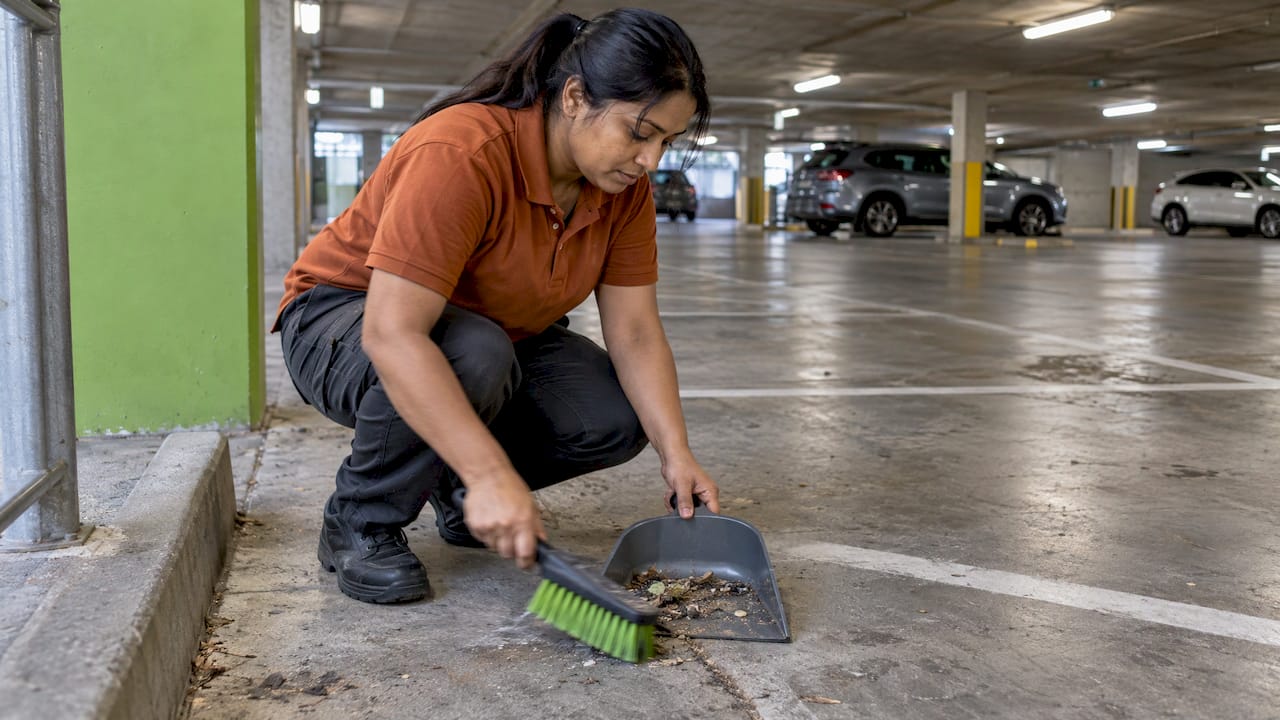
The same logic applies to dust control on the floor. The NSW Health guidance says that for dry dust control, gathered waste is picked up with a dustpan and brush and disposed of as general waste, rather than being pushed around or flicked into the air.
Tools that work for different surfaces and heights
No single tool covers a whole car park. Most crews use a small kit.
| Area | Suitable tool | Notes |
|---|---|---|
| Ceilings, beams, high corners | Telescopic pole with soft brush or duster | Keep it dry. An angle adapter helps in corners. |
| Tight corners and ceiling junctions | Rake-broom head with angle adapter | Designed to conform to corners and tight spaces. |
| Deep-seated webs in tight edges | Vacuum with hose and crevice tool, low suction | Good for delicate fittings and awkward edges. |
| Light fittings and covers | Soft duster, then a damp cloth only once the fitting is isolated and cool | Follow the site’s electrical safety rules. |
| Columns, walls, signage | Long-handled duster or soft broom | Work top to bottom. |
| Floor after webs are down | Mechanical sweeper, then scrubber | Collects debris without raising it into the air. |
Some specifics from product and trade information, so you know what is realistic:
- One Australian supplier states that a forward-pointing rake-broom head with an angle adapter follows corners, ceilings and tight spaces, and that a 1.4-metre telescopic handle gives roughly 3.4 metres of reach once you add the operator’s own reach. That covers many undercover car park ceilings from the ground, though not every one.
- Cleaning-trade guides agree on the vacuum option. A vacuum hose with a crevice tool at low suction suits tight edges and delicate areas, with the work moving from the top downward.
- A vacuum with a hose attachment is a suitable back-up for deep-seated webs in hard-to-clean corners of carports and garages, with a duster still the primary tool.
If the ceiling is higher than a pole will reach, stop and read the next section. The answer is rarely a ladder.
Planning around vehicles, pedestrians and trading hours
A car park is a workplace, and it stays one while you clean it. WorkSafe Victoria’s guidance says to identify and control car park hazards before work starts, including vehicle and pedestrian movement, slips, trips and falls, lighting and airborne contaminants. Its controls include separating vehicles and pedestrians with barriers or marked walkways, providing adequate lighting and ventilation, and providing PPE where needed. It is a Victorian regulator’s page, so check the equivalent requirements of SafeWork NSW for sites in Sydney, but the hazards are the same everywhere.
A practical pre-clean checklist
- Choose the window. Early mornings, weekends and low-occupancy periods reduce conflict with vehicles. For retail and commercial buildings, plan around peak arrival and departure times.
- Close zones, not the whole car park. Where practicable, close the lane, bay block or level being worked, and keep entry and exit routes clear for everyone else.
- Use traffic management. Cleaning-industry guidance for Australian car parks recommends high-visibility clothing and closing lanes or levels for machine or wet work where practicable, and says blind ramps or corners should not be worked without barriers or a spotter.
- Protect loading and pick-up areas. WorkSafe Victoria suggests a traffic management plan for loading areas and customer parcel pick-up zones. Treat them as separate work zones.
- Warn occupants. Notify tenants and residents in advance, especially strata buildings with allocated bays, so cars can be moved or covered if debris is a concern.
- Check ventilation. In enclosed basements, limit time spent near idling vehicles and make sure the ventilation system is running during the task, as one Australian cleaning guide advises.
- Check lighting. If lights are out, you cannot see webs, hazards or people. Report failures before work begins.
Work at height: choose the lowest-risk method
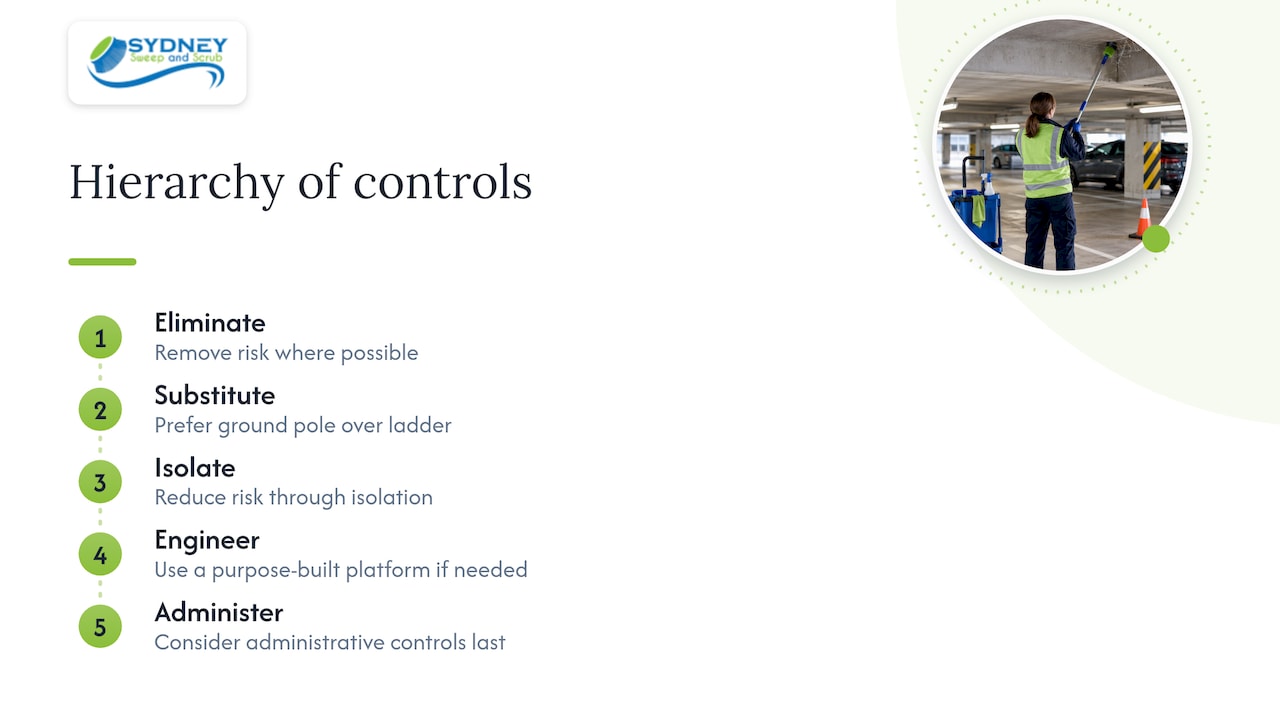
Many webs sit above reach. SafeWork NSW says work health and safety laws require a business to use the hierarchy of control: eliminate the risk where possible, then reduce it through substitution, isolation and engineering controls, and consider administrative controls last. In practice, that means preferring a pole from the ground over a ladder, and a purpose-built elevated work platform over a ladder when you cannot reach from the ground.
The same page warns that many workers fall from A-frame stepladders because they work from the top steps or over-reach. If webs are on high light fittings or ductwork, do not improvise with a stepladder and a broom. Ask a contractor who has the access equipment and the training. The person to see about your obligations is your building’s WHS adviser, or SafeWork NSW for sites in New South Wales.
Report, do not just clean
A cleaning round is a free inspection. The same Australian guide advises cleaners to report faded line markings rather than clean over them, and to report failed lights, damaged barriers or columns, and lifted drain covers. Ask your cleaners to do this. A failed light often explains a spider problem and a safety problem at the same time.
How to stop cobwebs returning
You can clear a car park on Monday and see webs by the following month. That is normal, and the cause is usually the insects, not the cleaning.
Cleaning-industry commentary on this explains the cycle. A Gold Coast provider says outdoor lighting and nearby flying insects attract spiders, and that reducing unnecessary lighting or switching to globes that attract fewer insects, alongside regular removal, can reduce web activity. Brushing a web away is temporary if the food source remains. That is a trade view rather than a regulator’s finding, so treat it as a sensible starting point and watch your own results.
A workable prevention plan:
- Audit lighting. Turn off lights in zones that do not need to be lit overnight, where safety and your insurer allow it. Ask your electrician about lamp types that attract fewer insects.
- Keep lights clean. Dirty, dusty fittings and the dead insects in them are a food supply.
- Control insect entry. Seal gaps, keep roller doors and gates closed when not needed, and manage rubbish and organic waste near entrances. Rubbish areas draw insects, and insects draw spiders.
- Remove webs on a regular cycle, so they do not build into thick, dusty curtains.
- Consider a protective treatment. A UK cleaning supplier suggests combining mechanical removal with a temporary protective treatment applied with a low-pressure sprayer in a dry spell to discourage re-attachment. Check any product against the site’s rules, the surfaces involved and its safety data sheet first.
One observation from the same source: webs keep reappearing in the same places, such as near outdoor lights and roof eaves, because those spots offer shelter and insects. So concentrate your effort there rather than spreading it evenly.
How often to clear cobwebs
There is no statutory frequency for cobweb removal in a car park. Cleaning guidance for Australian car parks says high-level cobweb, dust and bird-dropping removal belongs on a periodic cycle, separate from the routine floor sweep. Use the following as a way to set your own, not as a rule:
| Car park type | Reasonable starting point |
|---|---|
| Retail, hospital or high-visibility commercial car park | Include high-level web removal in every scheduled deep clean, and spot-check between cleans |
| Residential strata basement | Include it in the periodic sweep and scrub, and after any wet spell that has brought insects in |
| Open or semi-open decks, near bushland or water | Shorter intervals, because insect numbers are higher |
| Low-use staff or industrial car parks | Longer intervals, with a visual check built into routine inspections |
Then adjust. If webs return fully within weeks at one light cluster, shorten the cycle there or fix the cause. If a zone stays clear for months, lengthen it. Keep a simple record of date, area, method and what you found, because it also supports your position if a safety question is ever asked.
Pairing cobweb removal with sweeping and scrubbing
Web removal on its own leaves fallen debris, dust and insect remains on the ground. It works best as the first step of a full clean. After the high-level work, a machine sweep lifts the dry debris and a scrub removes oil, tyre marks, mud and other grime. If you are weighing up the order and the machines involved, our notes on removing dirt and dust from a car park and carpark sweeping set out how the floor stage fits in.
Seasons matter as well. Spring and summer bring more insects and therefore more webs, while storms and wet weather bring in mud and leaf litter. Timing the high-level clean just before your main floor clean means one visit handles both, with less disruption to occupants. For a broader look at what ends up on the floor, see common carpark contaminants.
Doing it in-house or bringing in a contractor
In-house work suits a small, single-level open car park with low ceilings, where a pole and a vacuum cover everything from the ground. It stops making sense when any of these apply:
- Ceilings, beams or fittings are beyond pole reach and need access equipment.
- The car park is busy, so you need traffic management and barriers.
- It is an enclosed basement with ventilation and air-quality considerations.
- You want a documented, repeatable service and one visit that also sweeps and scrubs the floor.
- Your staff would be doing it on top of other duties, without the right training or PPE.
For a closer look at that decision, we have written about professional carpark cleaning versus in-house cleaning, and about why regular cleaning points to a professional organisation.
What to ask a contractor
- How will they handle work at height, and what access equipment do they use?
- What traffic and pedestrian controls will they set up, and who supplies them?
- Do they work dry first, then sweep and scrub?
- Will they report faded line markings, failed lights and damaged drain covers?
- Can they work out of hours and give you a written record of what was done?
- What happens to the waste they collect?
How Sydney Sweep and Scrub can help
We are a family-owned Sydney business that cleans car parks, warehouses and public spaces with mechanical sweepers, scrubbers and pressure washing equipment. For property managers, strata managers and building owners, we can fold the high-level clean into a full carpark cleaning visit: sweeping, scrubbing and, where it suits, line marking, scheduled around your occupants. We also run optional recurring maintenance for larger facilities, and our booking process is online. Our services do not have published prices, so ask for a quote with your car park’s size, levels and access details. If you are managing several types of site, our Commercial Cleaning and Warehouse Cleaning pages cover the other parts of your portfolio.
Frequently asked questions
What is the easiest way to remove spider webs in a car park?
Use a dry, long-handled soft duster or rake-broom to take webs off ceilings, corners and fittings, working from the top down. Follow with a vacuum hose on low suction for tight edges, then sweep the fallen debris from the floor. Avoid spraying webs with water first, because it makes them clump and smear.
Can I pressure wash cobwebs off a car park ceiling?
It is better not to. Trade guidance says dusters should be used before any water-based cleaning, because water turns webs into a bigger mess. Dry removal first, then wash the floor and any grimy surfaces afterwards. Pressure washing near light fittings and electrical equipment also needs isolation and proper controls.
Why do spider webs keep coming back in my car park?
Because the insects that spiders feed on keep arriving, usually drawn by lighting and by sheltered, warm corners. Removing webs without addressing lighting, gaps and waste leaves the food supply intact. Combine regular removal with lighting changes and tidier entry points.
How often should cobwebs be removed from a car park?
There is no fixed legal interval, but high-level web removal should be on a regular cycle rather than done only when someone complains. Many managers tie it to their periodic deep clean and adjust the frequency according to how fast webs return at each hot spot.
Is it safe for staff to clear cobwebs themselves?
From ground level with a pole, in a quiet car park with good lighting, usually yes. Once work needs a ladder, traffic management or an enclosed, poorly ventilated basement, bring in trained people and talk to your WHS adviser or SafeWork NSW about your duties.
Sources
- Module 3: Work procedures for cleaning, NSW Clinical Excellence Commission
- Safety in workplace car parks, WorkSafe Victoria
- Working at heights, SafeWork NSW
- Spider webs, The Australian Museum
- Rake Broom Corner Cobweb Broom, Eurolux Australia
- How to remove cobwebs, Pressure Washing School
- How to clean cobwebs, JBN Cleaning
- How to clean cobwebs, KanKlean
- Car park cleaning: schedules, safe methods and records, SiteClara
- Why spider webs keep coming back, CPH Services
- How to remove cobwebs from buildings, Huchem