
In practice, yes: if you pressure wash a commercial or industrial site in Australia, you need to collect the wastewater. No single national rule says “reclaim your wash water”. The obligation comes from state and council rules that stop wash water reaching stormwater drains, and the only reliable way to meet them is to capture the water and then reuse it, send it to sewer with approval, or have a licensed contractor take it away. This guide covers what the rules say, how recovery works on a carpark, warehouse or footpath, what you can reuse, and what to check before you sign off a job.
TL;DR
- Stormwater drains are for rain. NSW EPA guidance says runoff from washing must not enter them, and other states say the same.
- Recovery means blocking drains, containing the work area, and vacuuming or pumping the water into a tank or treatment unit.
- Recovered water goes one of three ways: reuse after treatment, sewer discharge with the water authority’s approval, or collection by a licensed liquid waste contractor.
- Oil, detergents and chemicals change the answer. Dirt-only water is treated differently from water carrying oil or cleaning agents.
- Ask any contractor how they block drains, what they capture with, and where the water ends up. Get it in the quote.
Table of Contents
- Do you have to recover pressure washing wastewater?
- What is actually in the water
- How recovery works on site
- Can you reuse the recovered water?
- Disposal when you cannot reuse it
- A pre-job checklist for property and facility managers
- Where recovery matters most
- How we handle it
- FAQ
- Sources
Do you have to recover pressure washing wastewater?
The wording of the law differs by state, but the direction does not. Wash water is treated as a pollutant, and the offence is letting it reach drains, waterways or soil, not skipping a particular piece of equipment.
- NSW: the EPA says runoff from washing activities must not enter stormwater drains, and that washing should happen in a designated wash bay. Wastewater should go to sewer with council trade-waste approval, or be treated and possibly recycled (NSW EPA).
- Victoria: EPA Victoria states that wastewater from commercial or industrial washing of vehicles and equipment is industrial waste, and that discharging industrial waste to stormwater is an offence (EPA Victoria).
- Queensland: Tablelands Regional Council says pressure-cleaning wastewater is a prescribed water contaminant under Schedule 10 of the Environmental Protection Regulation 2014, and that section 440ZG of the Environmental Protection Act 1994 makes it unlawful to let it into roadside gutters or stormwater systems, with significant fines (Tablelands Regional Council).
- South Australia: the EPA lists high-pressure water-blasting waste, detergents, oil, grease and equipment washdown water as Class 1 pollutants that must not be placed on land where they may enter waters, including stormwater (SA EPA).
Why the strictness? The SA EPA notes that stormwater generally flows untreated to creeks, rivers, groundwater, wetlands and the sea, carrying whatever it picked up outdoors. A carpark wash that looks like harmless grey water is carrying oil, rubber, sediment and detergent into that system.
So “recover” is the practical name for “comply”. Confirm the specifics with your local council or state EPA, because trade-waste and stormwater rules sit at council and water-authority level.
What is actually in the water
The contaminants decide how the water can be handled. Cairns Regional Council lists suspended or dissolved solids, sediment, oils, chemicals, PFAS, building materials, and wastewater with a pH outside 6.5 to 8.5 as typical concerns (Cairns Regional Council). It also names high-pressure water blasting of commercial or industrial premises, fuel areas, plant, equipment, roofs, streets and vehicles as outdoor-cleaning sources.
In plain terms, sites fall into two groups:
| Site type | Typical contaminants | Handling direction |
|---|---|---|
| Footpaths, paving, building facades | Soil, dust, organic matter, some gum and grime | Collect; lower-risk, but still kept out of drains |
| Carparks, loading docks, warehouse floors, fuel areas | Oil, grease, rubber, detergent, heavy sediment | Collect; filter or separate oil; sewer with approval or licensed removal |
Logan City Council draws the same line: water with only soil and organic matter may be directed to a garden or grassed area where appropriate, while water containing oil or chemicals must be collected by a waste company (Logan City Council). Do not treat that as a licence on a commercial site. Check your own council first.
How recovery works on site
Good recovery is mostly preparation. The vacuum is the last step, not the first.
1. Map the drains before anything is wet
Cairns Regional Council advises knowing where drains and waterways are, collecting all wastewater, avoiding harmful or toxic chemicals, keeping containment gear such as spill kits, and using erosion and sediment controls (Cairns Regional Council). On a Sydney carpark that means walking every level, finding every grated gully, and noting where a ramp sends water.
2. Block and bund
WA’s Water Quality Protection Note 29 recommends barriers that prevent discharge into stormwater drains and, where practicable, cleaning at least 100 metres from estuaries, waterways or wetlands. It also says temporary plugs or plastic membranes can block grated gullies so wash water and sediment are recovered rather than released (WA Government). Sandbags and portable bunds do the same job around a drain, as Tablelands Regional Council notes.
3. Contain the work area
The WA note describes flat, impervious spill mats with raised perimeter bunds or depressed edges, with captured runoff mopped or pumped into recovery drums. EPA Victoria recommends a roofed, bunded wash bay connected to sewer through a water/oil separator under a trade-waste agreement, or a mobile wash mat for collection, sewer disposal or reuse.
For a fixed site you wash regularly, such as a workshop apron or a loading bay, a purpose-built wash bay is worth the conversation. For a one-off or periodic clean of a carpark or footpath, mobile containment and vacuum recovery is the realistic option.
4. Vacuum or pump as you go
Mobile contractors typically use a vacuum or reclaim unit that draws the water up behind the wash head. Water goes into a holding tank on the truck or trailer, and the solids settle out. Recovering continuously, rather than letting a pool form and cleaning it up later, is what keeps the water out of cracks, joints and drains.
5. Finish the surface
Sweep or vacuum the residue left on the surface once the wash is done. Fine sediment dries into dust that the next rain will carry into the drain. Mechanical sweeping first also reduces how much grit ends up in the recovered water, which is easier on filters and tanks. Our mechanical sweeping service is often used for exactly that first pass.
Can you reuse the recovered water?
Sometimes, once it has been treated. WA guidance says treated water may be reused or recycled after solvents, oils, greases and tars are removed by filtration or chemical separation (WA Government). One WA regulatory decision describes a treatment train of flocculation, oil and hydrocarbon removal, filtration and ozonation, judged sufficient for discharge of treated water to an approved sewer connection (WA DWER).
Three practical points for reuse:
- Reuse is for rinsing and pre-wash, not for the final clean. Intended use drives how clean the water must be. The Australian Guidelines for Water Recycling set out a risk-management framework that considers the source water, the intended uses and the exposure routes.
- Reuse systems need maintenance. Screens, settlement areas, tanks, filters and pumps need routine inspection and servicing, accumulated oil and sludge must be removed, and quality should be monitored for the intended reuse (Trade Wash).
- Sludge is still waste. Whatever the system captures has to go somewhere lawful.
The water saving is real, and it matters on large sites. Our note on saving water in industrial cleaning covers why less water per square metre helps your bill and your compliance position.
Disposal when you cannot reuse it
There are three lawful paths, and the contaminants decide which applies.
To sewer, with approval
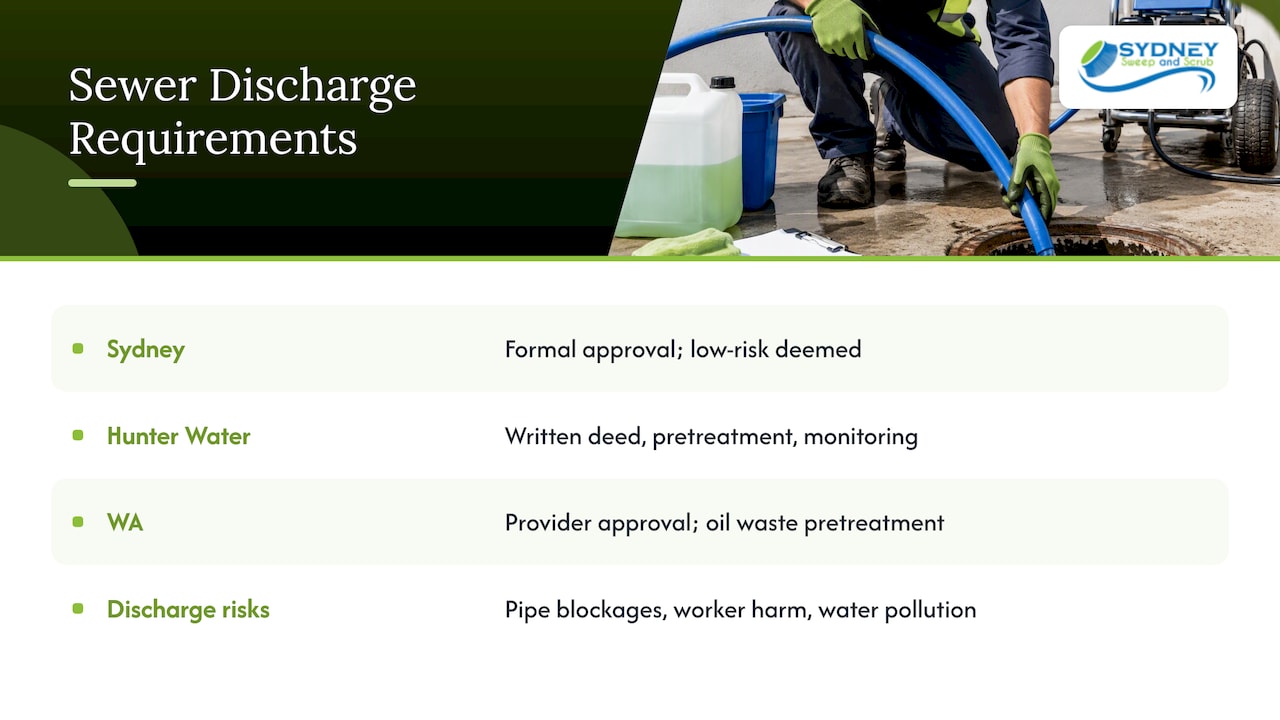
Sewer discharge is not automatic. In Sydney, businesses must seek formal approval to discharge commercial trade wastewater, although low-risk processes are “deemed” and need no formal approval (Sydney Water). In the Hunter Water area, operators need written approval through a trade-waste deed, and Hunter Water names pressure sprays among the businesses producing trade wastewater, with pretreatment and compliance monitoring required (Hunter Water).
The WA note adds that water containing oil or engine-flushing waste should pass through oil separation, dissolved-air flotation or chemical flocculation before sewer discharge, and that the sewerage provider must approve it. NSW EPA explains why: solvents, oils, coolant, paints, dirt and road grime can block sewer pipes, harm sewerage workers and affect treatment, and some pass through treatment plants into rivers or oceans (NSW EPA).
To a licensed liquid waste contractor
When water is too contaminated, or no sewer approval exists, it is held in a tank and taken away. A WA decision report describes industrial wash water stored in two 32,000-litre tanks until enough accumulates for transport to a licensed liquid-waste facility, classed as L150 waste (WA DWER). Queensland councils likewise say to collect pressure-cleaning wastewater and dispose of it lawfully, using suitable containment or a regulated-waste transporter.
Onto soil or garden
This is a narrow exception, not a default. Logan’s allowance applies to water carrying only soil and organic matter, “where appropriate”. Do not use it on a carpark, warehouse or any surface with oil, fuel or chemicals, and do not assume it is accepted in your council area.
A pre-job checklist for property and facility managers
The NSW EPA’s own summary of what to check is a good base: where stormwater drains and water bodies are, whether a designated wash bay is available, whether sewer discharge has council trade-waste approval or whether treatment and recycling are possible, and whether maintenance, waste removal and staff training are covered. Turn that into questions for your contractor:
- Where are the drains? They should be able to point to each one on your site and say how each will be blocked.
- What captures the water? Vacuum recovery, mats, bunds, or a wash bay. “We keep it away from the drain” is not a method.
- Where does the water finish up? Reused, sewer with approval, or licensed removal. Ask for the name of the approval or the transporter.
- What chemicals are used? Detergents and degreasers change the disposal route. Our hot water pressure cleaning often lets you cut chemical use on oily surfaces.
- What is left on the surface? Sludge and grit should be removed, not rinsed to the edge.
- What is in the quote? Recovery, tank handling and disposal are real costs. A price that ignores them is cheap for a reason. Our guide to commercial pressure washing costs explains what to expect on a request for quote.
Our five wastewater checks for Australian businesses goes through the same ground from the business owner’s side, and our piece on stopping pollutants before they reach stormwater covers prevention between washes.
Where recovery matters most
Carparks
Carparks combine oil drips, tyre residue and multiple drain points, usually on ramps that run straight to the gully. For strata and building owners, recovery planning is the main difference between a clean that passes and a clean that creates a pollution incident. Read how we use pressure washers on Sydney carparks.
Warehouses and end-of-lease cleans
Floors carry forklift oil, tyre marks and chemical residue. Washing inside a building does not remove the obligation: floor drains often connect to the sewer or stormwater system, and trade-waste conditions may apply. At end of lease, a landlord will not want a pollution issue on the handover, so recovery needs to be planned before the first wash.
Footpaths and public space
Open pavements have no bund, so the water has to be contained with mats and barriers and recovered as the wash head moves. A contained approach is what makes the work acceptable beside kerbs and gutters.
How we handle it
We are a family-owned Sydney business, and wastewater control is part of how we run pressure washing for carparks, warehouses, construction sites and public spaces. We combine mechanical sweeping, scrubbing and pressure washing with an eco-friendly approach, so the dry material is removed first and less ends up in the water. If you manage a carpark or warehouse and want the recovery method written into the scope, request a quote through our site or look at our carpark cleaning and warehouse cleaning pages.
FAQ
Do you have to reclaim water from pressure washing?
You have to keep it out of stormwater drains, and on commercial sites that in practice means collecting it. NSW, Victoria, Queensland and South Australia all treat the wash water as a pollutant. What you then do with it, reuse, sewer with approval, or licensed removal, depends on what is in it.
Can pressure washing water go down the drain?
Not the stormwater drain. The sewer is possible only with approval from the water authority, such as a trade-waste approval in the Sydney Water or Hunter Water areas, and oily water usually needs pretreatment first.
Who is responsible if a contractor lets wash water into a drain?
The rules target whoever allows the discharge, and a site owner or manager can be drawn in. Check your contractor’s containment method and disposal route before work starts, and keep it in writing. Your council or state EPA can confirm how this applies to your site.
What should I do about wastewater after pressure washing?
Remove the water and sludge from the surface, then send it down one lawful path: treated reuse, sewer with approval, or a licensed liquid waste contractor. Sweep or vacuum fine residue so rain does not carry it into the drain later.
Sources
- NSW EPA: Guidance for stormwater management, the drain is just for rain
- EPA Victoria: Keeping our waterways clean
- Tablelands Regional Council: Water pressure cleaning
- SA EPA: Around the home
- Cairns Regional Council: Reducing water contamination and runoff
- Logan City Council: Water pollution
- WA Government: Mobile mechanical servicing and cleaning
- WA DWER: licence amendment report
- WA DWER: decision report W6921
- Australian Guidelines for Water Recycling
- Trade Wash: wash water recycling systems
- Sydney Water: commercial trade wastewater
- Hunter Water: managing trade waste
- NSW EPA: smash repair industry