
Mechanical sweeping is the better choice for large areas of dry, bulky debris, such as warehouse floors, car parks, yards and footpaths. An industrial vacuum is the better choice for fine, hazardous or airborne dust, where capturing the particles matters more than covering ground quickly. Most busy commercial sites need both at different times, and the right call depends on what is on the floor, not on which machine sounds more powerful.
This guide is for property managers, strata managers, warehouse occupiers and site supervisors who have to decide what to book or specify. It covers how each method works, where each one falls short, what Australian regulators say about dust, and how the two are combined in practice.
TL;DR
- Mechanical (broom) sweepers brush debris onto a conveyor and into a hopper. They are fast and economical on large, dry, repetitive areas, but they are limited with fine sediment.
- Vacuum-based machines use suction and filtration, so they suit fine dust and sites where airborne dust is a concern.
- Hazardous dust such as silica or asbestos is a different category: dry sweeping is not acceptable, and the vacuum must be an M-class or H-class unit, not a household or standard machine.
- Wet spills, tyre film and embedded grime call for scrubbing, not just sweeping or vacuuming.
- A sweep first, then finer clean-up sequence is common and often gives the best result.
Table of Contents
- How the two methods actually work
- Mechanical sweeping vs vacuum at a glance
- When mechanical sweeping is the right tool
- When a vacuum is the better answer
- Hazardous dust: the rules change
- Wet spills, tyre film and grime: sweeping and vacuuming are not enough
- Combining the methods
- Choosing for your site: five questions
- End-of-lease warehouse cleaning
- Book sweeping and scrubbing across Sydney
- FAQ
- Sources
How the two methods actually work
The words “sweeper” and “vacuum” get used loosely, so it helps to pin down the mechanics.
A mechanical broom sweeper uses a rotating broom to push debris onto a conveyor and into a hopper, while a vacuum sweeper uses suction and high-velocity airflow to draw material into the hopper. In plain terms: one flicks and carries, the other lifts and filters.
That difference shapes everything else:
- Brushes are good at picking up gravel, packaging offcuts, leaves, cans, pallet splinters and the general litter that builds up in a loading dock or car park.
- Suction and filtration are good at the fine layer that brushes tend to flick back into the air or leave in the pores of the concrete.
A broom sweeper working through dry dust can raise a visible cloud. That is acceptable in an open car park and a problem in an enclosed warehouse with stock, forklift operators and people breathing the air.
You will also see small domestic gadgets in the search results for this phrase: electric floor sweepers, robot vacuums and vacuum mops. They are a different class of equipment, built for homes. Commercial and industrial floors, where a single bay can be thousands of square metres, are a different job, and that is what this article covers.
Mechanical sweeping vs vacuum at a glance
| Factor | Mechanical sweeping | Industrial vacuum or vacuum sweeping |
|---|---|---|
| Best debris | Bulky, dry: litter, gravel, offcuts, leaves | Fine dust, powders, airborne particulate |
| Coverage rate | High on open, large areas | Lower per pass on large floors, depends on machine size |
| Dust control | Limited, can disturb fine dust | Strong, with the right filter |
| Wet debris | Can handle some damp material | Wet-capable models exist, but dry units must not be used on liquids |
| Hazardous dust (silica, asbestos) | Not suitable | Only certified M- or H-class units |
| Typical sites | Car parks, yards, depots, footpaths, warehouse aisles | Production areas, dusty warehouses, plant rooms, post-works clean-up |
| Ongoing upkeep | Brush and conveyor wear | Filter cleaning, testing and disposal procedures |
Treat this as a starting point. Machine size, brush type and filter grade change the picture, and a good operator matters as much as the machine.
When mechanical sweeping is the right tool
US federal guidance on pollution control notes that mechanical sweepers suit commercial districts, industrial sites and parking areas, pick up large debris and work on wet streets at lower cost, but struggle to remove fine sediment. That matches what we see on Sydney sites.
Mechanical sweeping is usually the right first choice when:
- The area is large and open. Basement and rooftop car parks, hardstand, container yards, truck turnaround areas and long footpaths.
- The debris is mostly coarse. Leaf litter, bottle caps, cigarette butts, strapping, shrink wrap and broken pallet timber.
- The job repeats. A stable debris profile on a regular route is where a brush sweeper earns its keep, because the same settings work visit after visit.
- The site is outdoors or well ventilated. Any dust raised has somewhere to go.
- Budget matters. Covering a lot of area per hour is what keeps the cost per square metre down.
It is also the first step before a deeper clean. If you plan to pressure wash or scrub a car park, removing the loose material first stops gravel and litter blocking drains and scratching the surface. Our car park sweeping service and mechanical sweeping service are built around exactly this: scheduled, repeatable passes that keep the site presentable and the walkways clear.
For recurring work, ask how often the area really needs it. We cover that in how often to clean your warehouse floors.
When a vacuum is the better answer
Vacuuming comes into its own where the problem is what you cannot see easily: fine dust that hangs in the air, settles on stock and gets breathed in.
Industry guidance for Australian warehouses points out that vacuum sweepers are preferred where dust volumes are significant, because suction and filtration reduce the dust released during cleaning. Typical examples:
- Food, pharmaceutical and packaging environments where dust can contaminate product.
- Warehouses handling cement, flour, powders, plaster or timber products.
- Enclosed spaces with poor air movement.
- Clean-ups after grinding, cutting or construction work.
The trade-off is upkeep. Filters clog and need regular cleaning, and what is collected has to be emptied and disposed of in a controlled way. A machine that captures dust but releases it at the bin only moves the hazard to another place.
Our article on high-dust industrial sweeping and air quality goes deeper on how we approach dusty sites.
Hazardous dust: the rules change
This is where “mechanical sweeping vs vacuum” stops being a matter of preference. If the dust could contain silica, asbestos or other hazardous material, the method is dictated by work health and safety guidance, and the wrong choice can put people at risk.
In Australia, industrial vacuums and dust extractors for hazardous dust are classed L, M or H under AS/NZS 60335.2.69, and H-class units are suitable for asbestos, carcinogens, pathogens and respirable crystalline silica.
For silica specifically, SafeWork NSW recommends low-pressure water, wet sweeping or an M- or H-class vacuum, and prohibits dry sweeping and household vacuum cleaners, even those with a HEPA filter.
For asbestos, Queensland guidance specifies an H-class vacuum followed by wet wiping, with H-class filtration efficiency stated as 99.995%. The same document requires inspection and filter testing at least annually and maintenance logs.
What this means in practice:
- If you suspect asbestos or silica, stop and get advice first. Do not sweep, brush or use a standard vacuum. Contact a licensed asbestos assessor or removalist, or your WHS adviser, depending on the material.
- Do not assume a household or workshop vacuum is safe because it has a HEPA label.
- Ask for evidence that any contractor’s hazardous-dust vacuum is the right class and has current test records.
A general sweeping contractor deals with ordinary site dust and debris. Hazardous material needs a specialist who is licensed for it. Being clear about that boundary protects you as the person in control of the site.
Wet spills, tyre film and grime: sweeping and vacuuming are not enough
Many floors are not dry and dusty. They are greasy, stained with tyre marks, or sticky with spilled product. Neither a broom sweeper nor a dry vacuum fixes that.
A sweeper handles loose dirt and rubbish, while a scrubber uses liquid and brushes to lift dirt. Scrubbing also removes the dirty water, which leaves the floor cleaner and safer to walk on.
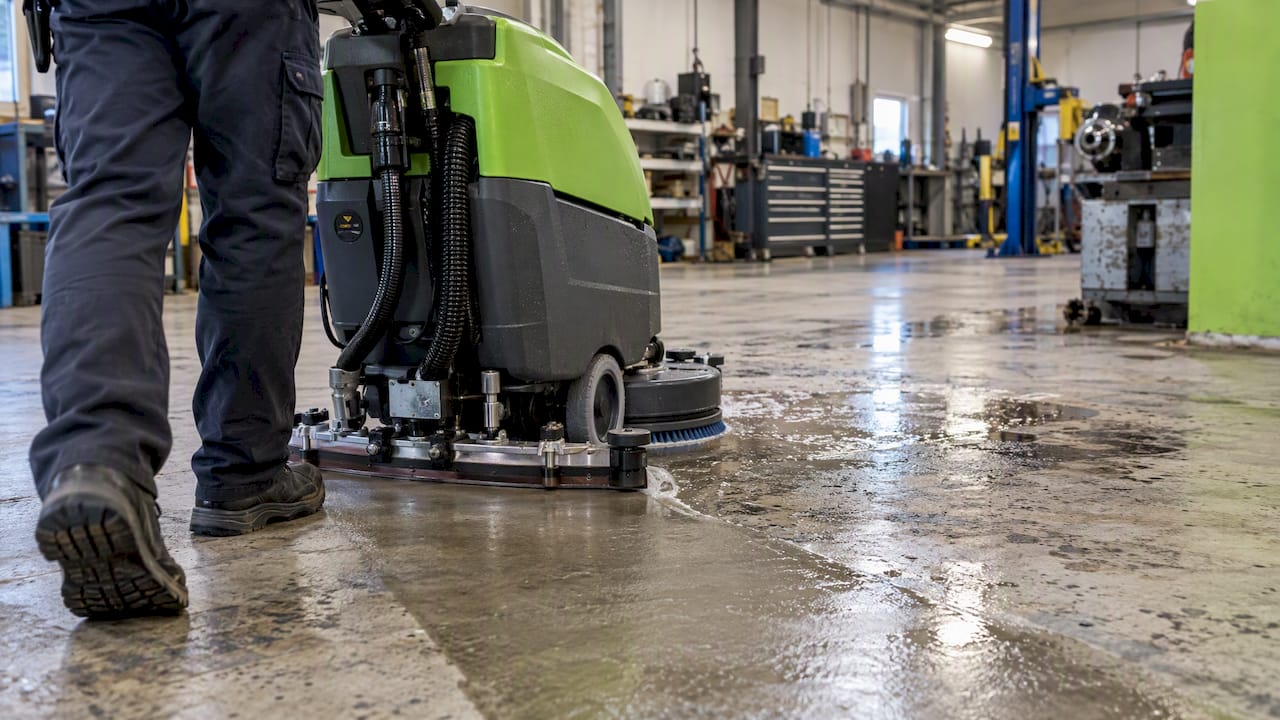
WorkSafe Queensland’s cleaning guidance makes the safety point plainly: choose methods based on the flooring and contaminants, respond quickly to spills, aim for clean and dry surfaces, and use barriers and signs where wet areas cannot be dried. Slips are one of the most common reasons a clean floor becomes a hazard, so how you clean matters as much as whether you do.
For oil, heavy staining or baked-on residue, pressure washing, including hot water, does what neither sweeping nor vacuuming can. See our pressure washing options and hot water pressure washing. If you manage the building envelope as well as the floors, specialists in exterior building washdowns in Sydney can handle the work at height while floor cleaning stays at ground level.
Combining the methods
The question is rarely either/or. Stormwater guidance from the US EPA notes that mechanical sweepers can remove large particles before a regenerative-air cleaner picks up finer sediment. Warehouses follow the same logic: a sweeper clears debris first, then a scrubber deals with fine dust and tyre film, as described in one Australian equipment guide.
WorkSafe Queensland’s cleaning guidance takes the same line, saying no single machine is right for every site and that a combination of methods may be appropriate.
A typical combined routine on a Sydney warehouse might look like this:
- Manually pick up strapping, tape, foil and timber splinters that could jam brushes.
- Mechanical sweep the aisles and loading areas to remove the bulk debris.
- Vacuum edges, racking bases and fine-dust zones that the sweeper cannot reach or should not disturb.
- Scrub where there is tyre film, spills or embedded grime.
- Check that the floor is dry, or signed and barricaded until it is.
Our comparison of sweep and scrub versus mop and bucket in warehouses shows why a machine-based approach beats manual cleaning on big floors.
Choosing for your site: five questions
No method wins in the abstract. The right comparison depends on the result you need, the debris profile, route length, access limits, operator skill and maintenance support. Work through these questions:
- What is on the floor? Coarse litter points to sweeping. Fine powder points to vacuum. Liquid or grime points to scrubbing or pressure washing. Unknown or suspect material points to testing first.
- Is the space enclosed? Enclosed spaces with people and stock need dust control. Open car parks are more forgiving.
- How big is the area, and how tight are the aisles? Choose the smallest machine that suits the floor type, aisle width, gradient and likely contamination. A machine too large to turn in the aisle wastes time.
- How often does it need doing? Predictable debris suits a regular schedule and a sweeper. One-off clean-ups after works suit a combined approach.
- Who owns the upkeep? Filters, brushes and test records all cost time. Owning a machine means owning that burden; hiring a contractor moves it off your plate. We explain that trade-off in why hire a contractor instead of buying a machine.
When estimating how long a job will take, be realistic about machine output. Manufacturer guidance suggests subtracting 30% to 50% from the theoretical area performance to allow for interruptions and the fact that machines do not travel in perfectly straight lines.
End-of-lease warehouse cleaning
If you are handing back a warehouse, the same logic applies, with a few extra points.
- Remove the awkward items by hand first. Foil residue, packaging tape and wood splinters can clog machines or wrap around a roller brush, so they should be taken out manually.
- Sweep, then scrub. Sweeping clears the bulk, and scrubbing deals with forklift tyre marks, oil and product spills so the floor is presentable at the inspection.
- Check your lease. Make-good clauses vary, so read what your lease requires and what condition report you were given at the start.
- Allow for post-refurbishment dust. After fit-out removal or concrete work, fine dust is common. Our post-refurbishment sweep and scrub page explains the process, and if the work involved cutting or grinding of silica-containing material, the hazardous dust rules above apply.
We cover this service on our end of lease commercial cleaning page.
Book sweeping and scrubbing across Sydney
Sydney Sweep and Scrub is a family-owned business providing mechanical sweeping, scrubbing, pressure washing, rubbish removal and automated robotic cleaning for warehouses, car parks, construction sites, public spaces and event venues. We can inspect your site, tell you honestly which method or combination fits, and set up a one-off clean or a recurring schedule.
Start with our warehouse cleaning or car park cleaning pages, or request a quote and describe what is on your floor. Pricing is quoted per job, so we need the site size and condition first.
FAQ
Is a sweeper or a vacuum better for a warehouse?
It depends on the dust. For bulky, dry debris across large floors, a mechanical sweeper is usually faster and more economical. Where fine dust is a concern for stock or air quality, vacuum-based cleaning is preferred. Many warehouses use a sweeper first and finer methods after.
Can I dry sweep or use a normal vacuum for silica dust?
No. SafeWork NSW prohibits dry sweeping and household vacuum cleaners for silica dust, including those with a HEPA filter. It recommends low-pressure water, wet sweeping or an M- or H-class vacuum. If you are unsure what the dust contains, get WHS advice before cleaning.
What do L, M and H class mean on an industrial vacuum?
They are dust-class ratings under AS/NZS 60335.2.69 for vacuums used on hazardous dust. H-class is the highest and is suitable for asbestos and respirable crystalline silica. H-class units also need inspection and filter-efficiency testing at least annually under Queensland asbestos guidance.
Does a sweeper remove oil and tyre marks?
No. A sweeper collects loose dirt and rubbish. Oil, tyre film and embedded grime need scrubbing or pressure washing, and wet floors must be dried or signed off until safe to walk on.
Sources
- Street Sweeper vs. Industrial Sweeper: Key Differences
- Environmental Review Toolkit, FHWA
- Warehouse cleaning, Kärcher Australia
- Industrial vacuum cleaners and hazardous dust, WorkSafe Queensland
- Clean-up and disposal of silica dust, SafeWork NSW
- Maintenance, inspection and testing of H-Class vacuum cleaners, Queensland asbestos guidance
- Sweeper or scrubber: which is right for your job?, Kennards Hire
- Cleaning, WorkSafe Queensland
- Stormwater Best Management Practice: Parking Lot and Street Sweeping, US EPA
- Warehouse Cleaning Equipment Guide: Debris and Traffic
- Exterior building washdowns in Sydney