
Edges and corners are where commercial sites fail first. A sweeper or scrubber covers the open floor quickly, but silt, leaf litter, cigarette butts and grit pile up along kerbs, wall bases, column footings and drain surrounds, because that is where wind, traffic and water push them. The fix is a set order of work: remove loose debris first, treat the edge with the right tool for the surface, then wash only what needs washing and keep the water out of the stormwater drain. This guide covers how to do that in Sydney car parks, warehouses and public spaces, what to watch for on safety, and how often to schedule it.
It is written for property managers, strata committees, warehouse operators and anyone responsible for a commercial surface. If you are searching for lawn edging, this is not that guide: here, edging means the perimeter of paved, concrete and sealed surfaces.
TL;DR
- Edges and corners need their own step in the schedule. A machine pass down the middle of a car park or warehouse leaves the perimeter dirty.
- Always remove loose soil before wet cleaning. Washing first spreads grit and turns it into a film along the wall line.
- Use a side brush or a detail tool for edges, a power scrubber or pressure washer for stuck-on grime, and capture the wash water. In NSW it must not reach the stormwater system.
- Build-up at kerbs and corners is a slip and drainage risk, not only a looks problem. Inspect it on a routine, not after a complaint.
- Sweep on a regular cycle, deep clean the perimeter periodically, and respond to spills straight away.
Table of Contents
- Why edges and corners get dirty first
- Choose the tool for the edge
- The right order of work
- Edges and corners in car parks
- Edges and corners in warehouses
- Match the method to the surface and the soil
- Safety when cleaning edges in busy places
- Managing water, dust and runoff
- How often should edges and corners be cleaned?
- Common mistakes that leave dirt behind
- What we do at Sydney Sweep and Scrub
- FAQ
- Sources
Why edges and corners get dirty first
Wind, foot traffic and vehicle movement all push loose material outward until something stops it: a kerb, a wall, a bollard, a drain grate. Water does the same job. When rain or washdown water crosses a floor it carries fine soil to the lowest point and leaves it there as it dries. In a car park that means the wheel-stop line, the base of ramps and the pits around drains. In a warehouse it means the line where racking meets the wall, the area around dock doors and the corners behind pallets.
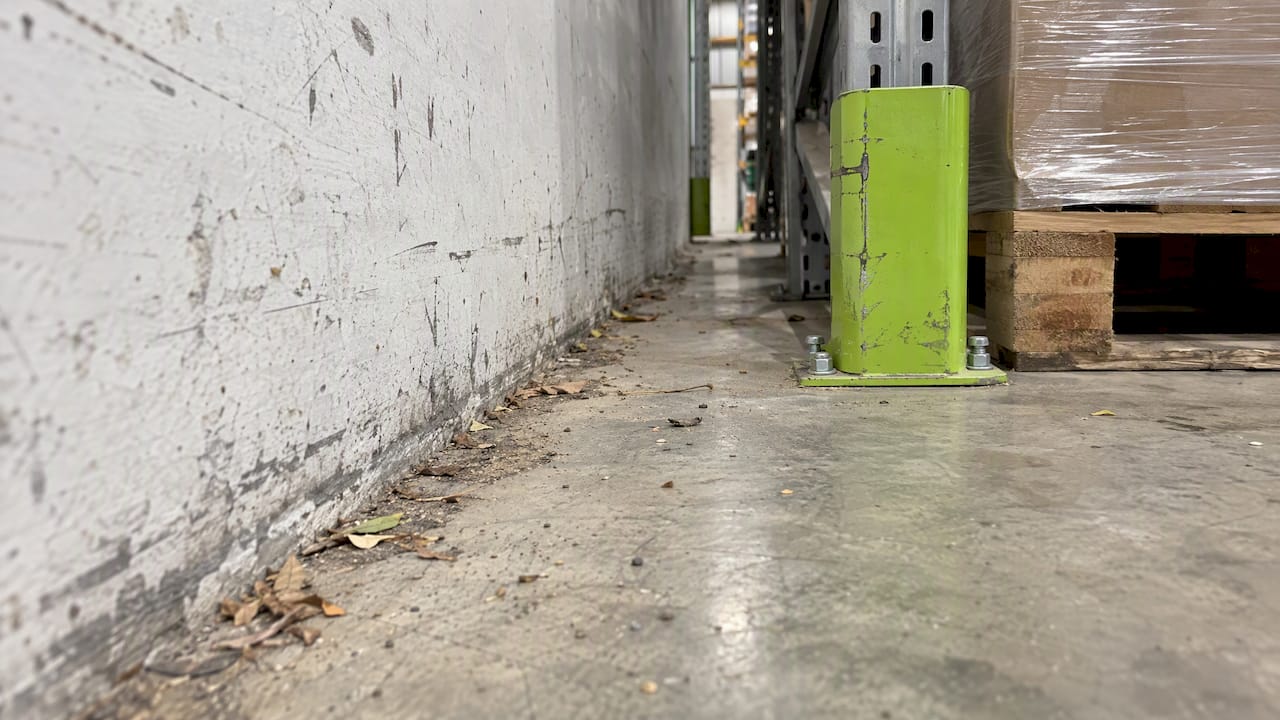
There is a practical reason this matters beyond appearance. Safe Work Australia’s model code of practice on managing the work environment and facilities says floors must be inspected regularly and maintained to eliminate or minimise slip and trip hazards, including uneven edges, broken surfaces and loose mats. Debris banked along an edge sits in exactly the place people step when they move aside for a vehicle or forklift.
Choose the tool for the edge
No single machine does everything. The usual mix on commercial sites looks like this.
| Situation | Suited tool | Why it works |
|---|---|---|
| Kerb lines and wall bases on open paved areas | Ride-on or truck sweeper with side brush | The side brush reaches past the machine’s main path to the edge |
| Tight corners, behind columns, around bollards | Push sweeper, blower and dustpan and brush, or a compact scrubber | Machines cannot turn into a 90 degree corner |
| Baked-on oil, gum, tyre marks and algae along edges | Pressure washing, hot or cold water | Lifts what dry brushing leaves behind |
| Stairs and stair edges | Hand-held power scrubber with squeegee | Combines pressure and brush action in a confined space |
| Warehouse floor perimeters | Ride-on scrubber-dryer plus manual detail pass | Machine handles the floor, a person handles the last few centimetres |
Kärcher Australia’s guidance on cleaning car parks and paths lists push sweepers, push vacuum sweepers and ride-on vacuum sweepers for outside areas, and notes that a ride-on sweeper’s side brush suits edges and corners. The right pick depends on the surface, the type of dirt and the size of the area. Kärcher also describes its PS 30 power scrubber as combining high-pressure jets with manual brush pressure and an integrated squeegee, and as ideal for stairs and edges.
The lesson is simple. Where a machine’s side brush can reach, use it. Where it cannot, someone has to finish by hand, and that step should be on the job sheet, not left to chance.
The right order of work
Most edge problems are order problems. Cleaning in the wrong sequence moves dirt around rather than removing it. This is the sequence we recommend for a commercial site.
- Walk and survey. Note spills, damaged edges, drain locations, vehicles or stock that must be moved, and any wet areas that need barriers.
- Pick up large debris. NSW Health’s work procedures for cleaning call for a rubbish picker to remove large items from external areas before sweeping with a broom in long, straight, overlapping strokes, which avoids stirring up dust.
- Move loose material. If you use an air blower, survey first and direct the chute so debris goes where you can collect it, then pick it up with a dustpan and brush for general waste, as the same NSW Health document describes. Blowing dust into open doorways or onto neighbours is not collection.
- Sweep mechanically. Run the sweeper along the edge with the side brush engaged, then across the open floor. Sweeping the perimeter first stops edge debris being dragged back into a cleaned area.
- Detail the corners. Use hand tools for what the machine could not reach. For indoor scrubbed floors, the New York State Office of General Services suggests cleaning tight corners by hand with a damp microfibre mop and pulling excess water away from edges with a squeegee (NYS OGS, 2021, United States). The method transfers well to warehouse floors.
- Wash only what is left. Use pressure washing for stains and film that dry methods will not shift, and choose hot or cold water to suit the contaminant.
- Capture and remove the water. See the runoff section below.
- Inspect. Look along the edges once the surface dries. Dark lines mean residue or missed soil.
The rule behind steps 2 to 6 is that dry removal comes before wet cleaning. Wet-cleaning over loose grit just turns it into slurry that settles along the edge as a grey line.
Edges and corners in car parks
Car parks collect more than dust. Leaf litter and plastic from the street, oil from vehicles, chewing gum, cigarette butts and food packaging all end up against walls and kerbs. Drain pits fill with silt, then water backs up onto the floor during storms.
A sound car park routine covers the following:
- Kerb lines and wheel stops. Sweep with the side brush against the kerb. Dirt packed hard against concrete often needs a second pass or a pressure wash.
- Walls and column bases. Tyre rub, splash and brake dust build up here. Our page on pressure washing walls and edges in your car park explains how we approach it.
- Ramps and stairwells. Grit gathers at the bottom of ramps and on every stair edge. These are also the places where a slip does the most damage.
- Drains and sumps. Clear debris before it blocks them. Build-up in corners and kerbs is a drainage risk as well as a slip hazard, as the sweeper industry keeps pointing out.
- Bin areas. Bin enclosures are corners by nature and attract spills. See our notes on cleaning bin areas.
For a wider view of the process, our step-by-step guide to carpark and warehouse cleaning and the page on regular carpark sweeping cover the full routine. Multi-storey buildings add their own issues, which we set out in best cleaning practices for multi-storey car parks.
Edges and corners in warehouses
Warehouse edges are different. The dirt is mostly fine dust, packaging offcuts, pallet splinters and tyre marks, and a lot of it hides behind stock. Three places deserve extra attention:
- Under and behind racking. Dust settles under the lowest beam and at the wall line, where scrubbers cannot reach. Plan a periodic clear-out and sweep when stock allows.
- Dock doors and thresholds. These take the most outside grit. Dirt here is tracked inside on every wheel.
- Spill points. Oil, drink and chemical spills tend to creep to the wall or a floor joint. Our warehouse spill response playbook sets out what to do in the first minutes.
If you are a tenant preparing to hand a unit back, edges and corners are where landlords’ inspectors look, because they show how the floor has really been maintained. Our end of lease commercial cleaning service covers the perimeter as well as the open floor, and the warehouse cleaning page lists the other options. For a build or fit-out finish, see post-refurbishment sweep and scrub.
Match the method to the surface and the soil
The method should fit the surface and the dirt:
- Fine dust and silt on sealed concrete: sweep or vacuum, then damp-clean if a film remains.
- Oil and grease: absorb fresh spills first, then use hot water pressure cleaning or a suitable degreaser. Hot water breaks down grease that cold water leaves smeared.
- Algae, mould and organic stains in shaded corners: pressure washing, with water capture.
- Gum and tyre marks: hot water or targeted scrubbing.
- Painted line marking and coated floors: gentler pressure, because aggressive washing can strip paint and sealers. If line marking needs redoing after cleaning, that can be arranged on the carpark cleaning job.
Incorrect cleaning can itself make a floor more slippery. WorkSafe Queensland lists incorrect products or procedures and cleaning residue build-up among the signs of a poor cleaning system, along with reactive cleaning, unattended spills and wet floors left accessible. Rinse thoroughly and let the surface dry before reopening it.
If you want to compare hot and cold water, see our notes on pressure washing with hot water and pressure washing with cold water.
Safety when cleaning edges in busy places
Edges are often where pedestrians walk, where vehicles turn and where equipment is stored, so the cleaning itself needs controls.
Keep people and vehicles apart from the work. Close the bay or aisle, use barriers and signs, and schedule noisy or wet work for quiet periods. WorkSafe Queensland recommends routine daily cleaning during quiet periods, periodic deeper cleaning and rapid response to spills, covering indoor and outdoor areas. Good signage for outdoor areas also helps people see that a surface is being worked on.
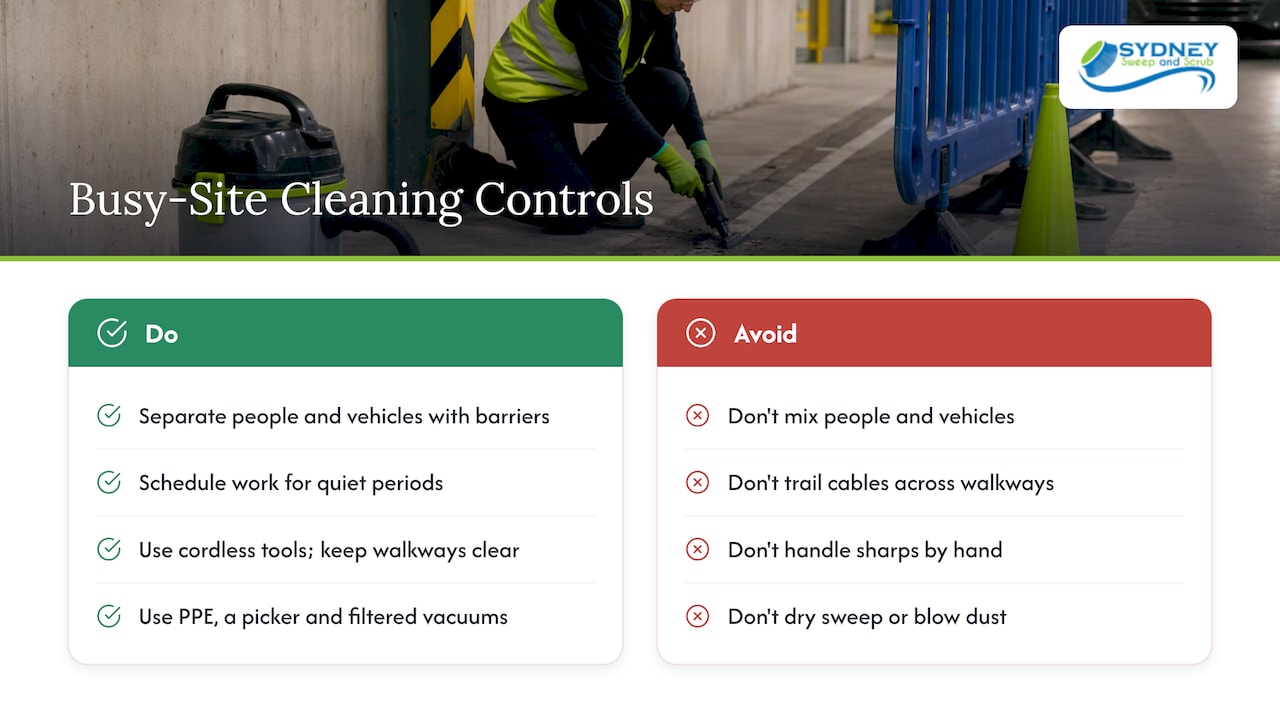
Eliminate the hazard before you reach for PPE. Safe Work Australia’s hierarchy of controls starts with removing the risk, for example using cordless vacuum cleaners to remove a trip hazard, and uses PPE for what remains. On a site, that means cordless or battery tools where a cable would cross a walkway.
Wear PPE for manual work. For manual external cleaning, NSW Health recommends gloves and eyewear and hand hygiene afterwards. Sharps, broken glass and needles are a real possibility in public car parks, so use a picker rather than your hand.
Keep walkways clear. Safe Work Australia’s slips and trips fact sheet says good housekeeping means keeping access ways clear and cleaning up spills immediately. The same housekeeping logic is explained in these flooring safety best practices for facilities teams. Safe Work Australia’s code adds that work materials should be stored neatly and waste removed regularly.
Control dust. Dry sweeping and blowing raise dust. Safe Work Australia lists local exhaust ventilation and industrial vacuums with appropriate filtration among engineering controls for dust at work. Mechanical sweepers with dust suppression or vacuum collection suit enclosed car parks and warehouses better than a blower.
If you manage a site, your duty is to keep the workplace safe so far as is reasonably practicable. Speak to your WHS adviser about your own risk assessment, because edges differ from site to site.
Managing water, dust and runoff
This is where edge cleaning goes wrong most often. Pressure washing pushes dirty water to the lowest point, and on most sites that is a stormwater drain.
The NSW EPA’s Solutions to Pollution information sheets are plain on this: stormwater drains carry rainwater only, and anything that goes down them is not treated. The EPA advises that wash water must not enter stormwater drains, that washing should be confined to a bunded area, and that wastewater should go to sewer with approval or be treated and recycled. The same sheets say loose materials such as sand and soil kept outside belong under a roof and within a bunded area, and spills should be cleaned quickly with dry absorbent material.
In practice:
- Sweep and vacuum first so less solid material enters the wash water.
- Block or cover nearby drain inlets before washing and use a wet vacuum or recovery unit to collect water along edges.
- Do not wash into a gutter, and do not assume a floor waste is connected to sewer. Check with your local water utility about trade waste approval.
- Collect fine silt by mechanical means rather than hosing it down.
We cover this in more depth in stopping pollutants at the source.
How often should edges and corners be cleaned?
There is no single schedule that suits every site. Safe Work Australia’s code says facilities should be cleaned regularly, taking into account the work performed, how likely contamination is, the number of workers, including shift work, and the type of facility. A busy retail car park under trees needs more than a quiet office basement.
A sensible starting point, to adjust for your site:
| Site type | Routine sweep (including edges) | Deeper edge clean |
|---|---|---|
| Retail or shopping centre car park | Frequent, often weekly or more, before trading hours | Periodic pressure wash of walls, kerbs and bin areas |
| Strata or residential basement | Regular cycle, often monthly or more | Periodic, plus after storms or leaks |
| Warehouse with high traffic | Regular, matched to shifts and throughput | Periodic perimeter and rack-line clean |
| Construction site | Frequent, often daily during heavy works | After each major stage |
| Event venue or public space | Before and after events | Periodic |
These are working guides, not regulations. Adjust them after your first few inspections. If dark lines return within days, shorten the cycle. If an edge is still clean at the next visit, lengthen it. Our page on 10 signs you need sweeper-scrubber services helps you judge the timing, and regular warehouse cleaning explains the efficiency case.
Common mistakes that leave dirt behind
- Washing before sweeping. Grit becomes slurry and ends up on the edge.
- Cleaning only the open floor. The perimeter gets no attention until a complaint arrives.
- Random cleaning routes. Work from cleaner to dirtier areas so you do not drag soil back over finished work.
- Leaving wet surfaces open. Barrier them until they dry.
- Ignoring damaged edges. WorkSafe Queensland notes that floor and ground surface maintenance can include repairing uneven or broken concrete and height changes. No amount of cleaning fixes a crumbling kerb.
- Washing into the drain. It is the quickest route to an EPA problem.
- Reactive-only cleaning. Scheduled work is cheaper than emergency work.
What we do at Sydney Sweep and Scrub
We are a family-owned Sydney business offering mechanical sweeping and scrubbing, pressure washing, hot water cleaning, rubbish removal and automated robotic cleaning for car parks, warehouses, construction sites, public spaces and event venues. Edges and corners are part of the job, not an extra: we plan machine passes along the perimeter, finish tight areas by hand and wash only what needs washing. See our mechanical sweeping and pressure washing pages, or the full list of services. Recurring maintenance contracts are available for larger facilities.
To get a quote or book online, start at Sydney Sweep and Scrub or go straight to carpark cleaning. Tell us the surface, the size and where the dirt sits, and we will scope the edge work with the rest.
FAQ
What is the best way to clean corners in a car park or warehouse?
Remove loose debris first with a picker, broom or vacuum, then use a compact machine or hand tools for the corner. Wash only what remains and collect the water. Dry removal before wet cleaning is the step most people skip.
Should edges be cleaned before or after the main floor?
Edges first. Sweeping the perimeter before the open floor stops edge debris being dragged back onto a cleaned area. Follow with the main pass, then a quick check of the corners.
Can I pressure wash edges and let the water run off?
Not into the stormwater system. The NSW EPA advises that wash water must not enter stormwater drains and should be bunded and sent to sewer with approval or treated and recycled. Sweep first and use water recovery along the edges.
How often should commercial edges and corners be cleaned?
It depends on traffic, contamination and the number of people using the site. Safe Work Australia says cleaning should be regular and take those factors into account. Most sites sweep on a fixed cycle, deep clean the perimeter periodically, and respond to spills at once.
Sources
- Cleaning car parks and paths, Kärcher Australia
- PS 30 power scrubber surface cleaner, Kärcher International
- Module 3: Work procedures for cleaning, NSW Health Clinical Excellence Commission
- Routine Maintenance floor care quick reference card, NYS OGS
- Managing the work environment and facilities, Safe Work Australia
- Slips and trips at the workplace, Safe Work Australia
- Accommodation services: managing risks, Safe Work Australia
- Occupational lung diseases: managing risks, Safe Work Australia
- Cleaning, WorkSafe Queensland
- Floor and ground surfaces, WorkSafe Queensland
- Solutions to pollution: information sheets for small industries and businesses, NSW EPA