
You control noise during cleaning in four ways: choose quieter equipment, schedule loud work for the right hours, tell your neighbours before it happens, and protect the people running the machines. No single national rule covers all of it. Workers are covered by workplace health and safety law. Neighbours are covered by state and council noise rules. A site manager has to satisfy both.
This guide is for property managers, strata managers, warehouse occupiers and council or event staff who book sweeping, scrubbing or pressure washing and want to avoid complaints, fines and hearing damage.
TL;DR
- Two sets of rules apply: Safe Work Australia’s workplace standard protects workers, while state and council rules protect neighbours.
- Schedule first, then equipment, then PPE. Earmuffs are the last line of defence, not the first.
- Tell neighbours and adjacent tenants in advance. Complaints often come from surprise, not from the decibel level.
- Stationary equipment such as pumps and compressors causes most avoidable trouble. Enclose it, silence it or move it.
- Ask your contractor for the noise output of each machine and a written plan for the hours you need.
Table of Contents
- Two kinds of noise rules, and who each one protects
- What counts as unacceptable noise
- Hours: when loud cleaning is allowed
- Start with scheduling
- Choose quieter equipment and ask for the numbers
- Pressure washing: the loudest job on most sites
- Tell your neighbours first
- Protect the people running the machines
- A worked example: quiet carpark cleaning near apartments
- How we approach noise at Sydney Sweep and Scrub
- FAQ
- Sources
Two kinds of noise rules, and who each one protects
Most confusion comes from mixing these up.
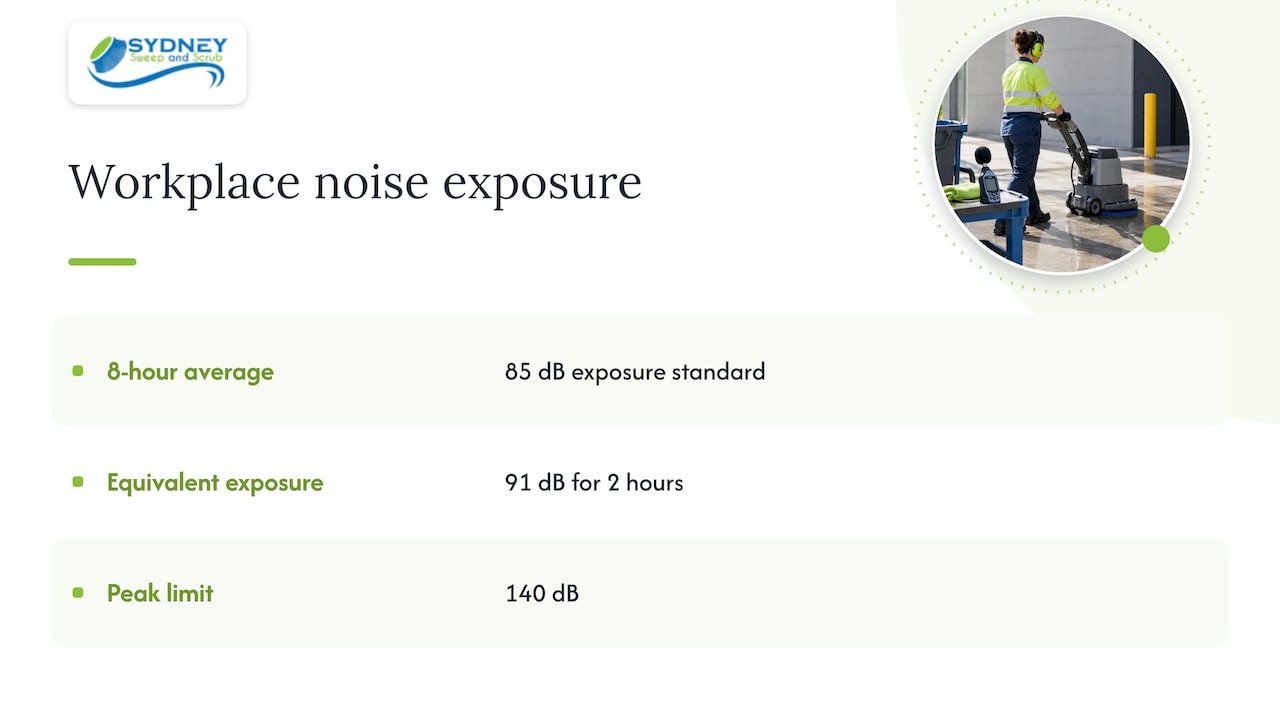
Workplace noise is about the people doing the cleaning. Under the model WHS laws, the person conducting a business or undertaking must reduce worker exposure to noise as far as is reasonably practicable. Safe Work Australia sets the exposure standard at an average of 85 decibels over an eight-hour shift, with a peak limit of 140 decibels. The risk at 91 decibels for two hours is equivalent to 85 decibels for eight, so a short burst of a loud machine still counts.
Environmental or neighbourhood noise is about everyone else. States and councils regulate it, and the rules differ. The common thread is that noise is treated more strictly early in the morning, late at night, on Sundays and on public holidays.
A property manager usually carries both duties at once. The machine operator is a worker. The family in the apartment block next to your carpark is a neighbour.
What counts as unacceptable noise
There is no single number. Regulators generally ask whether noise causes an adverse impact on amenity, and the test differs by state.
In New South Wales, the City of Sydney explains that officers apply an offensive noise test under the POEO Act. That test is judged by an authorised officer and does not rely on a measured level. So a machine that is technically “within hours” can still draw action if the noise is excessive or recurring.
South Australia gives a clearer benchmark for construction. The SA EPA construction noise information sheet points to figures around 45 dB(A) average or a 60 dB(A) peak at the receiver. Those are South Australian guides, not a national limit. Still, they are a sensible yardstick for any contractor working near homes, whatever the state.
Queensland has its own building work noise standard under its Environmental Protection Act. Victoria publishes residential noise rules with time limits for prescribed items.
The practical conclusion: check your own state EPA and your local council before you lock in a schedule. For a deeper look at after-hours risk, see our piece on night cleaning noise and penalties for facility managers.
Hours: when loud cleaning is allowed
Permitted hours depend on the equipment type and the state. Some examples from official sources:
| State | What the source says | Source |
|---|---|---|
| Victoria | Vacuuming and other prescribed residential items are restricted before 7am or 9am and after 10pm, depending on the day | EPA Victoria |
| Queensland | Building work with audible noise is limited to 6:30am to 6:30pm Monday to Saturday | Queensland Government |
| NSW | Noise that is offensive can be actioned at any time, even inside listed hours | City of Sydney |
Two cautions. First, these tables are written mostly for residential activity. A commercial site near homes is often judged more strictly, not less. Second, “end of lease” cleaning is not exempt. Councils regularly investigate complaints about night-time industrial vacuuming or pressure washing at commercial premises, as Logan City Council’s guidance on noise at odd hours shows.
If you are unsure, ring your council’s environmental health team. They can tell you what applies to your address and whether a particular job needs approval.
Start with scheduling
The cheapest noise control is doing the loud work when fewer people are affected. In a busy facility, that usually means rotating tasks around occupancy.
- Warehouses: run mechanical scrubbing between shifts or on weekends when forklifts and pickers are off the floor.
- Carparks in mixed-use buildings: sweep and scrub in the low-footfall window, but check how close the nearest bedroom is before choosing night work. A retail-only carpark and a residential tower carpark are different problems.
- Public spaces and event venues: do the heavy machine work after the crowds leave and the hours allow, and keep a quiet hand-clean for the early morning.
Scheduling is what Safe Work Australia calls an administrative control. It works well, but it sits lower on the hierarchy than removing or reducing the noise at source, so treat it as a partner to good equipment, not a replacement.
You can split one job into two. Do the quiet tasks (manual pickup, rubbish removal, damp mopping) at the awkward hours. Do the loud tasks (pressure washing, mechanical sweeping with heavy brushes) within the clearly permitted window.
Choose quieter equipment and ask for the numbers
WorkSafe Victoria’s cleaning guidance recommends selecting equipment with noise output in mind. That means comparing noise specifications before you buy or book, and swapping noisy fuel-powered machines for electric alternatives where practical.
When you request a quote, ask the contractor:
- What is the sound level of each machine you plan to use, and at what distance was it measured?
- Are any units electric or battery powered?
- Is a pump, generator or compressor running outdoors, and where will it sit?
- Which tasks can run at lower speed or on a quieter setting?
- What is your plan if a neighbour complains mid-job?
A contractor who has ready answers has probably done this before. One who says it will be fine is guessing.
Compressed air and nozzles
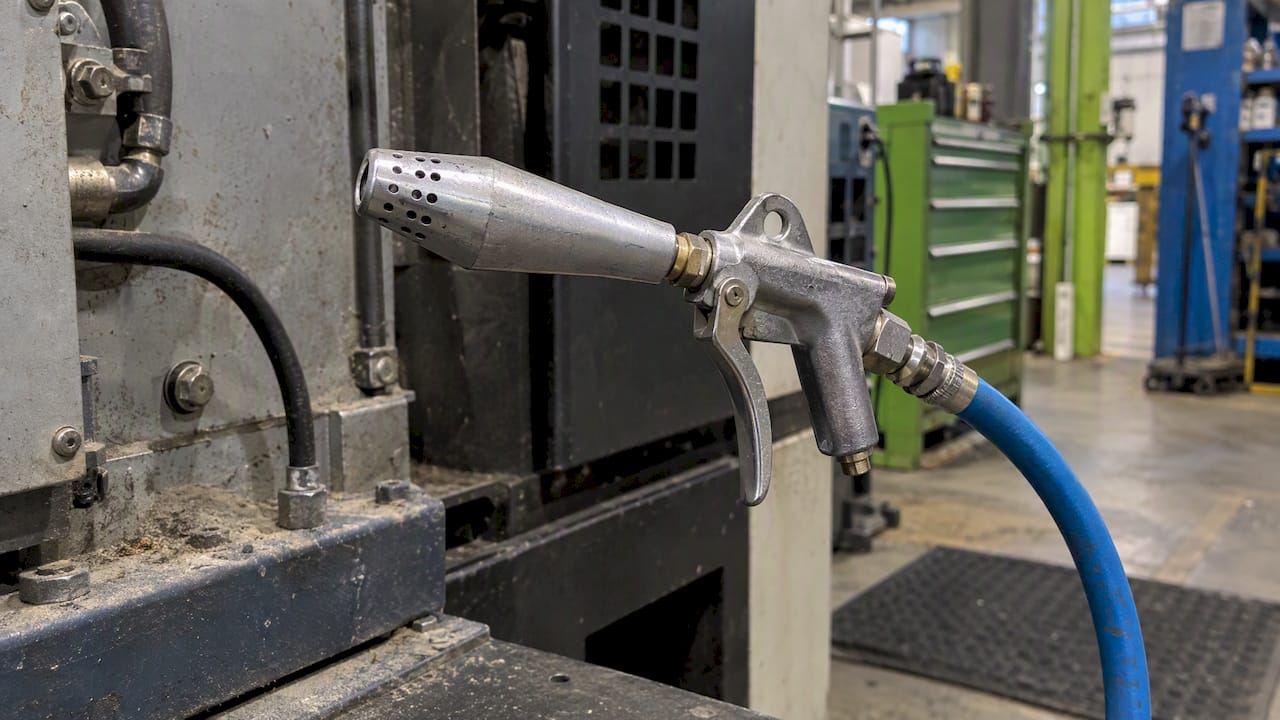
Compressed air is a surprisingly common noise source when blowing down dock areas or machinery. WorkSafe Victoria’s page on controlling compressed air noise is a good starting point. Fitting quiet nozzles or expansion chambers can cut noise by 10 to 15 dB(A), which is sometimes enough to bring a system into line without replacing it.
Robotic and automated cleaning
Automated machines are one of the more effective ways to reduce noise at carparks and warehouses, because they run steadily and can work unattended through quiet periods. Our page on automated robotic cleaning for carparks and warehouses explains where they fit. If you are weighing them up, our article on whether warehouse and industrial cleaning robots are worth the investment covers the trade-offs.
Pressure washing: the loudest job on most sites
Pressure washers are the machine most likely to generate a complaint, because the pump and engine are loud and the job often runs for hours. Ways to keep them manageable:
- Use the quietest suitable pump and keep it as far from boundaries and bedrooms as the hose allows.
- Place the unit behind a solid barrier, such as a vehicle, a wall or a temporary acoustic screen. The SA EPA and other regulators list barriers and enclosures among basic controls.
- Limit the work to permitted hours and finish one zone at a time, so the noise ends sooner rather than dragging across days.
- Choose the right method. Hot water often lifts oil and grease faster than cold water, which can mean a shorter job. See our pages on pressure washing with hot water and pressure washing with cold water.
Noise is not the only compliance issue with this work. Wastewater has its own rules, which we cover in five wastewater checks for Australian businesses. If you need a budget guide first, our pressure washing cost and RFQ guide sets out what to put in a request.
Tell your neighbours first
Logan City Council advises that if you plan a noisy activity you should let your neighbours know. The council notes that noise at early, late or weekend times is more likely to be a nuisance. People tolerate noise better when they know it is temporary and scheduled.
For a commercial site, a good notice includes:
- The dates and the start and finish times.
- What will happen (for example, mechanical sweeping and pressure washing of the basement carpark).
- A phone number or email that reaches someone who can act the same day.
- What you are doing to reduce noise.
Deliver it by letterbox drop, lobby noticeboard or an email to adjacent tenants and the strata committee. Send it several days before, not on the afternoon of the job. For strata, it also helps to tell the building’s owners corporation so residents hear it from their own channel.
Protect the people running the machines
A quiet neighbourhood job can still be a loud workplace. Under the Safe Work Australia guidance on managing risks, the first step is a noise assessment. It can be simple if you have one source above 85 decibels, but variable noise needs more careful measurement.
The model code of practice requires duty holders to work through the hierarchy of control measures:
- Eliminate the noise, for example by choosing a method that needs no loud machine.
- Substitute a quieter machine.
- Isolate it with barriers or enclosures, or place compressors away from workers.
- Engineering controls, such as silencers, quiet nozzles or lower fan speeds.
- Administrative controls, such as rostering and limiting time near the source.
- PPE, such as earmuffs, only for the risk that remains.
The most common mistake is jumping to earmuffs and stopping there. PPE depends on every worker wearing it properly every time. Engineering fixes protect everyone, including bystanders. Hearing protection is still necessary where noise remains high, and a safety adviser should confirm what fits your site.
If you run your own in-house team, a structured health and safety record helps you prove what you assessed and when. A broad overview of types of workplace hazards is a useful companion when you build your hazard register. For Victoria, the step-by-step approach to noise control sets out the employer duties under that state’s regulations.
A worked example: quiet carpark cleaning near apartments
Imagine a basement carpark under a mixed commercial and residential building that needs a full sweep, scrub and wash. A sensible plan looks like this:
- Week before: check council hours and any building by-laws, then send a notice to residents and tenants.
- Equipment: confirm the contractor’s noise specifications and choose electric or lower-noise units where possible.
- Layout: put pumps near the vehicle entry and away from lift cores, which carry sound upward.
- Sequence: do quiet tasks (litter pick-up, spot cleaning) at the edges of the day, and run the loud scrubbing and washing in the permitted window.
- During: keep a named contact on site and log any complaint with the time.
- After: debrief and adjust the schedule for next time.
This is the kind of plan that stops a one-off complaint turning into a repeat problem. It also gives you a record if a council officer asks questions.
How we approach noise at Sydney Sweep and Scrub
We are a family-owned Sydney business doing mechanical sweeping, scrubbing, pressure washing and automated robotic cleaning for carparks, warehouses, construction sites and public spaces. We plan jobs around your site and your neighbours, and we book online so you can lock in a time that suits your building.
If noise is your main worry, tell us when you request a quote: the nearest residents, your permitted hours and any building rules. Start with our carpark cleaning or warehouse cleaning pages, or contact us through the main site. Construction managers should also read our guide to sweeping requirements for construction sites.
FAQ
Is it illegal to vacuum after 10pm?
In Victoria, vacuuming is among the prescribed residential items restricted after 10pm, and similar time limits exist elsewhere. Even where no fixed hour applies, noise that is offensive or clearly audible at a neighbouring building late at night can be actioned. Check your own state and council before scheduling night work.
What are the noise regulations in Australia?
There is no single national noise law for neighbours. States, territories and councils set the rules, and Safe Work Australia sets the workplace exposure standard of 85 decibels averaged over eight hours. Always check the rules for your location.
What is classed as unacceptable noise?
Generally, noise that has an adverse impact on amenity. Some regulators use numbers, such as the SA EPA’s 45 dB(A) average or 60 dB(A) peak for construction. In NSW, offensive noise is judged by an authorised officer rather than a meter.
What time are noise restrictions in Victoria?
For prescribed residential items, EPA Victoria lists restrictions before 7am or 9am, depending on the day, and after 10pm. Commercial and industrial activity is regulated differently, so confirm with EPA Victoria or the council before you book.
Sources
- Noise | Safe Work Australia
- Noise: managing risks | Safe Work Australia
- Managing noise and preventing hearing loss at work | Safe Work Australia
- Residential noise | EPA Victoria
- Cleaning | WorkSafe Victoria
- Controlling compressed air noise | WorkSafe Victoria
- A step-by-step approach to noise control | WorkSafe Victoria
- Construction noise information sheet | SA EPA
- Building work noise standard | Queensland Government
- Noise nuisance | Logan City Council
- Neighbourhood noise fact sheet | City of Sydney
- Types of workplace hazards