
Tracking dirt control on a construction site comes down to three layers: stop mud picking up on the tyres, shake off what does stick before the truck reaches the road, and sweep up whatever still escapes with a mechanical sweeper, never a hose. Skip any layer and the dirt ends up on the road, in the stormwater drain and, eventually, in front of a council officer.
This guide covers how track-out happens, what a working exit looks like, how often to sweep, and where the legal lines sit in NSW. The details differ by council, so treat your approved plan and consent conditions as the final word.
TL;DR
- Track-out is dirt carried out on tyres and bodies, then dropped on public roads. It is a safety hazard and a pollution issue, and the site owner carries the risk.
- A proper exit has three parts: a stabilised aggregate pad, a rumble grid that is kept clear, and a sweeping routine. A grid on its own does not do the job.
- Never wash sediment off a road with a hose. It sends the dirt straight into the drains. Mechanical sweeping is the accepted clean-up method.
- Check the exit at least daily, and add a sweep whenever trucks are hauling in wet weather or after earthworks.
- Dust and mud are one problem on site. A written plan, matched to your activities and weather, beats reacting after a complaint.
Table of Contents
- What tracking dirt actually is
- Where the dirt comes from
- Building an exit that works
- How often to sweep
- Keep a record
- Dust is the other half of the problem
- What mechanical sweeping adds
- A worked example: a medium civil job with a wet week ahead
- Common mistakes
- Work with us
- FAQ
- Sources
What tracking dirt actually is
Track-out is soil, clay and fine dust that sticks to wheels, mudguards and undercarriages and is then deposited along the road as the vehicle leaves. The NSW EPA’s visual guide to dust from construction sites treats it as its own category alongside wind-blown dust, and includes photos of functional and non-functional rumble grids side by side. It is worth a read before you design your exit.
It matters for three reasons.
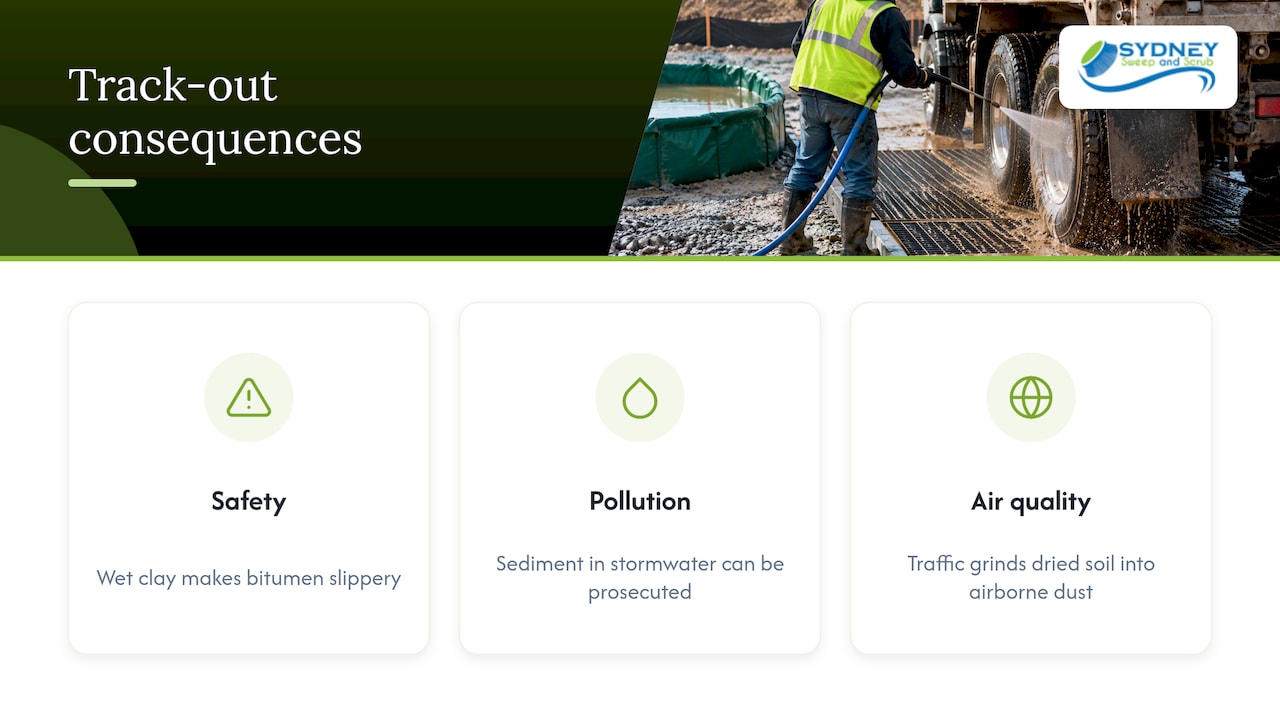
Safety. Ballina Shire Council notes that mud on roads is a hazard that can cause accidents, and that drivers can be held responsible if mud is identified as the cause. Wet clay on a bitumen road is slippery, and motorcyclists and cyclists feel it first.
Pollution. Mud is washed into drains and waterways. Under NSW law, sediment reaching stormwater can be prosecuted as water pollution, and the penalty regime is real. The same council page says fines for breaches related to mud tracking can exceed $45,000.
Air quality. Dried track-out is ground into fine dust by passing traffic and lifted back into the air. So mud control and dust control are not two jobs. Fix the first and you remove a good share of the second.
Where the dirt comes from
Before you buy a rumble grid, work out why your site leaks. Typical sources:
- Unprotected haul routes. Bare, wet clay between the work area and the gate loads tyres with mud.
- Earthworks and stockpiles. Excavation, loading and tipping all put loose soil where wheels will find it.
- Overloaded or uncovered trucks. Spillage from the tray adds to what falls off the tyres.
- Wet weather. A site that is clean on Monday can be a mud bath after Tuesday’s storm.
- Poorly maintained exits. A pad that has silted up stops working without anyone noticing.
The NSW EPA’s construction sites guidance note makes the point that controls should be scaled to the stage of work, whether demolition, earthworks or building, and that the best approach is prevention first: limit the area you disturb and keep existing vegetation where possible. A smaller disturbed footprint means less mud to start with.
Building an exit that works
Layer 1: a stabilised access pad
The first job is to stop wheels picking up soil. Ballina Shire Council specifies a stabilised access with at least 200 mm depth of aggregate, with stone at least 60 mm in size, laid over geotextile fabric so the stone does not mix into the subsoil. The accompanying data also lists a minimum width of 3 m. Your own council or consent may ask for more, so check before you build.
Some practical points:
- Size the pad for the widest vehicle and the number of trips, not the minimum.
- Keep one defined entry and exit. Every extra gap in the fence is another leak.
- Top up or replace the stone when it is buried in mud. Clean aggregate is the whole point.
Layer 2: a rumble grid or shaker
A rumble grid shakes off the clods that survive the pad. The NSW EPA visual guide describes it as the standard fix for track-out, and the same guide shows what a clogged one looks like. The catch is maintenance. According to the Ballina guidance, once the gaps fill with mud a grid loses its function entirely. It also works best when:
- it follows a rock pad, not bare soil;
- the approach road is rough gravel, so less mud reaches the grid;
- someone clears the gaps on a schedule, not when the supervisor remembers.
A blocked grid is worse than none, because it gives the site a false sense of control.
Layer 3: sweeping the road and the apron
No exit catches everything. What the pad and the grid miss lands on the road and the footpath, and this layer is where most sites fall down. The common reflex is to get a hose. Don’t.
The Ballina guidance is explicit that hosing soil off a road is not an acceptable clean-up, because it washes sediment into stormwater drains and waterways and can attract fines. Mechanical sweeping is the accepted way to pick up the material, and it removes it from the site’s responsibility in one pass.
How often to sweep
There is no universal number. Your approved erosion and sediment control plan, consent or council condition may set a frequency, and that wins. Where it does not, use triggers instead of a calendar:
| Condition | Suggested response |
|---|---|
| Dry weather, light traffic | Inspect the exit daily, sweep as needed |
| Heavy haulage or tipping | Sweep at the end of each haul day, or between loads if mud is visible |
| Rain, or a wet haul route | Sweep during and after the event, and check the grid |
| Earthworks or demolition stage | Increase frequency for the whole stage, not only the wet days |
| Complaint from a neighbour or council | Sweep straight away and record it |
The Transport for NSW air quality management guideline for its project sites backs daily visual inspections as the way to catch problems early, before they become a compliance incident, and suggests restricting high-dust activities in high winds. That guideline is written for transport projects, but the logic carries over to any site.
Keep a record
A site that can show what it did is in a far better position than one that can only say it did something. Keep a simple log:
- Date, time and weather.
- Condition of the pad and grid, with a photo.
- Whether the road needed sweeping, and who did it.
- Any complaint received and the action taken.
Photos with timestamps settle most disputes with neighbours. If a council officer arrives, a log turns an argument into a conversation.
Dust is the other half of the problem
Track-out dries and becomes airborne. So your exit plan should sit inside a wider dust plan. The NSW EPA’s guidance note says a documented plan, varied by site scale, weather and activity, is the right approach. The common tools are:
- water spraying on haul roads (with controlled runoff);
- covering stockpiles and exposed areas;
- wind barriers on high-risk sites, as Wollondilly’s dust control sheet recommends where the risk of dust generation is high;
- tidy loads and covered trays on trucks.
Don’t overlook the machines. The Transport for NSW guideline suggests a simple rule: an engine that produces visible exhaust for more than 10 seconds continuously should come out of service for maintenance. Smoky plant is an air-quality problem too.
When the dust is silica
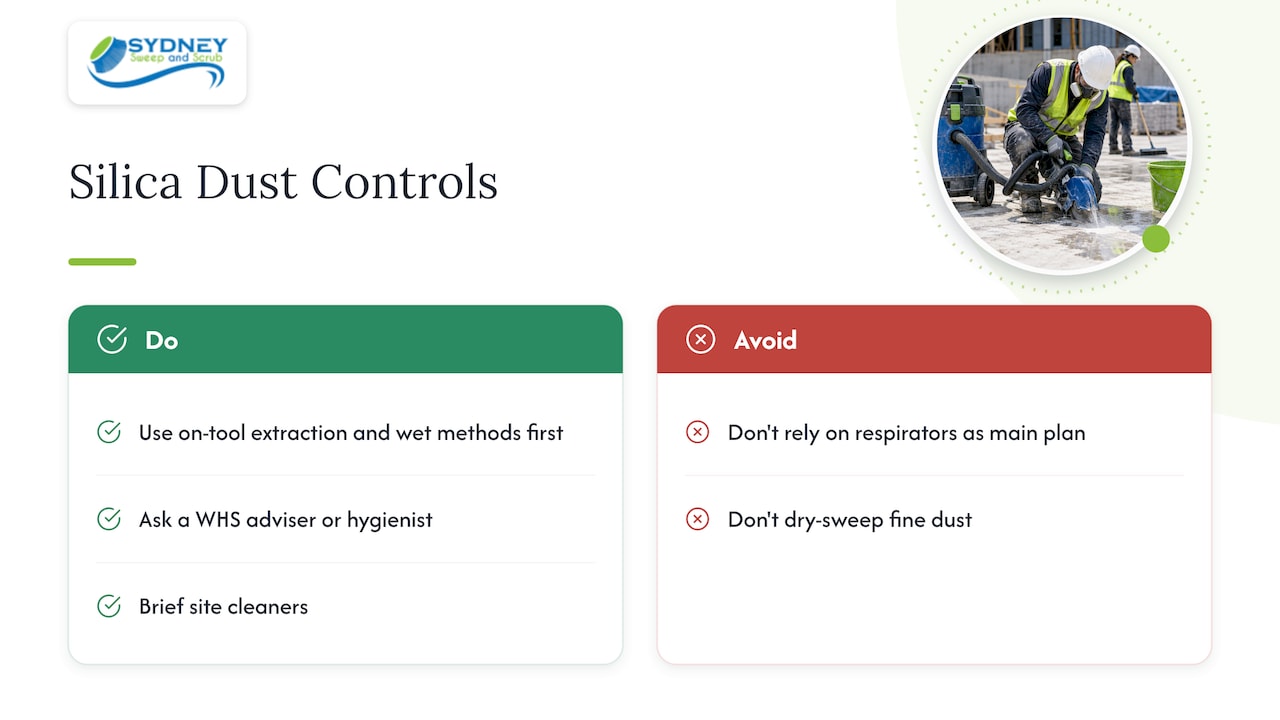
Cutting, grinding, drilling and crushing masonry, concrete or stone can release respirable crystalline silica. Safe Work Australia sets the workplace exposure standard at 0.05 mg/m³ as an eight-hour time-weighted average. Its guidance applies the hierarchy of control: at the source, use on-tool extraction and wet methods first, and keep respirators as a back-up, not the main plan. See its construction silica page for typical high-risk tasks.
This is where cleaning method matters. Dry sweeping fine dust with a broom or blower just puts it back into the air. Where silica may be present, ask your WHS adviser or hygienist what the clean-up method should be, and make sure whoever cleans the site is briefed. For more on this topic, see our note on silica dust as a site hazard.
What mechanical sweeping adds
A purpose-built sweeper lifts mud, grit and dust from the road surface and holds it in a hopper, so nothing is pushed into a drain or left to dry into dust. It gets into kerb lines, gutters and the apron in front of the gate, which hand crews tend to miss.
For a construction site this means:
- Fast response. A scheduled or on-call sweep after a heavy haul day clears the road before the evening peak.
- No water into the drain. The material is collected, not rinsed away.
- A record. Booked visits create a paper trail you can show the council.
- Less work for site staff. Your labourers stay on the build instead of shovelling mud off the road.
We cover this in more depth in why expert mechanical sweeping is essential for construction sites, and in our guides to safe sweeping practice on site and what a compliant dust clean-up service delivers.
A worked example: a medium civil job with a wet week ahead
Imagine a townhouse development with one gate, a clay site and a forecast of rain. Here is how a sensible plan runs.
- Before earthworks: build the stabilised pad to the council’s specification, lay the grid on the approach, and seal off every other gap in the fence.
- Before the rain: cover stockpiles, check the pad for silting, and book sweeps for the days of heaviest haulage.
- During haulage: a supervisor inspects the exit at start and finish of each day. Mud on the road triggers a sweep, not a hose.
- After the rain: clear the grid gaps, top up the aggregate if it is buried, and sweep the road and footpath.
- Weekly: review the log and photos, and adjust the frequency if the problem is persistent.
The cost of this routine is small compared with one fine, one slip-and-fall claim or a stop-work conversation with the council.
Common mistakes
- Relying on the grid alone. Without a rock pad and a sweep routine, it clogs.
- Hosing the road. It moves the problem into the stormwater system and adds a pollution risk.
- Fixing it after a complaint. Councils and neighbours judge you on how long the mud was there.
- Forgetting the footpath. Pedestrians pick up mud too, and it is part of the public space you are responsible for.
- Treating dust and mud separately. One plan, one person responsible.
- Ignoring the end of the job. Final handover often needs a deeper clean of hardstand, car parks and loading areas, not just a road sweep.
Work with us
Sydney Sweep and Scrub is a family-owned business providing mechanical sweeping and pressure washing across Sydney. For builders and site managers, we can sweep the road and apron around your site, and clean up hardstand and car park areas as the job progresses. Read about sweeping your construction site, see how Safe Work Australia requirements shape sweeping on construction sites, or go to our mechanical sweeping service page to get a quote and book online. At the end of the build, our commercial cleaning service can handle the final clean of the finished premises.
FAQ
Can I wash mud off the road with a hose or pressure washer?
No. Washing soil off a road sends sediment into stormwater drains and waterways, which councils treat as pollution and can fine. The accepted approach is to pick the material up, which is what a mechanical sweeper does. Check your council’s conditions for site-specific wording.
What is a rumble grid and do I need one?
It is a set of bars at the exit that shakes loose mud off tyres as vehicles drive over it. Whether you need one depends on your soil, traffic and consent conditions. It only works while the gaps are clear and when it follows a rock pad, so plan to clean it often.
How big should a stabilised construction entry be?
Ballina Shire Council’s guidance calls for at least 200 mm of aggregate, stone of 60 mm or larger, geotextile underneath and a width of at least 3 m. Your own council or consent may set different dimensions, so confirm with them before building.
How often should the road outside a site be swept?
Follow the frequency in your approved plan or consent if it has one. Otherwise, inspect daily and sweep whenever mud is visible, after heavy haulage and after rain. Keep a short log with photos so you can show what you did.
Is dust control the same as track-out control?
They overlap but are not identical. Track-out is mud and dirt carried onto roads, which then dries into dust. Dust control also covers wind-blown dust from stockpiles, cutting and demolition. A good site plan handles both together.
Sources
- Mud tracking on roads, Ballina Shire Council
- Dust from construction sites visual guide, NSW EPA
- Construction sites guidance note, NSW EPA
- Air Quality Management Guideline, Transport for NSW
- Dust control, Wollondilly Shire Council
- Workplace exposure standard for respirable crystalline silica, Safe Work Australia
- Silica in construction, Safe Work Australia