
Most Sydney businesses pay low to mid hundreds of dollars for a one-off commercial rubbish removal, with large or full-truck clearances running higher, while scheduled bin services typically cost a low to mid hundreds of dollars per month per bin. The two biggest swing factors are how much waste you have and the NSW waste levy applied at the disposal gate. Use the checklist further down to brief suppliers accurately, and see how we can help with ongoing or one-off jobs.
TL;DR:
- Small clearances typically cost $150 to $300, medium jobs $300 to $650, and dedicated truck bookings may carry a minimum charge around $349.
- A weekly 1,100 litre bin costs about $125 to $230 monthly before GST; confirm whether quotes include the landfill levy.
- Sydney’s landfill levy is charged per tonne, while separating recyclable and green waste can lower disposal fees; 2026 to 2027 increases are capped at CPI.
- From July 1, 2026, many large food businesses must separate organics, with rollout timing tied to weekly waste and changes to bin sizes and pickup schedules.
- Send photos, waste types, and access details, and ask whether the levy, excess weight, and access fees are included or charged separately.
Table of Contents
- Typical Sydney price bands and what they cover
- What affects the price: volume, material type, access and disposal levy
- How to estimate your job: convert items to cubic metres and typical weights
- Contracts vs one-off removals for businesses: which is cheaper and when
- Regulatory and cost changes to plan for: NSW waste levy and FOGO mandates
- How to get accurate quotes: what to include in your brief and questions to ask
- Practical examples and tips from Sydney Sweep and Scrub
- How Sydney Sweep and Scrub can help with commercial rubbish removal in Sydney
- FAQ
- Sources
Typical Sydney price bands and what they cover
Quotes vary a lot between suppliers, so it helps to know what a “normal” job actually costs before you start ringing around. For small loads, a single office clean-out, a few pieces of furniture or a handful of boxes, expect to pay somewhere in the $150 to $300 range. This band usually covers a trailer-sized load or a small van trip to a transfer station.
Medium jobs sit between roughly $300 and $650. Think a full office fit-out clearance, a small retail strip-out or several cubic metres of mixed waste from a warehouse clean-up. Large or full-truck loads, such as end-of-tenancy clearances for bigger commercial tenancies or construction debris runs, push past that and are usually quoted per job once the provider has seen photos or visited site.
Many operators charge by the cubic metre rather than by the item, and most apply a minimum call-out fee regardless of load size, since a truck still has to travel, a crew still has to load, and the tip fee still applies even for a small trailer load. Minimum charges in the Sydney market commonly start around $349 for a dedicated truck booking, though this varies by provider and distance.
If you run a business that generates waste regularly rather than in one-off bursts, a scheduled bin service is usually more cost-effective than booking removals as you go. Indicative monthly or per-lift pricing looks roughly like this:
- A 240 litre bin collected weekly typically costs in the lower tens of dollars per lift, scaling with collection frequency.
- A 660 litre bin suits small to medium retail or hospitality sites and costs more per lift but less per litre than a 240 litre bin.
- A 1,100 litre bin collected weekly often costs around $125 to $230 per month excluding GST, with the waste levy making up a meaningful share of that figure.
- A 3 cubic metre front-lift bin is generally reserved for larger warehouses, shopping centres or construction sites with high weekly volumes.
These ranges are a starting point for comparing quotes, not a quote in themselves. Access, waste type and how far your site sits from a transfer station all move the final number, which the next section covers in detail.
What affects the price: volume, material type, access and disposal levy
Four variables explain almost every difference between quotes for the same job: how much waste there is, what it is made of, how hard it is to get to, and what the tip charges to accept it.
Volume and weight determine the baseline. Light, bulky waste like cardboard or polystyrene is usually charged by the cubic metre because it takes up truck space without adding much weight. Dense waste like rubble, soil or tiles is often charged by the tonne instead, because weight, not volume, is what drives disposal cost at the tip. A provider may quote per m3 for an office clean-out and per tonne for a construction clearance from the same site.
Material type changes the gate fee at the receiving facility, and that gets passed through to you:
- Green waste and clean timber are usually cheaper to dispose of than general waste because they can be mulched or recycled.
- Metals often attract a lower fee, or even a rebate, because scrap has resale value.
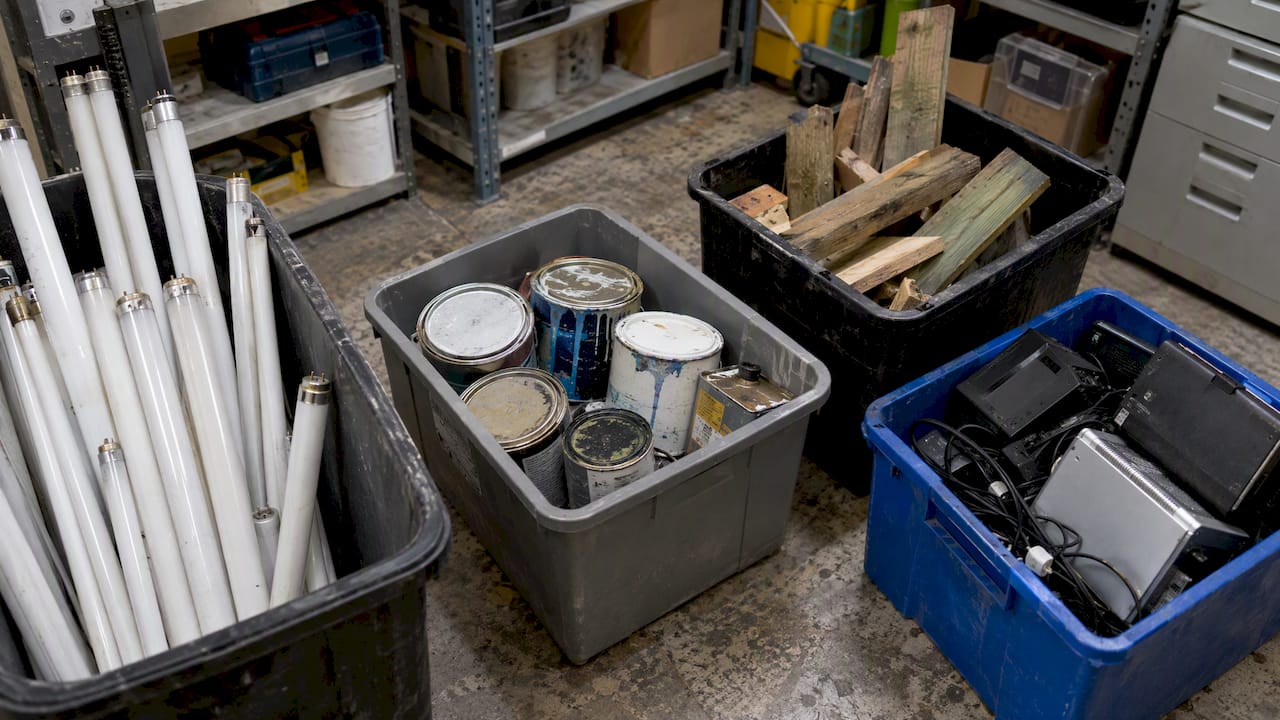
- E-waste, batteries and fluorescent tubes require separate handling and typically carry a surcharge.
- Heavy construction debris, rubble and plasterboard are charged by weight and can be the most expensive stream per cubic metre.
- Hazardous materials such as asbestos, chemicals or contaminated soil require licensed handling and are priced well above general waste.
Access and site conditions add labour time, which adds cost. Stairs instead of a lift, a long carry distance to the truck, CBD loading dock bookings, clearway permits for kerbside parking, and after-hours work to avoid disrupting a busy retail strip all push the price up before a single kilogram of waste is weighed.
The NSW waste levy is the factor businesses most often overlook when budgeting. The levy applies to waste sent to landfill within the levy regulated area, which covers the Sydney metropolitan region, and it’s charged per tonne at the gate before any transport or labour cost is added. Because it’s applied at the point of disposal, it affects every commercial job that ends up in general waste, regardless of which removalist you book.
The NSW metropolitan waste levy is charged per tonne of waste sent to landfill within the regulated area, and because every Sydney-based collector and transfer station passes this cost through, separating recoverable material before collection is one of the few ways a business can directly lower its own bill.
How to estimate your job: convert items to cubic metres and typical weights
Knowing roughly how much space your waste will take up in a truck lets you sanity-check a quote before you accept it. A cubic metre is a cube one metre on each side, about the footprint of a standard pallet stacked waist-high, or roughly the volume of a three-seat sofa and an armchair together.
A simple way to estimate your own load:
- Measure the length, width and height of the waste pile or the room it fills, in metres.
- Multiply length by width by height to get a rough cubic metre figure.
- Add 15 to 20% to account for irregular shapes and air gaps between items, since waste rarely stacks perfectly.
- Round up to the nearest half cubic metre when requesting a quote, since providers typically price in those increments.
Weight per cubic metre varies a lot by waste stream, which matters because some providers price by weight rather than volume:
- General office waste (paper, cardboard, light furniture) is light, often well under 100 kg per m3.
- Hospitality and food-related waste is heavier due to liquid content and packaging density.
- Construction debris such as rubble, tiles or plasterboard can weigh several hundred kilograms per m3, which is why it’s usually priced per tonne.
A worked example: say a small office clear-out fills roughly 3 m3 of desks, chairs and boxed paper. At a light general-waste density, that load might weigh somewhere under 300 kg, well inside the range most one-off removalists quote as a standard medium job. A construction strip-out filling the same 3 m3 with rubble and plasterboard could weigh several times that, which is why two “3 cubic metre” jobs can carry very different price tags.
Flag anything heavy, bulky or potentially hazardous, such as old fluorescent tubes, paint tins, treated timber or e-waste, when you request your quote. Providers need to classify waste correctly before it leaves site, and misclassified loads can be rejected at the gate or incur extra handling charges on the day.
Contracts vs one-off removals for businesses: which is cheaper and when
A one-off removal makes sense for anything unpredictable: an office strip-out, a tenancy clean-up at lease end, a one-time event clear-out, or an urgent clearance after a flood or storm. You pay for a single job, with no ongoing commitment, and the price reflects exactly what’s collected that day.
A scheduled contract makes more sense once your business generates waste on a predictable cycle, retail stores, cafes, warehouses and offices with regular bin collections. Contracts typically bring the per-lift cost down because the provider can plan routes and truck loads around a known, recurring volume rather than quoting a one-off job cold.
A few contract details matter more than the headline rate:
- Contamination rules determine whether a mixed bin gets charged at general waste rates even when most of the contents are recyclable.
- On-site storage requirements affect how much space you need to allocate for bins between collections.
- Collection windows (time of day, days of week) can restrict or enable after-hours servicing that avoids disrupting trading hours.
- Overflow or missed-collection penalties can add unexpected cost if your volume regularly exceeds the contracted bin size.
City of Sydney guidance confirms that businesses are responsible for arranging their own commercial waste collection and keeping bins on-site, which means the contract terms you negotiate, not just the headline price per lift, determine your real monthly cost.
Regulatory and cost changes to plan for: NSW waste levy and FOGO mandates
Two regulatory shifts are worth building into your budget now rather than reacting to later.
The NSW metropolitan waste levy applies to all landfill-bound waste generated within the regulated area, which includes Sydney, and it’s charged at the disposal gate before any collection or transport fee is added. NSW waste levy rates will not rise above the Consumer Price Index in 2026 to 2027, giving Sydney businesses a degree of predictability when forecasting disposal costs for the year ahead, though the levy itself remains a substantial part of every general waste bill.
Separately, FOGO mandates require many large food-generating businesses to have a source-separated food organics collection service from 1 July 2026, with the rollout staged according to how much residual waste a business produces each week. Cafes, restaurants, caterers and food retailers with higher weekly volumes are affected earliest, and the practical effect is a change in bin mix: an extra organics bin, a smaller general waste bin, and a collection schedule that needs renegotiating.
A few practical steps reduce levy exposure regardless of which rules apply to your site:
- Separate recycling and food organics from general waste, since cleaner streams attract lower gate fees than contaminated mixed loads.
- Ask about a Bin Trim style waste assessment to identify which streams in your business are costing the most to send to landfill.
- Review your contract terms once FOGO requirements apply to your business category, since bin sizes and collection frequency will likely need adjusting.
How to get accurate quotes: what to include in your brief and questions to ask
A vague brief gets a vague quote, and a vague quote tends to get revised upward once the truck arrives. Giving a provider enough detail up front avoids that.
Include in your quote request:
- Photos or a short video of the waste, taken from a few angles.
- Access notes: stairs, lifts, loading dock booking requirements, parking restrictions.
- A rough breakdown of waste types (general, green, e-waste, construction debris).
- A contact person on site and preferred collection date or time window.
- Any known hazardous or heavy items that might need special handling.
Then ask the provider directly:
- What’s the minimum call-out charge, and does it change based on access or distance?
- Is the waste levy included in the quote, or added separately once the load is weighed?
- Are there overload or excess-weight fees if the load is heavier than estimated?
- Can they provide evidence of lawful disposal, such as a tip docket or transfer station receipt?
- Are they insured for the work, and do they follow standard WHS practices for manual handling?
Comparing quotes gets easier once you know the pricing format each provider uses. Per cubic metre pricing suits light, bulky waste. Per tonne pricing suits dense material like rubble or soil. Per item pricing suits small, predictable loads like a single fridge or mattress. A quote that mixes formats without explaining which applies to which part of your load is worth querying before you book.
Pro Tip: Ask for the levy and any access premium to be itemised separately on your quote, so you can see exactly what’s driving the price before you compare providers.
Practical examples and tips from Sydney Sweep and Scrub
Scoping a job properly before the truck arrives is what separates an accurate quote from a surprise invoice. We ask for photos or a short walkthrough video before quoting, which lets us confirm waste type, estimate volume properly and flag any access issues, stairs, lifts, loading dock bookings, before the day of the job rather than on it.
We build source separation into how we scope and collect waste, so clients who want to track their own sustainability commitments have a service option that supports that goal.
A few things we recommend to every commercial client:
- Pre-sort waste into general, recyclable and green streams where possible, since mixed loads cost more to dispose of.
- Book loading dock windows and lift access in advance for CBD sites, since on-the-day access delays add labour time to the job.
- Flag hazardous or heavy items up front so we can confirm handling requirements before the crew arrives, not after.
How Sydney Sweep and Scrub can help with commercial rubbish removal in Sydney
Whether you need a one-off clearance after an office fit-out or a scheduled collection for a busy warehouse, our rubbish removal service covers both ends of that spectrum, and we often pair it with bin-area cleaning or end of lease commercial cleaning for tenants clearing out before handover.
We quote based on the details above, photos, access notes and waste type, so the price you’re given reflects the actual job rather than a generic estimate. Booking is straightforward through our website, and we work with property managers, strata managers, construction companies and event organisers across Sydney.
A few things worth knowing before you book with us:
- We’re family-owned and run our services with eco-friendly operations.
- We offer flexible scheduling, including scheduled warehouse cleaning and recurring commercial arrangements alongside one-off removals.
- Our pricing is quoted against the specifics of your site, not a flat rate regardless of access or volume.
If your business also generates textile or soft-furnishing waste alongside general rubbish, it’s worth checking textile waste reduction options for reuse before disposal, since diverting usable textiles can reduce what ends up in a landfill-bound bin altogether.
Get in touch through our website to request a quote for your next clearance or to set up a recurring collection schedule.
FAQ
How much does rubbish removal cost in Sydney?
Most one-off commercial rubbish removals in Sydney cost between $150 and $650 depending on volume, waste type and access, with minimum call-out charges often starting around $349 for a dedicated truck booking. Scheduled bin services typically cost $125 to $230 per month for a 1,100 litre bin collected weekly, excluding GST.
How much do you charge for waste removal?
Charges depend on whether a job is priced per cubic metre, per tonne or per item, with light bulky waste usually charged by volume and dense material like rubble charged by weight. Requesting a quote with photos, access details and waste type gives the most accurate price for your specific job.
What are the waste levy rates in NSW for 2026?
The NSW Government has confirmed waste levy rates will not rise above CPI in 2026 to 2027, giving businesses more predictable disposal costs for the year ahead. The levy itself applies per tonne to landfill-bound waste within the Sydney metropolitan regulated area.
What is the cheapest way to remove junk?
Separating recyclable and green waste from general waste before collection reduces the levy portion of your bill, since cleaner streams attract lower gate fees. Booking a scheduled contract instead of repeated one-off removals also typically lowers the per-lift cost for businesses with regular waste volumes.